
John Sculley, Apple and the Long Shadow of Executive Choice
Some decisions do not reveal their true cost when they are made. They reveal it years later.
Strategic Decisions That Compound
In 1983, Steve Jobs persuaded John Sculley to leave Pepsi and become Apple’s chief executive.
Two years later, their relationship had fractured. Jobs lost control of the Macintosh division and subsequently left Apple. Around the same period, the historical Human Futurist source records another decision: Sculley rejected an approach from Bill Gates concerning software licensing.
Then came another strategic commitment in the early 1990s. Apple backed the PowerPC architecture rather than Intel. By 1993, Sculley himself was out.
And several years after that, Apple found itself buying NeXT and bringing Steve Jobs back into the company he had left.
Look at those moments separately and you have a series of corporate decisions. Look at them together and something else appears.
A decision can finish in the boardroom long before its consequences finish in the organisation.
That is what caught Chris Styles’ attention.
The Decision Wasn’t the End of the Story
It is easy to judge executive decisions retrospectively. We know what happened next. The people making those decisions did not. That distinction is particularly important in the Sculley story.
The historical research does not portray him as an executive who simply failed at Apple. Quite the opposite.
During Sculley’s period at the company, the source records Apple sales increasing from approximately $800 million to $8 billion. When he left, it states that Apple held approximately $2 billion in cash against $200 million in debt.
So this is not a simple story about incompetence. That makes it much more useful. Because strong leaders make consequential mistakes too. Sculley had been recruited precisely because Apple needed management experience. Jobs was the visionary founder. Sculley was the experienced corporate operator.
In the historical account, their disagreement in 1985 was not trivial.
The Macintosh division was struggling. Jobs wanted a significant price reduction and more marketing support. Sculley refused. The dispute went to Apple’s board, which removed Jobs from leadership of the Macintosh group. Jobs subsequently resigned and created NeXT.
At that moment, Sculley had won the argument. But Chris became interested in a different question:
When exactly do we decide whether a strategic decision was successful?
At the meeting? At the end of the quarter? At the end of the year? Or only when the consequences have had enough time to unfold?
Then One Decision Became Several
The Jobs rupture might have remained one controversial leadership decision. It didn’t. The historical article places another choice in the same 1985 period: Sculley’s rejection of a Microsoft software-licensing proposal.
The source presents that as one of the decisions that later troubled him, particularly as Microsoft became Apple’s formidable competitor through the late 1980s and 1990s.
Then came PowerPC. In the early 1990s, Apple committed its operating-system future to the PowerPC processor architecture. The historical source states that Sculley later regarded the failure to pursue Intel instead as another major mistake.
Years later, Apple changed direction.
In 2005 Steve Jobs announced Apple’s move away from PowerPC, and Intel-based Macs followed. The historical article quotes Jobs explaining that Apple could see products it wanted to build that the future PowerPC roadmap would not adequately support.
None of this means one Sculley decision “caused” everything that happened to Apple afterwards. That would be far too simple.
- Technology changed.
- Competitors changed.
- Management changed.
- Markets changed.
Apple made many decisions after Sculley. But Chris saw something strategically important in the sequence:
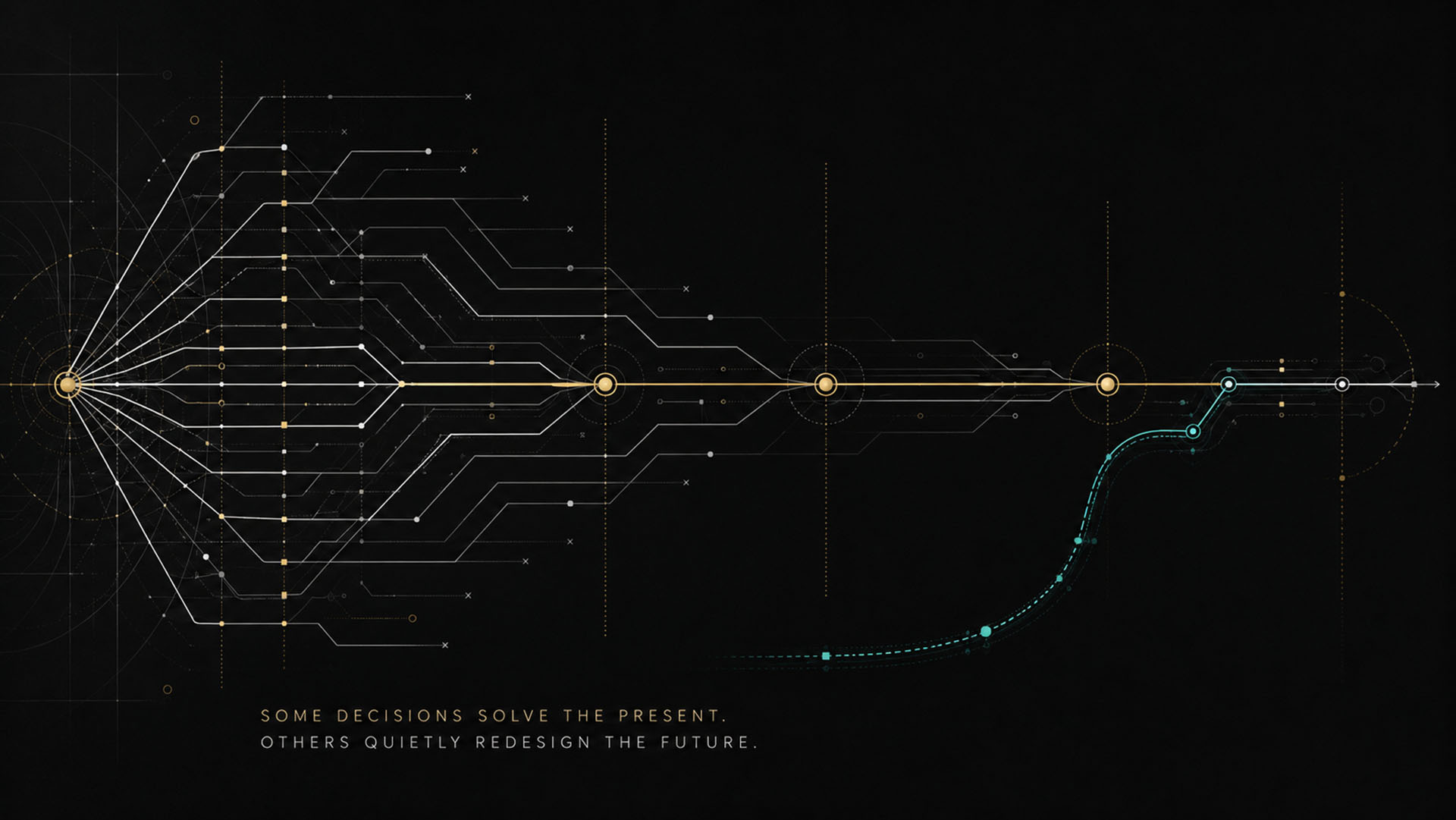
1985 decision → reduced option → later strategic constraint → further decision → accumulated consequence.
That is different from asking whether one decision was right or wrong. It is asking what that decision removed from the future.
The Hidden Cost of Losing Options
This may be the most useful way to revisit the Sculley research today. A strategic decision does not only produce an immediate result. It can also alter optionality.
Say yes to one architecture and another becomes less available. Close one relationship and future collaboration becomes harder.
Reject one commercial model and competitors may occupy the territory instead. Commit resources in one direction and changing direction later becomes increasingly expensive.
The organisation gradually develops what we might call decision lock-in. And that creates something the Archive Analysis identifies as Consequence Lag.
The consequence does not necessarily arrive with the decision. It may arrive years later. That makes it unusually difficult for leaders to connect effect back to cause.
The executive who made the original decision may even be gone by the time the organisation pays the full price. This is where Sculley becomes much more interesting than another “worst CEO decision” story.
His Apple years provide a way of asking:
Can some future organisational problems be understood as the delayed accumulation of earlier choices?
Chris Went Looking at the Timeline
Chris’s original investigation approached the case through the 365 Pin Code system that preceded the contemporary Intelligent Mathematical Blueprint.
Its language is unmistakably historical. The source talks about karmic lessons, life-path numbers, shadow experiences and annual experience numbers.
Those origins should not be hidden. But underneath the terminology Chris was doing something increasingly important to the later Human Futurist research: mapping a leader longitudinally rather than examining one isolated moment.
Sculley’s historical model identified four missing numbers in his full birth name: 2, 4, 5 and 9.
Within the original numerological framework these were described as “karmic lessons.” Chris then compared those numbers with periods in Sculley’s Apple career. And that is where the pattern became more interesting.
The model placed repeated 4s around the 1982–1985 period.
Sculley became Apple CEO in 1983. In 1985, Jobs left Apple and the licensing decision discussed in the historical paper occurred.
Then, from 1990 through 1993, the historical timeline shows 11/2 as the Annual Experience Number, bringing into the original model the Number 2 that Chris regarded as Sculley’s strongest unresolved lesson.
And 1993 was the year Sculley left Apple. The historical interpretation was highly deterministic. The contemporary research position should not be.
The numbers do not establish that Sculley was destined to make those decisions, nor that they caused the events. What matters is what Chris was beginning to investigate:
Do particular patterns recur around important periods of executive decision, relationship tension and consequence?
Then Chris Noticed the Mirror
There was another feature in Sculley’s chart that made Chris look more closely.
The historical paper calls it a “hot chart.” Sculley’s personal and professional sides appeared as mathematical mirror images of one another.
Chris interpreted that to mean that what was happening internally and personally could become strongly echoed externally and professionally.
Again, the interpretation remains an historical proposition rather than an established finding. But the underlying leadership question is fascinating.
What happens when the pressures inside the decision-maker and the pressures surrounding the organisation begin amplifying one another?
A disagreement is no longer just strategic.
- It becomes relational.
- The relationship influences the decision.
- The decision changes the organisation.
- The organisational consequences increase pressure.
- And that pressure feeds back into the next decision.
- That produces a very different sequence:
PRESSURE → DECISION → LOCK-IN → CONSEQUENCE → MORE PRESSURE → NEXT DECISION
Now the Sculley case is no longer primarily about numerology. It is about decision architecture.
The Strange Return of Steve Jobs
And this is where the Apple story delivers its extraordinary final turn. The executive relationship that broke apart in 1985 did not simply disappear from Apple’s history.
- Jobs built NeXT.
- Apple later needed a new operating-system direction.
- Apple acquired NeXT.
- And Jobs returned.
The man whose influence had been diminished during Sculley’s leadership ultimately came back into the organisation as it searched for a way forward. The wider Apple archive subsequently follows Jobs through the company’s recovery and another extraordinary period in its history.
That does not make Apple’s later crisis Sculley’s responsibility. It does something more useful. It demonstrates just how long organisational consequences can travel.
A decision made under one set of circumstances can still shape which choices are available under an entirely different set of circumstances years later.
That is Consequence Lag.
And for senior decision-makers, it may be one of the most important ideas in this research.
The Question Changes
Chris’s original article asked:
What was John Sculley’s worst decision?
The contemporary question is better.
Which decisions changed the range of choices Apple would have available later?
That subtle shift matters. Because leaders rarely face a flashing sign saying:
THIS DECISION WILL MATTER FOR THE NEXT TEN YEARS.
Instead, the decision often looks local.
- A difficult employee.
- A licensing proposal.
- A technology architecture.
- A pricing argument.
- A restructuring.
- A partnership.
- A market entry.
- A board dispute.
The strategic danger is that the decision is evaluated against today’s problem while quietly changing tomorrow’s options.
That is where Human Futurist decision intelligence becomes interesting. Not as a machine that tells an executive which decision to make. But as another way of asking before the decision:
- What could this choice set in motion?
- What option disappears if we do this?
- What relationship becomes harder to recover?
- What are we locking ourselves into?
- And if we are wrong, how easily can we reverse course?
The Bigger Leadership Lesson
John Sculley’s story does not give us a neat villain. That is precisely why it belongs in the Human Futurist Research Archive. He achieved substantial growth at Apple. He was managing genuine commercial pressures. He dealt with an exceptionally difficult founder relationship. He made decisions that could be defended in the circumstances in which they were made.
And some of those decisions later looked very different. That makes the research far more useful than hindsight criticism.
Because the challenge facing today’s executive is exactly the same. You do not get to make tomorrow’s decision with tomorrow’s information. You make it now.
The question is whether you can become better at seeing what the decision might constrain, amplify or remove before its consequences begin compounding.
That is the wider proposition Chris’s, “Sculley” research leaves behind.
The most consequential decision may not be the one with the largest immediate effect.
It may be the one that quietly changes every decision that comes after it.
From the Human Futurist Research Archive
This contemporary article revisits Article 144, John Sculley – why the 90s took him down, historical 365 Pin Code research examining John Sculley’s leadership of Apple, his conflict with Steve Jobs, strategic choices during the 1980s and early 1990s and the numerical patterns Chris Styles associated retrospectively with those periods. The historical source used substantially more deterministic numerological language than the contemporary Human Futurist standard permits. Its enduring value lies instead in the leadership question it exposes: how individual decisions create strategic lock-in, reduce optionality and produce consequences that may only become visible years later.
Share This Article, Choose Your Platform!
Related Posts





From understanding decisions to informing them.
Beyond the Research
The Business & Leadership archive examines consequential decisions after they have happened.
The Intelligent Mathematical Blueprint and Private Advisory take the underlying Human Futurist thinking into a different environment: helping leaders examine the circumstances surrounding decisions that have yet to be made.