
Part Of the Apple Case Study
Steve Jobs had already left Apple once in this story. Steve Wozniak had stepped away on very different terms.
Now the Case Study reaches the executive recruited from outside Apple to help turn an extraordinary young company into a disciplined global business.
And the decisions that followed would become inseparable from Apple’s history.
Some leadership decisions end when they are made.
Others continue changing the organisation long after the meeting is over.
John Sculley led Apple for a decade, grew the business dramatically and made decisions that appeared rational within the world he was managing. But when Chris Styles examined the sequence surrounding Sculley’s final years at Apple, something else caught his attention: the most difficult part of the story appeared to continue well beyond Sculley’s departure.
The Executive Steve Jobs Chose
In 1983, John Sculley left PepsiCo to become Apple’s chief executive.
The recruitment has become part of Silicon Valley mythology: Steve Jobs persuading one of corporate America’s most successful marketing executives to abandon soft drinks for personal computers.
It made sense. Jobs had vision, product instinct and an almost uncompromising belief in what technology could become. Sculley understood consumers, marketing, scale and corporate management.
For a while, the partnership worked. Then it didn’t.
By 1985, Apple was dealing with disappointing Macintosh sales, internal disagreement and two powerful executives who increasingly saw the company’s immediate priorities differently. Sculley’s later account is important because it complicates the familiar story.
He did not describe himself as somebody trying to destroy Jobs’ vision. Years later, he recalled believing deeply in many of Jobs’ founding principles, particularly Apple’s insistence on controlling the relationship between hardware and software and creating an exceptional user experience.
The disagreement was not simply visionary founder versus unimaginative corporate executive.
It was also about what Apple could afford to do then. That distinction matters.
Because the Apple Case Study is not interested in turning every consequential decision into a simple choice between right and wrong.
Then the Partnership Broke
The conflict intensified in 1985. Jobs wanted changes around the Macintosh business. Sculley resisted. Eventually Apple’s board backed Sculley and removed Jobs from operational control of the Macintosh division.
Jobs subsequently left Apple and founded NeXT. Knowing what happened later makes it almost impossible to read that sentence neutrally. Apple would eventually acquire NeXT.
Jobs would return.
And the founder whose influence had been dramatically reduced in 1985 would ultimately become the person most closely associated with Apple’s extraordinary resurgence.
But none of that was available to Sculley in the room in 1985.
That is precisely why hindsight needs to be handled carefully.
There were also other consequential strategic questions.
Bill Gates urged Apple in 1985 to license Macintosh technology more broadly to other computer manufacturers.
Apple did not pursue that strategy.
Sculley continued to believe that Apple’s advantage lay in controlling the complete experience rather than becoming a technology-licensing company primarily.
That decision would look increasingly significant as Microsoft Windows expanded through the much larger ecosystem of IBM-compatible personal computers.
Later came another strategic commitment: Apple’s move towards the PowerPC architecture developed with IBM and Motorola.
Each decision can be debated independently. But Chris’s research was asking a different question.
What did the timing surrounding Sculley’s Apple years look like when viewed as one continuous sequence?
The Decisions Didn’t End In 1985
The original research examined Sculley’s underlying analytical structure before turning to the individual years.
It identified 4 and 5 as his two central baseline patterns within the historical framework.
In contemporary Human Futurist language, the 4 pattern is associated with ideas such as:
- structure
- systems
- order
- work
- discipline
- practicality
The 5 pattern is associated more closely with:
- change
- freedom
- movement
- experience
- adaptation
That immediately made one section of Sculley’s Apple chronology interesting to Chris.
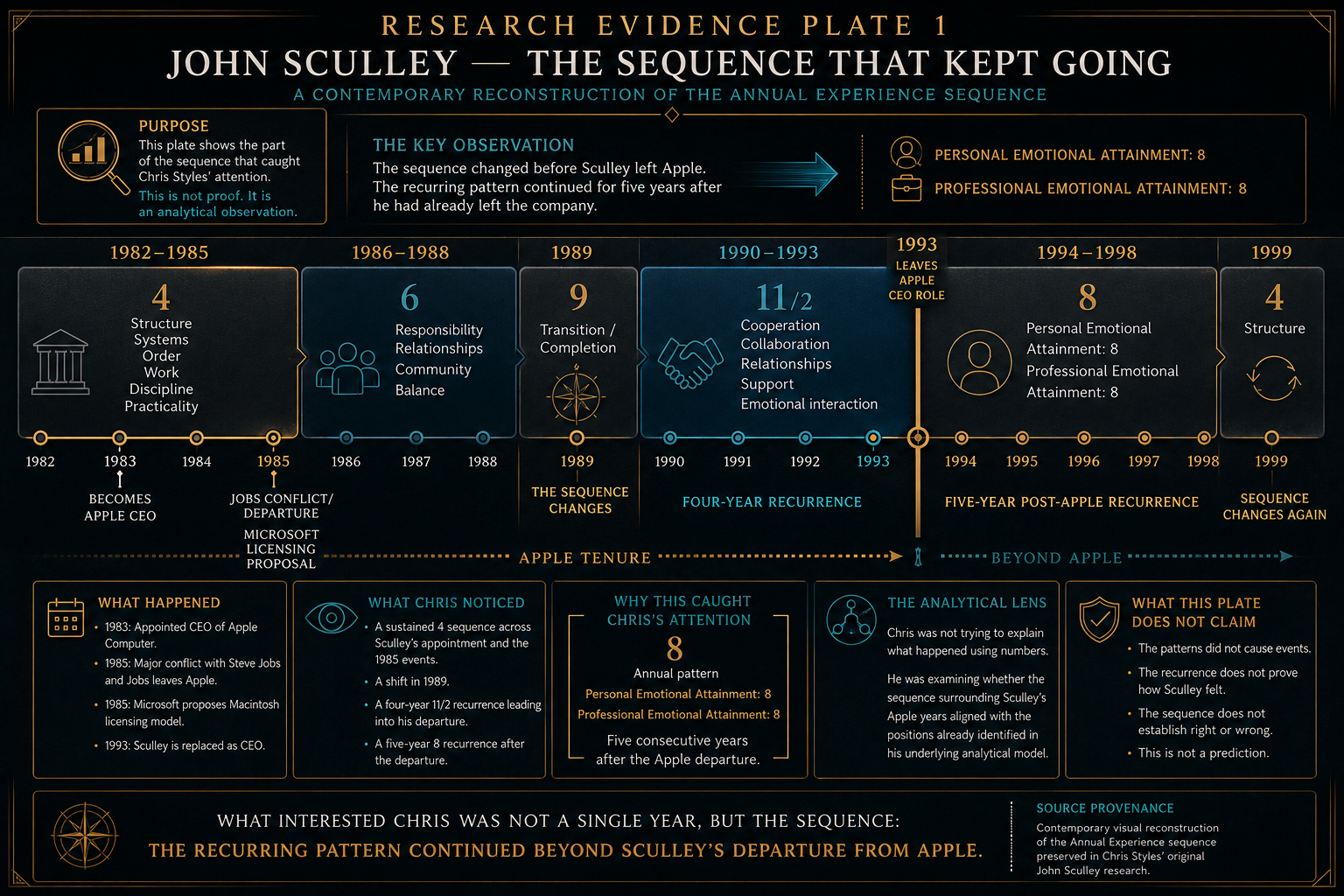
From 1982 through 1985, the annual sequence repeatedly returned to 4. Sculley became Apple’s CEO in 1983.
The confrontation with Jobs reached its decisive point in 1985. And Microsoft’s proposal that Apple consider licensing Macintosh technology also arrived in 1985.
Chris was not arguing that a number caused any of those events. What interested him was the recurrence.
A prolonged analytical period associated in the framework with structure, order and work coincided with the years in which Sculley was being asked to impose corporate structure on one of the most unconventional companies in America.
Then the sequence changed.
Then the Pattern Changed
The original annual table covers 1981 through 1999.
Seen as a whole rather than as individual calculations, it has a striking rhythm.
- 1982–1985: 4
- 1986–1988: 6
- 1989: 9
- 1990–1993: 11/2
- 1994–1998: 8
- 1999: 4
Chris’s attention was particularly drawn to 1989.
Within the historical framework, 9 was associated with completion, endings and transition.
The original research therefore interpreted 1989 as the beginning of a shift rather than as the moment of an obvious external ending.
Nothing as dramatic as Sculley’s departure happened that year. That makes it more interesting, not less. Because the visible corporate event was still several years away.
What followed was the sequence that became the centre of Chris’s analysis.
Four Years Chris Couldn’t Ignore
From 1990 through 1993, the same annual pattern — 11/2 — remained in place.
In the contemporary framework, 2 is associated with themes including:
- cooperation
- collaboration
- relationships
- support
- patience
- emotional interaction
The historical analysis had already identified this area as unusually significant for Sculley.
Chris therefore saw the four-year recurrence as a period worth watching closely. And these were not inconsequential years for Apple.
Competition intensified. The strategic environment became harder. Questions surrounding Apple’s technology direction grew more consequential.
By 1993, the relationship between Sculley and Apple’s board had deteriorated, and he was replaced as CEO.
The tempting version of this story would be: “the pattern predicted his removal.”
That is not what this Case Study claims.
Chris was looking retrospectively at a sequence and noticed that the same analytical pattern persisted across the four years leading into one of the defining professional transitions of Sculley’s life.
What happened next made the observation more intriguing.
Leaving Apple Didn’t End the Sequence
If 1993 had been the end of the analytical story, Sculley’s article would be relatively straightforward.
It wasn’t. From 1994 through 1998, another pattern repeated every year.
This time it was 8.
And in Sculley’s underlying framework, 8 occupied both his Personal Emotional Attainment and Professional Emotional Attainment positions.
That distinction mattered to Chris. The visible professional event, leaving Apple, had already happened.
Yet the subsequent five-year sequence repeatedly aligned with positions the framework associated with Sculley’s emotional experience of personal and professional attainment.
The original research interpreted those years as an extended emotional aftermath. That interpretation cannot establish what Sculley experienced internally year by year.
But Sculley’s own later descriptions of the breakdown with Jobs as deeply painful make the broader human question difficult to dismiss.
A chief executive can leave a company on a particular date.
The consequences of having led it do not necessarily leave with him.
Then, in 1999, the annual sequence changed again. The long run of 8 ended. The 4 pattern returned.
For Chris, the significance was not one isolated number. It was the architecture of the sequence:
decision → pressure → transition → departure → aftermath → change
And that created a much more interesting question than: Was John Sculley right or wrong?
It asked:
How long can a consequential leadership period continue to shape the person and organisation after the original decisions have been made?
Sculley’s decade at Apple resists a simple verdict. Under his leadership, Apple grew enormously. He helped build the market for Macintosh. He defended a product philosophy centred on an integrated user experience. He also presided over strategic choices that would later be reconsidered. His relationship with Apple’s defining founder collapsed. And eventually he lost control of the company he had been recruited to lead.
That is not a morality tale. It is a leadership story.
And leadership stories become more interesting when we stop pretending that consequence arrives neatly at the same moment as decision.
A decision can be defensible when it is made and still create consequences nobody in the room can yet see.
That may be the most useful way to read John Sculley’s place in the Apple Case Study.
- Not as the villain who removed Steve Jobs.
- Not as the executive who somehow failed to recognise Apple’s future.
- But as a leader making difficult decisions inside an organisation whose future was still profoundly uncertain.
Chris’s analysis adds another layer.
It asks us to look not only at the decision itself, but at the sequence surrounding it, and at how long the consequence appeared to keep travelling.
What This Article Adds to the Case Study
John Sculley changes the question. Jobs introduced the founder. Wayne introduced the cost of relinquishing optionality. Wozniak showed that leaving an extraordinary company does not automatically mean losing. Sculley introduces Consequence Lag.
For the first time, the Case Study asks whether the significance of a decision may continue unfolding long after the original decision has disappeared into corporate history.
That matters because the next Apple leader inherits an organisation already shaped by those decisions.
And Apple was heading towards a crisis.
Share This Article, Choose Your Platform!
Related Posts





From understanding decisions to informing them.
Beyond the Research
The Business & Leadership archive examines consequential decisions after they have happened.
The Intelligent Mathematical Blueprint and Private Advisory take the underlying Human Futurist thinking into a different environment: helping leaders examine the circumstances surrounding decisions that have yet to be made.