Apple – Six People. One Organisation. Decades of Decisions.
Read Together, The Question Changes.
What Happens When You Stop Looking At One Decision At A Time?
Apple makes an unusual Case Study because so much of its history is already known. Its founding, products, conflicts, leadership changes and extraordinary commercial rise have been documented repeatedly.
But knowing what happened is not quite the same as understanding the decision environment in which it happened.
What did Ronald Wayne know when he chose to leave? What happens when extraordinary professional success no longer guarantees creative or personal fit? How long can the consequences of a leadership decision continue travelling? Can a brief and difficult tenure still change what becomes possible next? And what does a successor actually inherit from the people who came before?
Your Content Goes Here
Why Apple?
Six People. Different Questions. One Continuing Organisation.
Apple gives this research something rare: time.
Its history contains founders and professional managers, early exits and dramatic returns, creative tension and executive conflict, near-collapse and extraordinary recovery, illness, succession and continuity.
Chris Styles returned to different people within that history at different stages of his developing research. The six analyses were not created to manufacture one retrospective explanation. Each began with its own person, circumstances and question.
This is therefore not a ranking of Apple’s leaders, and it is not an attempt to identify a single formula behind Apple’s history. It is a longitudinal Case Study of people, decisions, organisational fit, transition and consequence.
Six people. Seven organisational thresholds.
Apple’s story moves through a series of defining organisational thresholds. In 1976, Steve Jobs, Steve Wozniak and Ronald Wayne came together at the founding, before Wayne’s departure created the first exit that same year. During the 1980s, Wozniak’s changing relationship with Apple marked a creative exit, followed by John Sculley’s executive era from 1983 to 1993. Gil Amelio then entered during the critical 1996–1997 turnaround, helping create the circumstances for Jobs’ return and transformation of Apple from 1997 to 2011. From 2011 onward, the story entered its succession era, with Tim Cook inheriting the organisation that those earlier people and decisions had helped shape.
The People Change. The Organisation Continues.
The Apple Story Across Time
The Longitudinal Anchor of the Apple Story
Start With Steve Jobs
Chronologically, Ronald Wayne was the first of these six people to leave Apple.
Founder. Conflict. Departure. Return. Transformation. Health. Resignation. Succession.
Jobs reaches backwards to Apple’s creation and forwards into the leadership environment Tim Cook inherited. He is the longitudinal anchor from which the other five perspectives can be explored.
Six People. Six Different Questions.
01 · STEVE JOBS
The Founder Who Left, Returned, and Became Load-Bearing
Jobs connects Apple’s founding, rupture, return, transformation and eventual succession. Within that long story, one period in Chris’s analysis became especially difficult to ignore.
Could unusually consequential periods sometimes become visible before their full consequences were known?
02 · RONALD WAYNE
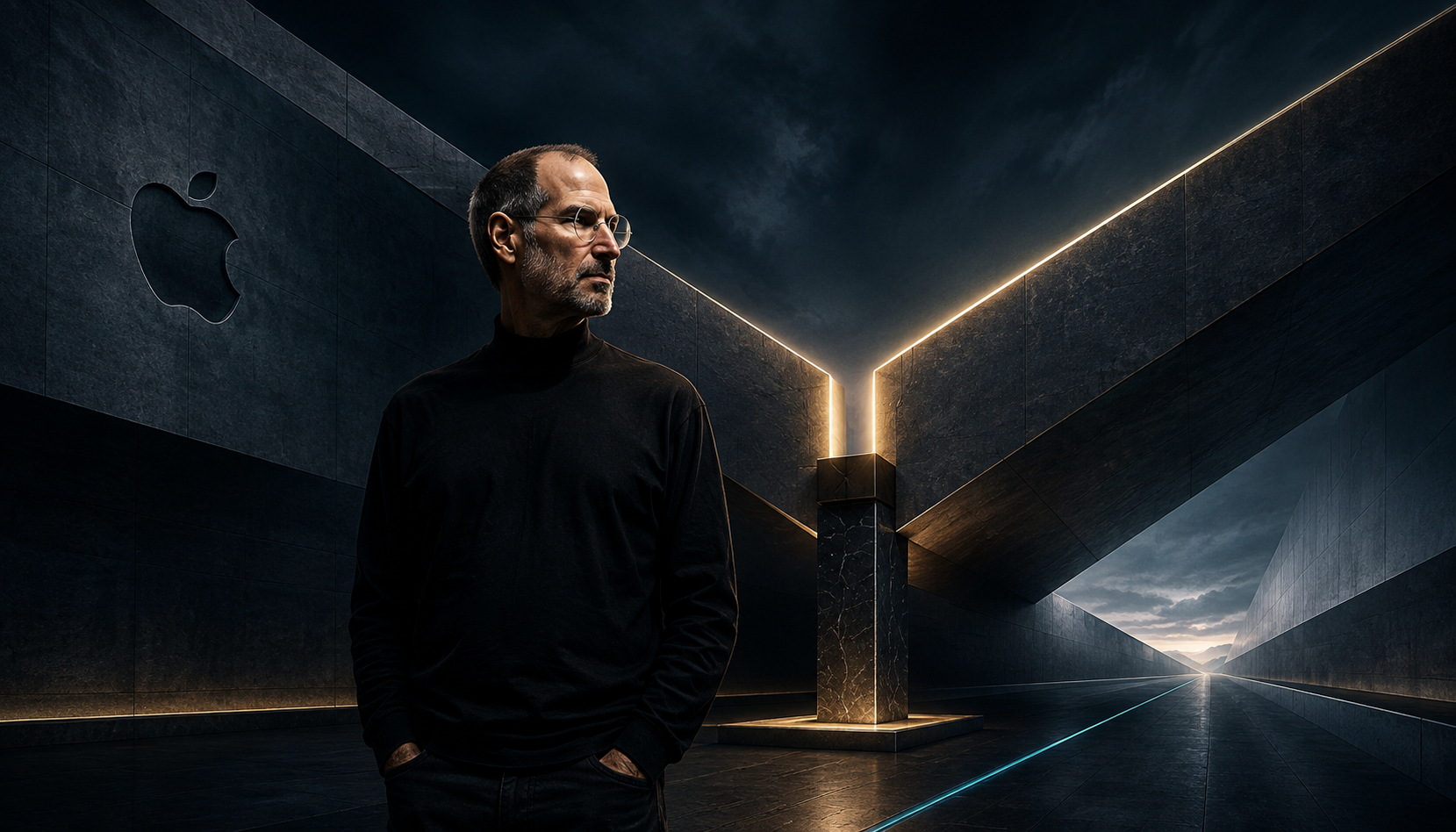
The Founder Who Walked Away Before Anyone Knew What Apple Would Become
Wayne’s decision is easy to judge from the future. But he made it inside the uncertainty of 1976, before Apple’s eventual scale could reasonably have been known.
What does a decision look like when the outcome everyone remembers has not happened yet?
03 · STEVE WOZNIAK
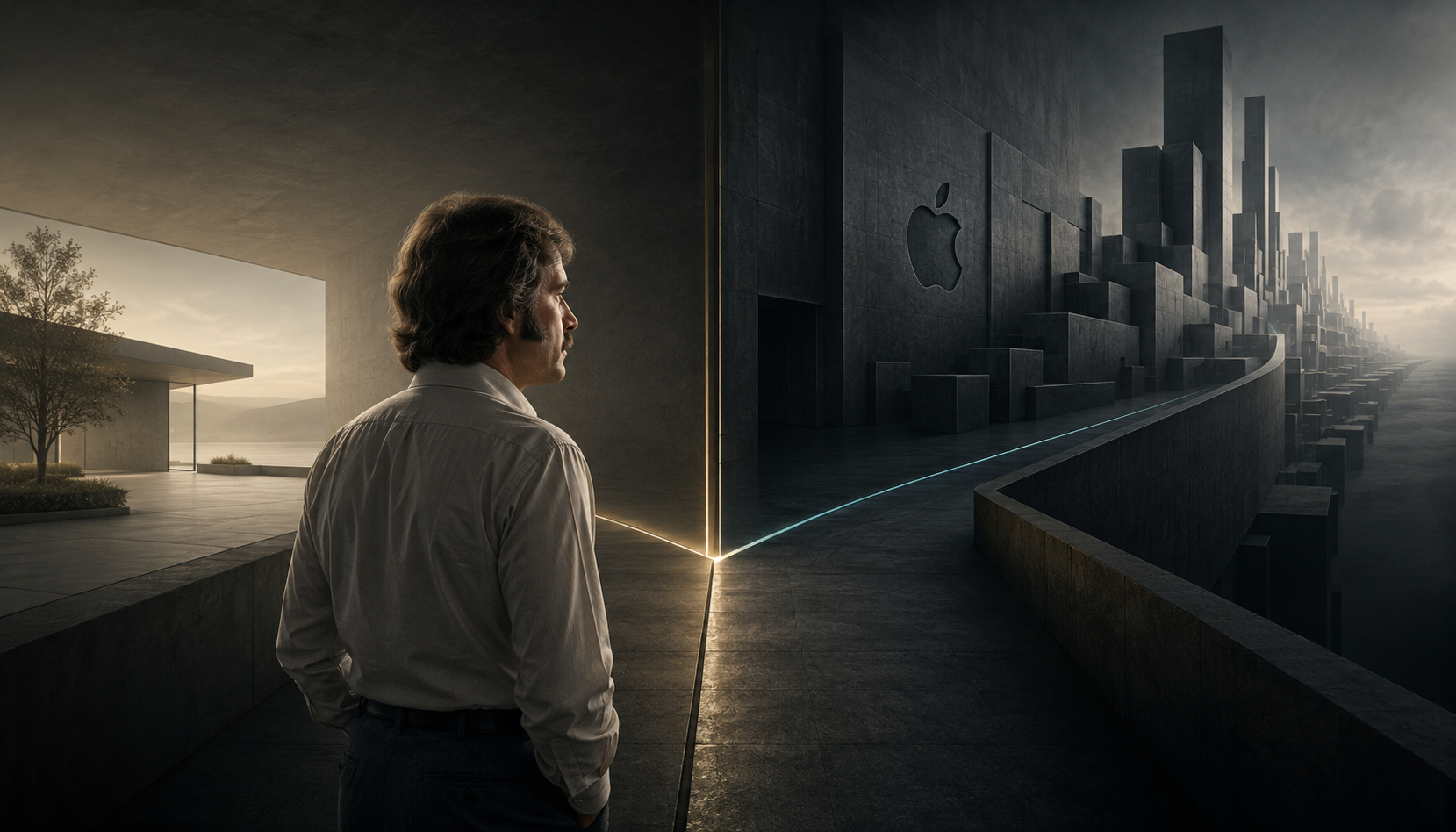
What If Leaving Apple Wasn’t Losing?
Wozniak helped create the technology that made early Apple possible. Yet his relationship with the organisation developed very differently from Jobs’.
What happens when professional achievement and personal or creative fit stop pointing in the same direction?
04 · JOHN SCULLEY
The Decisions That Kept Travelling
Sculley led Apple for a decade. The conflict with Steve Jobs became the defining story of his tenure, but Chris became interested in something that appeared to extend beyond that famous rupture.
When does the consequence of a leadership decision actually end?

A decision happens at a particular moment.
Its consequences do not always respect the same boundary.
Its consequences do not always respect the same boundary. One choice changes an environment; the next person makes a decision inside that changed environment; another leader inherits the result.
That does not mean every later event can be traced neatly to one earlier decision. It means what happens earlier can change the landscape in which later decisions have to be made.
A decision happens at a particular moment.
Some Decisions Keep Travelling.
Its consequences do not always respect the same boundary. One choice changes an environment; the next person makes a decision inside that changed environment; another leader inherits the result.
That does not mean every later event can be traced neatly to one earlier decision. It means what happens earlier can change the landscape in which later decisions have to be made.
05 · GIL AMELIO
The CEO Who Brought Steve Jobs Back
Amelio inherited an Apple under severe pressure. His tenure was brief, but during it Apple acquired NeXT and Steve Jobs returned.
Can a leadership period be historically significant even when the leader does not remain to complete the transformation?
06 · TIM COOK
The Year Tim Cook Had Seen Before
Nine years after Cook inherited one of the most scrutinised leadership positions in business, Chris noticed something familiar in his analysis — something he had seen around the 2011 succession.
What did that recurrence make visible, and what happened as the story continued?
Not one formula for Apple.
What Was Chris Looking At?
Different things caught Chris’s attention in different cases: risk, timing, creative expression, organisational fit, leadership transition, concentrated personal or professional pressure, delayed consequence, and recurrence.
The Intelligent Mathematical Blueprint does not replace the history surrounding those events. It provides another perspective from which Chris examined them.
The Question Is Not: Did The IMB Prove Apple’s History?
The Question Is: What Did Chris Notice When He Looked At These Moments Through A Different Lens?
How To Read the Research
Throughout this Case Study, four things are deliberately kept separate:
Historical Event → Analytical Observation → Chris’s Interpretation → Subsequent Historical Continuation
That distinction matters. The research does not claim that an analytical pattern caused an event, that recurrence guarantees repetition or that later history was predetermined.
The purpose is to preserve what happened, what Chris could see when he examined it, how he interpreted it and what happened afterwards.
The Case Study does not end with another Apple leader.
When The Six Stories Become One
After the six individual stories, the Summary places the research into one organisational chronology: founding, departure, creative tension, executive decision-making, turnaround, return, succession and recurrence.
It does not turn those stories into a prediction scorecard or assign wins and losses.
What Becomes Visible When Six Stories Become One?
Why This Case Study Matters
Organisations are usually explained through products, revenue, market share, leadership tenure, success and failure.
But organisations are also accumulations of human decisions.
Someone joins. Someone leaves. Someone hires. Someone removes. Someone returns. Someone inherits what came before.
Apple provides an unusually long and well-documented environment in which to ask whether another analytical perspective can draw attention to relationships, recurrences, pressure points or periods of consequence that deserve closer examination.
Not to rewrite Apple’s history. Not to claim that one framework explains it. And not to suggest that the future was predetermined.
Sometimes The Advantage Begins With Seeing That Something Deserves Closer Attention.
Precision Over Prediction. · Clarity Over Noise. · Foresight Over Reaction.
The IMB doesn’t make the decision. It can change what you see before you make it
Begin The Case Study
Six people. One organisation. Decades of decisions. Start with the person whose story connects almost all of them.
CASE STUDY ROUTE
Apple Case Study → Steve Jobs → Ronald Wayne → Steve Wozniak → John Sculley → Gil Amelio → Tim Cook → Apple Case Study Summary
THE STORY CHANGES. THE QUESTION CONTINUES.
Apple explores leadership, departure, succession and organisational consequence across decades.
But what happens when the same analytical approach is taken out of the boardroom and placed inside a global sporting competition — where decisions, pressure and outcomes unfold in real time?
From understanding decisions to informing them.
Beyond the Research
The Business & Leadership archive examines consequential decisions after they have happened.
The Intelligent Mathematical Blueprint and Private Advisory take the underlying Human Futurist thinking into a different environment: helping leaders examine the circumstances surrounding decisions that have yet to be made.