WHEN ONE DECISION CAN AFFECT MILLIONS
Political leadership creates an unusual research environment.
A corporate leader can influence an organisation. An athlete can alter the result of a competition.
But the decisions of presidents, prime ministers, ministers and other political figures can change institutions, economies, international relationships and the lives of millions of people. That makes political leadership particularly interesting to Human Futurist research.
Across the archive, Chris Styles has examined political figures, elections, leadership transitions, public pressure, influence, institutional power and prospective political outcomes.
The central question is rarely simply: Who will win? It is more often:
What happens when the individual’s architecture meets the complexity of the political system around them?
Can We Understand Political Consequence Before It Fully Emerges?
Political outcomes are rarely produced by one person alone.
A leader operates inside a much larger system:
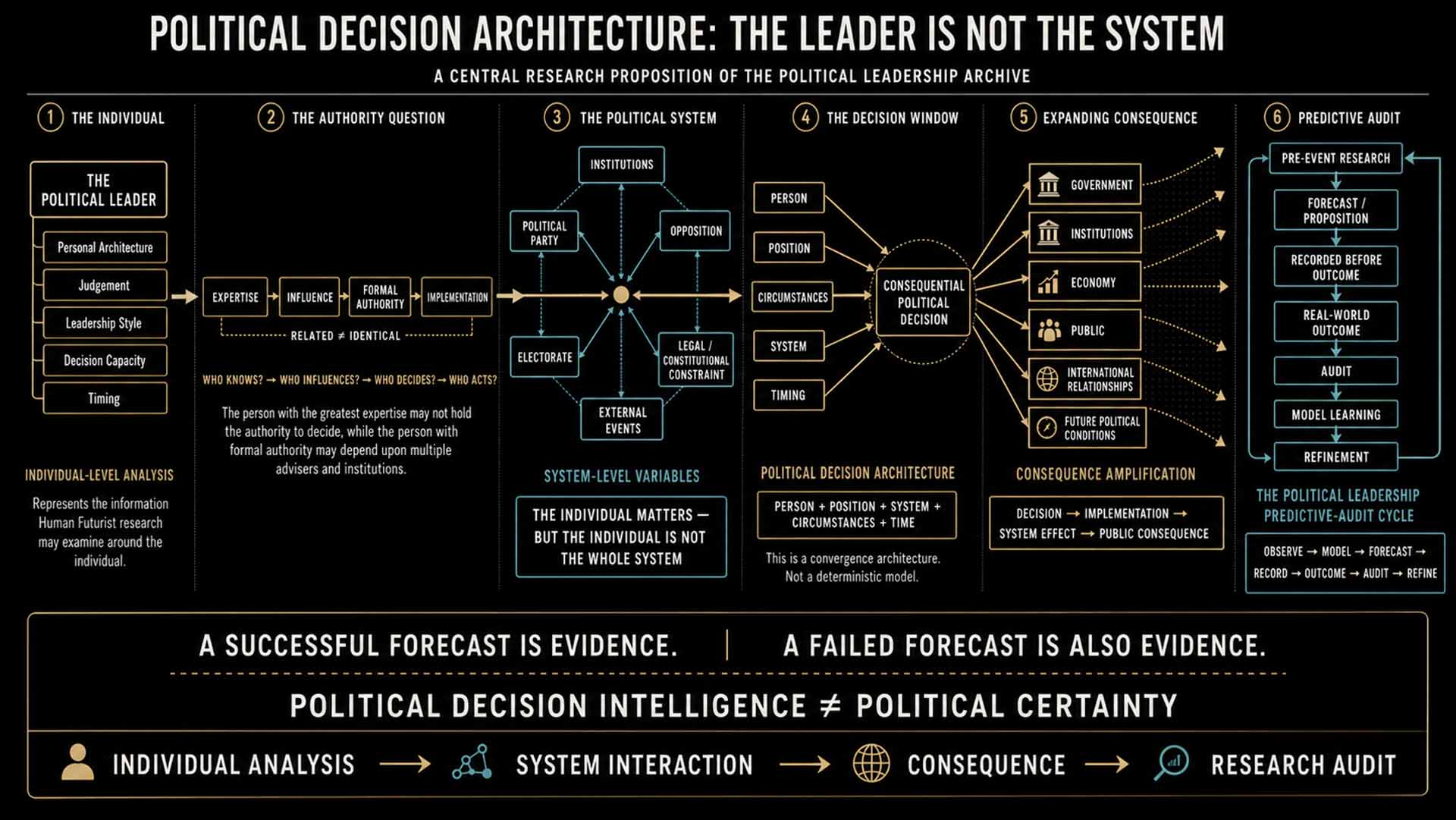
THE INDIVIDUAL → THE DECISION → THE INSTITUTION → THE ELECTORATE → EXTERNAL EVENTS → CONSEQUENCE
The Political Leadership Archive investigates the relationships between those forces.
It asks whether recurring structures, periods of increased pressure, leadership characteristics and unusual timing relationships can provide useful additional intelligence around consequential political moments.
It also asks an equally important question:
Where does that analysis stop being useful?
Because elections, governments and geopolitical events contain variables that no analysis of an individual leader can capture in isolation.
That tension makes Political Leadership one of the archive’s most important testing grounds.
Leadership. Authority. Influence. Consequence.
Power Under Pressure
Political leadership exposes the difference between holding power and being able to use it effectively.
The research examines moments when personal judgement interacts with electoral pressure, institutional constraint, public scrutiny, political rivalry and events beyond the leader’s control.
Five Studies. Five Different Questions About Political Power.
Within the wider Political Leadership Archive, studies are assessed for their research strength, originality, decision-intelligence value, evidence, evergreen value, historical significance and strategic importance.

For this collection, particularly valuable research does more than analyse a politician.
It may compare competing leaders before an election.
Examine the difference between expertise and authority. Test whether a historical pattern carries meaningful information. Preserve a highly specific forecast so that it can later be audited. Or follow a political leader across a longer period to determine whether the original research proposition survived contact with reality.
When political prediction accidentally became a prototype for comparative leadership intelligence.
Cyril Ramaphosa, Julius Malema, Two Leaders, One System
When political prediction accidentally became a prototype for comparative leadership intelligence.
Before South Africa’s 2019 election, Chris Styles compared Julius Malema and Cyril Ramaphosa inside the same Human Futurist model. The specific forecast was only partly borne out, but the methodology introduced a much more durable idea.
The Question
Can two competing leaders be compared meaningfully inside the same environment rather than assessed independently?
What Chris Found
The historical model constructed individual architectures for Malema and Ramaphosa, then combined corresponding positions, including a 1 + 8 = 9 World/Career relationship, before comparing their 2019–2022 trajectories.
Expertise Without Authority
Anthony Fauci and the Problem of Influence Without Authority
When the person with the strongest expertise still does not control the decision.
In April 2020, Chris Styles examined Anthony Fauci as scientific expertise collided with presidential authority during the opening phase of COVID-19. The historical research identified concentrated responsibility in 2020 and analytical intensity in 2021, but the more enduring question lies in what happens between expert advice and executive action.
The Question
What happens when the person with the most relevant expertise can influence a consequential decision but does not have the authority to make it?
What Chris Found
The historical model highlighted Fauci’s 24//6 Personal Number, his Professional Emotional Attainment Number 7, and a Number 7 Hidden Passion at 189%. Chris then identified a double 6 Professional Physical concentration in 2020, followed by a double 7 in 2021, creating a striking transition from responsibility to intensified analytical demand.
When Patterns Accumulate, Meaning Becomes Harder to Prove.
JFK, Pattern Density and the Problem of Retrospective Meaning
When Many Patterns Appear Around a Major Historical Event, How Do We Know Which Ones Matter?
Some historical events become magnets for retrospective interpretation. The assassination of John F. Kennedy is one of them. Rather than treating pattern density itself as proof, this research creates a more difficult methodological question.
The Question
When numerous apparent relationships can be identified after a major event, how do we distinguish meaningful structure from coincidence?
What Chris Found
The case revealed a high density of retrospective numerical relationships surrounding Kennedy and the historical event. But the contemporary importance of the study lies in interrogating those relationships rather than simply accumulating them.
Biden–Clinton 2024
Biden, Harris or Clinton?
The question was not simply who looked strong — but which combination looked strongest.
With Biden–Harris widely assumed to be the Democratic ticket for 2024, Chris Styles compared the Human Futurist architectures of Biden, Harris, Clinton, Trump and DeSantis. The exercise produced an unexpected proposition: Hillary Clinton appeared to offer the stronger alternative running-mate profile.
The Question
Can comparing several Human Futurist profiles reveal a relative advantage that cannot be seen when people are analysed in isolation?
What Chris Found
Biden appeared stronger than Trump in the historical comparison. Harris showed an unusually challenging 2024 structure. Clinton carried a concentrated 22//4 sequence from 2023–2025 and emerged as the strongest alternative running-mate profile. DeSantis was assessed as comparatively weaker.
Vladimir Putin 2020–2024
The Five-Year Power Window
In March 2022, Chris Styles identified 2020–2024 as a unique five-year 26//8 run in Vladimir Putin’s Human Futurist model.
The window is now complete, allowing the original observation, including a pre-event marker on 2023, to be revisited against the historical record.
The Question
Can a longitudinal model identify a period of exceptional political consequence before the exact events are known?
What Chris Found
The model placed 26//8 across five consecutive years and showed 17//8 in both Putin’s World / Career and Personal Attainment positions. Within the wider run, Chris separately marked 2023 through a Personal Emotional double 8.
When Political Comparison Becomes More Valuable Than Studying Either Leader Alone.
Cyril Ramaphosa, Julius Malema and the 2019 South African Election
When Political Comparison Becomes More Valuable Than Studying Either Leader Alone.
Ahead of South Africa’s 2019 General Election, the research examined Cyril Ramaphosa and Julius Malema within the same political environment. The enduring value of the study lies beyond the election itself. It raises a much larger research question: Can comparative analysis reveal differences in political trajectory, influence and timing that cannot be seen by examining candidates independently?
The Question
Can the relative position of competing political leaders provide more useful intelligence than analysing either person in isolation?
What Chris Found
The research identified materially different structures around Ramaphosa and Malema and attempted to interpret how those differences might manifest within the same election period.
Rather than treating an election as a simple prediction problem, it began moving the research towards comparative political modelling.
Expertise Under Political Pressure
Anthony Fauci and the Problem of Influence Without Authority
Knowing What Should Be Done Is Not the Same as Having the Power to Make It Happen.
Anthony Fauci presents a different political leadership question. He was not primarily interesting because he held elected political authority. He was interesting because he occupied the difficult space between expertise, influence, political leadership and implementation.
The Question
What happens when specialist knowledge carries enormous influence but ultimate authority sits somewhere else?
What Chris Found
The case highlights an important distinction between:
EXPERTISE → INFLUENCE → AUTHORITY → IMPLEMENTATION
These are related, but they are not the same. A person may possess considerable expertise without controlling the final decision. Another may possess formal authority without possessing the specialist knowledge upon which that decision depends.
Why It Matters
The case highlights a crucial distinction: EXPERTISE → INFLUENCE → AUTHORITY → IMPLEMENTATION. These are connected, but not interchangeable. Someone may understand the issue deeply without controlling the decision, while another may hold authority without the same specialist expertise.
When Patterns Accumulate, Meaning Becomes Harder to Prove.
JFK, Pattern Density and the Problem of Retrospective Meaning
When Many Patterns Appear Around a Major Historical Event, How Do We Know Which Ones Matter?
Some historical events become magnets for retrospective interpretation. The assassination of John F. Kennedy is one of them. Rather than treating pattern density itself as proof, this research creates a more difficult methodological question.
The Question
When numerous apparent relationships can be identified after a major event, how do we distinguish meaningful structure from coincidence?
What Chris Found
The case revealed a high density of retrospective numerical relationships surrounding Kennedy and the historical event. But the contemporary importance of the study lies in interrogating those relationships rather than simply accumulating them.
Biden–Clinton 2024
A High-Specificity Electoral Forecast and Critical Predictive-Audit Case
A Failed Forecast Can Sometimes Teach More Than a Successful One.
Political prediction becomes meaningful research only when the original prediction remains visible after the outcome is known. This article is important precisely because it exposes the model to a demanding test.
The Question
What can a specific pre-event political forecast teach us when events do not unfold as predicted?
What Chris Found
The historical research made a sufficiently specific electoral proposition to allow meaningful retrospective evaluation. That means the article can now be examined not simply for what appeared persuasive beforehand, but for: What the model identified correctly, what it failed to anticipate, which assumptions proved too strong, which external variables became decisive, and whether the original analytical framework needs refinement.
Vladimir Putin 2020–2024
Testing a Long-Horizon Political Leadership Forecast
The Further a Forecast Travels Into the Future, the More Opportunities Reality Has to Intervene.
Long-range forecasting poses a different challenge from analysing one election or one decision. Chris examined a multi-year period around Vladimir Putin and therefore created an opportunity to investigate whether a proposed political trajectory remained meaningful across changing circumstances.
The Question
Can a longitudinal Human Futurist model identify a significant political period several years in advance?
What Chris Found
The original research identified 2020–2024 as an unusually significant interval within Putin’s longer timeline. Its contemporary value now lies in comparing that proposition with what subsequently occurred, carefully separating events that correspond with the original framework from those that could only be interpreted retrospectively.
FIVE STUDIES. ONE LARGER QUESTION.
How Much of Political Consequence Belongs to the Leader, and How Much Belongs to the System?
Taken together, the Featured Research moves across very different forms of political power
Competition • Influence • Retrospection • Prediction • Time
Taken together, the Featured Research moves across very different forms of political power:
COMPETITION: Ramaphosa and Malema examine political leadership comparatively.
INFLUENCE: Fauci separates expertise from formal authority.
RETROSPECTION: JFK questions when apparent patterns become meaningful evidence.
PREDICTION: Biden–Clinton preserves a specific electoral forecast for critical audit.
TIME: Putin tests what happens when political analysis extends across several years.
Together they point towards a more mature Human Futurist proposition:
Political consequence emerges from the interaction between the person, the position, the system, the circumstances and time.
THE POLITICAL LEADERSHIP ARCHIVE
Forty Records. Multiple Political Systems. One Continuing Research Programme.
The reconciled archive currently contains 40 physical source records assigned primarily to Political Leadership.
These include studies of:
- presidents and prime ministers;
- elections and electoral competition;
- political succession;
- leadership under pressure;
- political rivalry;
- expertise and advisory influence;
- institutional authority;
- government;
- political movements;
- long-range leadership forecasts;
- failed predictions;
- and periods of significant political transition.
The number represents physical archive records rather than 40 entirely independent research cases, because duplicate and alternate versions remain preserved as part of the archive’s provenance.
NINE RESEARCH THEMES. ONE POLITICAL LANDSCAPE.
From the individual leader to the political system around them.
Political Leadership is organised around nine principal areas of investigation…
Together, they connect individual studies into a broader body of research exploring how power, judgement, institutions, timing and external forces interact when political decisions carry consequence.
WHY POLITICS IS DIFFERENT
The Individual Matters. But the Individual Is Never the Whole System.
Political outcomes are shaped by far more than one leader.
Elections involve millions of voters, while governments operate through institutions, parties, advisers, legal structures, economic conditions and external events.
That makes politics difficult for individual-level modelling — and particularly valuable for testing it.
When a proposition succeeds, the archive gains evidence. When it fails, the question becomes equally important:
What did the model fail to see?
POLITICAL LEADERSHIP — PREDICTIVE AUDIT
Keep the Forecast. Record the Outcome. Learn From Both.
Some of the archive’s most valuable political research was produced before the outcome was known.
Those original propositions remain preserved and can be compared against what actually happened.
PRE-EVENT RESEARCH → OUTCOME → AUDIT → MODEL LEARNING
This creates a continuing research discipline:
OBSERVE → MODEL → FORECAST → RECORD → OUTCOME → AUDIT → REFINE
The purpose is not to preserve certainty. It is to improve the research.
The Most Valuable Question Is Not Always “Was the Prediction Right?”
From Political Prediction To Political Decision Intelligence
Some of the earliest Political Leadership research used direct predictive language. The contemporary archive preserves those claims because they form part of the historical research record.
But it does not need to repeat their certainty. Instead, the archive can now ask better questions.
- What information was available before the event?
- What did the research identify?
- What actually happened?
- What variables were missing?
- Did the model discriminate between competing outcomes?
- How specific was the original forecast?
- And what should be changed before the next test?
This creates a continuing research cycle:
OBSERVE → MODEL → FORECAST → RECORD → OUTCOME → AUDIT → REFINE
Political Leadership therefore becomes more than a collection of historical political studies.
It becomes one of the principal environments in which the Human Futurist methodology can be tested.
POWER MAKES CONSEQUENCE VISIBLE
The Higher the Authority, the Further a Decision Can Travel.
Political leadership makes one of the central ideas behind The Human Futurist unusually easy to see.
A decision begins with a person.
But it does not necessarily end there.
It can move through advisers, institutions, political parties, governments, economies, international relationships and entire populations.
Understanding the individual is therefore useful.
Understanding the system surrounding them is essential.
And understanding the interaction between the two may be where the most interesting research begins.
Follow the Connections
One Political Decision Can Reveal a Much Larger System.
The strongest Political Leadership research often begins with one leader, one election, one institution or one consequential moment.
Follow those investigations further and they begin connecting power with judgement, influence, public pressure, institutions, timing and recurring patterns of consequence.
From understanding decisions to informing them.
Beyond the Research
The Business & Leadership archive examines consequential decisions after they have happened.
The Intelligent Mathematical Blueprint and Private Advisory take the underlying Human Futurist thinking into a different environment: helping leaders examine the circumstances surrounding decisions that have yet to be made.