
What changes when two political leaders are analysed not separately, but against each other inside the same competitive system?
The birth of Comparative Human Intelligence
Before South Africa Voted, Chris Asked a Different Question
South Africa was heading towards a consequential election. Cyril Ramaphosa had become President only the year before, following Jacob Zuma’s resignation. Julius Malema’s Economic Freedom Fighters were still a comparatively young political force, but they had already established themselves as a disruptive presence in national politics.
Chris Styles could have analysed either man. Instead, he did something more interesting.
He placed Malema and Ramaphosa beside one another. The historical article asked how South Africa’s 2019 General Election might affect them individually. But beneath the election language was a methodological shift that is much easier to see in hindsight.
Chris was beginning to ask whether two leaders competing inside the same environment should be studied comparatively rather than independently.
That distinction ultimately matters more than the election prediction itself.
Analysing One Leader Was No Longer Enough
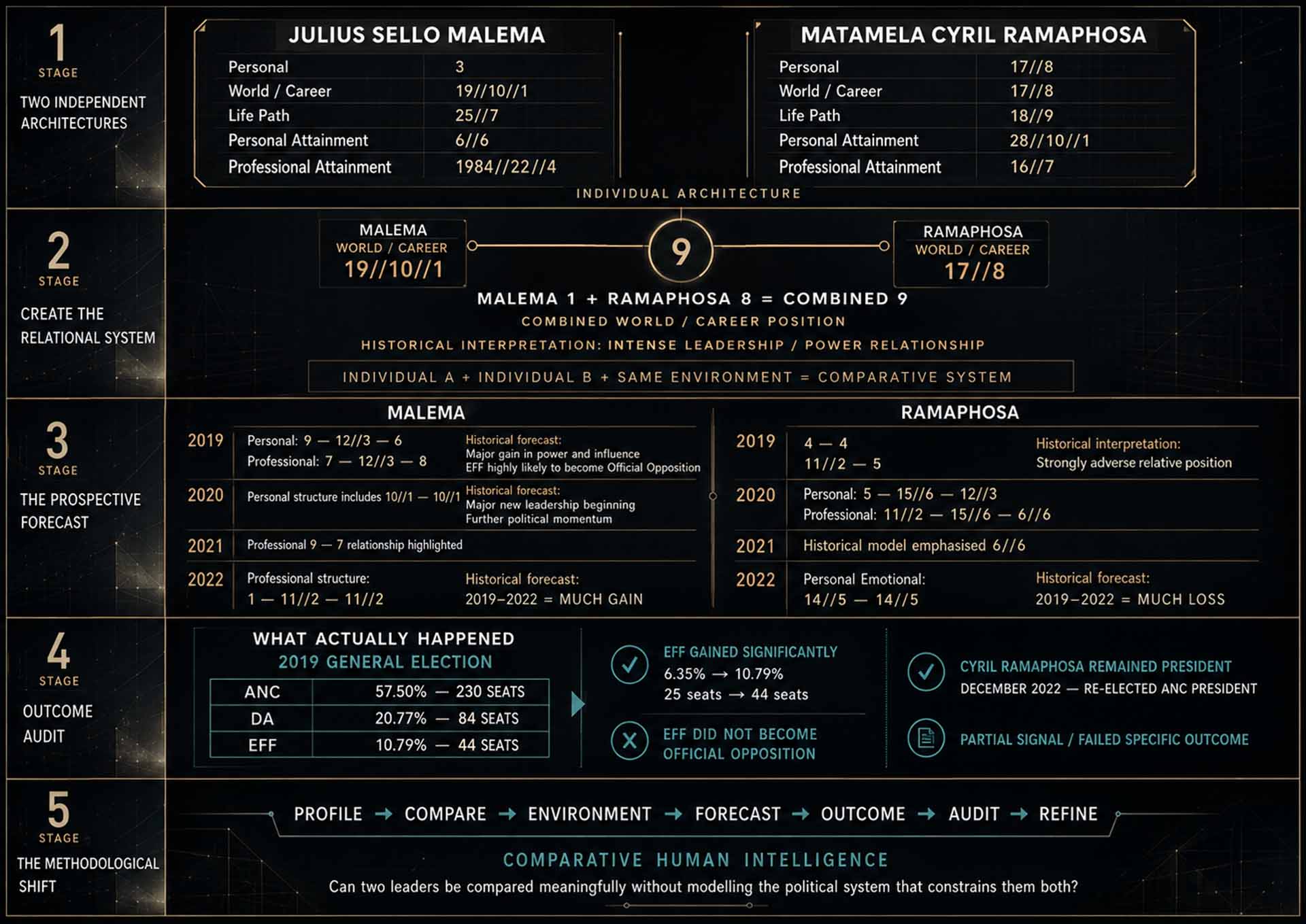
The original research first constructed separate numerical architectures for the two men.
For Julius Sello Malema, born 3 March 1981, the historical model recorded:
- Personal Number: 3
- World/Career Number: 19//10//1
- Life Path: 25//7
- Personal Attainment: 6//6
- Professional Attainment: 1984//22//4
For Matamela Cyril Ramaphosa, born 17 November 1952, it recorded:
- Personal Number: 17//8
- World/Career Number: 17//8
- Life Path: 18//9
- Personal Attainment: 28//10//1
- Professional Attainment: 16//7.
Historical interpretations associated Malema’s World/Career 1 with leadership and independence, while Ramaphosa’s World/Career 8 was associated with authority, power and material influence.
Those interpretations belong to the historical 365 Pin Code framework. They should not be presented today as validated psychological measurements.
But Chris then made the move that gives Article 23 its enduring research value. He did not stop with two profiles. He combined them.
Then Chris Put Them Inside the Same System
Malema’s World/Career position was 1. Ramaphosa’s was 8. The historical methodology combined the two: 1 + 8 = 9
Chris interpreted this combined 9 in the World/Career position as signalling an unusually intense relationship around leadership, power and eventual consequence.
Whether that numerical interpretation ultimately proves meaningful is a research question. The methodological move itself is unmistakable. The unit of analysis had changed.
It was no longer merely:
Malema and Ramaphosa It had become: Malema × Ramaphosa × shared political environment.
That is the beginning of what the Archive Analysis now calls Comparative Competitive Intelligence.
And it immediately creates a much wider application. A board choosing between two chief executives does not really need two unrelated personality descriptions.
It needs to know: Who appears better positioned for this role, in this organisation, against this strategy, during this period, relative to the alternative candidate?
Political leadership offered Chris an early laboratory for that problem.
The Model Strongly Favoured Malema’s Trajectory
The historical paper then moved into its prospective 2019–2022 window.
For Malema, 2019 was modelled through a 12//3 Annual Experience, with a Personal Physical sequence of: 9 — 12//3 — 6 and a Professional Physical sequence of: 7 — 12//3 — 8.
Chris considered that configuration highly favourable.
The article went considerably further than merely predicting increased influence. It explicitly asked whether the EFF would overtake the Democratic Alliance and become South Africa’s official opposition, concluding that there was an outside possibility that it would.
The model then identified 2020 as another major Malema year. A concentrated 10//1 structure was interpreted as a powerful new beginning, while his transition into a Number 1 Pinnacle was framed as additional evidence of rising leadership momentum.
By 2021 the article highlighted a professional 9–7 relationship. And in 2022 it recorded the professional line: 1 — 11//2 — 11//2 which the historical research associated with Malema operating at unusually high professional intensity.
The conclusion was unequivocal: 2019 through 2022 would represent “much gain” for Julius Malema. Ramaphosa was given the opposite trajectory.
Your Content Goes Here
The 2019 election produced something much more nuanced than the forecast. The EFF did indeed make a substantial advance.
Its national vote increased from 6.35% in 2014 to 10.79% in 2019, and its representation increased from 25 to 44 National Assembly seats.
That was a meaningful gain. But it did not become the official opposition.
The Democratic Alliance remained second nationally with 20.77% and 84 seats. The ANC won 57.50% and 230 seats, retaining its parliamentary majority.
So the first predictive audit produces two different answers.
- Directional proposition: stronger EFF influence, supported.
- Specific proposition: EFF becomes Official Opposition, failed.
- That distinction is crucial.
A methodology becomes impossible to improve if broadly compatible developments are allowed to erase specific failed forecasts. The research article should do the opposite. Preserve both.
The Bigger 2019–2022 Forecast Did Not Survive Intact
The historical comparison was even more negative about Ramaphosa.
The source interpreted his 2019 structure as markedly unfavourable relative to Malema.
For 2020 it recorded: Personal Physical : 5 — 15//6 — 12//3 Professional Physical : 11//2 — 15//6 — 6//6 and interpreted these as considerable personal and professional pressure.
It highlighted another 6//6 structure in 2021. For 2022, Ramaphosa’s Personal Emotional architecture contained: 14//5 — 14//5 which Chris interpreted as an unusually concentrated change and freedom-related challenge.
The historical conclusion therefore became much stronger than the evidence ultimately justified:
2019–2022 = much gain for Malema, much loss for Ramaphosa.
There certainly were political pressures during Ramaphosa’s first full presidential term.
But the principal leadership outcome contradicts any interpretation that he was being displaced by Malema. Ramaphosa remained President and, critically for the original forecast window, was re-elected President of the ANC in December 2022.
The longer record strengthens that conclusion: he was again elected President of South Africa by the National Assembly in June 2024.
- Malema did not replace him.
- That part of the forecast failed.
- And that matters.
Why the Failure Makes this Research More Valuable
It would be easy to treat that result as a reason to downgrade this research article. The Archive Analysis reaches almost the opposite conclusion.
The article scores 86/90 because its deepest contribution is methodological, not predictive. It is one of the earliest substantial attempts in the archive to compare competing human architectures rather than describe one person at a time.
The predictive miss actually helps expose what that methodology still lacked.
- Politics is not a race between two isolated individuals.
- Malema was not simply competing against Ramaphosa.
- The EFF was operating against the ANC, the DA and numerous other parties.
- Electoral geography mattered.
- Party machinery mattered.
- Voter history mattered.
- Institutions mattered.
- Coalitions mattered.
- Economic conditions mattered.
- Unanticipated events mattered.
- And, above all, South Africans themselves made the decision.
This reveals one of the most important lessons in the Political Leadership archive: individual architecture is not system architecture.
From Political Prediction to Comparative Decision Intelligence
That does not make comparison less useful. It tells us how comparison needs to evolve. Imagine applying the same idea to two candidates for a chief executive position.
A stronger model would not simply ask:
What does Candidate A look like?
and:
What does Candidate B look like?
It would compare both against:
- the role;
- the organisation;
- the strategy;
- the board;
- the operating environment;
- the decision horizon;
- the pressures approaching;
- their relationship with key stakeholders;
- and the governance structures surrounding them.
- The question becomes:
Who is comparatively better aligned with the system they are actually being asked to lead?
This is much closer to decision intelligence than conventional profiling.
The Missing Variable Was the System
Article 23 therefore reveals both an advance and a limitation. The advance was relational thinking. Chris recognised that two consequential people should sometimes be examined together.
The limitation was treating that comparative human relationship as though it could carry enough information to forecast a vastly larger political system.
The contemporary research proposition can now be expressed more precisely:
INDIVIDUAL A × INDIVIDUAL B × ENVIRONMENT × TIME
rather than simply:
INDIVIDUAL A versus INDIVIDUAL B.
That creates a possible future Comparative IMB Decision Matrix, exactly as proposed in the Archive Analysis:
Strength Architecture → Risk Architecture → Timing Alignment → Role Alignment → Relationship Tension → Environmental Fit → Governance Requirement → Relative Decision Intelligence.
That is a considerably more interesting legacy than asking whether Malema should have beaten Ramaphosa.
The Real Legacy of Article 23
The original article tried to forecast a political contest. The contemporary article reveals something larger. The EFF did gain substantially in 2019.
The specific prediction that it would become the official opposition did not happen. The wider proposition that Malema would rise while Ramaphosa experienced corresponding political displacement through 2022 did not survive the outcome intact.
Those failures belong permanently in the research record. But so does the idea Chris was beginning to develop underneath them.
Leadership intelligence becomes more useful when it becomes comparative.
And comparative intelligence becomes more credible when it includes the system surrounding the people being compared.
That moves the research beyond:
Who looks stronger?
towards:
Who is better positioned for this environment, during this period, relative to the alternatives and what important variables are we still failing to model?
That last question may be the most important one Article 23 ever produced.
FROM THE HUMAN FUTURIST RESEARCH ARCHIVE
This contemporary article has been developed from historical Human Futurist research preserved as: Article 23 – Malema vs Ramaphosa. Original Title: How will South Africa’s 2019 General Election affect Julius and Cyril Archive ID: HF-RA-023
The historical source was produced prospectively around South Africa’s 2019 electoral period and contains specific forward-looking claims concerning Julius Malema, Cyril Ramaphosa and the period through 2022.
Its original terminology, calculations and predictions remain preserved in The Human Futurist Research Archive.
The contemporary publication does not rewrite those forecasts after the event. It distinguishes the historical prediction from the subsequent outcome and reframes the article’s strongest enduring contribution as the emergence of Comparative Human Intelligence.
Share This Article, Choose Your Platform!
Related Posts





From understanding decisions to informing them.
Beyond the Research
The Business & Leadership archive examines consequential decisions after they have happened.
The Intelligent Mathematical Blueprint and Private Advisory take the underlying Human Futurist thinking into a different environment: helping leaders examine the circumstances surrounding decisions that have yet to be made.