

Part Of the Apple Case Study
Gil Amelio occupies the transition between two very different chapters of Apple’s leadership history. John Sculley’s story showed how decisions can continue travelling long after they are made. Amelio’s raises another question: can a period be exceptionally important in somebody’s professional life without being professionally positive? And then his story adds something even bigger. During Amelio’s short tenure, Steve Jobs walked back through Apple’s door.
500 DAYS THAT CHANGED WHAT CAME NEXT
Apple Needed a Turnaround
By the time Gil Amelio became Apple’s chief executive in February 1996, he was not inheriting a comfortable leadership position. He was being asked to deal with a company in serious difficulty.
The original Human Futurist research describes an organisation struggling with finances, product quality, an unfocused research and development operation, an increasingly urgent operating-system problem and a difficult corporate culture. Amelio arrived with turnaround credentials.
He had previously led National Semiconductor and had already served on Apple’s board. His response at Apple included substantial cost reduction and workforce restructuring. These were not the actions of somebody presiding over business as usual. They were interventions inside an organisation under pressure.
And that matters when looking back at Amelio, because his 500 days are easily flattened into a simple story: Apple struggled. Amelio failed. Jobs returned. Apple recovered.
The actual transition is more interesting than that. Amelio did not inherit the Apple that Steve Jobs would later rebuild. He inherited part of the problem Jobs would eventually have to solve. And before Amelio left, he made one decision that would profoundly alter who was available to solve it.
Then Amelio Made the Decision That Changed the Story
Apple needed a modern operating system. Its attempts to develop the required successor internally had left the company searching for another answer.
In December 1996, Apple agreed to acquire NeXT. NeXT brought technology. It also brought its co-founder: Steve Jobs.
More than a decade after leaving the company he had helped create, Jobs was coming back to Apple as an adviser.
The historical irony is difficult to miss. Amelio had been recruited to turn Apple around. One of his most consequential decisions brought back the person who would ultimately lead a far more dramatic turnaround – and who would do so after Amelio was gone.
That does not make the NeXT acquisition a mistake. Quite the opposite. It is precisely why reducing Amelio’s tenure to success or failure loses something important.
A leader can leave without achieving the outcome expected of them and still make a decision that materially changes what the organisation can do next. Amelio’s place in the Apple story therefore sits somewhere more complicated than the conventional hero-or-failure narrative. He became part of the transition.
What Chris Noticed
Chris’s original analysis came from the earlier numbers-based research that eventually developed into today’s broader Human Futurology and Intelligent Mathematical Blueprint framework.
His attention centred particularly on 1996, 1997 and 1998.
Amelio’s underlying analytical architecture contained two Professional Attainment positions carrying the same value: 9 – one in Professional Physical and the other in Professional Emotional.
The annual pattern then brought that same value into focus across the period surrounding his Apple tenure. That was what caught Chris’s attention.
Within the framework he was using at the time, professional attainment was associated with periods of unusually important professional consequence. But the word attainment creates a potential trap. It sounds positive. Chris’s interpretation was not that simple.
The appearance of an attainment pattern did not necessarily mean promotion, victory, wealth or professional success. It meant that the period could matter enormously. The direction of the consequence remained another question.
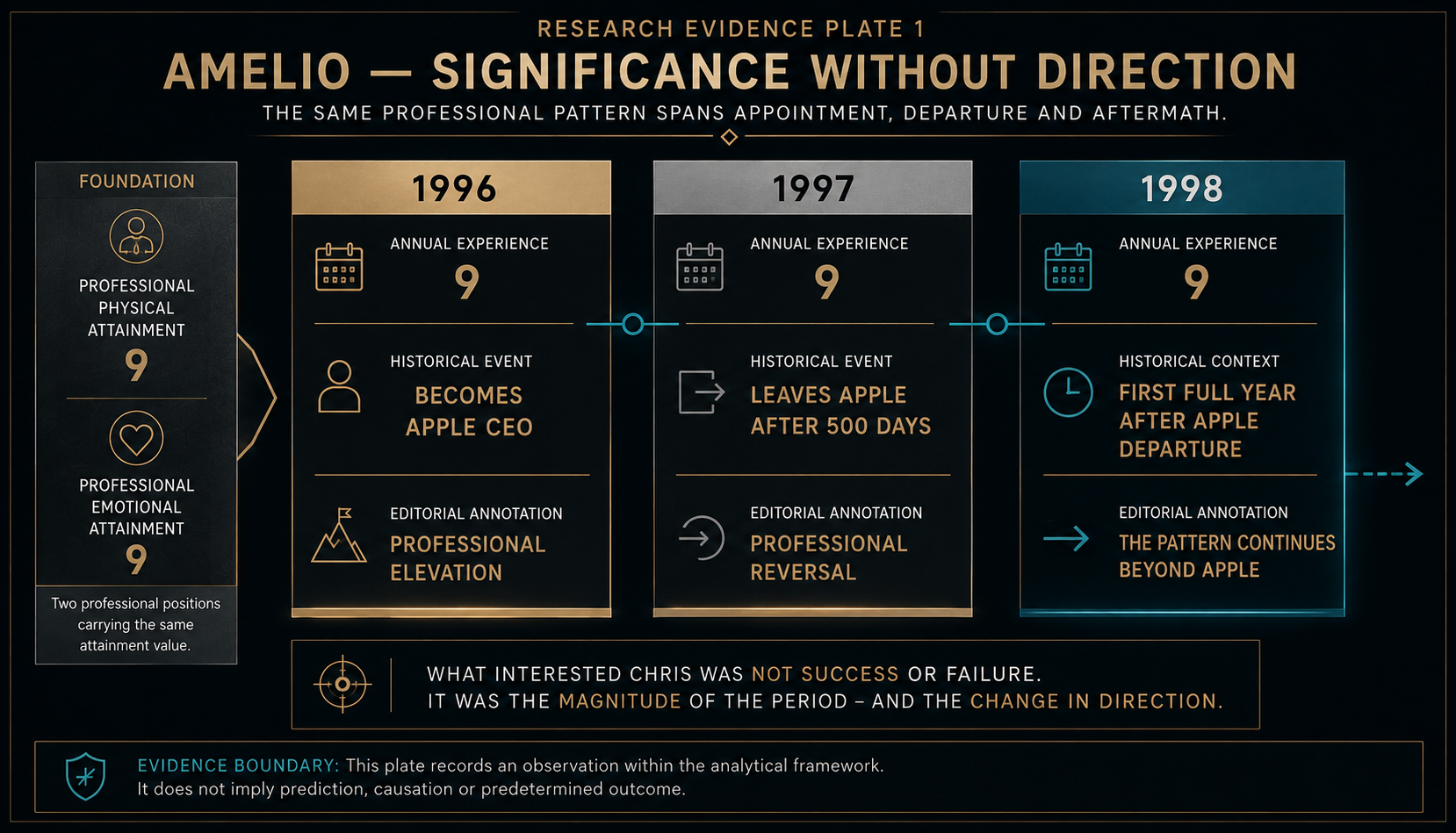
What interested Chris was not that the pattern identified success or failure. It was that it appeared across an unusually consequential professional period in which the direction changed dramatically.
Significance Did Not Mean Success
This is where the Amelio analysis becomes more useful than a retrospective attempt to match a pattern to a known event.
If Chris had simply interpreted professional attainment as professional success, Amelio would have created an obvious problem. 1996 certainly contained elevation. Becoming chief executive of Apple placed Amelio in one of the most visible positions in global technology.
But 1997 brought something very different. Apple continued to struggle. Board confidence deteriorated. Amelio left the chief executive role in July 1997.
So Chris’s question became more interesting: what if the analytical pattern was better at drawing attention to magnitude than determining direction?
That is a very different proposition from saying that a particular value meant Amelio would fail. It leaves room for the environment. The condition of Apple mattered. The board mattered. Execution mattered. Competition mattered. Leadership fit mattered. And the return of Steve Jobs mattered.
The analytical sequence did not remove any of those things. It simply caused Chris to look more closely at the period in which they collided.
A consequential professional period does not have to be a successful one. Sometimes the significance lies in how much changes.
500 Days, and a Very Different Apple
Amelio later called his memoir On the Firing Line: My 500 Days at Apple. The number is memorable because the tenure was so brief. But duration is not necessarily the best measure of consequence.
When Amelio entered the chief executive role, Steve Jobs had been outside Apple for more than a decade. Before Amelio left it, Apple had acquired NeXT and Jobs was back inside the organisation.
The Apple story had changed direction.
It would be too simple to claim that Amelio caused the Apple that followed. He did not. Nor should the NeXT acquisition be retrospectively transformed into a deliberate succession plan. Amelio was trying to solve Apple’s operating-system problem, not engineer his own replacement.
But the decision changed the environment. It created an organisational possibility that had not existed in the same way before it. Steve Jobs was back inside Apple.
That makes Amelio’s tenure difficult to categorise neatly. As a turnaround, it ended before the turnaround Apple is famous for had happened. As a transition, however, it sits directly across one of the most important thresholds in the company’s history.
And that is exactly why Chris’s distinction between importance and direction becomes so interesting here.
What This Article Adds to the Case Study
Gil Amelio changes the Apple Case Study in two ways.
First, his analysis introduces an important distinction: a period can be unusually consequential without the analytical pattern determining whether the consequence will be positive or negative. That prevents the wider Case Study from becoming a simplistic exercise in labelling patterns as good or bad.
Second, Amelio reconnects the story to Steve Jobs. Ronald Wayne left. Steve Wozniak gradually moved away from Apple’s day-to-day organisation. John Sculley’s leadership became part of the rupture that preceded Jobs’ departure. Amelio entered much later – and during his tenure, the founder returned.
The organisational sequence is beginning to close a circle. But the Apple that Jobs came back to was not the Apple he had left.
And what happened after his return would eventually create an entirely different leadership question: how does Apple continue when Steve Jobs can no longer lead it? That takes the Case Study to Tim Cook.
Share This Article, Choose Your Platform!
Related Posts






From understanding decisions to informing them.
Beyond the Research
The Business & Leadership archive examines consequential decisions after they have happened.
The Intelligent Mathematical Blueprint and Private Advisory take the underlying Human Futurist thinking into a different environment: helping leaders examine the circumstances surrounding decisions that have yet to be made.