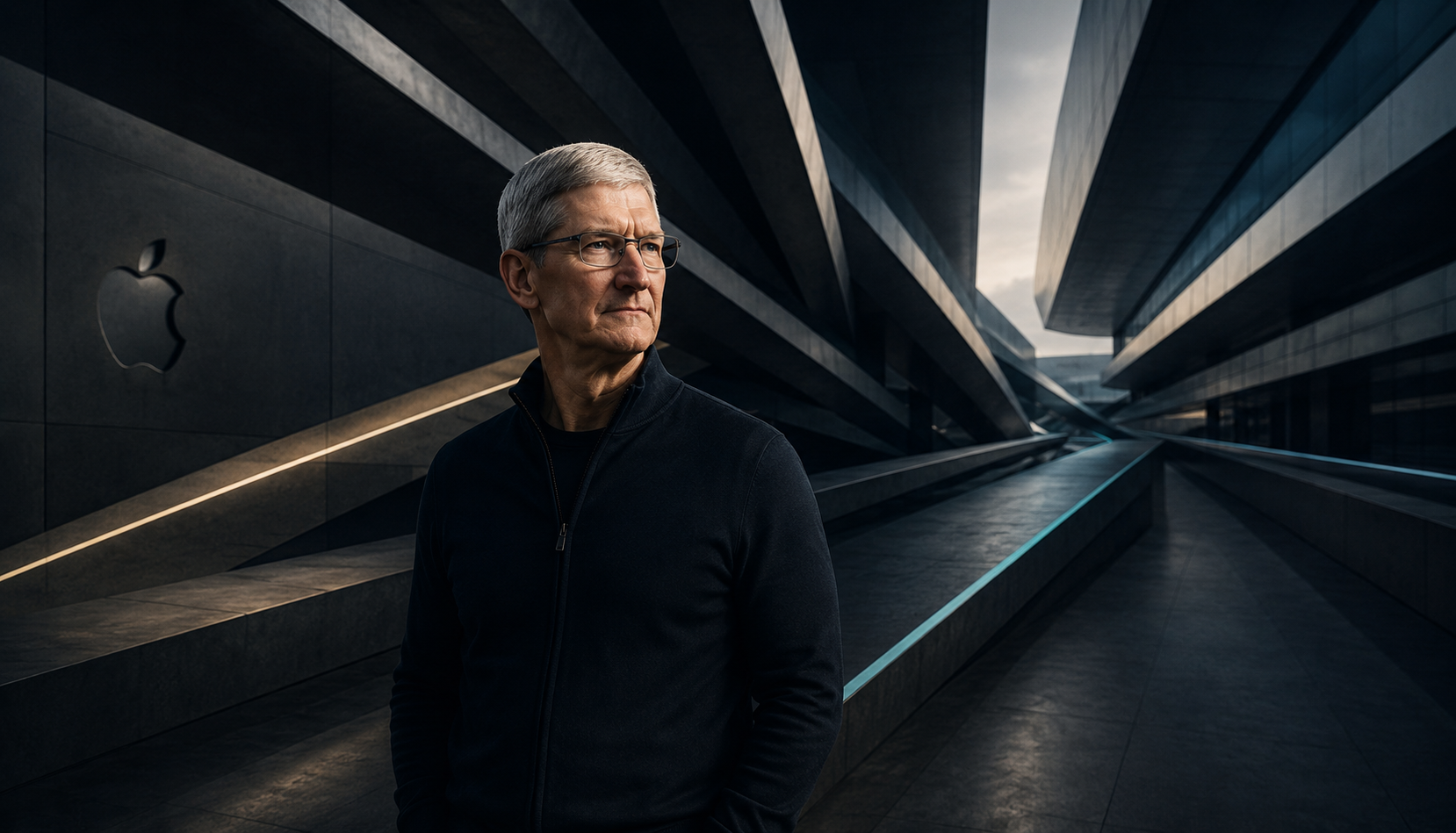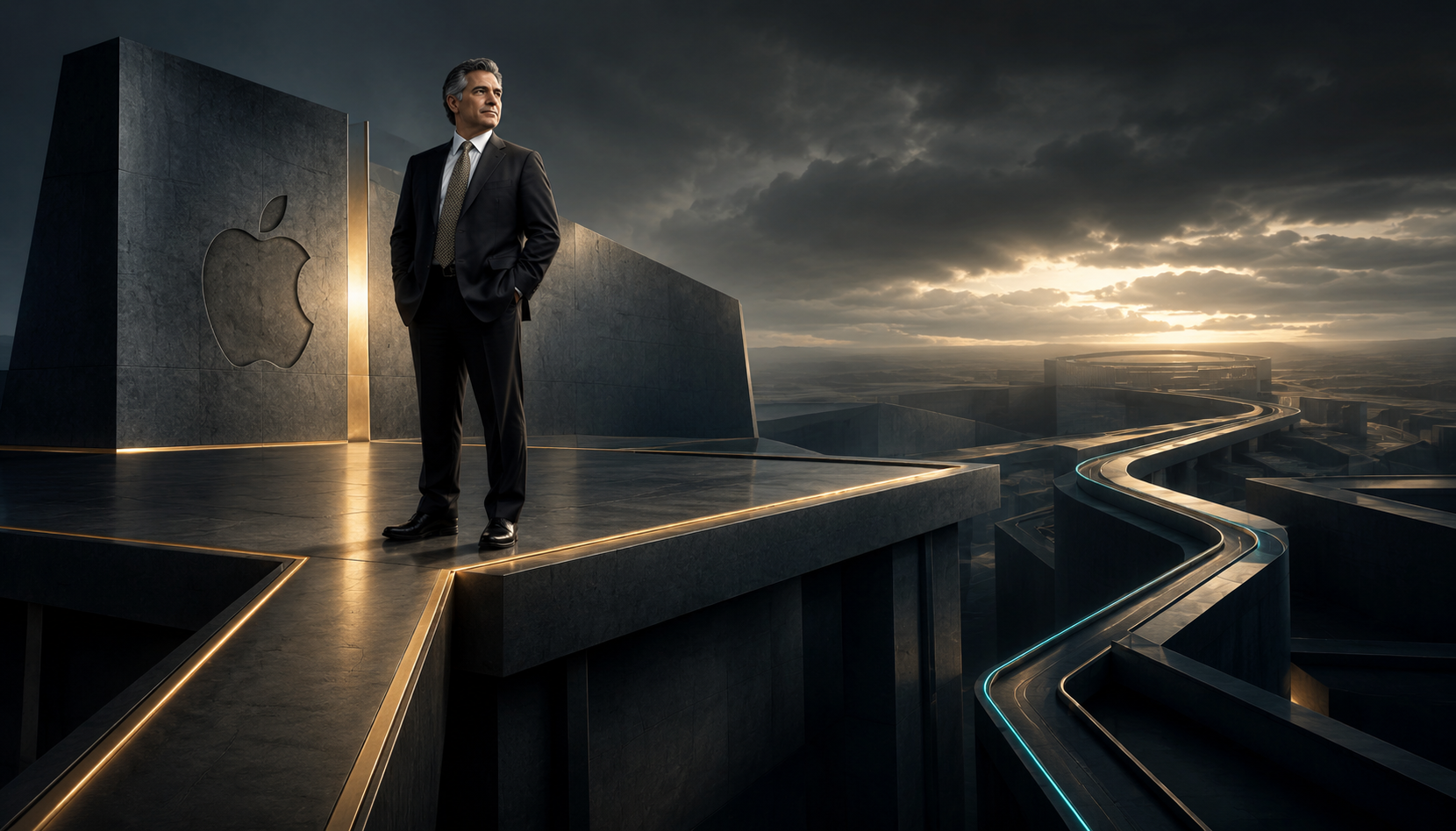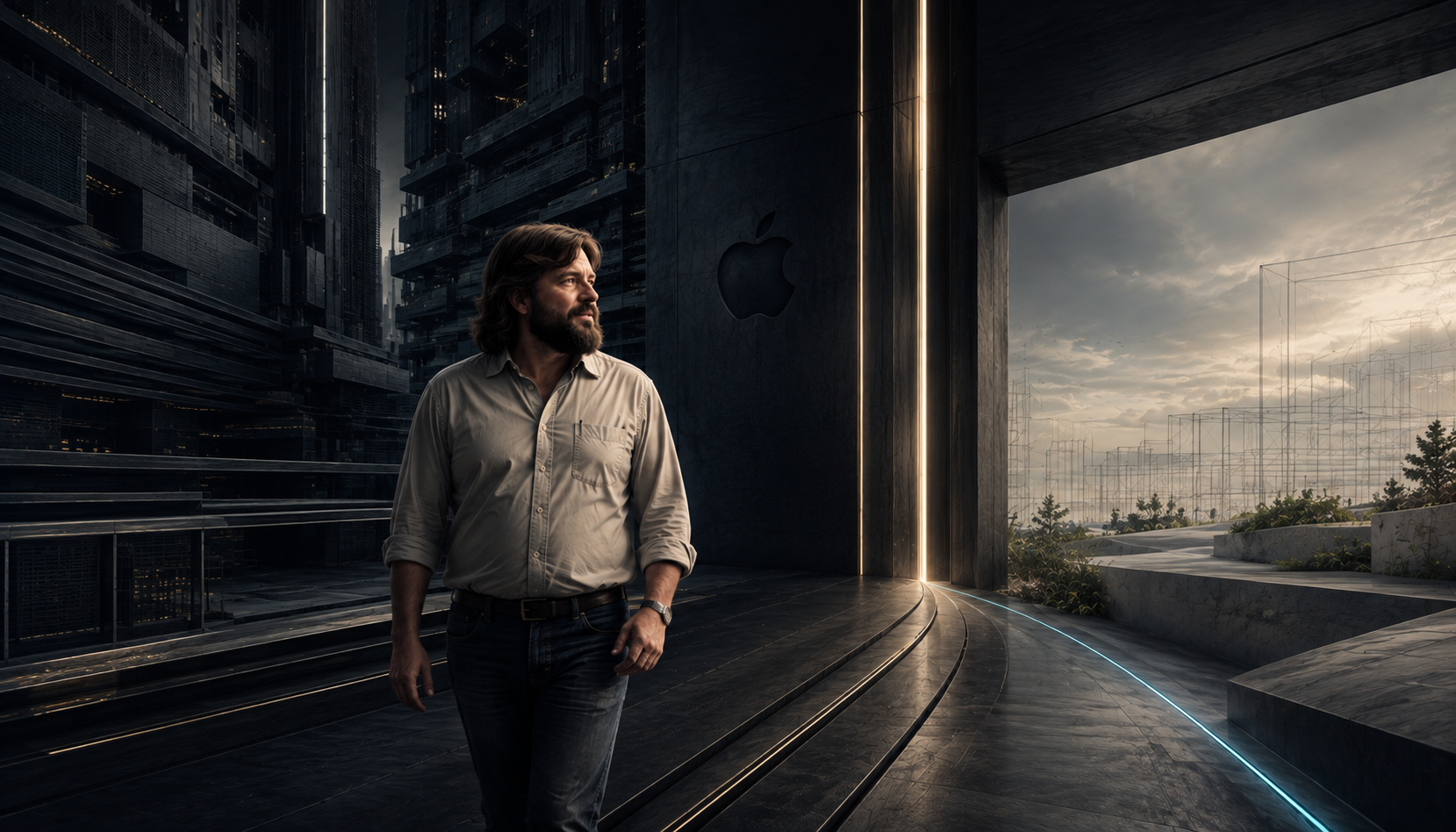
Part Of the Apple Case Study
The individual articles in this Case Study followed six very different people.
One helped create Apple, left it, returned and eventually handed it on. One left almost before the story had begun.
Another helped build the machine that made Apple possible, then chose a different relationship with the company he had created.
One was recruited to professionalise it. Another arrived when the organisation was fighting for survival.
And the last inherited a company almost inseparable from the identity of the man who came before him.
Read separately, they are remarkable human stories. Read together, the question changes.
The People Changed. The Organisation Kept Moving.
Apple did not travel from a California garage to one of the world’s most valuable companies in a straight line.
Its history contains exits, reversals, arguments, near-collapse, unexpected returns and leadership transitions that would have been almost impossible to imagine from the beginning.
That matters to this Case Study. Because the purpose was never to take six famous names and search backwards for six neat explanations.
Chris Styles had examined these people at different stages of his research.
When those analyses were brought together, what became increasingly interesting was not simply what appeared around each individual.
It was the continuity between them. Every person entered an organisation partly shaped by decisions made before they arrived.
And almost every person left something behind that changed the environment confronting whoever came next.
That is where six separate stories begin to become one.
Ronald Wayne Left Before Anyone Knew What Apple Would Become
The easiest way to misunderstand Ronald Wayne is to begin with today’s Apple. Do that, and selling his interest in the company becomes one of history’s most spectacular financial mistakes. But Wayne did not make his decision while looking backwards from a trillion-dollar corporation. He made it inside the uncertainty of 1976. He was older than Steve Jobs and Steve Wozniak, had assets to protect and faced a risk environment very different from theirs.
Chris’s later analysis became interesting because the decision appeared coherent when considered from Wayne’s position at the time.
The outcome was extraordinary lost optionality. But that is not the same thing as saying the original decision was irrational. And that distinction becomes important throughout the Case Study.
A decision can make sense when it is made and still carry an enormous later consequence.
Apple’s first departure therefore introduces something that will keep returning. Hindsight changes the appearance of a decision. It does not change the information available when the decision was actually made.
Wozniak Changed The Definition Of Success
Steve Wozniak presents a different kind of departure.
He did not simply walk away from an uncertain startup. He stepped away from day-to-day Apple involvement after helping create a company that was already becoming enormously successful.
Again, financial hindsight supplies an obvious judgement: why leave? Chris became interested in another question. What if staying was no longer the obvious definition of winning?
His historical analysis placed particular attention around a period associated, within the framework, with values, structure, creative expression and organisational fit.
That did not cause Wozniak to leave. Nor does it explain away the complicated real-world reasons surrounding his changing relationship with Apple.
What it does is make the human decision more interesting. Because professional success and personal fit are not always the same thing.
The Apple Case Study now has two founders who left. But they did not leave for the same reason. And they should not be judged by the same measure.
Then Leadership Decisions Started Travelling
John Sculley’s story moves the Case Study from founders into formal executive leadership.
It is tempting to reduce his decade at Apple to one event: Steve Jobs lost the internal struggle and left. But that framing throws away most of what makes the period useful.
Sculley grew Apple substantially. He was operating inside a rapidly changing technology market. Several decisions made under his leadership were rational responses to the organisation and competitive environment he faced.
Yet when Chris followed the analytical sequence farther forward, he became interested in something different. Some consequences seemed to outlive the original decisions.
The Jobs conflict. Strategic choices. Licensing decisions. Changes in competitive position. Then later organisational pressure. This introduced one of the most important ideas in the entire Apple Case Study: consequence lag.
A leadership decision does not necessarily reveal its full significance in the year it is made. It can alter the environment. The next decision is then made inside that altered environment. And the organisation keeps moving.
Sculley’s chapter therefore shifts the question from ‘Was the decision right?’ to ‘What did the decision make possible, difficult or necessary later?’
That is a much richer leadership question.
Gil Amelio Showed That Importance And Success Are Not The Same Thing
By the time Gil Amelio became Apple’s chief executive, the organisation was in serious trouble. His task was not to manage the Apple of later legend. It was to stabilise a company facing severe operational and strategic problems.
His tenure lasted roughly 500 days.
Measured purely by duration, it was brief. Measured by what changed while he was there, it sits across one of the most important thresholds in Apple’s history. Apple acquired NeXT. Steve Jobs returned. Amelio subsequently left. And Jobs would eventually take control of the company again.
Chris’s analysis around Amelio therefore introduced another essential distinction. A period can be highly significant without being highly successful.
An analytical framework that draws attention to consequence cannot automatically tell us whether that consequence will feel positive or negative.
Reality still contains competition, boards, capital, execution, personality, timing, markets, technology and other people. That boundary matters. Because without it, retrospective research becomes dangerously easy. Everything important gets labelled a success after the event.
Amelio prevents that. His tenure matters precisely because the outcome was complicated. He arrived to rescue Apple. He did not complete the turnaround for which Apple would later become famous.
But one of the decisions made during his tenure changed the organisational environment profoundly: Steve Jobs was back inside the company.
Then The Founder Returned To The Centre Of The Story
Steve Jobs is impossible to contain within a single leadership moment. He helped create Apple. Lost control of the organisation. Left. Built elsewhere. Returned. Reasserted leadership. Oversaw one of the most remarkable corporate transformations in modern history.
Then he faced an entirely different human problem. Apple had become extraordinarily successful. But its dependence on its defining founder made Jobs’s health and eventual succession organisational questions as well as personal ones.
When Chris examined Jobs’s 2004 period, a concentrated analytical pattern caught his attention. The later health history makes that observation particularly vulnerable to hindsight. So the distinction matters. The framework did not diagnose cancer. It did not medically explain Jobs’s illness. And it cannot turn correlation into causation.
What happened instead was more important to the development of Chris’s research.
The concentration was unusual enough to make him ask whether highly consequential periods in a person’s life might become identifiable through repeated case-study work. That question intensified his curiosity.
What if similar concentrations could be examined across hundreds, eventually thousands, of lives? Not to predict a disease. Not to guarantee an event. But to investigate whether periods of unusual human intensity could sometimes become visible before all of their consequences were known.
Jobs therefore became more than another retrospective Apple analysis. His story helped expand the research question itself. And eventually it created the final leadership problem in this Case Study.
Who inherits Apple when Steve Jobs can no longer lead it?
Tim Cook Changed The Direction Of The Research
On 24 August 2011, Steve Jobs resigned as Apple’s chief executive and recommended that Tim Cook succeed him. Six weeks later, Jobs died. Cook inherited far more than a job title.
He inherited Apple’s scale. Its culture. Its expectations. Its history. And perhaps the most difficult comparison any incoming corporate leader could face. Nine years later, Chris noticed something that made him look more closely.
The annual analytical structure he identified around Cook in 2020 matched the structure he had recorded around 2011. The year of succession had established the reference point. Now the structure had returned.
That recurrence mattered to Chris because he had already seen what surrounded its first appearance in Cook’s Apple story. So he began asking what its return might mean. His interpretation at the time included the possibility of substantial pressure around Cook personally and professionally, with potential consequences extending into Apple.
Then history continued.
The world entered the extraordinary disruption of COVID-19. Global supply chains, manufacturing, workplaces, retail and consumer behaviour came under pressure. Apple itself continued evolving through that environment and subsequently reached levels of corporate performance and valuation that could not have been known when Chris recorded his interpretation.
That later history does not need to be used to prove or disprove the recurrence. It serves a different purpose. It allows the original observation, Chris’s prospective interpretation and the subsequent historical record to remain visible beside one another.
And that distinction is fundamental to the research.
- 2011 established the reference point.
- 2020 brought the recurrence.
- Chris interpreted what he was seeing.
- The story then continued.
The Case Study preserves all four. Because identifying a recurrence is not the same thing as claiming that two periods must produce identical outcomes. And preserving an interpretation made before the outcome existed is more useful than rewriting that interpretation afterwards.
The value is not in making the past fit. It is in preserving what Chris could see before the story continued.
Six People Became a Chain Of Inheritance
Now put the stories beside one another.
- Ronald Wayne made a decision inside the risk environment of an uncertain startup.
- Steve Wozniak confronted a different question: whether the organisation Apple was becoming still matched what he wanted from his own working life.
- John Sculley inherited an entrepreneurial company becoming a global corporation and made decisions whose consequences continued beyond his tenure.
- Gil Amelio inherited an Apple in crisis and helped create the organisational conditions in which Steve Jobs could return.
- Jobs inherited that damaged organisation, rebuilt it and eventually confronted the impossibility of leading forever.
- Tim Cook inherited the Apple Jobs left behind.
Different people. Different pressures. Different choices. But the organisation connects them. This suggests a more useful way of thinking about leadership.
We often study leaders as though their tenure begins on the day they receive the title. It rarely does.
They inherit decisions, culture, relationships, systems, unresolved problems, successful strategies, expensive assumptions, previous compromises and expectations created by people who may no longer be in the room.
Leadership is partly about what you decide. It is also about what was already moving when you arrived.
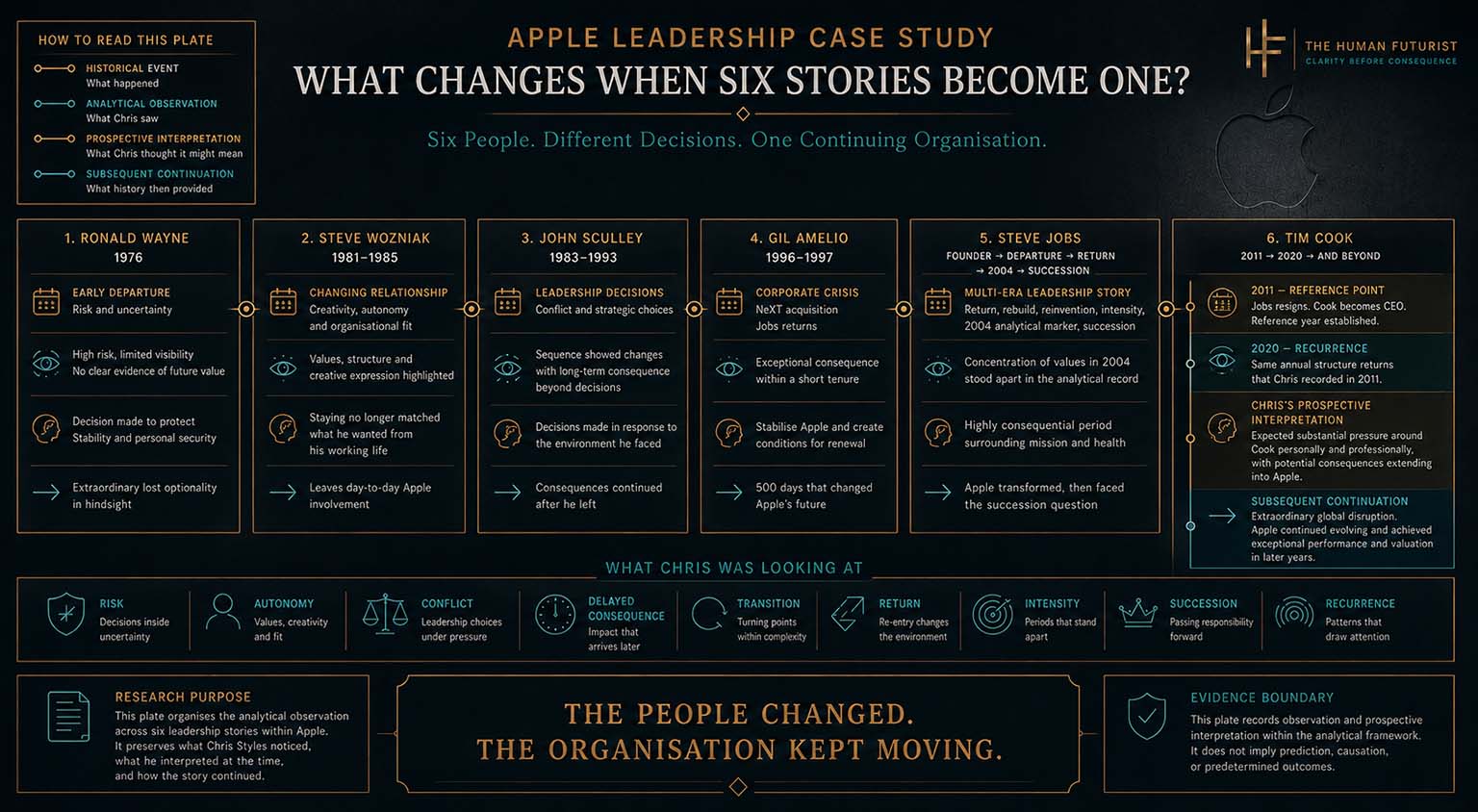
What Chris Saw Was Not The Same As What History Had to Produce
Across these six stories, Chris identified relationships, concentrations, sequences and recurrences that made particular periods stand out within his developing research.
Some were examined retrospectively. Others became more significant because Chris recorded his interpretation while the eventual outcome was still unknown.
But the purpose of bringing those cases together is not to divide them into predictions that were right and predictions that were wrong.
That would reduce a much more interesting body of research to a scorecard. The better question is: What caused Chris to look more closely?
- Sometimes it was recurrence.
- Sometimes concentration.
- Sometimes an unusual relationship between personal and professional structures.
- Sometimes it was the way one period appeared to connect with another.
Those observations did not cause the events that followed. Nor did they guarantee a particular outcome. They created a reason to pay attention.
And once that distinction is maintained, the historical record can remain exactly what it is, evidence of what happened next, rather than something that must be made to validate the framework.
What Apple Makes Visible
Following one organisation across six people changes the scale of the question.
Risk Without Hindsight. Wayne reminds us that tomorrow’s value is invisible when today’s decision has to be made.
Success Without A Single Definition. Wozniak shows that financial maximisation, creative freedom and personal coherence are not automatically the same objective.
Consequences That Arrive Late. Sculley demonstrates why leadership decisions may continue shaping an organisation long after the original decision-maker has gone.
Importance Without Guaranteed Direction. Amelio shows that an exceptionally consequential period does not have to be an obviously successful one.
Intensity Without Medical Causation. Jobs demonstrates both why concentrated timing relationships attracted Chris’s attention and why evidence boundaries matter.
Recurrence Without Certainty. Cook shows why recognising something familiar is different from knowing how the next chapter will unfold.
And underneath all six sits one continuing idea. The person changes. The decision environment does not reset to zero. Every leader steps into a story already in motion.
So What Did Chris Actually Find?
- Not a formula for Apple.
- Not proof that every important decision can be predicted.
- And not six examples that should be forced into one identical analytical explanation.
What emerged was more subtle. Certain periods repeatedly attracted Chris’s attention when he applied the developing framework to people caught inside highly consequential moments.
Departures. Conflict. Transition. Pressure. Return. Succession.
Sometimes the correspondence was retrospective. Sometimes, as with Tim Cook, the interpretation was preserved prospectively.
The value of collecting the cases is therefore not that they all behaved perfectly. It is that they allow the questions to become more precise.
- Can periods of heightened consequence sometimes be identified?
- Can recurrence be useful without assuming repetition?
- Can decision-makers benefit from examining personal and professional pressure before it becomes obvious?
- How much of an individual’s decision environment belongs to the individual, and how much has been inherited?
- What happens when similar questions are tested across far more people, organisations and outcomes?
Those are research questions. They remain open.
The Case Study Ends. The Question Doesn’t.
Apple gives this research an unusually long human timeline.
- A founder leaving before success was visible.
- Another founder leaving after success had arrived.
- A recruited chief executive whose decisions echoed beyond his tenure.
- A turnaround leader whose short stay changed what became possible next.
- A founder returning to rescue the company he had once lost.
- And a successor asked to prove that the organisation could survive its own mythology.
None of those stories is complete when viewed only through an analytical framework. Nor is the framework irrelevant simply because conventional history already explains much of what happened.
The interesting territory lies between those positions. History tells us what happened. The contemporary reconstruction shows what Chris was looking at. The comparison allows us to ask whether anything useful becomes visible when both are placed together.
That is the purpose of the Apple Leadership Case Study.
- Not prediction theatre.
- Not retrospective certainty.
- Not an argument that six lives prove a universal model.
- Something more useful than that.
- A disciplined invitation to look again.
Because when decisions carry consequence, the advantage may not always lie in knowing exactly what happens next.
Sometimes it begins with seeing that something deserves closer attention before everyone else can see why.
Closing Statement
Six People. One Organisation. Decades Of Decisions.
Apple’s history was never created by one person acting alone.
- Each leader entered a structure shaped partly by those who came before.
- Each changed something.
- Each left something behind.
And the organisation carried it forward.
That is what becomes visible when six stories become one.
Independent Research Note
Apple and the individuals discussed in this Case Study are the historical subjects of independent Human Futurist research.
The Case Study does not imply endorsement, sponsorship or any commercial relationship with Apple Inc. or the individuals discussed.
The analytical framework is presented as a research and decision-intelligence perspective. It does not establish causation, predetermined outcomes or certainty about future events.
Share This Article, Choose Your Platform!
Related Posts


From understanding decisions to informing them.
Beyond the Research
The Business & Leadership archive examines consequential decisions after they have happened.
The Intelligent Mathematical Blueprint and Private Advisory take the underlying Human Futurist thinking into a different environment: helping leaders examine the circumstances surrounding decisions that have yet to be made.