
Personal Attainment, Risk Concentration and the Evolution of Futurist Coaching
When several risk signals converge, foresight matters only if it can change what happens next.
Steve Schwarzman has spent much of his career making decisions in environments where one mistake can carry enormous financial consequences.
That makes one of his own observations particularly relevant to this research. When he is under pressure to commit to a transaction but does not yet know the right answer, Schwarzman has described deliberately postponing the decision, gathering more information and taking another pass around the problem.
That instinct sits remarkably close to the question Chris Styles was exploring when he examined Schwarzman’s numbers in early 2022.
Not simply: What is going to happen to Steve Schwarzman?
But: What if additional intelligence could identify a period in which an already powerful decision-maker should become unusually careful about what he does next?
That distinction is what makes this study important. Because Chris did not identify one isolated number in 2022. He found several independently calculated structures beginning to concentrate around the same period. And one of the most important did not disappear when 2022 ended.
It continued through 2023, 2024 and 2025.
Why Schwarzman Became an Interesting Research Subject
The timing was striking. The historical article records that Schwarzman had received more than $1 billion in dividends and compensation during 2021, while Blackstone itself had enjoyed an exceptional year and was moving towards $1 trillion in assets under management.
There was no obvious external picture of weakness. Quite the opposite. Schwarzman appeared to be operating from extraordinary financial strength.
That made him useful to Chris because risk is easy to recognise after something has already gone wrong. The harder problem is identifying whether a period deserves additional caution while everything still appears successful.
By this stage, Chris was increasingly using the evolving Human Futurology model to examine four interacting dimensions of experience:
- Personal Physical
- Personal Emotional
- Professional Physical
- Professional Emotional
The distinction matters.
Rather than taking one number and attaching a forecast to it, Chris was looking for convergence. Where did an annual sequence reproduce an important number already embedded within the individual’s architecture?
Where did several independent calculations begin pointing towards the same period? And did the concentration become strong enough to justify increased attention?
With Schwarzman, several structures caught his attention.
The Architecture Behind the Forecast
Schwarzman was born on 14 February 1947. Within the historical methodology, his Life Path was calculated as:
14 + 2 + 1947 = 1963
1963 → 19 → 10 → 1
giving the complete sequence:
1963//19//10//1
The final Number 1 was associated within the original model with independence, leadership, attainment, ambition and the desire to operate at the front.
Schwarzman’s career makes that an understandable point of interest.
But Chris retained the backing number 19 because the methodology treated the complete sequence as more informative than its final reduction alone.
The historical interpretation of 19 concerned the relationship between individual attainment and the consequences of power — particularly how extraordinary personal success is balanced against responsibility towards others.
Several additional values added to the picture. Schwarzman’s birth day produced: 14//5 His Emotional Life Path was: 17//8 His Subconscious Self was: 8
And his Personal Attainment Number, historically described as his Sun Number, was: 16//7
Chris therefore had several enduring reference points against which future years could be compared. The significance of those numbers within this article is not that they caused particular events.
The research proposition is more limited and more useful:
Does a period become more significant when annual or temporal calculations begin reproducing numbers already prominent in an individual’s underlying architecture?
That question became especially important when Chris looked at 2022.
The Number 6 Connection
Schwarzman’s full birth name, Stephen Allen Schwarzman also produced an unusual feature in the historical Inclusion Chart.
Number 6 was the only number identified as absent within that calculation and was consequently classified as his sole Karmic Lesson.
Within the methodology, 6 was associated with responsibility, relationships, loyalty, community and the obligations that arise between self and others.
Schwarzman’s Subconscious Self was consequently calculated as 8, a number strongly associated in the historical system with finance, business, material achievement, authority and organisation.
Then came 2022. 2 + 0 + 2 + 2 = 6.
The Universal Year therefore reproduced the one number the Inclusion Chart had isolated.
There were more 6 relationships. His first name, Stephen, calculated to 33//6. The name Stephen Schwarzman produced 78//15//6.
None of these relationships independently establishes what would happen in 2022. What interested Chris was their accumulation.
Several separate calculations were now beginning to point towards the same year.
Schwarzman and Blackstone
Another relationship emerged between Schwarzman and the company he co-founded.
Chris calculated the name Blackstone as: 30//3
Schwarzman’s initials, S.A.S also produced a Primary Balance Number of 30//3 within the historical methodology.
That created a direct correspondence:
Blackstone 30//3 → Schwarzman Primary Balance 30//3
Chris interpreted this as a strong founder–enterprise synchronisation. The finding does not demonstrate that Blackstone became successful because of the number 3.
Its research value lies elsewhere.
It raises the possibility that founders and the organisations they create may be studied as connected systems rather than entirely separate entities.
For the Schwarzman article, however, the most important finding was still ahead.
Then 16//7 Returned
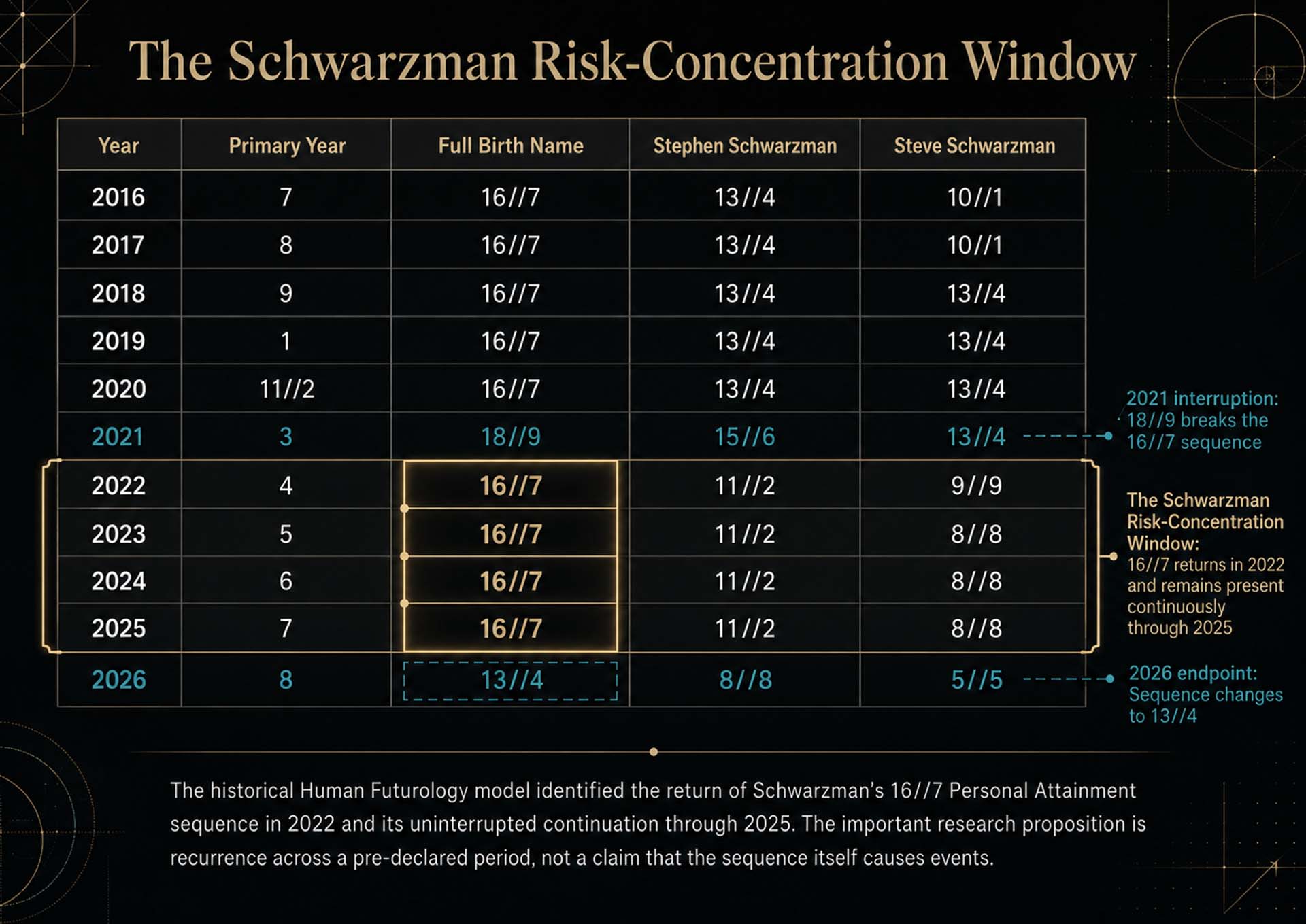
Chris’s longitudinal Annual Experience modelling allowed him to compare the numbers appearing in 2022 with the years around it.
The 2022 line included:
Primary Year: 4 → Full Birth Name AEN: 16//7 → Stephen Schwarzman: 11//2 → Steve Schwarzman: 9//9
The value that immediately stood out was: 16//7 because this was also Schwarzman’s Personal Attainment Number. A temporal sequence had therefore reproduced an enduring number already embedded within his architecture.
But the longitudinal chart revealed something more interesting. The 16//7 Annual Experience sequence had appeared across the period 2016–2020.
It then disappeared in 2021. In 2022, it returned. And it remained:
- 2022 → 16//7
- 2023 → 16//7
- 2024 → 16//7
- 2025 → 16//7
Only in 2026 did the sequence change. This altered the nature of the research. Chris was not simply identifying 2022 as a difficult-looking year. He was identifying the beginning of a four-year recurrence window in which Schwarzman’s own Personal Attainment architecture remained active within the annual model.
That made 2022–2025 a defined period that could later be audited against what actually happened.
More Than One Risk Signal
The historical article identified further concentration around 2022. One of the most important was the appearance of a 13//4 + 16//7 Personal Physical combination. The methodology treated this pairing as particularly challenging. Separately, the call-name calculation for Steve Schwarzman produced 9//9 for 2022.
Number 9 was associated within the original system with completion, culmination and endings. The interest therefore did not lie in any one sequence. It lay in several relationships appearing together:
- 16//7 returning as an Annual Experience Number
- 16//7 matching Schwarzman’s Personal Attainment Number
- 13//4 combining with 16//7
- 9//9 appearing through his call-name architecture
- Universal 6 connecting with his only missing-number lesson
- and 16//7 continuing through 2025
This is where the historical study begins to resemble something more sophisticated than conventional numerology.
The emerging idea is one of risk concentration. A single recurring value may be interesting. Several independently calculated values converging around the same period create a stronger research question.
2022 Was Only the Beginning
The original article naturally placed considerable emphasis on 2022 because it was written that year.
The longitudinal table reveals that the more important proposition actually extended beyond it.
Across the full-birth-name Annual Experience model:
- 2022 → 16//7
- 2023 → 16//7
- 2024 → 16//7
- 2025 → 16//7
Then:
- 2026 → 13//4
The forecast therefore created something unusually valuable within the archive.
Chris had identified the period before its outcome was known.
That matters. Retrospective pattern analysis begins with an event and asks whether the numbers surrounding it are interesting.
This article works in the opposite direction.
- The calculations came first.
- The future was still open.
The research was effectively saying, watch this period.
That gives Article 238 value as a prospective case rather than merely an explanatory one.
From Prediction to Risk Intelligence
There is another reason the Schwarzman study matters. It begins to expose a change in what Human Futurology might actually be for.
Traditional predictive language asks:
What will happen? The Schwarzman study points towards a different question: When should a decision-maker become more careful about what they make happen?
That is a much more practical proposition.
An experienced investor who believes risk has increased need not know the precise future loss before taking action.
- They can increase scrutiny.
- They can slow a decision down.
- They can challenge assumptions.
- They can seek independent advice.
- They can reduce exposure.
- They can wait.
This brings the research back to Schwarzman’s own philosophy of decision-making. When he does not have enough information, he does not rush to commit.
He gathers more. The developing Human Futurist proposition was that the Intelligent Mathematical Blueprint might provide one additional layer of information.
- Not a substitute for financial analysis.
- Not a replacement for governance.
- Not an instruction to make or avoid a transaction.
A second lens through which a period of unusual concentration might be recognised.
The Coaching Question
And this is where prediction becomes more complicated.
Suppose a leader is told in advance that several risk indicators are clustering around the coming year.
- They respond differently.
- They delay a transaction.
- They reduce exposure.
- They repair a relationship.
- They increase oversight.
- They avoid an emotionally driven decision.
- Then nothing dramatic happens.
Was the forecast wrong? Or did awareness change the outcome?
That is the question which begins to move the work from forecasting towards futurist coaching.
Prediction asks: Did the forecasted event happen?
Coaching asks: Did the information improve the decision?
Those are not the same test.
And if Human Futurology is intended to become decision-support intelligence, the second question may ultimately be the more useful one.
The emerging architecture becomes:
Signal → Awareness → Scrutiny → Intervention → Decision → Outcome
The IMB does not have to make the decision.
Its potential value lies in changing what the person sees before making it.
But the Forecast Still Has to Be Audited
There is an important caution here. Intervention cannot become an excuse for every forecast that fails. Otherwise the model becomes impossible to test.
The historical Schwarzman article made clear prospective claims.
- It identified 2022 as unusually high risk.
- It highlighted 16//7.
- It identified 13//4 + 16//7 as particularly challenging.
- It drew attention to 9//9.
And its own longitudinal data showed the 16//7 recurrence continuing through 2025.
Those claims should remain exactly where they were placed in the historical record. They should now be tested against the completed 2022–2025 period. If significant outcomes correspond convincingly with the forecast, they should be documented.
If they do not, that matters equally. A methodology improves only when successful and unsuccessful predictions are preserved.
The supplied archive material does not contain that completed outcome audit, so it would be inappropriate to manufacture one here.
Why the Schwarzman Study Matters
The enduring value of this research is therefore not simply that Chris Styles believed Steve Schwarzman faced increased risk in 2022.
Its importance lies in the architecture behind that conclusion. Several independently calculated structures were concentrating. One of Schwarzman’s central Personal Attainment sequences returned.
It then persisted through a defined four-year period. And the research began asking what should happen after a warning has been identified. That question takes Human Futurology somewhere more useful.
- Away from fatalistic prediction.
- Towards intervention.
- Towards decision intelligence.
Towards the possibility that foresight becomes valuable not when it proves an unavoidable future, but when it creates enough awareness to influence what happens next.
The Schwarzman research therefore leaves us with a much more interesting question than whether one forecast was right or wrong:
If a leader can see a period of concentrated pressure before entering it, can that knowledge change the quality of the decisions made inside it?
That is where forecasting begins to become futurist coaching.
And where Human Futurology begins to move from predicting consequence towards helping people respond before consequence is fixed.
From The Human Futurist Research Archive
This contemporary article revisits Article 238 — Steve Schwarzman personal attainment, written in 2022 during the developing Human Futurology / 365 Pin Code phase of Chris Styles’ research. The historical article prospectively identified 2022 as an unusually high-risk period for Stephen Schwarzman and recorded a 16//7 recurrence continuing through 2025. Contemporary terminology has been updated so the former Shadow framework is described as Emotional architecture. The original forecast remains preserved rather than retrospectively rewritten; a separate evidence-led audit of the completed 2022–2025 period is still required.
Share This Article, Choose Your Platform!
Related Posts






From understanding decisions to informing them.
Beyond the Research
The Business & Leadership archive examines consequential decisions after they have happened.
The Intelligent Mathematical Blueprint and Private Advisory take the underlying Human Futurist thinking into a different environment: helping leaders examine the circumstances surrounding decisions that have yet to be made.