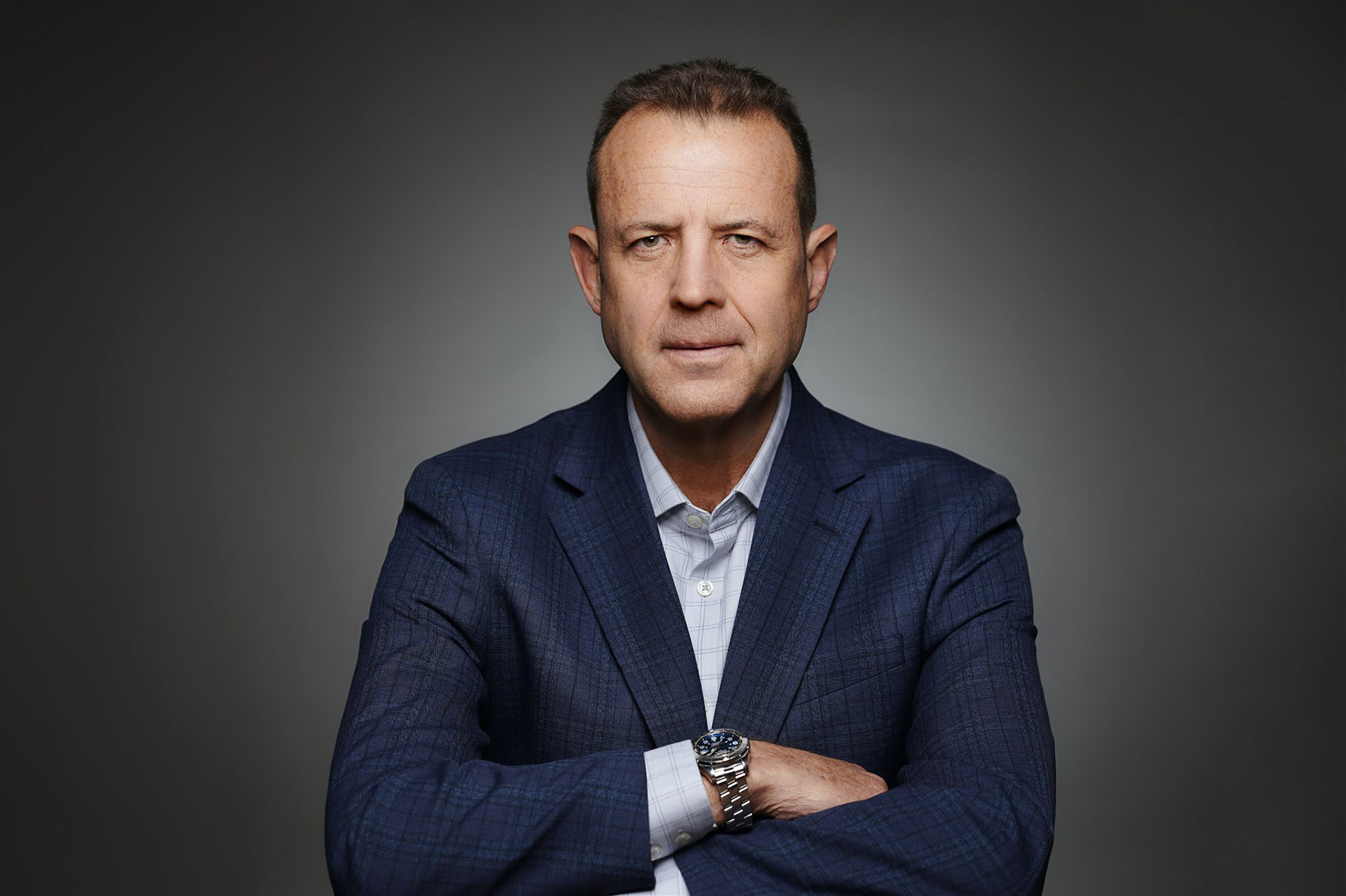

Markus Jooste, Scale, Power and the Cost of Misaligned Leadership
The architecture that appeared to describe extraordinary capacity also exposed an extraordinary failure mode.
On 4 December 2017, Markus Jooste resigned as chief executive of Steinhoff International. Within days, the company’s share price had collapsed from R46.25 to R10.00.
For most observers, the story was corporate: accounting irregularities, investigations, questions of governance and the extraordinary destruction of value surrounding one of South Africa’s most prominent business leaders.
Chris Styles looked at something else. He went back to a mathematical profile he had constructed from Jooste’s date of birth and full birth name.
And one feature immediately stood out. ‘22′. Not once. Twice.
Within the historical 365 Pin Code methodology, Number 22 was called The Master Builder, a number associated with the ability to conceptualise, organise and build at unusually large scale.
Jooste had it in two of the model’s most important positions. He had built at enormous scale. And then that same empire had become the setting for extraordinary consequence.
That contradiction became the real subject of Chris’s investigation. It was no longer simply: What do Markus Jooste’s numbers say about him? The more interesting question was:
Could the architecture associated with exceptional capability also reveal the conditions under which that capability becomes dangerous?
That question is what makes this one of the more important early studies in the Human Futurist Research Archive.
When Extraordinary Scale Meets Extraordinary Consequence
The historical article was written in 2018, after the Steinhoff crisis had already broken and Jooste had resigned.
That distinction matters. This was not a prediction of the 2017 collapse.
It was a retrospective investigation into whether characteristics and timing structures within the 365 Pin Code model appeared unusually relevant to the executive who had been at the centre of Steinhoff’s extraordinary rise and subsequent crisis.
But the paper did something else. After analysing what had already happened, Chris extended Jooste’s timeline forwards.
He identified years he believed would carry particular pressure from 2018 onwards. That makes the source unusual: part retrospective case study, part prospective risk proposition. And underneath both sits the same idea. A leader’s strongest characteristic should perhaps never be examined only for its upside. Its possible failure mode matters just as much.
What Caught Chris Styles’ Attention
Jooste was born on 22 January 1961.
The historical model generated a series of interconnected positions from that date.
Among them were five that Chris regarded as especially important:
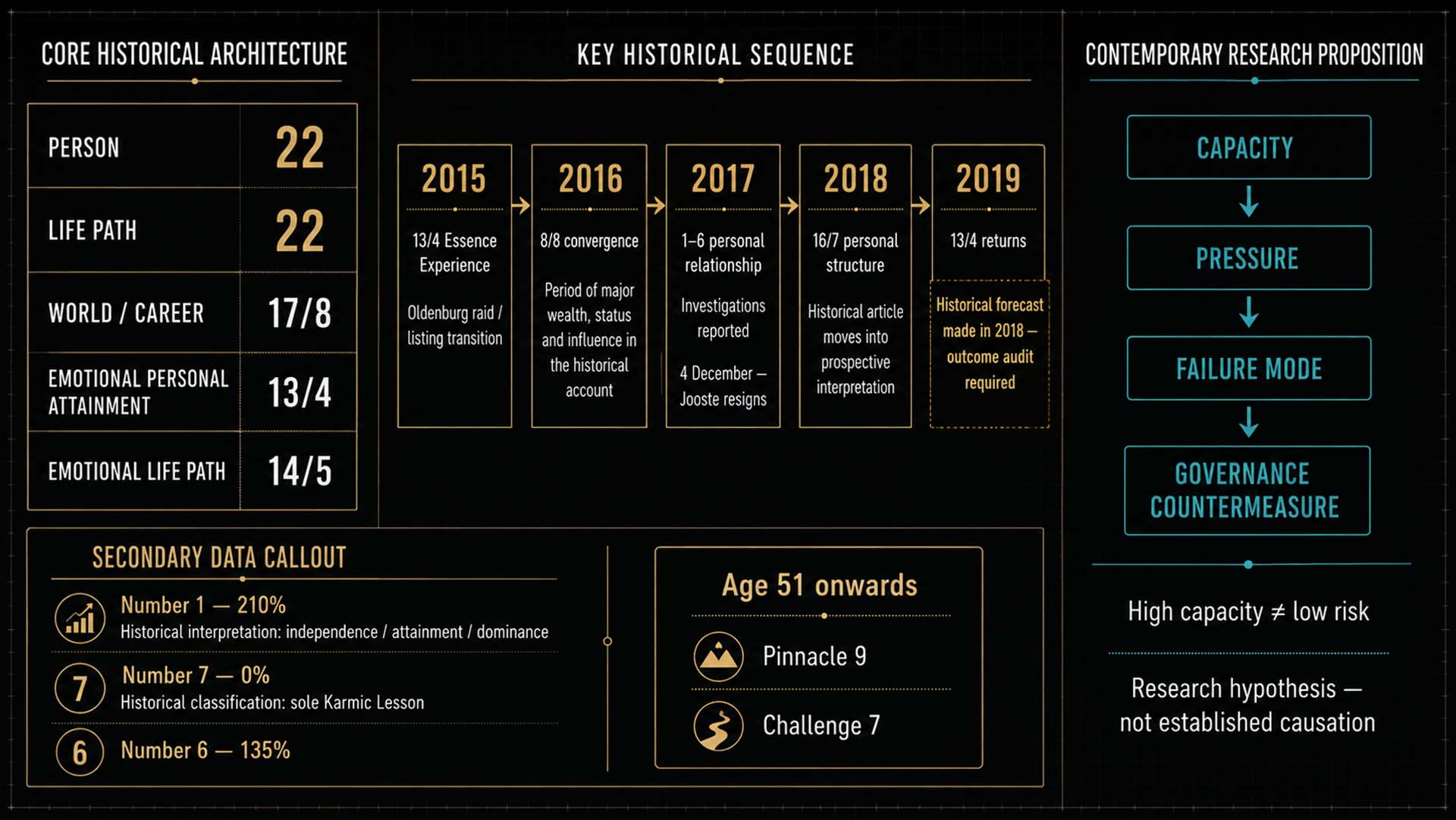
Person: 22
Life Path: 22
World / Career: 17/8
Emotional Personal Attainment: 13/4
Emotional Life Path: 14/5
Even before the longitudinal timeline was examined, Chris saw a powerful tension inside the architecture.
The visible side of the model contained extraordinary building potential, ambition and material capability.
The shadow side introduced 13/4 and 5, interpreted in the historical methodology through themes of corrective pressure, freedom, risk and excess.
That combination gave Chris his starting question.
What happens when a person possesses an unusual capacity to build, acquire influence and operate at scale, but the same architecture contains vulnerabilities around how power, freedom and responsibility are handled?
The First Anomaly: 22 Appeared Twice
The Person: 22
Jooste was born on the 22nd. Within the original methodology, this meant Number 22 occupied what the model called the Person position.
The historical interpretation treated this as a major indicator of scale-building potential.
It was not merely about ambition.
Number 22 was associated with taking an idea and turning it into something tangible, structured and substantial.
The language used in the old research was explicitly aspirational: the Master Builder was someone capable of seeing the larger picture while also possessing the practical drive required to make it real.
Look at Jooste’s professional life from that perspective and the attraction of the case becomes obvious.
Scale was not theoretical.
He had lived it.
The Life Path: 22
Then Chris calculated the Life Path. Again: 22.
This was the unusual part.
Master Number 22 was not occupying one isolated position. It was repeated in another central component of the architecture.
The original article therefore regarded Jooste’s profile as carrying an unusually concentrated Master Builder signature.
That concentration is important because the research did not interpret Master Numbers simply as gifts.
It treated them as high-demand architectures.
The larger the capacity, the greater the responsibility attached to how that capacity was used.
That is metaphysical language in the historical source.
Translated into contemporary leadership terms, however, the proposition becomes unexpectedly practical:
The more power a leader possesses to affect a system, the greater the consequences when that power is poorly governed.
An average managerial weakness can damage a department.
The same weakness in someone controlling an international corporate system can damage organisations, investors, employees, lenders and entire networks of stakeholders. Scale magnifies impact.
That is the beginning of the Master Builder Paradox.
The Career Architecture: 8
A third number reinforced the picture.
Jooste’s birth year, 1961, was reduced in the historical model:
1 + 9 + 6 + 1 = 17. 1 + 7 = 8
That placed Number 8 in what the model called the World / Career position.
The source associated 8 with material affairs, money, authority, governance, status, influence, ambition and power.
Again, the language is historical numerology.
But notice the architecture Chris was seeing.
- 22 — scale.
- 22 — scale repeated.
- 8 — material and organisational power.
For someone whose professional life eventually became synonymous with building and controlling a vast corporate organisation, that combination interested him enormously.
The Shadow Architecture: 13/4 and 5
The model then introduced two less comfortable variables.
Jooste’s Emotional Personal Attainment was calculated as 13/4.
His Emotional Life Path was 14/5, reduced to 5.
Within the historical framework, 13 was treated as a karmic-debt sequence linked to the reduced Number 4.
And Number 4 mattered because:
22 → 2 + 2 → 4.
So the same base number sat underneath the Master Builder architecture.
The historical interpretation viewed 22 as the high-capacity expression and 4 as the more restrictive expression: structure, limitation, discipline, confinement and the consequences of failing to handle the larger 22 responsibility appropriately.
Whether one accepts that metaphysical interpretation is not the only reason this deserves attention.
Conceptually, Chris had identified something useful:
the strength and the failure mode were connected.
The very architecture associated with building was also being examined through what happened when building lost balance, discipline or appropriate restraint.
Meanwhile, the Shadow Life Path 5 was associated in the historical model with freedom, adaptability and risk — but, in its negative expression, excess, boundary-pushing and misuse of freedom.
Put those pieces together and Chris was effectively constructing an early executive-risk profile:
- Scale.
- Power.
- Independence.
- Risk.
- Constraint.
- Consequence.
What Master Number 22 Meant in the Original Research
The historical article spends considerable time explaining 22.
That material should not be removed from the contemporary version, because the Jooste case makes little sense without it.
Within 365 Pin Code, Master Number 22 combined enormous practical capability with enormous responsibility.
Chris described it as the architecture of someone able to conceive large plans and bring them into material reality.
But he also treated it as inherently double-sided.
Its constructive expression was:
- vision
- plus
- execution
- plus
- scale
- plus
- benefit beyond the individual.
Its destructive or poorly integrated expression could lead instead to disproportionate consequence.
That is the historical claim.
The contemporary Human Futurist research question is more restrained.
Do unusually strong capability indicators also point towards unusually important governance vulnerabilities?
That proposition does not require us to believe that a number causes corporate misconduct.
It asks something much more useful:
When analysing an exceptional leader, should we actively identify the failure mode concealed inside their greatest strength?
The More Useful Question: What Happens When a Strength Loses Its Governance?
Consider the following leadership transitions:
Ambition → domination
Confidence → overconfidence
Independence → isolation
Persistence → rigidity
Strategic secrecy → concealment
Risk tolerance → uncontrolled exposure
Scale → systemic consequence
Nothing on the left is inherently dysfunctional. Quite the opposite. These are often characteristics rewarded in entrepreneurs, founders and senior executives.
But that is precisely the problem.
The trait that receives applause while a company is growing may be the same trait that becomes dangerous once power has accumulated and challenge has weakened.
This is the larger significance of the Jooste research.
Chris was beginning to move from a model that described people towards one that might eventually help examine executive vulnerability before vulnerability becomes a consequence.
The Timeline Began Tightening Before the Collapse
The second major part of the historical research mapped Jooste year by year from 2010 through 2026.
The important section begins around 2014.
Chris believed the resulting sequence showed progressively intensifying relationships between Jooste’s underlying architecture and the years immediately preceding the Steinhoff crisis.
2014 — Pressure Enters the Model
On the personal shadow side, the historical chart connects 2 with 11/2.
Chris interpreted this as emotionally intense. On the professional physical side, the model linked 1 and 2, a combination the original methodology considered discordant.
The Number 1 was particularly important because the backing number 10 reduced to 1 and, within the model, represented the beginning of a new nine-year professional cycle.
From Chris’s retrospective viewpoint, 2014 therefore looked less like an isolated year than the entrance into a developing sequence.
2015 — 13/4 Appears
Then came 2015. The year contained a 13/4 Essence Experience. That immediately caught Chris’s attention because Jooste already had 13/4 in Shadow Personal Attainment.
It also returned the analysis to Number 4 — the reduced form of 22. The historical article connects this with events already known when Chris was writing.
On 4 December 2015, authorities in Oldenburg carried out a raid at Steinhoff’s European headquarters in Westerstede. Three days later, Steinhoff International Holdings transferred its primary listing from Johannesburg to Frankfurt.
The numerical interpretation was retrospective. Chris already knew those events had occurred. But within the architecture he was examining, 2015 became an important point because a 13/4 annual structure had appeared alongside a consequential development inside the company.
The signal disappeared from that particular Essence position the following year. That made it stand out even more to him.
2016 — The 8/8 Peak
The 2016 Essence Experience became 8. And Jooste already carried 17/8 in the World / Career position.
Chris therefore read 2016 as an 8/8 convergence. Within the historical methodology, 8 represented money, authority, power, business, material success and status.
The source notes that Jooste was at that stage being reported as one of Africa’s wealthiest people, with an estimated fortune of around $400 million.
Seen retrospectively, the contrast was striking.The model had moved from:
13/4 in 2015 → 8/8 in 2016 → and then into 2017.
A year associated in the source with material ascendancy sat immediately before the year in which Jooste’s position collapsed. That became one of the strongest narrative sequences in the original research.
2017 — The Public Break
For 2017, Chris identified a personal relationship between 1 and 6. The historical methodology associated 1 with beginning or individuation and 6 with responsibility.
The source then traces the public events. In August 2017, German investigations concerning Jooste were reported.
Steinhoff’s share price fell before recovering after the company denied allegations. Further accusations of accounting impropriety followed.
Then, on 4 December 2017, Jooste resigned as CEO as Steinhoff acknowledged accounting irregularities. Between 5 and 7 December, according to the historical article, the share price fell from approximately R46.25 to R10.00.
For Chris, the sequence from 2015 to 2017 became difficult to ignore. Not because the numbers demonstrated causation. They did not.
But because several numbers already important within Jooste’s baseline architecture reappeared around years of dramatically different professional significance.
13/4 →: 8/8 → collapse.
This is where the case became less about a single number and more about longitudinal architecture.
2018 and Beyond, Where the Historical Article Became Prospective
The article was written in 2018. From this point, its status changes.
Chris calculated 2018 as containing a 16/7 personal structure and associated 7 with retreat, reflection, introspection and reassessment. The year also sat within what the methodology considered an 11 Universal Year.
More importantly, Jooste’s final Challenge, which we will return to, was also 7.
The source then made a series of forward-looking interpretations concerning 2019 onwards. For 2019 it identified the return of 13/4 as an annual Essence Experience and associated the year with an 8 Personal Year, including the possibility of legal or material consequences.
The historical paper then described 2019–2024 as an extremely difficult period. These were forecasts made inside the 2018 source. They should therefore remain visible as part of the archive. But they should not be silently converted into proven predictions.
The supplied historical article does not contain a later objective audit comparing every forecast with the eventual outcome. That distinction is part of the contemporary research standard.
Then Chris Looked at Jooste’s Name
The third major analytical instrument was an Inclusion Chart built from Markus Johannes Jooste.
And here another striking imbalance appeared.
Number 1 at 210%
The historical Inclusion Chart calculated seven occurrences of Number 1 against a normalised average of 3.3.
Result: 210%.
That made Number 1, in the article’s terminology, Jooste’s Hidden Passion. The original interpretation was forceful.
It associated the concentration with enormous independence, competitive drive, ego, dominance and an intense desire to reach the top.
The language of the 2018 source goes considerably further than a contemporary research article should when it predicts how such a person will behave.
There is no validated psychological instrument here establishing that a 210% Inclusion Chart score causes dominance or misconduct.
But the result remains an important part of the historical methodology. And it creates another compelling research question.
If an executive model identifies an unusually concentrated independence or self-directed drive, what governance should surround that leader once their authority becomes substantial?
Because the risk is not independence itself. Independence can build extraordinary companies. The risk emerges when independence becomes unchecked.
Number 7 Completely Absent
The Inclusion Chart contained another extreme.
Number 7 occurred zero times against the model’s expected 1.1.
The historical methodology therefore designated 7 as Jooste’s single Karmic Lesson.
The old interpretation associated 7 with introspection, analysis, deeper reflection, truth-seeking, investigation and the hidden dimension of life.
That becomes especially interesting when we return to 2018.
The year Chris was analysing Jooste retrospectively was itself calculated as a 7 Personal Year. And Jooste’s final Challenge was also 7.
So the number completely absent from his name architecture was simultaneously becoming prominent within the historical timing model.
That was another major convergence within the original paper.
Why This Made the Case More Interesting
The rest of the Inclusion Chart adds nuance.
Number 6 was calculated at 135%, above the normalised value.
Numbers 2, 3, 4, 5, 8 and 9 were below target within the historical system.
Chris interpreted these distributions through various strengths, weaknesses and developmental lessons.
But the two most useful variables for the contemporary article remain the extremes:
1 at 210% and 7 at 0%.
One, associated with self, independence and attainment, and seven, associated in the old model with reflection, deeper analysis and truth-seeking.
That produces a much more useful modern leadership tension than simply calling one number good and another bad:
- drive versus reflection.
- attainment versus self-examination.
- action versus scrutiny.
- control versus challenge.
Every powerful executive needs both sides.
The Final Pinnacle and Challenge
The fourth analytical structure in the source examined Jooste’s Pinnacles and Challenges.
The historical model produced:
Birth–32: Pinnacle 5 | Challenge 3
33–41: Pinnacle 3 | Challenge 4
42–50: Pinnacle 8 | Challenge 1
51 onwards: Pinnacle 9 | Challenge 7
Again, two numbers mattered greatly to Chris. The final Challenge 7 repeated the same number absent from the Inclusion Chart and active in his 2018 Personal Year.
Meanwhile, the final Pinnacle 9 was interpreted through themes of humanity, service and a broader orientation beyond the self.
The original paper expresses this in overtly spiritual language and presents Jooste’s later life as an opportunity for reflection, service and redemption.
A contemporary interpretation need not make metaphysical claims to preserve the important idea. The model was effectively asking:
Once power has been lost, what comes next?
Can the same executive capacity that built enormous personal and corporate influence be redirected towards something wider than self-interest?
The historical article explicitly insists that choice remains involved. That point deserves preservation.
This Was Never Really Just a Numerology Story
At first glance, Article 12 appears to be a numerology investigation into one disgraced executive.
But that undersells it. Its lasting research value lies in an early statement near the beginning of the source.
Chris argued that, properly interpreted, these charts could provide both a strategic planning framework and a risk-management landscape.
That is the bridge. The investigation was beginning to move beyond:
What kind of person is this?
towards:
Where could this person’s greatest capability become a source of organisational risk?
That is a radically different question. And it points directly towards the later Intelligent Mathematical Blueprint.
Capacity–Consequence Asymmetry
The Archive Analysis gives the idea a contemporary name:
Capacity–Consequence Asymmetry.
The proposition is straightforward. When an ordinary person makes a poor decision, the consequences may remain local.
When someone controls enormous capital, authority, people, reputation and organisational complexity, the same quality of poor decision can have exponentially greater effects.
More capacity means more possible upside. It can also mean more possible downside. This is why the Jooste case should not be reduced to:
22 is good when honoured and bad when dishonoured.
That belongs to the historical interpretive language. The enduring Human Futurist idea is more sophisticated.
Every exceptional capacity should be interrogated for its corresponding failure mode.
A leader who is exceptionally independent may need stronger external challenge. A visionary who acts faster than everyone else may need decision friction.
A leader able to persuade almost anyone may need governance structures that are resistant to charisma.
An executive capable of extraordinary secrecy and strategic control may need transparency mechanisms that do not depend upon their willingness to disclose.
A leader with enormous appetite for scale may need independent limits around leverage, complexity and exposure.
That transforms the model from a description into something potentially actionable.
From Personality Description to Executive Risk Architecture
A mature Executive IMB would therefore never simply tell a leader:
This is one of your greatest strengths. It would continue: This is the pressure under which that strength may distort. This is the likely failure mode. And this is the governance structure that should exist before that happens.
The sequence becomes:
CAPACITY → PRESSURE → FAILURE MODE → GOVERNANCE COUNTERMEASURE
Take independence.
- Capacity: decisive autonomy.
- Pressure: resistance to outside interference.
- Failure mode: isolation or unchecked unilateral action.
- Governance countermeasure: independent challenge with genuine authority.
Take ambition.
- Capacity: relentless advancement.
- Pressure: the escalating need to maintain success.
- Failure mode: excessive risk or goal protection at the expense of wider consequences.
- Governance countermeasure: independent risk limits and transparent performance scrutiny.
Take scale-building.
- Capacity: ability to construct highly complex organisations.
- Pressure: increasingly difficult systems become dependent upon a small number of powerful decision-makers.
- Failure mode: systemic rather than local failure.
- Governance countermeasure: distributed oversight, auditable information flows and genuinely independent accountability.
This is where the Markus Jooste article becomes surprisingly contemporary.
It asks a question boards still struggle with:
What if the person who appears most capable of building the organisation is also the person whose unchecked failure mode could do it the greatest harm?
What the Jooste Case Cannot Prove
There are important boundaries.
The historical article is largely retrospective.
Chris knew Steinhoff had entered crisis and that Jooste had resigned before interpreting much of the numerical architecture around those events.
That creates the possibility of retrospective selection. The case cannot demonstrate that Master Number 22 caused Jooste to build Steinhoff at scale.
It cannot demonstrate that 13/4 caused investigation or corporate consequence.
It cannot establish that an Inclusion Chart concentration of Number 1 predicts misconduct.
And the forecasts extending from 2018 onwards should be treated as historical prospective propositions until they are independently outcome-audited.
Those limits do not make the case unimportant. They tell us where the research must go next.
What It Can Ask
The Jooste case generates several testable questions.
Do executives who build unusually large organisations show similar high-capacity structures within the IMB?
When those structures are extreme, are particular shadow or counterbalancing variables also more pronounced?
Do consequential executive failures cluster around periods in which baseline architecture and annual sequences converge?
Do leaders with comparable architecture but stronger governance environments produce different outcomes?
Does the same underlying Master Builder structure appear in constructive and destructive cases?
That final question is especially important. Because Jooste should not be studied alone. The archive already contains other cases involving Master Number 22.
The next stage is comparison.
Same architecture. Different leader. Different organisation. Different outcome.
That is how the Master Builder Paradox becomes research rather than anecdote.
Why This Research Still Matters
The most interesting thing about exceptional leaders is rarely that they possess strengths.
Everyone already knows that. The more consequential question is what happens when the very characteristic responsible for extraordinary success escapes the structures that once kept it useful.
That is why the original research deserves its place in the Business & Leadership collection.
Chris Styles began with Markus Jooste, Steinhoff and a repeated Master Number 22.
But hidden inside that historical numerology case study was an idea far more relevant to modern executive decision intelligence:
High potential and low risk are not the same thing.
Sometimes the opposite may be true.
The leader capable of creating the greatest organisational value may also require the most sophisticated governance around their vulnerabilities.
The bigger the architecture becomes, the more important the failure point becomes.
And perhaps that is the real Master Builder Paradox.
The characteristics capable of building something extraordinary may be the very characteristics we most need to understand before extraordinary scale makes their consequences impossible to contain.
From the Human Futurist Research Archive
This contemporary article revisits Article 012 — 12 – Markus Johannes Jooste written in 2018 during the 365 Pin Code phase of Chris Styles’ research. The historical article examined Markus Jooste’s repeated Master Number 22 architecture, his wider personal and professional number structure, and the year-on-year sequences surrounding the Steinhoff crisis. Its significance lies in an early shift from interpreting executive characteristics towards asking whether exceptional capability may also carry identifiable points of vulnerability. The article therefore helped establish the later Human Futurist proposition that leadership risk may be examined through Capacity → Pressure → Failure Mode → Governance Countermeasure, while also providing a basis for future comparative research into different expressions of Master Number 22 across multiple leaders.
Share This Article, Choose Your Platform!
Related Posts




From understanding decisions to informing them.
Beyond the Research
The Business & Leadership archive examines consequential decisions after they have happened.
The Intelligent Mathematical Blueprint and Private Advisory take the underlying Human Futurist thinking into a different environment: helping leaders examine the circumstances surrounding decisions that have yet to be made.