
Before Biden withdrew, Chris Styles asked a different question: was Kamala Harris really his strongest option for 2024?
Biden, Harris or Clinton? The 2024 Running-Mate Comparison
Biden–Harris looked like the obvious Democratic ticket for 2024.
Joe Biden was the sitting president. Kamala Harris was his vice-president. Biden had announced his intention to run again. Unless something dramatic changed, the partnership appeared to carry forward almost by default.
Chris Styles looked at the same political landscape and asked a less obvious question: what if the assumed combination was not the strongest one? That question became the centre of Article 250.
The Ticket Everyone Expected
The historical article was written prospectively, before the 2024 race took its eventual shape. Its starting point was not a prediction about an unknown field. Biden had already indicated that he intended to seek another term, and the public assumption was naturally Biden–Harris.
Chris did not begin by trying to prove that Hillary Clinton should return. He began with the person already beside Biden.
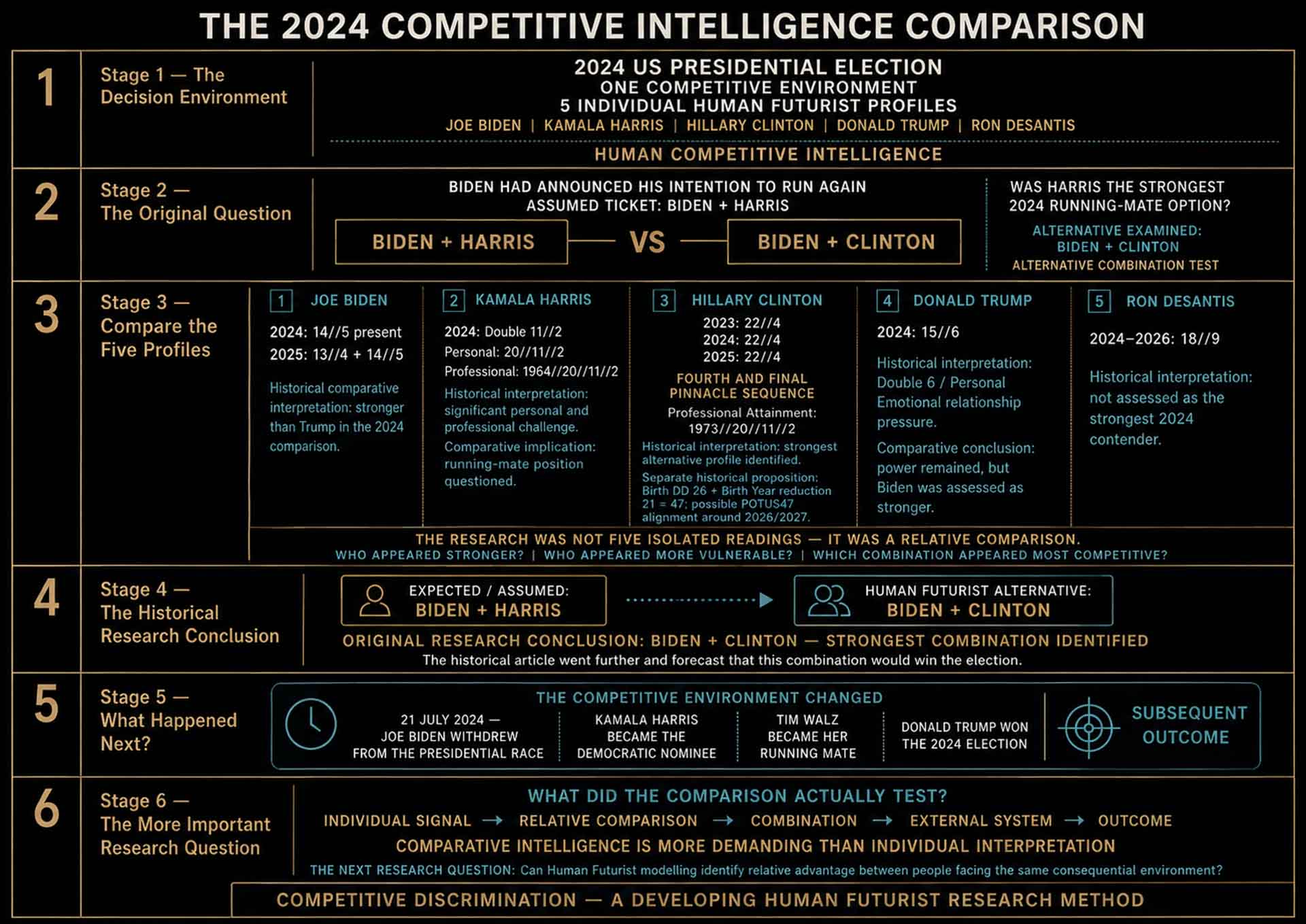
What caught his attention was Harris’s 2024 architecture. The original model showed a Double 11//2 in the year, alongside a Personal position of 20//11//2 and a Professional position of 1964//20//11//2. Within the historical interpretation, Chris read that concentration as a period carrying unusual personal and professional pressure.
That did not automatically mean Harris would leave the ticket. But it was enough to make him question the assumption that she was unquestionably Biden’s strongest partner.
If Biden runs again, is Harris necessarily his strongest running mate?
Once the question changed, the research changed with it.
One Election. Five People.
Article 250 compared five political figures who could shape the same electoral environment: Joe Biden, Kamala Harris, Hillary Clinton, Donald Trump and Ron DeSantis.
That is the feature that makes the article more interesting today than a simple prediction about who would win.
Most early Human Futurology articles examined one person at a time. Here Chris began placing people side by side.
Biden was compared with Trump. Harris was compared with Clinton. DeSantis was considered against the broader field. And then two possible Democratic combinations were implicitly placed against one another: Biden–Harris and Biden–Clinton.
The research was moving from individual interpretation towards relative comparison.
In other words, the question was no longer merely, “Does this person appear to have a strong year?” It became, “Does this person appear stronger than the alternatives facing the same contest?”
That is a much harder question.
Biden Looked Stronger Than Trump
The first comparison was the obvious one.
Trump’s 2024 line contained 15//6, with the historical article highlighting a Double 6 and interpreting it as significant Personal Emotional relationship pressure. The source did not argue that Trump lacked political power. It explicitly acknowledged that his sequences still carried strength.
Chris’s judgement was comparative: he believed Biden’s 2024 position was stronger.
Biden’s sequence carried 14//5 into 2024, while 2025 brought both 13//4 and 14//5 into the same line — values the historical model connected with his Personal Attainment architecture. The article also anticipated that the political contest would take a toll on him through 2025 and 2026.
The conclusion was therefore not “Trump is weak”. It was “Biden looks stronger than Trump in this particular comparison”.
That distinction matters because relative advantage is not the same thing as an absolute forecast.
Why Harris Became the Question
If Biden appeared to hold the stronger position in Chris’s comparison with Trump, the next question was who should stand beside him.
Harris’s Double 11//2 became the trigger for that enquiry.
The historical article associated the same 11//2 structure with both her Personal and Professional positions. Chris interpreted that as a concentration of challenge severe enough to make her place on the ticket worth questioning.
This is where the article moved beyond the predictable Biden-versus-Trump discussion.
Instead of assuming the sitting vice-president remained the natural choice, Chris began looking for an alternative profile.
And Hillary Clinton’s sequence looked very different.
Why Clinton Became the Alternative
Clinton’s model carried 22//4 across three consecutive years:
2023 — 22//4
2024 — 22//4
2025 — 22//4
The historical article identified this run as her fourth and final Pinnacle Sequence and treated the concentration as unusually significant.
Chris also highlighted her Professional Attainment sequence, 1973//20//11//2, and interpreted the surrounding period as one of exceptional professional potential.
Inside the five-person comparison, Clinton therefore stood out for a very specific reason: she appeared stronger than Harris as a potential Biden running-mate alternative.
That was the most provocative move in the article.
The proposition was not simply that Clinton had interesting architecture. It was that comparison changed the apparent choice.
The strongest profile in isolation is not necessarily the most important finding. Sometimes the real insight appears when two people are placed beside one another.
The Model Went Further
The original article did not stop at identifying Biden–Clinton as the stronger combination.
It went further and forecast that Biden and Clinton would win the 2024 presidential election, describing them as “the unstoppable combination”. It also developed a separate Clinton proposition around the number 47.
Clinton was born on the 26th. The historical source reduced her birth year, 1947, to 21. It then combined 26 + 21 = 47 and asked whether that might connect with her eventually becoming POTUS47 around 2026 or 2027.
Those claims are part of the historical record and should remain visible. They show how far Chris was prepared to take the comparison at the time.
But for a contemporary reader, they are not the only reason Article 250 matters.
The more transferable idea sits underneath them: Chris was experimenting with the possibility that several human profiles could be compared before a consequential decision rather than interpreted one by one.
Then 2024 Changed the Question
The later political outcome changed the entire structure of the comparison.
Biden withdrew from the presidential race on 21 July 2024. Harris did not leave the Democratic ticket; she moved to the top of it. Tim Walz became her running mate, and Donald Trump ultimately won the election.
The Biden–Clinton ticket therefore never existed.
That means the original electoral conclusion did not materialise, and the later Clinton–POTUS47 proposition did not occur as framed.
Those facts belong in the contemporary article because prospective research only becomes useful when later events are allowed to challenge it.
But reducing Article 250 to “a failed prediction” would miss what is most interesting about it.
The comparison itself remains a separate research question.
Did Chris identify a genuine difference between the profiles but over-translate that difference into one literal political outcome? Did the model mis-rank the competitors? Did the external system change faster than the individual comparison could accommodate? Or was the apparent difference simply not predictive?
Those are better questions than quietly rewriting the original claim, and more useful than treating one incorrect outcome as the whole story.
What Was Chris Really Comparing?
Seen now, Article 250 is an early Human Futurist experiment in comparative decision intelligence.
It asks whether the same framework can be applied to several people facing the same consequential environment and reveal meaningful differences in relative strength, pressure, timing or combination.
That idea extends far beyond politics.
Consider two executives competing for succession. Three candidates for a critical appointment. A founder choosing between potential partners. An investor considering several management teams. A captain-and-coach pairing in elite sport.
In each case, analysing one person in isolation tells only part of the story.
A decision is relational.
The important question may not be whether a candidate has a favourable period. It may be whether that person appears stronger, more pressured, more complementary or more exposed than the alternatives available at the same moment.
That is the durable proposition Article 250 leaves behind.
From Prediction to Decision Intelligence
The historical Human Futurology archive often used direct predictive language. Article 250 is a good example.
The contemporary opportunity is more disciplined.
The Intelligent Mathematical Blueprint does not need to declare an inevitable winner to become useful. A stronger role may be to add another layer of information before a consequential choice is made.
- Who appears to carry the more favourable timing?
- Where is pressure concentrated?
- Does one potential partnership appear materially different from another?
- And what external variables could still overturn that apparent advantage?
That last question is essential. Politics, leadership and performance do not unfold inside isolated human profiles. Institutions, health, public opinion, competitors, rules, timing, events and millions of independent decisions can reshape the environment.
Article 250 therefore belongs in the Feature Research collection not because its original Biden–Clinton outcome occurred. It did not.
It belongs because the underlying exercise pushed Human Futurist research into a more demanding territory: comparing people with people, combinations with combinations, before the future was known.
The next stage is not simply to make more confident predictions.
It is to test whether comparative Human Futurist modelling can repeatedly identify relative advantage in ways that are useful before a real decision is made.
The enduring question is not simply who looks strong. It is what becomes visible when the alternatives are compared.
FROM THE HUMAN FUTURIST RESEARCH ARCHIVE
Archive Note: This contemporary article has been developed from historical Human Futurist research preserved as Article 250 — `Biden Clinton win 2024 Election, Archive ID HF-RA-250.
The historical source compared Joe Biden, Kamala Harris, Hillary Clinton, Donald Trump and Ron DeSantis ahead of the 2024 US presidential election. It proposed that Hillary Clinton could replace Harris as Biden’s running mate, concluded that Biden–Clinton represented the strongest combination, forecast that the pairing would win the election, and separately explored a possible Clinton–POTUS47 alignment around 2026/2027.
The contemporary article does not rewrite those historical claims. It reframes the enduring value of the case around comparative decision intelligence while preserving the later outcome as part of the permanent research record. The original historical article remains preserved within The Human Futurist Research Archive.
Share This Article, Choose Your Platform!
Related Posts






From understanding decisions to informing them.
Beyond the Research
The Business & Leadership archive examines consequential decisions after they have happened.
The Intelligent Mathematical Blueprint and Private Advisory take the underlying Human Futurist thinking into a different environment: helping leaders examine the circumstances surrounding decisions that have yet to be made.