

South African Airways Institutional Failure and the New Beginning Paradox
When collapse and renewal occupy the same moment.
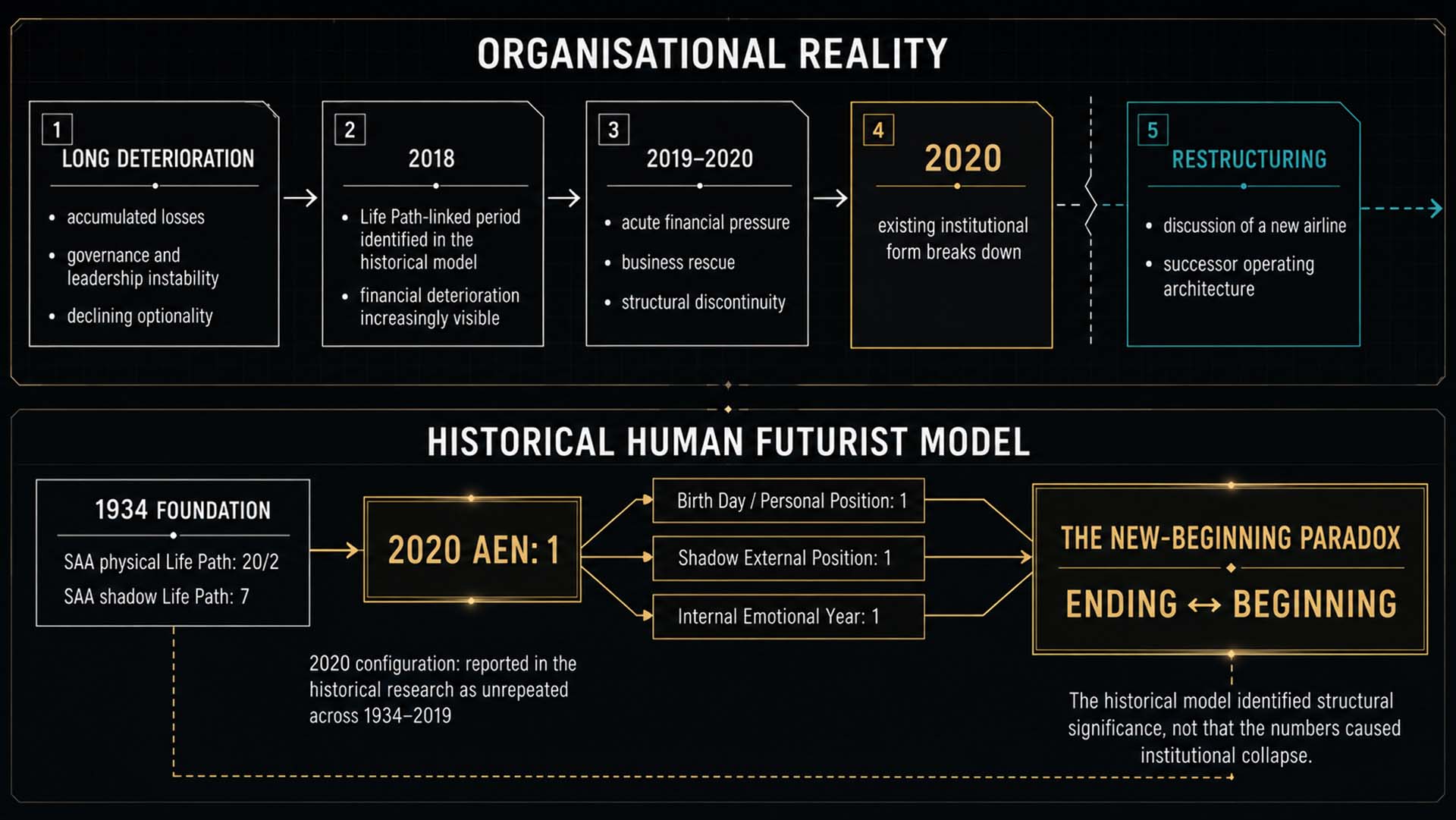
By late 2019, South African Airways was running out of options. The airline was struggling to meet payroll, required further working capital and faced growing uncertainty over continued government support. By April 2020, proposals were being discussed that could result in the departure of all 4,700 employees.
Then, on 1 May, the language changed. The Department of Public Enterprises was talking about the creation of a new, restructured airline.
Collapse and creation were appearing in the same story. That contradiction is what makes the historical Human Futurist research into SAA so interesting today.
Chris had been examining organisations using the early 365 Pin Code Business Numerology methodology. When he mapped SAA’s year-by-year numerical profile, he calculated that SAA’s Annual Experience Number [AEN] for 2020 was 1.
The original research defined the AEN as the number used to describe the dominant theme for the business during a particular year. Within that historical numerology framework, Number 1 was associated with new beginnings.
But this was hardly an obvious beginning. The existing institution was coming apart. So the more interesting question became:
Can an organisational ending and an organisational beginning actually be the same event?
The Failure Did Not Begin in 2020
SAA’s crisis was not created in a single year.
The historical article records a sustained run of losses from 2010/11 onwards:
- 2010/11 — R782 million
- 2011/12 — R843 million
- 2012/13 — R1.2 billion
- 2013/14 — R2.6 billion
- 2014/15 — R5.6 billion
- 2015/16 — R1.5 billion
- 2016/17 — R5.6 billion
- 2017/18 — R5.7 billion
The article calculated the cumulative loss across those eight years at approximately R23.825 billion.
By the time COVID-19 delivered an extraordinary external shock to global aviation, SAA was already structurally vulnerable.
Chris’s research question was therefore not whether the pandemic had created the airline’s underlying problems. It was whether SAA’s own longitudinal numerical model contained anything unusual around the period in which those accumulated problems reached a critical point.
Then SAA’s 2020 AEN Produced Something Different
When Chris calculated SAA’s Annual Experience Number for 2020, the historical model produced:
AEN 1
That distinction matters. The research was not saying that 2020 itself equals 1. It was saying that SAA’s organisation-specific Annual Experience Number for 2020 was 1.
Within the original 365 Pin Code system, that AEN was interpreted through the themes associated with Number 1: beginning, initiation and the start of something new. On its own, an AEN of 1 would not have been the most interesting part of the finding.
What made Chris look more closely was where the same value appeared elsewhere in SAA’s IMB.
SAA was founded on the 1st of the month, giving it a birthday, or personal number, 1 in the historical model. The business IMB also contained a Shadow External Number 1.
Then, in SAA’s 2020 annual line, the AEN 1 aligned with a 1 in the Internal Emotional Year position.
So the finding was not simply: SAA’s 2020 AEN = 1.
It was the convergence of that 2020 AEN 1 with other Number 1 positions already contained within SAA’s organisational architecture.
The original research described the AEN 1 as synchronising with SAA in three places.
And then Chris noticed something else.
When he reviewed the annual business numerology sequence from SAA’s foundation in 1934 through 2019, he reported that the complete numerical configuration appearing in the 2020 line was not repeated anywhere in that preceding period.
That was what made 2020 unusual within the historical analysis.
Not that 2020 = 1, but: SAA’s 2020 AEN was 1 → that AEN synchronised with three Number 1 positions → the complete 2020 configuration was reported as unrepeated across 1934–2019.
But an AEN 1 Was Supposed to signal a ‘New Beginning ‘. This is where the case becomes interesting.
SAA was in crisis. Business rescue was already under way. Employees faced enormous uncertainty. The existing organisational structure was under severe pressure.
Yet the historical methodology associated SAA’s AEN 1 for 2020 with the idea of a new beginning. At first glance, that appears contradictory.
Then look at what was happening around the institution itself.
By 1 May 2020, the Department of Public Enterprises was discussing what it described as a new approach and the creation of a restructured national airline for the post-COVID environment.
- The existing structure was reaching a breaking point.
- A successor structure was being contemplated.
- The beginning was arriving through the ending.
- That is the central observation.
THE NEW-BEGINNING PARADOX
ENDING → DISMANTLING → STRUCTURAL BREAK → RECONFIGURATION → BEGINNING
An institution may enter a new cycle not because the old structure succeeds, but because it can no longer continue.
The same event can therefore look like collapse from one side and renewal from the other.
A Beginning Is Not the Same as a Good Outcome That distinction matters.
The fact that SAA’s 2020 AEN was 1 did not tell Chris that whatever followed would necessarily succeed. Within the historical system, it described the thematic character assigned to that organisation’s year.
That is very different from saying that Number 1 guaranteed a favourable result. A new beginning can follow success. But it can also follow failure, restructuring or the exhaustion of an existing model.
The useful question is therefore not whether AEN 1 was a “good” or “bad” number. It is whether the convergence identified in the historical research corresponded with an unusually significant period of organisational transition.
That is a much more defensible proposition.
From Prediction to Prevention
This is also where the contemporary interpretation must differ from the original article.
The SAA analysis was written while the crisis was already visible. It should therefore be understood primarily as a retrospective consequence review, not as evidence that Chris prospectively predicted SAA’s collapse before its financial and institutional difficulties were known.
That distinction does not diminish the case. It changes the question. The retrospective research identified a potentially testable proposition:
Could unusual temporal convergence eventually be used as a trigger for deeper organisational risk review before a structure reaches the point of failure?
The value would not be in telling a board: “Your organisation will collapse.”
It would be in saying: This period deserves exceptional scrutiny.
- Re-test liquidity.
- Re-test governance.
- Re-test leadership stability.
- Re-test stakeholder dependency.
- Re-test strategic optionality.
The temporal signal would become one source of intelligence alongside conventional organisational evidence rather than a substitute for it.
That is the shift from prediction towards decision intelligence. The purpose is no longer to be proved right by catastrophe.
It is to change what leaders examine before consequence removes the choice.
The Bigger Question
Read in its original form, Article 143 is explicitly a piece of Business Numerology.
Its terminology includes Life Paths, Annual Experience Numbers, Universal Years and numerical synchronicity. Those historical origins should remain visible rather than being rewritten as though the research had always used contemporary Human Futurist terminology.
But underneath that terminology, Chris was also treating an institution as a longitudinal system.
- He was comparing annual states.
- He was looking for recurrence and non-recurrence.
- He was examining convergence between independently calculated positions.
And he was asking whether unusual periods might contain strategically useful information. That approach would later contribute to the wider development of Human Futurology and the Intelligent Mathematical Blueprint.
The SAA case therefore leaves a question more useful than whether the historical interpretation of 2020 was simply “right”:
Can structural transition be recognised early enough to change what happens before failure removes the choice?
If that can eventually be tested prospectively, the purpose of the research changes.
Prediction is no longer the destination.
Prevention is.
Share This Article, Choose Your Platform!
Related Posts






From understanding decisions to informing them.
Beyond the Research
The Business & Leadership archive examines consequential decisions after they have happened.
The Intelligent Mathematical Blueprint and Private Advisory take the underlying Human Futurist thinking into a different environment: helping leaders examine the circumstances surrounding decisions that have yet to be made.