

From prediction to preparation, and preparation to better decisions.
Human Futurist Coaching: From Prediction to Intervention?
There is an obvious reason people are fascinated by the possibility of seeing into the future. They want to know what is going to happen. But in 2022, a Human Futurology article quietly raised a much more useful question.
What if knowing something about the future could change what you did before you reached it?
That distinction may sound small. It isn’t.
It marks an important shift in Chris Styles’ research from using numbers primarily to interpret lives and anticipate significant periods towards using that intelligence as the basis for intervention.
The original article called it Thinking Into Results Futurist Training. Its language belongs unmistakably to an earlier stage of the work. It speaks openly about numerology, numerical codes and a “hardcoded future.”
But underneath that language is an idea that would become increasingly important to Human Futurology:
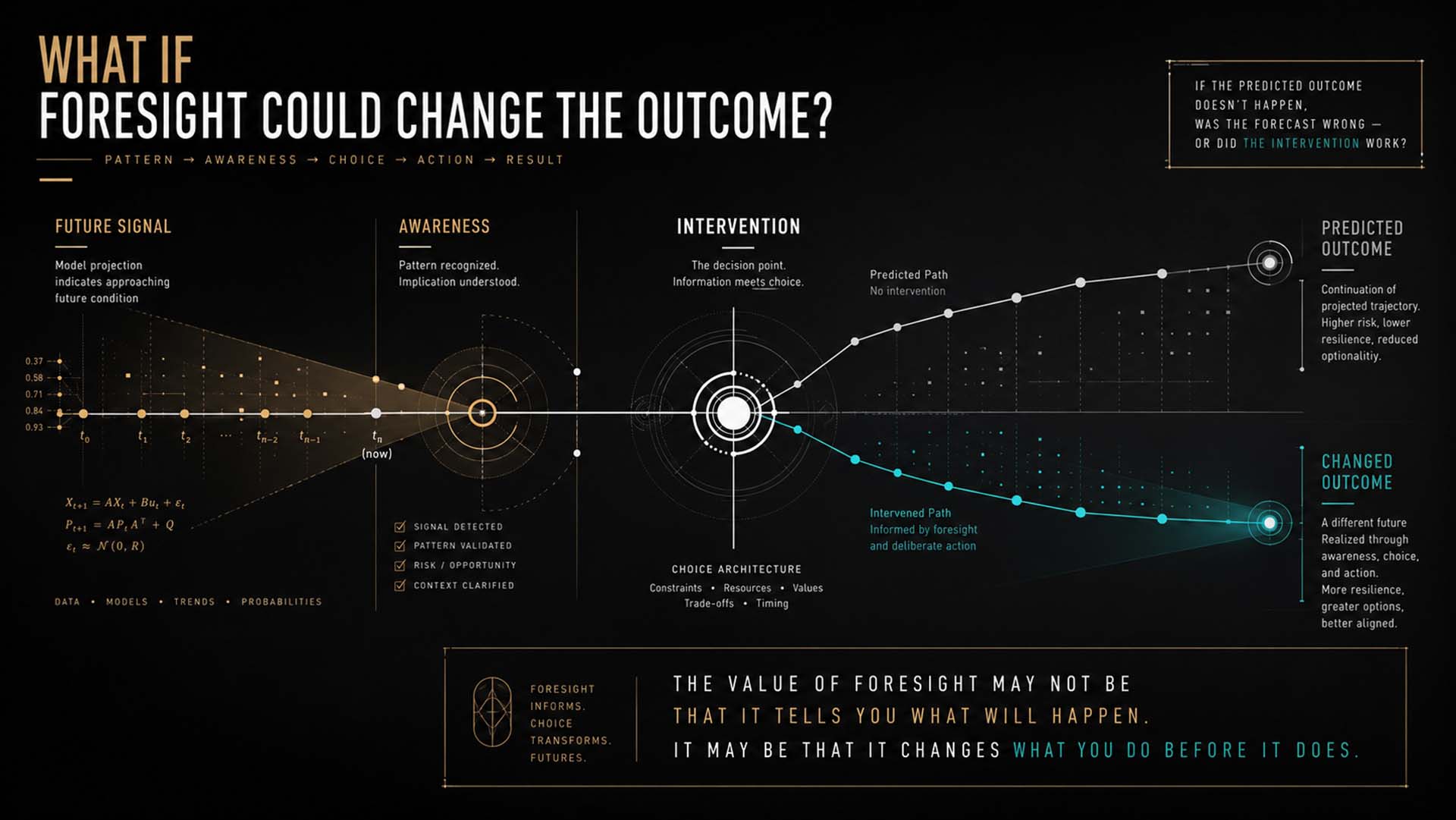
past patterns → future conditions → different thinking → different decisions → potentially different results.
That is the part worth looking at again.
The Future Was No Longer the End of the Exercise
The historical article begins with a simple proposition:
thoughts + emotions + actions = results.
That idea was already familiar from personal-development and coaching programmes. Change the way someone thinks, and you may change the behaviour that follows.
Chris was adding another layer. By this point, his numerical research had developed into what the article describes as an Intelligent Mathematical Blueprint, a matrix of hundreds of interacting numerical data points intended to map characteristics of an individual and significant periods across their life.
The historical proposition was that you could first look backwards.
- Which numerical structures were present during major successes?
- Which appeared during failures?
- What repeated?
- Where did change, pressure or opportunity appear to cluster?
Then came the crucial second step. Look forwards. And instead of stopping at:
This may be a difficult year. ask:
What are you going to do differently because you know it may be difficult?
That was the change.
From Prediction to Preparation
Traditional forecasting tends to end with the forecast. Something is expected to happen. Then everyone waits to see whether it does. Chris was beginning to describe something different.
The 2022 article proposed using an individual’s future numerical timeline as part of a coaching process. Once potentially important periods had been identified, the client could deliberately think about how to approach them differently.
In the original words, the objective was to help someone: “optimise your future potentiality and mitigate your future risks.”
That sentence may be one of the most important in this particular historical source. Because the objective is no longer simply prediction.
It is risk mitigation. Suppose a future period appears, within the model, to carry unusually high professional pressure.
The interesting question becomes:
- Do you make the same decisions you would otherwise have made?
- Do you take the same risk?
- Do you respond to conflict in the same way?
- Do you proceed with the same transaction?
- Do you challenge the same person?
- Do you wait?
- Do you seek another opinion?
- Do you prepare more carefully?
The model has not made the decision. But potentially, it has changed what you see before you make it.
This Is Where the Research Gets More Interesting
This Is Where the Research Gets More Interesting
At first glance, this sounds like an obvious improvement. Surely if foresight helps somebody avoid a problem, the model has done its job. But there is a surprisingly difficult research problem hidden inside that idea.
Imagine the model identifies a future period as unusually risky.
- The person takes the warning seriously.
- They change their behaviour.
- And the predicted problem never occurs.
- What happened?
- Was the original forecast wrong?
- Or did the intervention work?
This is what the completed Human Futurist Archive Analysis identifies as The Intervention Paradox. It creates a fascinating problem.
Prediction says: “This may happen.”
Intervention says: “Then do something so it doesn’t.”
Validation asks: “If it didn’t happen, was the prediction wrong, or was the intervention successful?”
That changes the research question completely.
When a “Failed” Prediction Might Be a Success
Consider a simple hypothetical example. A leader is told that a forthcoming period appears unusually vulnerable to professional conflict.
Without that information, perhaps they would make an aggressive decision, escalate a disagreement and lose an important relationship. But because the period has been highlighted, they consciously behave differently.
- They delay.
- They consult.
- They communicate more carefully.
- The conflict never happens.
From a conventional forecasting perspective, the prediction appears wrong. Nothing happened.
From an intervention perspective, however, “nothing happening may have been the objective”.
That means future Human Futurist research cannot measure everything with one simple question:
Did the predicted event happen?
It may need to distinguish three very different things:
- Event Prediction Accuracy
Did the model correctly identify what would happen? - Risk Identification Accuracy
Did the model correctly identify that this was an unusually consequential or vulnerable period? - Intervention Effectiveness
Did changing behaviour alter the eventual outcome?
The Archive Analysis identifies precisely this distinction and gives the 2022 study an 81/90 working research score, classifying it as a major methodological asset rather than as empirical proof of the underlying predictive claims.
And that is why this otherwise modest historical coaching article matters.
The Tension Hidden Inside the Original Idea
There is another interesting contradiction in the source. The article sometimes describes the future as “hardcoded.” Yet it simultaneously tells the reader to examine that future and do something differently.
Both ideas cannot operate in exactly the same way.
If an outcome is completely fixed, intervention is meaningless.
If behaviour can alter the outcome, the future cannot simply be treated as an inevitable event waiting to happen.
That tension becomes highly useful when the old terminology is viewed through the contemporary Human Futurist lens.
Perhaps the more useful proposition is not:
“This event is hardcoded.”
But:
“This period may contain conditions worth preparing for.”
That leaves room for something essential. Agency. The future condition may matter. But so might judgement.
Preparation → Behaviour → Choice.
The Beginnings of Human Futurist Decision Intelligence
This helps explain why the 2022 source occupies such an important place within Foundational Research.
Chris was no longer simply asking whether recurring numerical structures corresponded with what happened to somebody.
He was moving towards:
What do we do with that information?
That progression is now visible across the archive:
interpretation → individual architecture → historical pattern analysis → prospective modelling → future-risk identification → personalised intervention → decision intelligence.
The contemporary Intelligent Mathematical Blueprint develops from that same underlying proposition.
Not that a mathematical model should make decisions for someone. And not that every future event can be known in advance. But that identifying potentially important conditions before a decision is taken may add another layer of intelligence to the decision itself.
That is considerably more interesting than fortune-telling. Because the value of foresight is no longer measured only by whether somebody can say:
“I told you that would happen.”
Its value may also lie in being able to say:
“We saw the risk early enough to do something about it.”
So What Would We Actually Need to Test?
The 2022 article does not demonstrate that IMB-informed coaching works better than conventional coaching.
It does not establish that the future periods identified by the model are objectively predictive. Those remain research questions. But because the historical proposition is now preserved, those questions can be defined far more clearly.
A future study could identify proposed risk or opportunity periods in advance. Participants could then receive different levels of intervention.
Some might receive ordinary coaching without IMB information. Others could receive coaching specifically shaped around the risks or opportunities identified in their prospective model.
Researchers could then compare what happened.
- Did behaviour change?
- Were decisions different?
- Did identified risk periods actually contain more significant events than ordinary periods?
- Did intervention reduce negative outcomes?
- Did opportunities identified beforehand produce different behaviour?
And perhaps most intriguingly:
Would the very act of knowing about a future risk alter the future being measured?
That is the Intervention Paradox. And it emerged naturally from a piece of research originally presented as Thinking Into Results Futurist Training.
The Bigger Idea
The deepest value of foresight may not be knowing precisely what tomorrow will bring. It may be creating enough advance awareness to approach tomorrow differently. That is the methodological shift preserved in this 2022 research.
- From prediction to preparation.
- From preparation to intervention.
- From intervention to better judgement.
And eventually, from an early form of Human Futurist Coaching towards the wider idea of decision intelligence.
The future research challenge is now much sharper. Not simply:
Can the model see something coming?
But:
If it can identify a meaningful risk or opportunity before it arrives, can that knowledge help a person make a better decision, and can we demonstrate that it did?
That is a much more consequential question. And it may ultimately prove to be the more important one.
From the Human Futurist Research Archive
This contemporary article revisits Thinking Into Results Futurist Training, published in 2022. The historical source combined personal development coaching, early Intelligent Mathematical Blueprint thinking, and prospective numerical modelling. Its predictive claims were not validated within the article and should not be treated as established findings. Its enduring importance is methodological: it records a clear move from analysing or predicting future periods towards using anticipated risk and opportunity as the basis for personalised behavioural intervention.
Share This Article, Choose Your Platform!
Related Posts






From understanding decisions to informing them.
Beyond the Research
The Business & Leadership archive examines consequential decisions after they have happened.
The Intelligent Mathematical Blueprint and Private Advisory take the underlying Human Futurist thinking into a different environment: helping leaders examine the circumstances surrounding decisions that have yet to be made.