

Part of the Apple Case Study
Steve Jobs sits at the centre of the Apple story. Ronald Wayne shows us something different.
He allows us to see what Apple looked like before anybody knew it would become Apple, and what it might have felt like to stand beside Jobs when his intensity was still attached to an uncertain young business rather than one of the most valuable companies ever created.
THE DECISION THAT ONLY LOOKS OBVIOUS AFTERWARDS
There is an easy way to tell the Ronald Wayne story.
Ronald Wayne helped create Apple, wrote its original partnership agreement and took a 10 per cent interest in the new company.
Eleven days later, he was out.
History remembers the billions he might have had. Chris Styles became interested in something else: why the year Wayne chose to leave appeared so prominently inside the analytical framework he was developing.
A man owned 10 per cent of Apple. He sold it. Apple became enormously valuable. Therefore, he made one of the worst financial decisions in history.
It is a spectacular story. It is also incomplete.
Because Ronald Wayne did not make his decision while looking at the Apple we know today. He made it in April 1976. And that changes almost everything.
Before Apple Became Apple
Wayne was considerably older than Steve Jobs and Steve Wozniak when the three came together around what would become Apple Computer.
He had worked with Jobs at Atari. He had business experience. He understood paperwork, documentation and some of the practical realities that came with creating a company.
When Jobs and Wozniak needed a third person, Wayne became more than a passive name on an agreement.
- He helped formalise the partnership.
- He wrote the original partnership agreement.
- He created Apple’s first logo.
- He worked on the Apple I documentation.
And his 10 per cent interest gave him another important role: if Jobs and Wozniak became deadlocked, Wayne could act as the deciding voice.
At the beginning, that arrangement had logic.
- Jobs and Wozniak each held 45 per cent.
- Wayne held 10.
- Three people.
- One very young company.
And almost none of the certainty hindsight would later attach to it.
Wayne had also already experienced what happened when a business went wrong. That matters. The young Jobs was prepared to move quickly, use credit and take risk to secure orders and parts. Wayne understood that the structure they had created could leave the partners personally exposed if things failed.
For somebody who had already been through a difficult business experience, the risk was not theoretical.
It was familiar.
Eleven Days Later, Wayne Was Out
On 12 April 1976, Wayne withdrew from the partnership. He received $800 for relinquishing his 10 per cent interest. Later accounts record a further payment connected with ending his involvement completely. Those figures would eventually become almost absurd when placed beside Apple’s later value.
But that comparison did not exist in April 1976.
What Wayne could see was something much smaller and much more dangerous.
A young company. Very limited capital. A highly ambitious Steve Jobs. Growing commitments. Potential personal liability. And two much younger partners whose appetite for risk was very different from his own.
Wayne later made clear that he understood why he left. He did not describe himself as somebody who had accidentally misplaced a winning lottery ticket.
He had made a decision about exposure. And viewed from inside the decision rather than from the other side of Apple’s subsequent success, that distinction matters.
The Money Makes The Story Spectacular. The Uncertainty Makes The Decision Interesting.
That is where Chris Styles’ historical research entered the story. Not in 1976. Much later. When the outcome was already known.
Then Chris Looked at 1976
The original work came from an earlier stage of Chris’s numbers-based research, before the framework developed into the broader Human Futurology and Intelligent Mathematical Blueprint work used today.
One element of Wayne’s profile immediately attracted Chris’s attention.
In the original Inclusion analysis, two themes were identified as unusually important.
One concerned power, money, authority, business and material responsibility.
The other concerned cooperation, collaboration, diplomacy, harmony, support and the ability to work constructively with other people.
In the historical terminology, Chris described both as “key life lessons”. But he did not give them equal weight.
The cooperation and relationship theme stood out more strongly in his interpretation because the corresponding value was absent from the primary birth chart he was examining, whereas the money-and-power theme appeared elsewhere within Wayne’s profile.
That distinction changed the question. The obvious retrospective story was: “Ronald Wayne lost an extraordinary amount of money.” Chris became more interested in: What if the most interesting part of the decision was the relationship challenge surrounding it?
And then he looked at the annual sequence.
The Pattern Wasn’t Really About Money
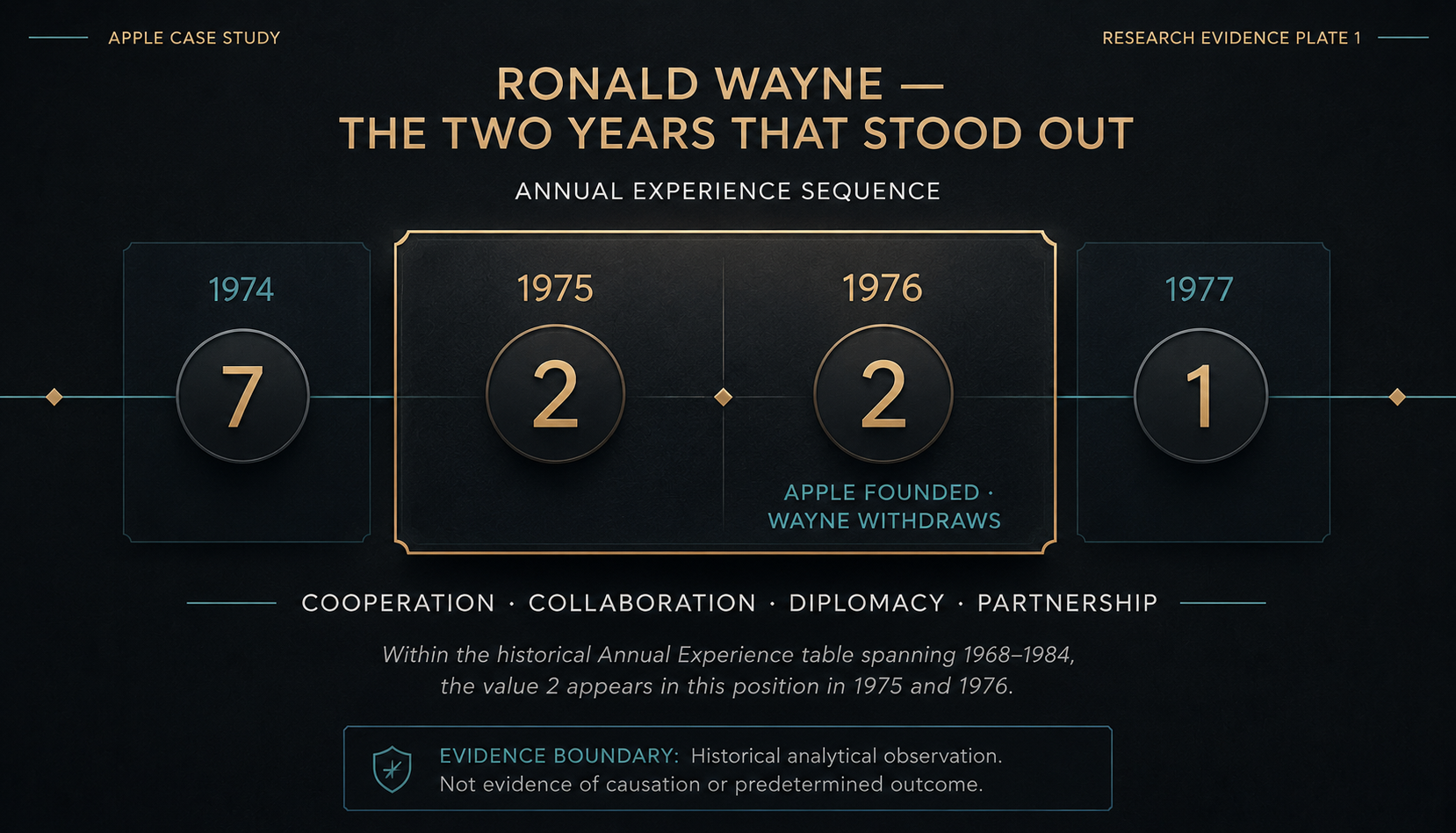
The Annual Experience table in the original research covers the years 1968 to 1984.
Within the particular annual position Chris was following, the cooperation-and-collaboration value appears only twice across that period:
1975 and 1976. 1976 was the year Ronald Wayne left Apple.
That correspondence became the centre of Chris’s interpretation. Not because it proved Wayne should have remained at Apple. It could not. The analysis was retrospective, and Chris already knew Wayne had left. Nor could it tell us that Apple was destined to succeed. It did not.
What interested Chris was the apparent overlap between the theme highlighted by the framework and the real-world difficulty Wayne was confronting at exactly that point in his life.
The difficult task was not simply: Can you tolerate financial risk? It may also have been: Can you remain constructively engaged with people whose way of operating is profoundly different from yours?
And that brings Steve Jobs back into the picture.
And Then There Was Steve Jobs
The original Wayne research did not stop with Wayne. Chris also examined Wayne and Jobs together. That matters because Wayne himself had identified Jobs as the more difficult of his two young partners.
Wozniak was not the central interpersonal problem. Jobs was.
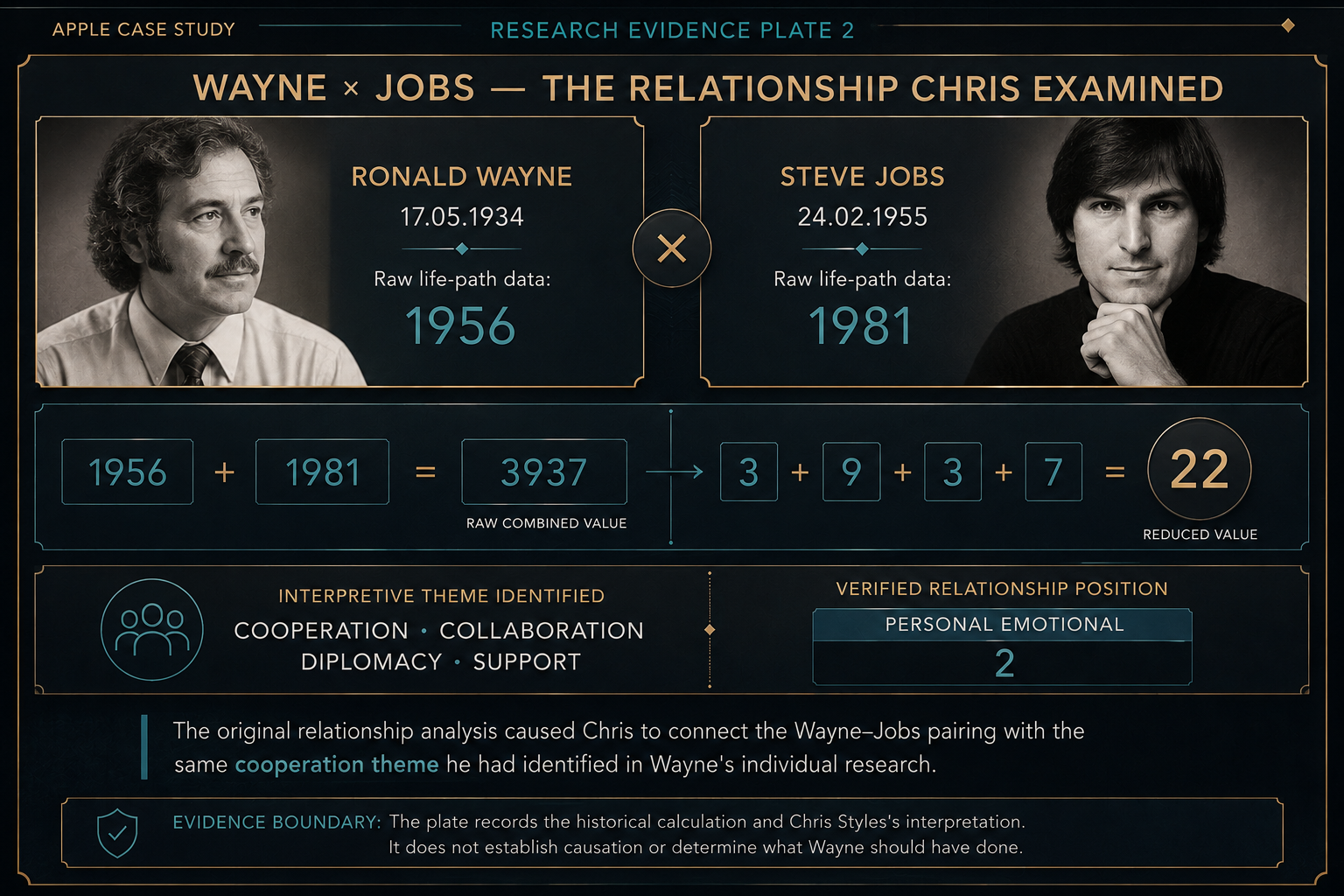
In Chris’s original relationship analysis, Wayne’s and Jobs’s data were combined into what was then called a co-joined chart.
The calculation produced a raw combined value of 3937, reducing to 22. Within the historical framework, Chris interpreted the repeated 2 component as reinforcing exactly the same cooperation, diplomacy and partnership theme that had already attracted his attention in Wayne’s individual analysis.
A corresponding 2 also appeared in what would now be described as the Personal Emotional area of their combined relationship analysis.
For Chris, this was the intriguing part.
The theme he thought Wayne most needed to encounter was appearing again when Wayne was considered specifically in relationship with the person he found hardest to work alongside.
Chris’s historical conclusion was much stronger than we would state it today. He described Jobs as Wayne’s “greatest teacher” and argued that Wayne’s task was to remain, cooperate and learn to work with him.
The contemporary Human Futurist reading needs a firmer boundary. We cannot know what would have happened had Wayne stayed. We cannot assume that remaining inside an uncomfortable or financially exposed partnership is automatically the better decision.
And we certainly cannot conclude that an analytical pattern creates an obligation to endure any relationship indefinitely.
But the research still leaves an interesting question behind:
What if the most consequential decisions are sometimes made at precisely the point where personal risk tolerance and relational tolerance collide?
The Difference Between Risk and Optionality
This is where Ronald Wayne becomes far more useful than a story about somebody losing billions. He exposes a problem that exists in almost every serious decision.
Risk is visible now. Optionality often becomes visible later.
Wayne could see the risk. His partnership could incur debts. Jobs was moving fast.
Wayne had more personal exposure than the younger founders and had already experienced business failure.
Leaving reduced that risk almost immediately. What Wayne could not see was the future value of the position he was surrendering. Nobody could.
That value did not exist yet. It had to be created through years of product development, financing, leadership decisions, conflict, success, failure, departure, return and reinvention.
So the real tension in the Wayne story is not: Why didn’t he know Apple would become enormous?
That asks him to know the unknowable. The better question is:
How much uncertainty are we prepared to tolerate in order to preserve access to a future we cannot yet see?
There is no universal answer. Sometimes leaving protects us from catastrophe. Sometimes staying preserves extraordinary optionality. Sometimes the same decision does both.
Wayne reduced immediate risk and simultaneously surrendered whatever Apple might later become. Only history revealed the scale of the second consequence. That is why describing his choice simply as stupidity does not help us understand it.
The decision can be rational and extraordinarily expensive.
Both can be true.
A decision does not have to be foolish to have an enormous consequence.
And that is precisely why Chris kept returning to these stories. The analytical framework was not interesting to him because it made difficult decisions disappear.
It was interesting because it sometimes caused him to look at a different part of the decision.
In Wayne’s case, everyone could see the lost money. Chris became fascinated by the timing, the relationship and the cooperation challenge surrounding the moment it was lost.
What This Article Adds to the Case Study
Steve Jobs gave the Apple Case Study its defining human anchor. Ronald Wayne introduces its first great divergence.
For the first time, the story asks us to separate what a decision looked like when it was made from what it looked like after its consequences became visible.
It also introduces a theme that will matter again as the Case Study develops:
“Organisational fit.”
- Not everybody who contributes to an extraordinary organisation must remain inside it.
- Not every departure is a failure.
- And not every rational exit leaves the future untouched.
Wayne’s story therefore gives us something more useful than an anecdote about lost wealth.
It gives the Case Study its first serious question about consequence. What disappears when we choose certainty now over possibility later?
The next Apple founder leaves on very different terms. And that changes the question again.
Share This Article, Choose Your Platform!
Related Posts






From understanding decisions to informing them.
Beyond the Research
The Business & Leadership archive examines consequential decisions after they have happened.
The Intelligent Mathematical Blueprint and Private Advisory take the underlying Human Futurist thinking into a different environment: helping leaders examine the circumstances surrounding decisions that have yet to be made.