

When the Model Could No Longer Decide
The Decision After the Tie: What the 2020 US Presidential Election Reveals About Predictive Confidence
The comparison reached 6–6. What happened next raises a much bigger question about how predictive decisions should be made.
Before the 2020 US presidential election, Chris Styles compared Biden–Harris with Trump–Pence using a structured predictive framework. An initial Republican advantage disappeared when a second analytical layer produced 6–6. Chris then used one remaining variable to choose between them. The forecast went one way; the election went the other. Nearly six years later, the most interesting question is not simply why the prediction was wrong. It is what the tie was already telling us about the limits of the evidence.
Before Americans cast their votes in November 2020, Chris Styles had already committed himself to an answer: Donald Trump and Mike Pence would win.
The result went the other way. Joe Biden and Kamala Harris won the election and entered the White House in January 2021.
That contradiction is the hook. But the more revealing moment came before Election Day. After two layers of comparison, the framework reached 6–6. What happened next turned a political forecast into a much larger question about predictive confidence: when the evidence stops separating two outcomes, what should a decision system do?
A Prediction Made Before the Outcome
The 2020 study was prospective. It formed the final part of a three-part investigation: one analysis of Biden and Harris, one of Trump and Pence, and a final comparison intended to decide the contest.
That chronology matters. The election result was not available to guide the interpretation, so the reasoning chain could later be compared with an external outcome. The original conclusion was explicit rather than vague: Trump and Pence were forecast to win.
The value of the case today lies in preserving that pre-event decision exactly as it was and examining how Chris got there.
Building the Comparison
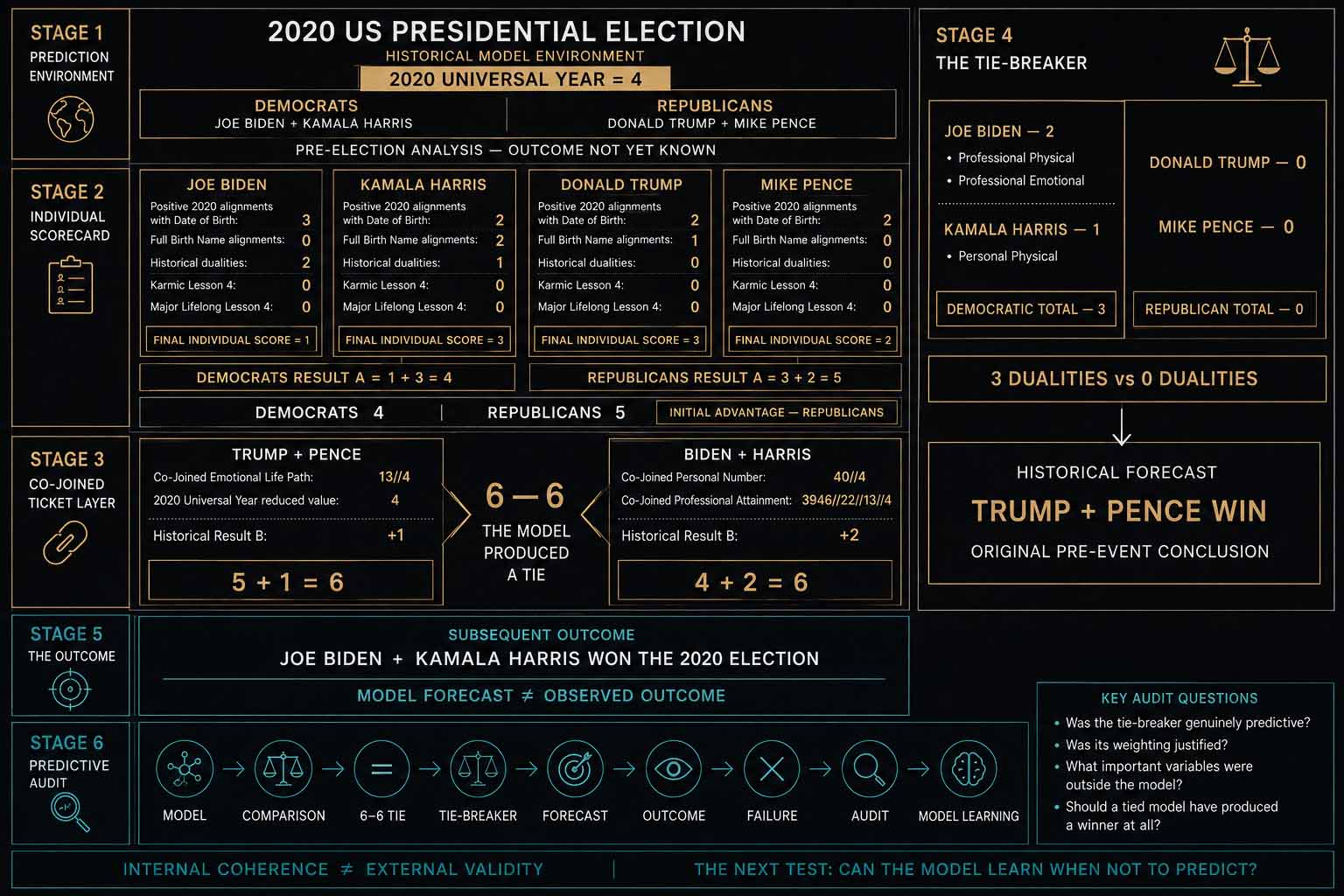
The historical scoring framework centred on each candidate’s relationship with the 2020 environment, which reduced to 4 within the methodology used at the time, together with several additional variables drawn from date-of-birth and name-based calculations.
DEMOCRATS
- Joe Biden received a final individual score of 1.
- Kamala Harris scored 3.
- Their combined Result A was therefore 4.
REPUBLICANS
- Donald Trump scored 3.
- Mike Pence scored 2.
- Their combined Result A was 5.
At that point the comparison read: DEMOCRATS 4 | REPUBLICANS 5. The Republican ticket held a narrow advantage.
Chris had, however, built a second layer into the analysis. Rather than treating the running mates only as separate individuals, he also examined what the original methodology called their Co-Joined profiles, a combined-ticket view.
From a Republican Advantage to 6–6
For Trump and Pence, one additional correspondence appeared between the 2020 value of 4 and their Co-Joined Emotional Life Path:
- Labelled Shadow Life Path in the original terminology, recorded as 13//4. That added one point: 5 + 1 = 6.
For Biden and Harris, two additional correspondences appeared:
- Co-Joined Personal Number of 40//4
- Co-Joined Professional Attainment sequence of 3946//22//13//4. That added two points: 4 + 2 = 6.
The initial Republican advantage disappeared.
TRUMP + PENCE = 6. BIDEN + HARRIS = 6.
This is the evidential centre of the case. The principal comparison had not produced a winner. It had produced equality.
That changed the decision problem. The question was no longer simply which ticket scored higher. It became whether any remaining variable had enough established discriminatory power to justify moving beyond the tie.
The Decision After the Tie
The earlier candidate analyses contained another feature described as a duality. Within the historical framework, dualities were treated as adverse indicators.
Biden had two in his 2020 profile: one Professional Physical and one Professional Emotional. Harris had one, Personal Physical. Together the Democratic ticket carried three.
Trump had none. Pence had none.
The final comparison therefore became:
DEMOCRATS — 3 DUALITIES | REPUBLICANS — 0 DUALITIES.
Chris treated that difference as sufficient to break the tie. The decision chain became: 6–6 → three dualities versus 0 → Trump and Pence win.
From inside the framework, the reasoning was coherent. The key question now is narrower and more useful: had the duality variable already earned the right to carry decisive weight, or was it simply the biggest difference still available once the main comparison could no longer separate the tickets?
Then Reality Supplied the Test
Joe Biden and Kamala Harris won the 2020 US presidential election.
That outcome contradicted the pre-event forecast. The original proposition must therefore remain frozen: Trump and Pence were predicted to win, and they did not.
The point of preserving that contradiction is not to turn the story into a verdict on Chris or on the wider framework. It is to give the decision chain an external test. The forecast, the reasoning and the outcome now sit beside one another, allowing the difficult part of model development to begin.
What Did the Comparison Actually Establish?
The obvious retrospective question is where the prediction went wrong. A better question is what the comparison had actually established before the final decision was made.
It had produced structured individual scores. It had given the Republican ticket an initial 5–4 advantage. It had introduced a second combined-ticket layer. And that second layer had removed the advantage completely.
The result was 6–6.
At that point the principal evidence was no longer separating the tickets. That does not mean the entire exercise was meaningless. It may mean those particular variables had reached the boundary of what they could discriminate.
The decision after the tie is therefore more revealing than the tie itself: it shows how easily a framework can move from observation to conclusion when the pressure to choose remains high.
Was the Tie the More Important Signal?
A tie is not necessarily a problem. It can be information.
When two alternatives cannot be reliably separated by the variables being measured, a single disciplined output yields insufficient discrimination. Another is to introduce a further variable, but only if that variable has already been shown to improve prediction under comparable conditions.
The three-versus-zero duality difference looked substantial. What the preserved record does not establish is a validated base rate showing that three dualities materially reduced the chance of electoral victory relative to zero, or that this variable had been independently calibrated to override a tied principal score.
That creates a wider decision-intelligence problem. When an analyst needs an answer, the strongest remaining difference can begin to feel important because it is available. The size of a contrast is not the same thing as validated predictive power.
The lesson is not that tie-breakers are inherently unsound. It is that the evidential status of a tie-breaker matters as much as the apparent clarity it creates.
What Existed Outside the Model?
Presidential elections are not contests between four isolated individual profiles. They are complex systems.
Voters, turnout, institutions, geography, campaigns, media environments, economic conditions, public events, political coalitions and millions of independent decisions interact to create the final result.
A framework may therefore describe something interesting about candidates or partnerships without containing enough information to determine an electoral outcome.
That creates one of the most useful questions in the case: what mattered outside the framework more than what appeared important inside it?
This is where Human Futurist thinking begins moving away from deterministic prediction and towards decision intelligence. The task becomes not only to identify the conditions the model can see, but also to recognise what sits beyond its field of view and calibrate confidence accordingly.
Why the Original Forecast Must Stay Frozen
A predictive archive becomes distorted if successful calls are preserved while contradictory outcomes are softened, reframed or allowed to disappear.
The complete chain therefore has to stay visible: the 4–5 Result A, the shift to 6–6, the three-versus-zero duality comparison, the Trump–Pence forecast and the later Biden–Harris outcome.
Preserving that sequence allows future cases to test whether dualities genuinely discriminate between outcomes, whether Co-Joined profiles add information beyond individual scores, whether some variables have been over-weighted, and whether certain patterns should change confidence without being allowed to determine an event.
The purpose is not to protect the model from contradiction. It is to make contradiction useful.
From Prediction to Predictive Audit
The wider contribution of the 2020 election case is therefore methodological rather than political.
The historical instinct was simple: MODEL → PREDICT. The stronger discipline is:
OBSERVE → MODEL → FORECAST → FREEZE → OUTCOME → AUDIT → REFINE.
Correct forecasts enter that audit. Contradicted forecasts enter the same audit. Neither earns exemption.
That changes what predictive precision means. Precision is not simply making the most confident statement possible. It is knowing what has been observed, what has been inferred, how strongly the evidence supports the inference, which important variables are absent, and when uncertainty is itself the most accurate output.
The 2020 election gets us into the story because forecast and outcome diverged. But the deeper Human Futurist question sits at 6–6.
When the evidence stops separating the alternatives, what should happen next?
That is where predictive audit begins turning prediction into decision intelligence.
FROM THE HUMAN FUTURIST RESEARCH ARCHIVE
This feature was developed from Physical Article 178, exact source filename “178 US presidential election result 2020”, Archive ID HF-RA-178. The original work was prospective and formed the final part of a three-stage 2020 election investigation comparing Biden–Harris and Trump–Pence before the result was known.
The source uses historical 365 Pin Code and numerology terminology, including “Shadow” and “Co-Joined” labels. Contemporary prose uses Emotional where the architecture supports the equivalence, while exact historical calculation labels and backing-number sequences are preserved where they matter.
The original forecast remains frozen: Donald Trump and Mike Pence were predicted to win. Joe Biden and Kamala Harris subsequently won. The contemporary value of the case lies in auditing the decision chain, particularly the 6–6 tie, the decisive use of the duality variable and the question of predictive confidence.
Share This Article, Choose Your Platform!
Related Posts






From understanding decisions to informing them.
Beyond the Research
The Business & Leadership archive examines consequential decisions after they have happened.
The Intelligent Mathematical Blueprint and Private Advisory take the underlying Human Futurist thinking into a different environment: helping leaders examine the circumstances surrounding decisions that have yet to be made.