
Polarity Under Pressure
Phillip Schofield, Holly Willoughby and the Breakdown of a High-Profile Working Relationship
The partnership looked effortless on screen. When Chris placed their profiles side by side, something more complicated appeared: mirrored structures that could support chemistry and intensify competition.
When the Chemistry Stopped Looking Effortless
For more than 15 years, Phillip Schofield and Holly Willoughby worked together across some of ITV’s most visible programmes, becoming particularly associated with This Morning. The appeal of the partnership was easy to understand. On screen, they could look spontaneous, familiar and unusually comfortable in each other’s company.
By May 2023, that public picture had changed. Reports described their relationship as strained. Schofield left This Morning on 20 May. Six days later he admitted that he had lied about a relationship with a younger male colleague and resigned from ITV. Willoughby subsequently said she had asked him directly about the relationship and had been told it was not true. When she returned to This Morning on 5 June, she described herself as “shaken, troubled, [and] let down”.
The public story was therefore not simply that two presenters stopped working together. Trust, reputation, status, organisational pressure and competing accounts had become part of the relationship environment.
That was the moment Chris Styles turned the case into a Human Futurist relationship study. But the enduring question is not who was right, who was stronger or whether one person’s numbers “caused” the split. It is more useful than that:
What happens when a partnership contains both unusually strong complementarity and unusually strong duplication?
The Mirror Beneath the Partnership
Chris began by placing the two individual profiles side by side. What appeared was an unusually clean inversion.
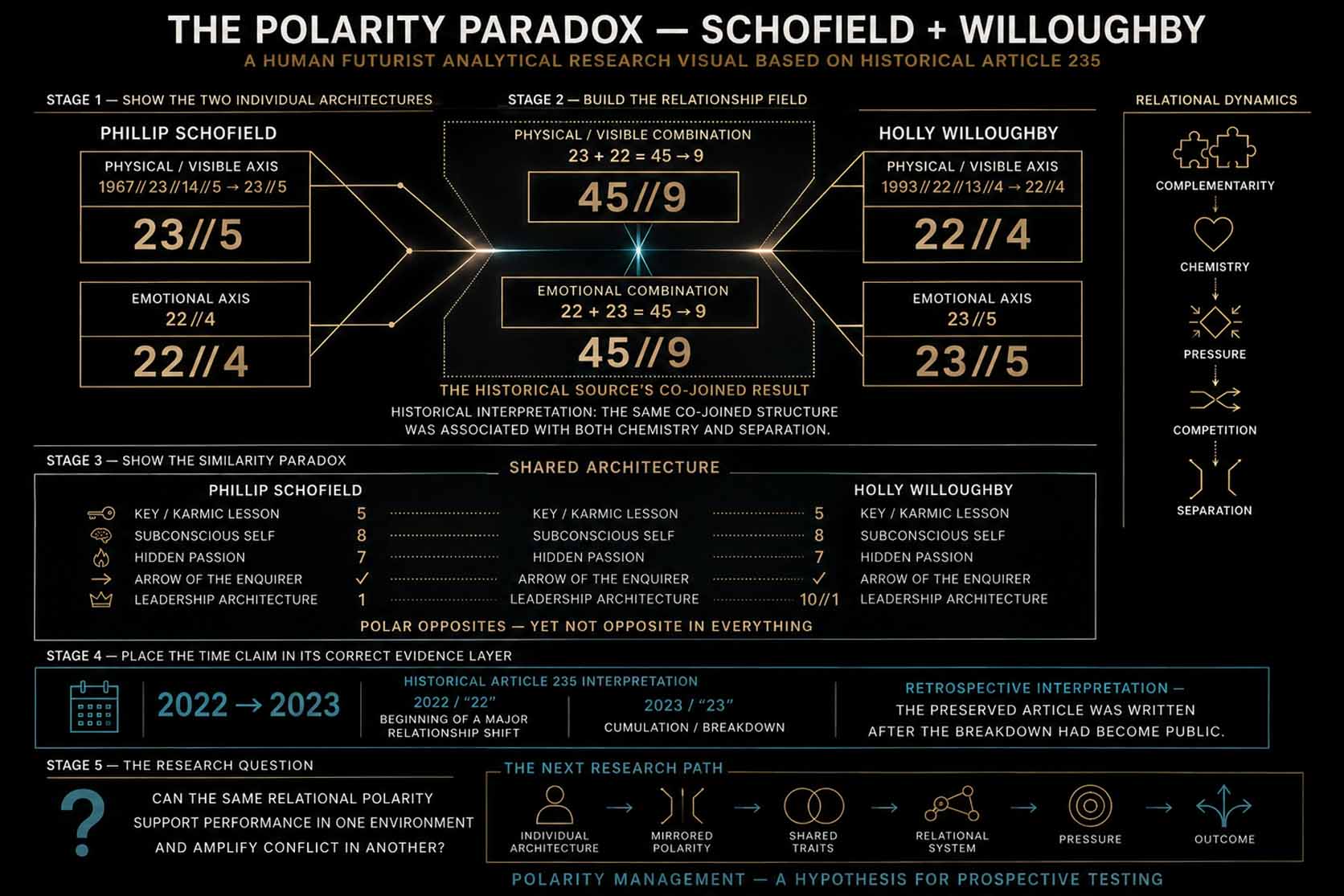
For Phillip Schofield, the physical or outward sequence was 23//5, derived from 1967//23//14//5. His corresponding emotional structure was 22//4.
For Holly Willoughby, the arrangement reversed: 22//4 physically, from 1993//22//13//4, and 23//5 emotionally.
Put side by side, the architecture is remarkably clean:
Schofield: 23//5 physical | 22//4 emotional
Willoughby: 22//4 physical | 23//5 emotional
Chris described this as “perfect polarity”.
He then combined the corresponding positions. On the physical side, 23 + 22 produces 45, reducing to 9. On the emotional side, 22 + 23 produces the same 45, again reducing to 9.
Chris’s original interpretation was that the same 45//9 structure appearing above and below could be associated with both powerful chemistry and separation.
That does not show that 45//9 caused either outcome. What remains striking is structural: once the two profiles were combined, the partnership produced a pattern that was not visible in either person alone.
That is the logic behind what Human Futurist now calls the Third System. Person A has one architecture. Person B has another. Their interaction creates something else to examine: the relationship itself.
The Paradox: Opposites With a Lot in Common
Then the pattern complicated itself.
Schofield and Willoughby looked like polar opposites at one level, yet Chris also found a notable set of similarities.
- Both were shown with a Number 5 key or karmic lesson.
- Both had a subconscious-self 8. Both had a Number 7 hidden passion.
- Both carried the Arrow of the Enquirer.
- And both contained substantial Number 1 architecture, associated within the earlier framework with independence, leadership and the drive to hold position.
The leadership comparison also differed in one detail:
Schofield was recorded as 1 and Willoughby as 10//1. In the earlier framework, Willoughby’s 10//1 was described as the stronger “alpha” expression.
The “alpha” label is historical terminology rather than an independently validated measure of dominance. The contrast still creates a useful question.
Compatibility and similarity are not the same thing.
Two people can complement one another because their structures are inverted, while simultaneously competing because important underlying capacities are duplicated. The same two people may therefore cooperate brilliantly when roles are clear, and trust is high, yet experience much greater friction when status, recognition, control or loyalty comes under pressure.
That is Polarity Under Pressure.
The relationship does not suddenly become a different system. The conditions around the system change, and the same capacities can begin expressing differently.
Why 2022 and 2023 Caught Chris’s Attention
Chris also noticed that 22 and 23, already central to the pair’s mirrored structure, reappeared in the years 2022 and 2023.
His retrospective interpretation was simple: 2022 marked the beginning of a major shift, while 2023 represented culmination or breakdown.
The public breakdown did occur in 2023, which makes the correspondence tempting. But the chronology matters.
This interpretation was written after the breakdown had become public. It therefore cannot be treated as evidence that Chris predicted the Schofield–Willoughby split before it happened.
That does not make the observation irrelevant. It changes the question the case can answer.
The 22 → 23 relationship is therefore better treated as something to look for in other partnerships before their outcomes are known, rather than as a validated prediction extracted from one famous split.
The stronger question is whether time-specific structures can identify periods when an already complex relationship becomes more sensitive to pressure, before the rupture is visible to everyone else.
What the Pattern Cannot Tell Us
The public events of 2023 provide a real outcome against which the relational model can be examined. Schofield’s departure, his later admission that he had lied about the affair, Willoughby’s statement that she had been misled, and ITV’s subsequent external review all show that the working environment had moved far beyond an ordinary change of presenting line-up.
But those events do not, by themselves, validate the numerical interpretation.
Hindsight is the obvious problem. Once a relationship has collapsed, almost any striking feature can begin to look more meaningful than it did beforehand.
The responsible conclusion is not that “the numbers explain why Holly and Phil split”.
Its value lies in the harder possibility: whether the same kind of relational structure can reveal anything useful before the outcome is known.
Could mirrored structures be unusually common in partnerships that experience strong chemistry?
And do duplicated leadership or control characteristics become a source of friction only when trust, status or roles begin to change?
Compatibility May Be the Wrong Question
That moves the story beyond two television presenters. The same question matters to co-founders, boards, leadership pairs, creative partnerships, coach–athlete relationships and couples.
Traditional compatibility thinking often asks whether two people “match”. This case suggests a more useful question: perhaps what matters is not compatibility alone, but how polarity is managed.
A polarity is not automatically good or bad. Independence can create initiative or rivalry. Control can create stability or a contest for authority. Inquiry can produce intellectual depth or relentless challenge. Similarity can create understanding or duplication. Complementarity can create balance or dependency.
The strategic question therefore becomes contextual:
What does this pair amplify in each other, and what happens to that amplification when the environment changes?
If that idea holds up across other relationships, relational intelligence would not need to wait for a partnership to fail. The value would lie in seeing where the system is becoming strained and changing the conditions around it: clarifying roles, reducing status ambiguity, improving decision rights or recognising when conflict needs more deliberate management.
Can Insight Arrive Before the Fault Line?
The memorable pattern is clear: 23//5 mirrored against 22//4, producing the same 45//9 relationship result across both dimensions.
But the most important finding is not the symmetry.
It is the contradiction.
Schofield and Willoughby were modelled as polar opposites and, at the same time, as people sharing several potentially amplifying characteristics. That contradiction is more useful than a deterministic claim about why a television partnership ended.
The next question is whether the same contradiction appears elsewhere before anyone knows how the relationship will turn out.
That means looking at other working pairs in advance and asking whether the same mix of mirrored complementarity and duplicated traits separates resilient partnerships from fragile ones.
Then comes the more important possibility: intervention.
Can insight change the conversation, governance or decision before the relationship reaches its fault line?
That is where Polarity Management becomes more than an explanation after the event. It becomes a form of decision intelligence: a way of changing what can be seen before the next decision is made.
FROM THE HUMAN FUTURIST RESEARCH ARCHIVE
This contemporary article has been developed from historical Human Futurist research preserved as Article 235 — HF Blog – Schofield and Willoughby. The original 2023 source described Phillip Schofield and Holly Willoughby as “perfect polar opposites”, centred on the mirrored 23//5 and 22//4 structures, the co-joined 45//9 results and several shared characteristics. The source also interpreted 2022–2023 as a high-risk relationship period. The original remains preserved within The Human Futurist Research Archive.
Share This Article, Choose Your Platform!
Related Posts





From understanding decisions to informing them.
Beyond the Research
The Business & Leadership archive examines consequential decisions after they have happened.
The Intelligent Mathematical Blueprint and Private Advisory take the underlying Human Futurist thinking into a different environment: helping leaders examine the circumstances surrounding decisions that have yet to be made.