

The model may not reveal the event itself, but it may reveal the consequence it creates
The Question Changed
How Khabib Nurmagomedov’s 2020 shifted a death-prediction question towards a more precise study of emotional consequence.
On 3 July 2020, Khabib Nurmagomedov lost his father, Abdulmanap Nurmagomedov. For Chris Styles, the event brought an old research question back into focus: could the numerical model he had been developing identify when someone would die?
By then, his work had already pushed him towards an uncomfortable distinction. The historical source records that he had not been able to identify death reliably in the life-path data of the person who died. Yet he believed that the emotional consequences surrounding a death could sometimes appear in the timelines of people closely connected to them.
Khabib’s case did not resolve the original question. It changed what Chris was asking the model to detect.
Khabib’s 2020 Put the Distinction in Focus
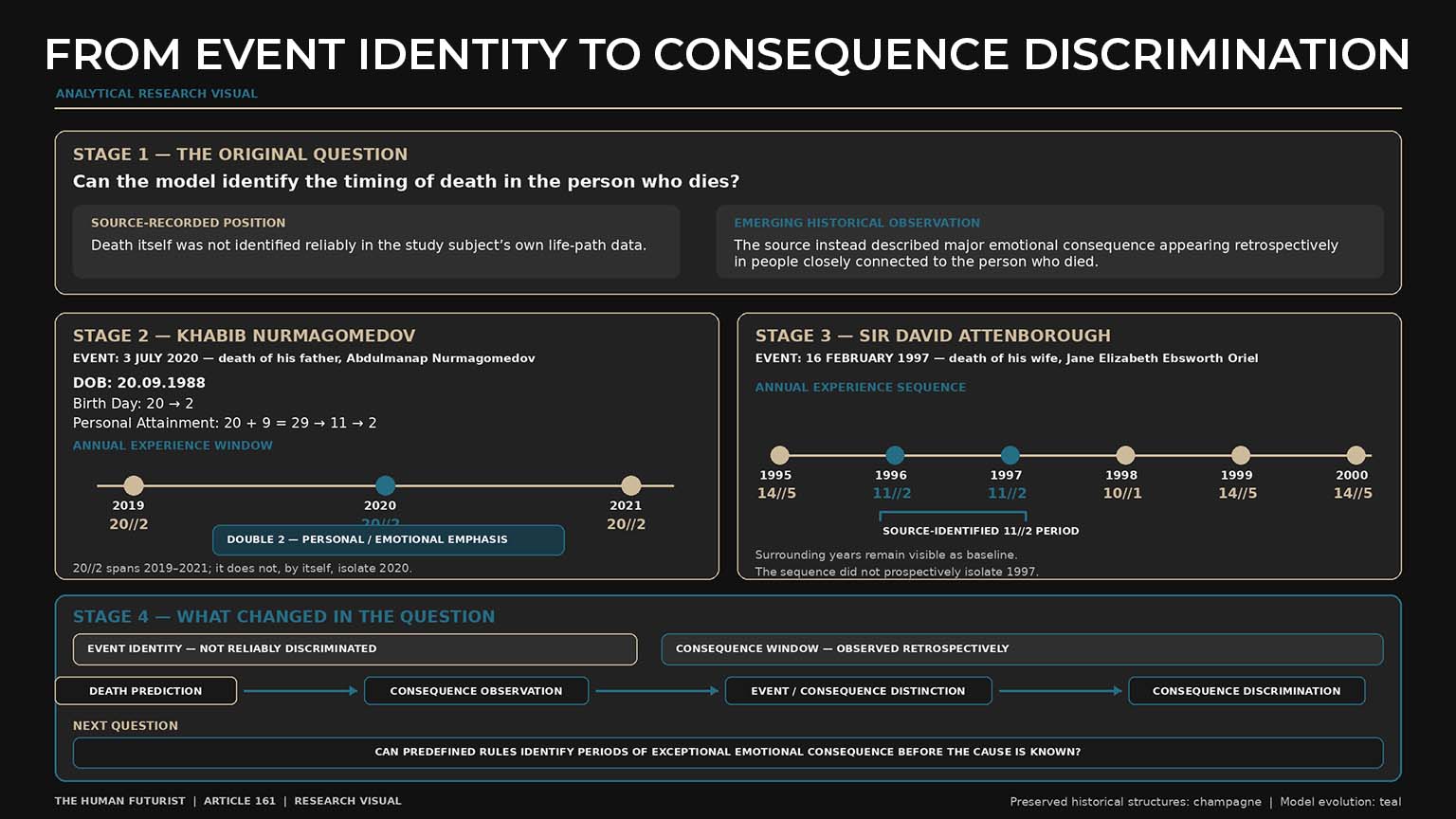
Khabib was born on 20 September 1988. In the historical system, his birth day was recorded as 20 → 2. His Personal Attainment calculation followed a different route to the same reduced value: 20 + 9 = 29 → 11 → 2.
Chris then looked at the annual sequence around 2020. The preserved table records 2019, 2020 and 2021 with the same 20//2 Annual Experience structure. Inside 2020, the source additionally highlighted what it called a “double 2” personal-emotional emphasis.
The historical interpretation attached strong emotional meaning to this concentration and connected it retrospectively with the death of Khabib’s father. The contemporary value lies less in that interpretation than in the structure itself: several independently derived positions converged around the same reduced value during a period of profound personal consequence.
The Three-Year Window Matters
The surrounding years make this more interesting — and more demanding.
If 20//2 were treated as a specific marker for death, the sequence immediately creates a problem. It appears in 2019, 2020 and 2021. The Annual Experience value does not isolate 3 July 2020, or even 2020 by itself.
That does not make the sequence irrelevant. It changes the level at which the observation can responsibly be interpreted. Instead of asking whether 20//2 named the event, the stronger question is whether the broader 2019–2021 period constituted an unusually consequential emotional window, with 2020 carrying an additional concentration within it.
This is a subtle but important shift. A model may be able to indicate heightened consequence without possessing enough discriminatory power to identify the event responsible for it.
Attenborough Added a Second Comparison
The historical source then applied the same idea retrospectively to Sir David Attenborough, whose wife, Jane Elizabeth Ebsworth Oriel, died on 16 February 1997 after 47 years of marriage.
His preserved annual sequence reads:
- 1995 — 14//5;
- 1996 — 11//2;
- 1997 — 11//2;
- 1998 — 10//1;
- 1999 — 14//5;
- 2000 — 14//5.
Chris drew particular attention to the two-year 11//2 period spanning 1996 and 1997.
Again, the sequence does not isolate the event cleanly. The focal value covers two years, while the death occurred in the second. The later 1998 and 1999 values were interpreted in the source as part of the changes that followed, but they were not prospective death markers.
The two public cases therefore point in the same methodological direction. What stands out is not a repeatable death signature. It is the possibility of a broader period of emotional consequence in the surviving person.
From Naming the Event to Measuring the Consequence
That distinction changes the proposition completely.
Death is an event category. Emotional consequence is a dimension of human experience. A model that claims to identify the first must discriminate death from illness, separation, conflict, redundancy, relocation and many other events capable of producing intense emotional disruption.
The historical material does not demonstrate that level of specificity. It does, however, preserve a different observation: when Chris looked at people profoundly affected by a death, he sometimes found concentrated structures around the period of loss. The source says there were additional client examples, but those cases are not presented in enough detail here to audit independently.
That evidence boundary matters because it prevents the research from quietly turning “a consequential period” into “a death signal”. Those are different claims, and they require different tests.
What This Changed in the Model
The most important development in this case is therefore conceptual rather than predictive.
The original question treated the event as the target: can the model tell us when death will occur? The cases encouraged a different unit of analysis: perhaps the observable signal, if there is one, sits in the consequence experienced by connected people rather than in the event itself.
That means the next version of the model would need to become less dramatic and more discriminating. Instead of assigning an event label after the outcome is known, it would need to identify a period in advance, define what “exceptional emotional consequence” means, and then see whether the signal appears more often around genuinely high-impact periods than ordinary ones.
The change is important because it moves Human Futurist work away from deterministic event naming and towards a question of sensitivity, magnitude and decision relevance.
The Next Question Is More Precise
Khabib Nurmagomedov’s 2020 is still a compelling case because the mathematics is visible. The 20//2 structure spans three years, the additional 2020 concentration is preserved, and the real-world event sits inside that window. Attenborough adds a second retrospective comparison with a different two-year focal structure.
Neither case establishes a predictive rule. Together, however, they clarify what a future rule would have to do.
It would need to identify unusually consequential periods before the cause is known. It would need to distinguish those periods from ordinary time. And it would need to resist the temptation to name the event unless the evidence genuinely supports that level of specificity.
The research began with a question about death. Its more useful legacy is a change in what the model is being asked to see.
The event is not the same as the consequence.
FROM THE HUMAN FUTURIST RESEARCH ARCHIVE
This contemporary feature was developed from historical Human Futurist research preserved as Physical Article 161, with the exact source filename “161 Death insights numerology”. No archive ID is established in the supplied source set. The original article was written in 2020 and used historical 365 Pin Code / numerology terminology, including “Shadow” for what contemporary Human Futurist prose describes as Emotional. The Khabib Nurmagomedov and Sir David Attenborough analyses are retrospective: the deaths were already known when the published comparisons were made. The contemporary article therefore treats them as model-evolution evidence and a consequence-discrimination hypothesis, not as validated death predictions.
Share This Article, Choose Your Platform!
Related Posts






From understanding decisions to informing them.
Beyond the Research
The Business & Leadership archive examines consequential decisions after they have happened.
The Intelligent Mathematical Blueprint and Private Advisory take the underlying Human Futurist thinking into a different environment: helping leaders examine the circumstances surrounding decisions that have yet to be made.