
A Six-Year Prediction Arrives
In 2020, the Ending Was Almost Impossible to See
Chris Styles put 2026 on the calendar six years early. Now the forecast has to face what actually happened.
In the opening months of COVID-19, Chris Styles made an unusually long-range proposition: the pandemic’s full global impact would continue through 2025 and begin to wane dramatically in 2026. That year has now arrived. The result is not a simple prediction score. It is a much more useful test of what a forecasting model must define before the future happens.
In 2020, the Ending Was Almost Impossible to See
There was a moment in 2020 when even the next few months were difficult to imagine.
COVID-19 had moved rapidly from outbreak to global emergency. Borders were closing. Health systems were under pressure. Governments were restricting movement while economists attempted to calculate consequences that seemed to change almost daily.
Chris Styles became interested in a question nobody could answer with much confidence: how long would the disruption last?
He approached it through the cyclical framework he was using at the time. And instead of predicting the next few months, he put a marker six years into the future.
2026.
That is what makes this case worth returning to now.
The Original Forecast Was Unusually Clear About Time
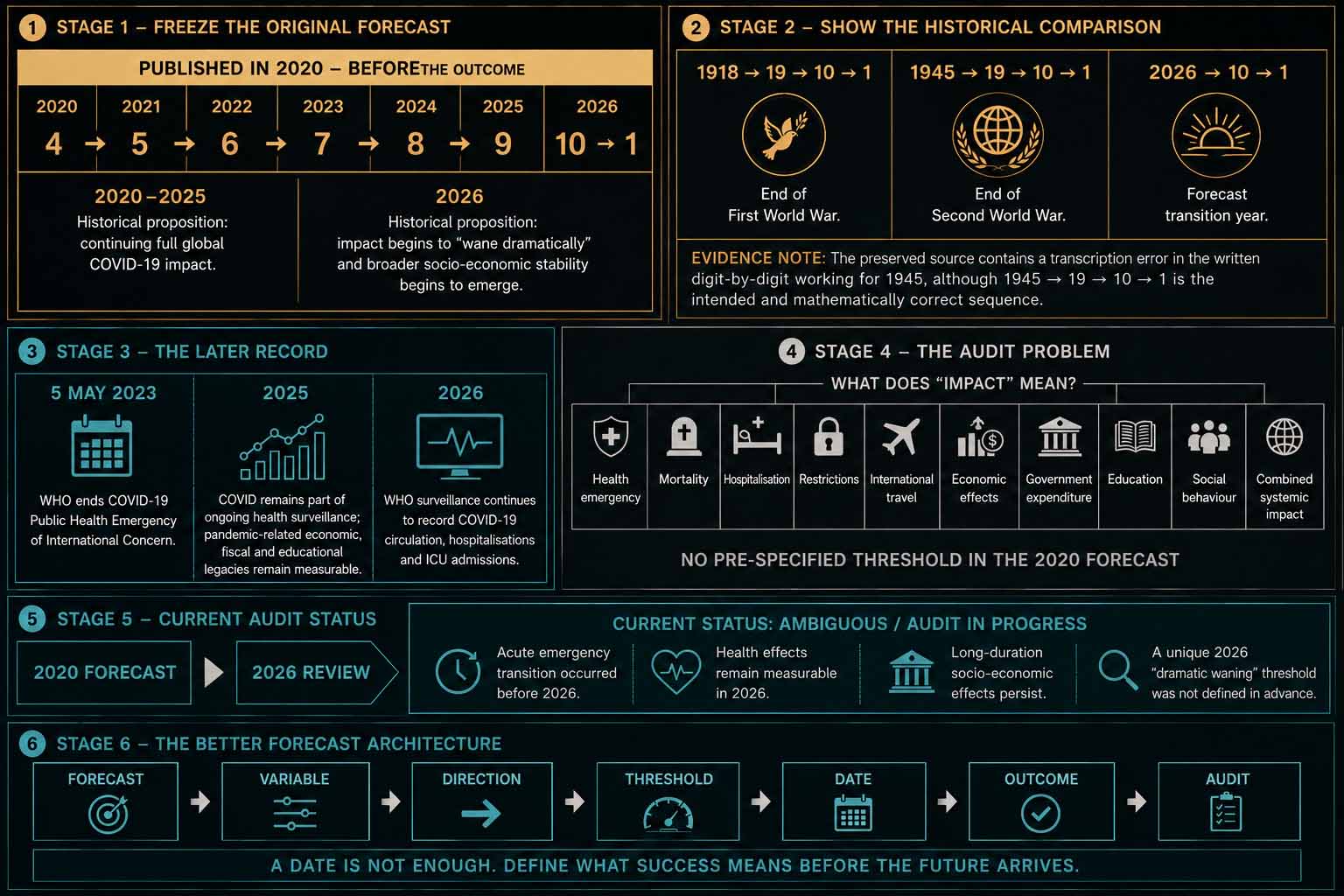
The historical calculation treated 2020 as the fourth year of a nine-year sequence:
- 2020 → 4
- 2021 → 5
- 2022 → 6
- 2023 → 7
- 2024 → 8
- 2025 → 9
- 2026 → 10//1
Within that framework, 2025 represented the closing year of the cycle and 2026 the beginning of another.
Chris translated that transition into a prospective claim. The full impact of COVID-19, he wrote, would continue through to and including 2025. In 2026 it would begin to “wane dramatically”.
He also connected the date to the wider economic and socio-economic disruption created by the pandemic, arguing that broader stability would begin to emerge around the same point.
The historical language was considerably more certain than the contemporary Human Futurist standard would permit. But the timing was not vague.
The proposition was recorded in 2020. The transition year was 2026. And six years later, the model has reached the date it selected.
Then Reality Made the Question Harder
By 2026, one thing is immediately obvious: COVID did not have a single ending.
The acute international emergency had receded much earlier. On 5 May 2023, the World Health Organisation ended COVID-19’s status as a Public Health Emergency of International Concern while stressing that the disease remained an established and ongoing health issue.
But that did not mean the virus disappeared. WHO surveillance continued in 2026. In the 28 days to 28 June 2026, reporting countries recorded 1,087 new COVID-19 hospitalisations and 59 ICU admissions, while WHO cautioned that reporting was incomplete and subject to delays.
At the same time, the pandemic left consequences that did not move on the same timetable as the emergency declaration: economic disruption, fiscal effects, educational loss, changed working behaviour and institutional after-effects.
So when the forecast arrives at 2026, several different timelines are sitting on top of one another.
The emergency had already changed. The virus remained. Some economic effects had diminished. Other social and institutional consequences continued.
That creates the central complication in the case: what exactly was supposed to “wane dramatically”?
The Model Identified a Date, But Not a Measurement
This is where the forecast becomes more interesting than a simple right-or-wrong judgment.
Chris had made a clear temporal discrimination. He had not merely said that COVID would eventually become less disruptive. He selected 2026 as the beginning of a major change after a six-year window.
But the original proposition did not define which observable condition would establish that the transition had occurred.
Was “impact” supposed to mean mortality, hospitalisation, restrictions, international travel, economic damage, government expenditure, social behaviour, or some combination of them?
The forecast does not say.
That means the model had identified when to look, but had not defined precisely what we should expect to see when we got there.
That distinction changes the audit. The problem is no longer simply: Was 2026 correct? It becomes: What did the model actually discriminate?
What the Forecast Can and Cannot Tell Us
The preserved record allows one strong conclusion.
The 2020 model produced a specific long-range transition point. That is genuine prospective evidence and should remain intact.
But the record does not support a clean declaration that the model predicted “the end of COVID”. The acute emergency phase had already receded before 2026. At the same time, measurable health consequences remained in 2026, while longer-duration economic, educational and institutional effects continued on their own trajectories.
Without a threshold defined in advance, neither side of that evidence is sufficient to settle the forecast cleanly.
The responsible status is therefore: AMBIGUOUS — AUDIT IN PROGRESS.
That does not make the case less valuable. It reveals where the original forecasting architecture stopped discriminating.
The date was specific. The outcome condition was not.
That Changed What Needed to Be Recorded
This is the part of the case that matters beyond COVID-19.
A long-range prediction becomes much more powerful when the future is prevented from changing the rules of the test.
If Chris were making the same type of proposition now, recording only a date would no longer be enough.
The forecast would need to establish in advance:
FORECAST → VARIABLE → DIRECTION → THRESHOLD → DATE → OUTCOME → AUDIT
Suppose the proposition concerned hospitalisation. The metric would need to be named.
Suppose it concerned economic normalisation. The indicators would need to be specified.
Suppose the model expected a dramatic change. “Dramatic” would need a threshold.
Only then could the future arrive without the interpretation moving with it.
The COVID case therefore contributes something more useful than another entry in a list of successful or unsuccessful predictions. It changes the design of the next prediction.
From Prediction to Forecast Design
The earliest Human Futurist work often concentrated on the question: What will happen?
This case points towards a more demanding question: What exactly are we expecting to change, when should it change, and what evidence would tell us that it did not?
That is a significant shift. The cyclical calculation remains part of the historical record. The 2026 forecast remains exactly where Chris put it.
The later outcome should not be rewritten to make the prediction look stronger, nor should the prediction be dismissed because one part of the pandemic transition occurred earlier.
Instead, the discrepancy reveals what the model still needed: better definitions, pre-specified measures, thresholds and a predetermined rule for deciding what the outcome means.
The Forecast Has Reached the Horizon, The Test Is Just Beginning
In 2020, Chris asked when the global impact of COVID-19 would end. The model pointed towards 2026.
Today, that date is no longer a distant prediction. It is an observable period. And what it reveals is more complicated than confirmation or failure.
The model identified a long-range transition year without defining the phenomenon tightly enough to determine whether that transition was uniquely captured.
That is the learning. Future Human Futurist forecasts can now be harder on themselves. Before the outcome is known, they can state the variable, the expected direction, the threshold, the review period and the conditions that would count against the proposition.
Then nothing needs to move when reality arrives. The enduring question created by the COVID case is therefore no longer simply: Can a cyclical model identify an important future transition?
It is more precise: Can it define that transition clearly enough in advance for somebody else to know whether it actually happened?
That is where prediction begins to become a testable forecasting discipline.
FROM THE HUMAN FUTURIST RESEARCH ARCHIVE
Physical Article 136 | Archive ID HF-RA-136 | Exact source filename: 136 What year will the impact of coronavirus Covid. The original research was published in 2020 as a prospective macro-level forecast. It used a nine-year universal-cycle framework and explicitly stated that COVID-19’s full global impact would continue through 2025 and begin to “wane dramatically” in 2026, with broader socio-economic stability emerging around the same time. The original deterministic language and legacy numerology framing are preserved as historical methodology, not presented as contemporary fact. The completed Archive Analysis classifies the case A- (79/90), places it provisionally in Feature Research, and identifies it as a very-high-priority Predictive Audit candidate because the timing is highly specific while the outcome definition is not.
Contemporary verification used for the 2026 audit layer:
- World Health Organisation — 5 May 2023 statement ending COVID-19’s Public Health Emergency of International Concern status while describing COVID-19 as an established and ongoing health issue.
- WHO COVID-19 Dashboard — June 2026 surveillance, including reported hospitalisations and ICU admissions, with WHO’s stated data limitations.
Share This Article, Choose Your Platform!
Related Posts






From understanding decisions to informing them.
Beyond the Research
The Business & Leadership archive examines consequential decisions after they have happened.
The Intelligent Mathematical Blueprint and Private Advisory take the underlying Human Futurist thinking into a different environment: helping leaders examine the circumstances surrounding decisions that have yet to be made.