

The Warning Signal Problem
Anders Breivik and the Limits of Retrospective Risk Modelling
Chris found an unusually dense convergence around 22 July 2011. The harder question is whether it could have meant anything before the outcome was known.
On 22 July 2011, Anders Breivik murdered 77 people in Norway. When Chris Styles later examined the date through the developing Human Futurist model, he found a dense cluster of repeated structures around the event and across Breivik’s profile. The observation is striking. Its real value now lies in a harder problem: can retrospective concentration ever become responsible risk intelligence without confusing hindsight for foresight?
A Date That Collapsed Into Four Values
Extreme events create a peculiar analytical danger. Once we know that a particular day became catastrophic, almost anything surrounding it can appear unusually meaningful. The outcome changes how we look backwards.
That is why the Breivik case is more difficult than a simple pattern story.
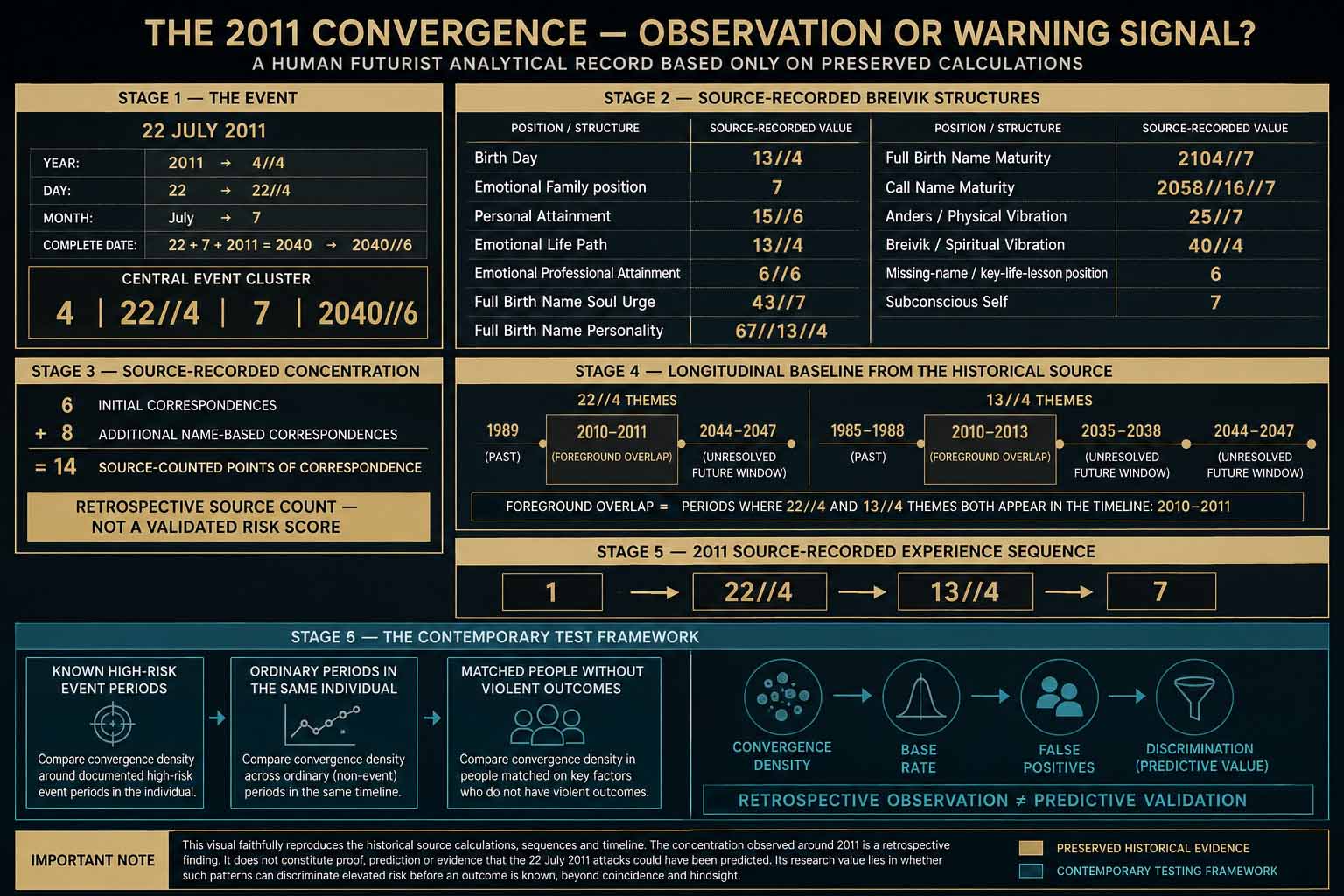
Chris began with the date itself. Inside the historical framework, 22 July 2011 generated four focal values. The year 2011 reduced to 4//4. The 22nd produced 22//4. July supplied 7. And the complete date — 22 + 7 + 2011 produced 2040//6.
Four independently derived routes therefore sat around the same event: 4 | 22//4 | 7 | 2040//6.
The question that caught Chris’s attention was not what those values meant in isolation. It was whether the same structures were already present elsewhere in Breivik’s profile.
Chris Looked for the Same Structures in Breivik
Breivik was born on 13 February 1979. When Chris compared the event values with positions derived from that date of birth, several relationships appeared.
His birth day produced 13//4. The February position had an Emotional Family counterpart of 7. The Personal Attainment calculation was 15//6. The source’s historical Emotional Life Path was another 13//4, while the Emotional Professional Attainment position was 6//6.
The original analysis counted six correspondences at this first stage. One of those relied on the source’s own interpretive relationship between 13//4 and 22//4, so the contemporary treatment preserves the count as a source-recorded claim rather than quietly converting it into a validated score.
That distinction matters. A source can tell us what Chris counted and how he interpreted it. It cannot, by itself, tell us whether the count is rare.
Then the Concentration Expanded
Chris then moved from date-of-birth architecture into Breivik’s name analysis.
There he recorded further 4, 6 and 7 relationships, including 43//7, 67//13//4, 2104//7, 2058//16//7, 25//7 and 40//4, together with source-defined positions of 6 and 7.
The historical article counted eight additional correspondences. Added to the initial six, the total became 14.
That is the evidential centre of the case: not one dramatic number, but a source-recorded concentration spread across several separately calculated parts of the model.
Chris also isolated a four-part 2011 experience sequence:
1 — 22//4 — 13//4 — 7. He interpreted the combined structure as evidence that 2011 represented an unusually consequential period in Breivik’s timeline.
The historical language went further. It described 2011 as a “perfect numerical storm” and suggested that security authorities equipped with this type of intelligence might have monitored Breivik more closely.
That claim is precisely where the contemporary question has to become tougher.
2011 Was Not Isolated
The source did not stop at the attack year. Chris modelled recurring 22//4 and 13//4 periods across a much longer timeline.
- For 22//4, the article identifies: 1989, 2010–2011 and 2044–2047.
- For 13//4, it identifies 1985–1988, 2010–2013, 2035–2038 and 2044–2047.
The 2010–2011 overlap therefore became particularly important to the historical interpretation. But the wider timeline also complicates it. Similar sequences appear in years that are not established in the source as violent-event years, while several future windows remain unresolved.
That is useful rather than inconvenient. A model becomes more informative when the dramatic case is forced back into its own baseline. If the same structures recur elsewhere, the question changes from “Did the numbers appear?” to “What, if anything, did this particular concentration discriminate?”
The Observation Changes When You Ask It Prospectively
The Breivik analysis was retrospective. Chris already knew the date of the attacks when he examined the convergence.
That means the case can show that the historical method was capable of describing a dense configuration around a known consequential event. It cannot establish that the same rules would have selected 2011 in advance, still less that they would have identified a specific act.
There was no pre-defined threshold for what counted as dangerous convergence. No control population was calculated alongside Breivik. No false-positive rate was measured. And the historical article did not demonstrate that people with similar configurations were more likely to commit violence.
Those omissions do not erase the observation. They redefine what it is: a retrospective signal strong enough to create a testable question, not a validated warning system.
The False-Positive Problem
Imagine a model that would have highlighted Breivik’s 2011 attack, but would also have highlighted thousands of people who never harmed anyone.
It would look impressive in a case study and be unusable in practice.
That is the central tension created by this article. In any high-consequence risk system, identifying the person who later committed violence is only half the problem. The system must also account for everyone it would have identified incorrectly.
The ethical threshold is correspondingly high. Numerical pattern analysis could not responsibly replace evidence of ideology, intent, behaviour, capability, preparation, threat intelligence, clinical assessment or established investigative methods.
The only defensible future proposition is narrower: if conventional evidence has already identified genuine concern, could temporal concentration add any incremental information about when attention should increase? Even that would require fixed rules, appropriate controls and prospective testing.
What This Case Changed
The historical article imagined a future field of “Criminal Futurology”. Its strongest contemporary legacy is not that label and not the claim that Breivik could have been predicted.
It is the move from description towards risk discrimination.
Chris had noticed something unusual: multiple independently derived structures concentrated around one exceptionally consequential period, and related sequences recurred across a longer timeline. Once that observation is preserved accurately, the case exposes the standard the next model would have to meet.
It would need to distinguish a meaningful concentration from an ordinary one. It would need to explain what the signal adds beyond known behavioural evidence. And it would need to be judged not only by the cases it appears to identify, but by the people it identifies incorrectly.
Breivik therefore remains a disturbing retrospective case, not a predictive demonstration.
The enduring question is more demanding, and more useful:
Can a model recognise a genuinely unusual human turning point before the outcome gives the pattern its meaning?
Until that question can be answered prospectively, the most important lesson from 2011 is not that a warning signal was proven. It is that hindsight can make a signal look much clearer than foresight ever allowed.
FROM THE HUMAN FUTURIST RESEARCH ARCHIVE
This contemporary feature was developed from historical Human Futurist research preserved as Physical Article 002, exact source filename “2. Criminal Futurist insights into mass killer Anders Breivik. Permanent Archive Identifier: HF-RA-002
The original source was written retrospectively in the early 2020s, after the 2011 attacks, and remains preserved within The Human Futurist Research Archive. It uses earlier terminology including “Shadow”, “synchronicity”, “Criminal Futurology” and stronger predictive language. The contemporary article preserves the calculations and historical claims but does not imply that the 2011 attacks were prospectively predicted or that the source-counted 14 correspondences constitute a validated risk score.
The source also contains unresolved future claims, including recurrence windows in 2035–2038 and 2044–2047 and a separate name-alignment claim around 2042–2043. These remain historical propositions rather than known outcomes.
Share This Article, Choose Your Platform!
Related Posts






From understanding decisions to informing them.
Beyond the Research
The Business & Leadership archive examines consequential decisions after they have happened.
The Intelligent Mathematical Blueprint and Private Advisory take the underlying Human Futurist thinking into a different environment: helping leaders examine the circumstances surrounding decisions that have yet to be made.