Part Of the Apple Case Study
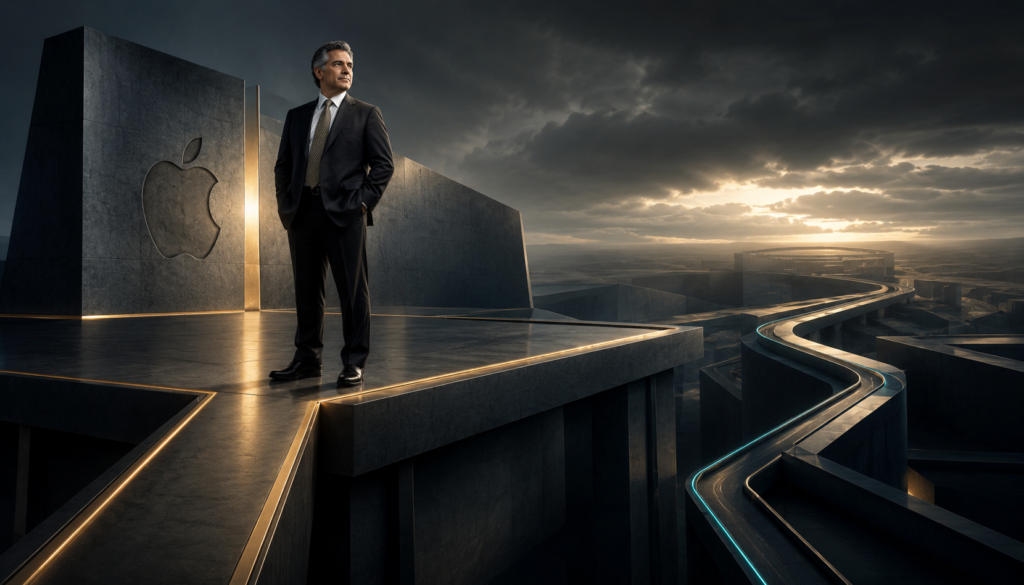
Tim Cook is the final individual in this six-person Apple sequence.
The earlier articles followed people who created Apple, left it, fought over its direction, struggled to save it and eventually helped create the circumstances for Steve Jobs to return.
Cook represents something different.
He inherited all of it.
- The company.
- The culture.
- The expectations.
And the extraordinary question of what Apple could become after the person most closely associated with its identity was no longer there.
2020 brought Tim Cook back to 2011, the year he inherited Apple’s leadership.
The Successor Who Inherited More Than a Company
On 24 August 2011, Steve Jobs resigned as Apple’s chief executive. He recommended that Apple’s succession plan be implemented and that Tim Cook replace him.
The board agreed.
Cook, then Apple’s chief operating officer, became CEO immediately. Apple described him as an executive whose thirteen years at the company had already been marked by exceptional operational performance and judgement.
Six weeks later, Jobs died.
For Cook, 2011 therefore contained two events of enormous professional and personal consequence almost on top of one another: assuming leadership of Apple and losing the man whose company he had been chosen to continue.
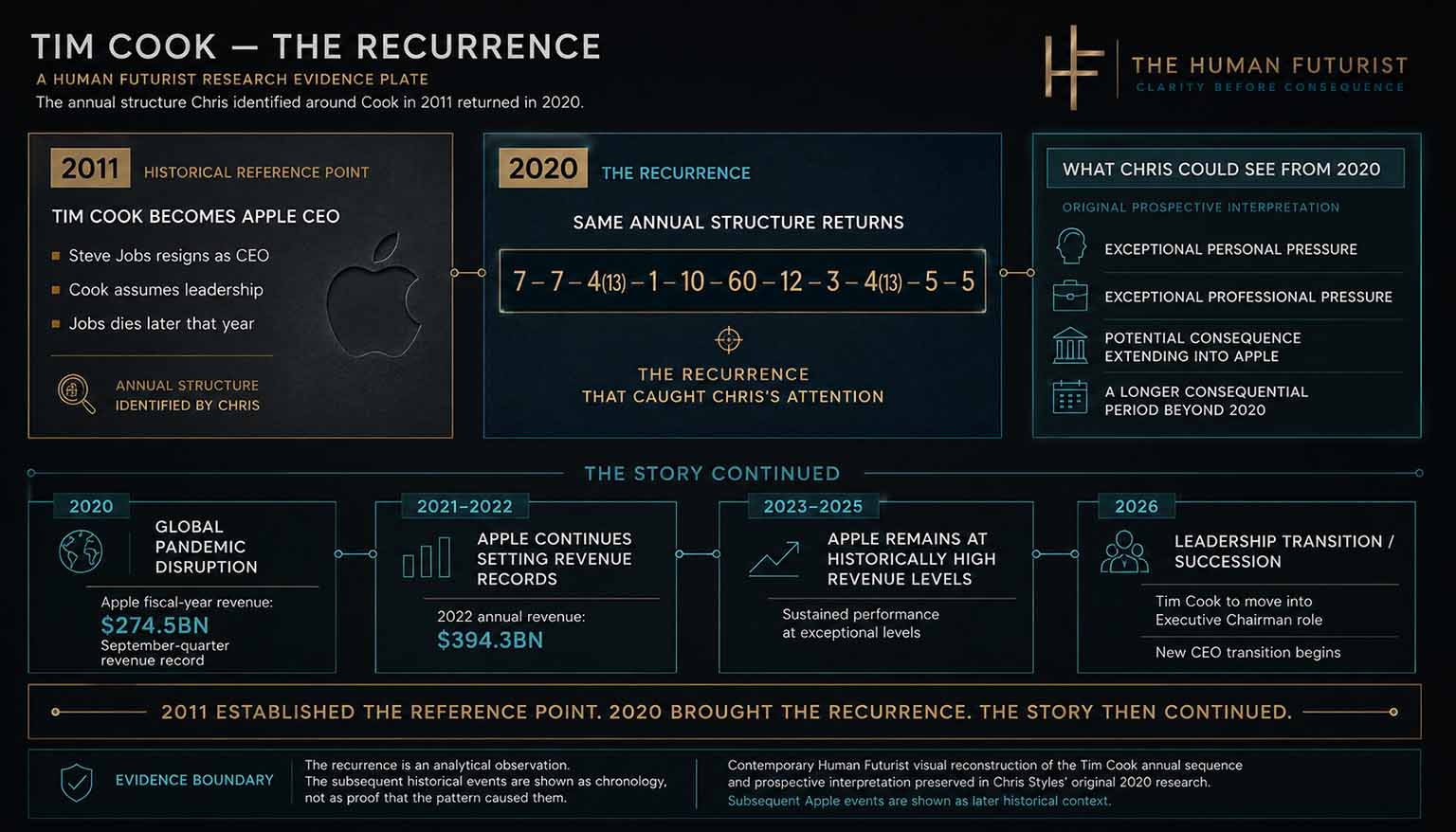
Nine years later, Chris Styles noticed something that made him return to that moment. According to the analytical framework he was using at the time, Cook’s 2020 annual sequence was identical to the one he had carried in 2011.
That was the hook. Not because identical patterns must produce identical events.
But because 2011 had already established what that particular sequence looked like when it appeared during an unusually consequential year in Cook’s life.
So Chris asked the obvious question.
What might its return mean now?
2020 Looked Familiar
The original research recorded Cook’s 2020 sequence as:
2020 | 7 — 7 — 4(13) — 1 — 10 — 60 — 12 — 3 — 4(13) — 5 — 5
Chris noted that the same underlying annual structure had appeared in 2011.
Using today’s terminology, he looked across Cook’s Personal Physical, Personal Emotional, Professional Physical, and Professional Emotional positions and saw several combinations he associated with tension rather than ease.
The 4 element attracted particular attention.
Chris associated it with work, constraint, systems, discipline, practical responsibility and restricted room for manoeuvre.
The 7 component introduced a different kind of pressure: introspection, searching and the need to resolve difficult questions.
Professionally, he saw another tension between structure and adaptability.
In the original 2020 article, Chris therefore made an unmistakably strong prospective interpretation.
He expected the year to be exceptionally demanding for Tim Cook personally. And he believed the pressure might extend into Apple itself. That distinction matters. Because those are not the same proposition.
What Chris Could See From 2020
What made the recurrence interesting was not simply that Cook had encountered the same analytical structure before. It was where it had appeared before.
In 2011, Tim Cook had stepped into the leadership of Apple as Steve Jobs stepped away. Within weeks, Jobs was gone. It was difficult to imagine a more consequential transition. So when Chris saw the same annual sequence return in 2020, he did not interpret it as an ordinary year.
He expected pressure.
Personally, he associated the pattern with constraint, demanding responsibility and difficult questions.
Professionally, he saw tension between structure and adaptability at a time when Cook was responsible for one of the world’s most complex organisations.
And he believed the significance could extend beyond Cook himself into Apple.
The original article went further still.
Chris saw 2021 as carrying increased responsibility and interpreted the years beyond 2020 as part of a longer consequential period.
From where he was standing in 2020, the broader sequence did not appear to materially turn until approximately the second half of 2026 or 2027.
None of that future had happened yet.
Chris was looking forward. And then the environment around Cook changed dramatically.
Then The World Changed
2020 became an extraordinary year for reasons nobody needed an analytical framework to recognise.
COVID-19 disrupted manufacturing, supply chains, retail, workplaces and consumer behaviour around the world.
Apple closed stores. Employees moved away from offices. Suppliers and manufacturing networks had to operate through extraordinary disruption.
And Tim Cook had to lead through it.
That matters to this story because the recurrence Chris had identified before the year unfolded now sat inside an objectively unusual leadership environment.
The pressures were real.
But the story that followed was not simply one of corporate difficulty.
Apple’s fiscal 2020 revenue reached approximately $274.5 billion, compared with about $260.2 billion the previous year.
Its September quarter established a company record for that quarter, while Mac and Services reached all-time revenue highs.
Then came 2021.
Apple continued setting records.
Its December 2020 quarter produced what was then an all-time company revenue record of $111.4 billion. Further quarterly records followed, and by fiscal 2022 annual revenue had reached $394.3 billion.
That gives the 2020 analysis an interesting contemporary dimension.
The period Chris had identified as unusually demanding became extraordinarily consequential, while Apple itself continued to perform at exceptional levels.
Those two things can coexist.
The Personal and Corporate Stories Were Not the Same
This distinction matters. A company’s financial performance tells us something important about the organisation.
- It does not tell us everything about the experience of the person leading it.
- Revenue cannot tell us how demanding a year felt.
- A share price cannot measure the weight of responsibility.
- Record sales cannot describe what it was like to lead employees, suppliers, manufacturing networks, customers and investors through a global crisis while attempting to preserve the operational continuity of Apple.
Nor should we use those unknowns to manufacture evidence about Cook’s private experience.
We simply do not have it. What we do have are two different historical records.
One is the analytical record Chris created before the year unfolded. The other is what subsequently happened around Cook and Apple.
The interesting question is what becomes visible when those records are placed alongside one another.
Tim Cook’s Apple Leadership Had Changed the Question
By 2020, another part of the Apple story had already changed. The central leadership question was no longer whether Tim Cook could succeed Steve Jobs. He already had.
The question had become what Apple could become beyond dependence on the founder who had defined its most famous period.
Cook’s significance lies partly in how different his leadership was. Before becoming CEO, he had spent years running Apple’s worldwide operations, supply chain, sales and service infrastructure.
He was not Jobs 2.0.That may have been precisely the point.
The Apple inherited by Cook was still profoundly shaped by Jobs, but the organisation increasingly had to operate without Jobs as its central load-bearing figure. Cook carried that inherited structure forward.
And Apple’s subsequent scale provides some indication of just how far. Revenue reached approximately $383.3 billion in 2023, $391.0 billion in 2024, and $416.2 billion in fiscal 2025.
By then, the succession question had fundamentally changed. It was no longer:
Can Apple continue without Steve Jobs?
It was:
What kind of Apple had Tim Cook’s leadership created after him?
And Then The 2026 Window Arrived
Chris did not stop his analysis at 2020. He looked further ahead and suggested that the broader period might not materially turn until the second half of 2026 or 2027.
When he wrote those words in 2020, that point was more than six years away.
Today, it is no longer theoretical. On 20 April 2026, Apple announced that Tim Cook would step down as CEO and move into the role of Executive Chairman, with John Ternus becoming Apple’s next CEO from 1 September 2026. Apple described the transition as the result of a carefully considered long-term succession process.
That places one of the most significant leadership transitions of Cook’s Apple career directly inside the later period Chris had identified years earlier.
It does not tell us that the analytical sequence caused the transition. It does not turn the original research into proof. But it does make the 2026–2027 window materially more interesting.
- In 2011, Cook became Apple’s CEO.
- In 2020, Chris noticed the return of the same annual structure and extended his attention forward into the years that followed.
- And in 2026, as that later window opened, Apple announced that Cook would leave the CEO role he had held for fifteen years.
The story therefore ends in a very different place from where it began.
- Not with collapse.
- Not with a verdict.
- With succession again.
And that creates a striking symmetry inside the Tim Cook chapter:
2011, Cook inherits Apple’s leadership. 2026, Cook begins handing that leadership on.
What This Article Adds to the Case Study
Tim Cook’s Apple leadership changes the nature of this Case Study. With Steve Jobs, Ronald Wayne, Steve Wozniak, John Sculley and Gil Amelio, we have largely been looking backwards.
- The events had already happened.
- The consequences were already visible.
- Cook introduces something different.
A preserved analysis made while the future was still unknown.
Chris saw Cook’s 2020 analytical structure repeating something he had previously seen around the extraordinary succession year of 2011.
That recurrence made him look more closely. Then history continued. A pandemic transformed the operating environment. Cook led Apple through it, and the company continued to grow. And the longer period Chris identified continued moving towards a point that, in 2020, was still more than six years away.
That makes Tim Cook an appropriate final individual chapter in the Apple Case Study.
Because for the first time, the story does not end entirely in the past. Part of it reaches into the present. And part of it remains ahead.
What becomes visible when the same organisation is followed long enough to watch a prospective question become part of the historical record?
Share This Article, Choose Your Platform!
Related Posts
From understanding decisions to informing them.
Beyond the Research
The Business & Leadership archive examines consequential decisions after they have happened.
The Intelligent Mathematical Blueprint and Private Advisory take the underlying Human Futurist thinking into a different environment: helping leaders examine the circumstances surrounding decisions that have yet to be made.