
Part of the Apple Case Study
Steve Jobs sits at the centre of this story because almost every later Apple leadership question touches him somehow.
- He helped create the company.
- He left it.
- He returned to it.
- He helped rebuild it.
And eventually Apple had to answer a question that every founder-led organisation ultimately faces:
What happens when the person who has become central to the structure can no longer carry it?
The Founder Apple Couldn’t Escape
There are few corporate stories with an arc quite like Steve Jobs and Apple.
He co-founded the business in 1976.
Less than a decade later, the relationship had fractured so badly that Jobs left the company he had helped create.
- Then, in 1997, he came back.
- Not to the Apple he had left.
- To an Apple under pressure.
The return would ultimately transform both the company and Jobs’ place inside it. Apple’s own board would later describe his vision and leadership as having saved the company.
But that extraordinary second act created another question.
The more successful the return became, the more difficult it became to separate Apple’s future from the man driving it.
And that is where Chris Styles’ historical analysis becomes interesting.
Because when he later examined Jobs across the span of his life, one year behaved differently from every other year in the sequence.
That year was 2004.
Apple Had Already Lost Him Once
Jobs’ first departure matters because the later story makes little sense without it.
Apple had begun as the creation of founders, engineers and entrepreneurs trying to build something new. But as the company grew, so did the tensions around leadership, control and how a rapidly expanding organisation should be run.
By 1985, Jobs was out.
With hindsight, it is tempting to treat that departure simply as a historic corporate mistake. That is too easy.
The people making decisions inside Apple in 1985 did not know that Steve Jobs would one day return. They did not know what NeXT would contribute to Apple’s future. They did not know what the technology industry would become.
They were making decisions inside the organisation they had then. That distinction matters throughout this Case Study. Consequence is not the same thing as obvious error.
Jobs went on to build NeXT and become deeply involved with Pixar. Apple continued without him. For more than a decade, their stories separated. Then the structure reconnected.
Then Jobs Walked Back Through The Door
Apple acquired NeXT, bringing Jobs back into the company. By 1997 his role had expanded dramatically, and he became interim chief executive before later assuming the CEO position formally.
The consequences were enormous.
- Products disappeared.
- Priorities narrowed.
- The company became more focused.
And the leadership identity of Apple increasingly became the leadership identity of Steve Jobs.
What emerged during the following years is now familiar business history.
But Chris was interested in something slightly different.
He was not studying Apple simply to explain why Jobs was successful.
He was looking for recurring relationships across people, periods and events.
And when he constructed a year-by-year analytical sequence for Jobs from his birth in 1955 until his death in 2011, something stood out.
One particular annual value appeared only once. In 2004.
The Year Chris Couldn’t Ignore
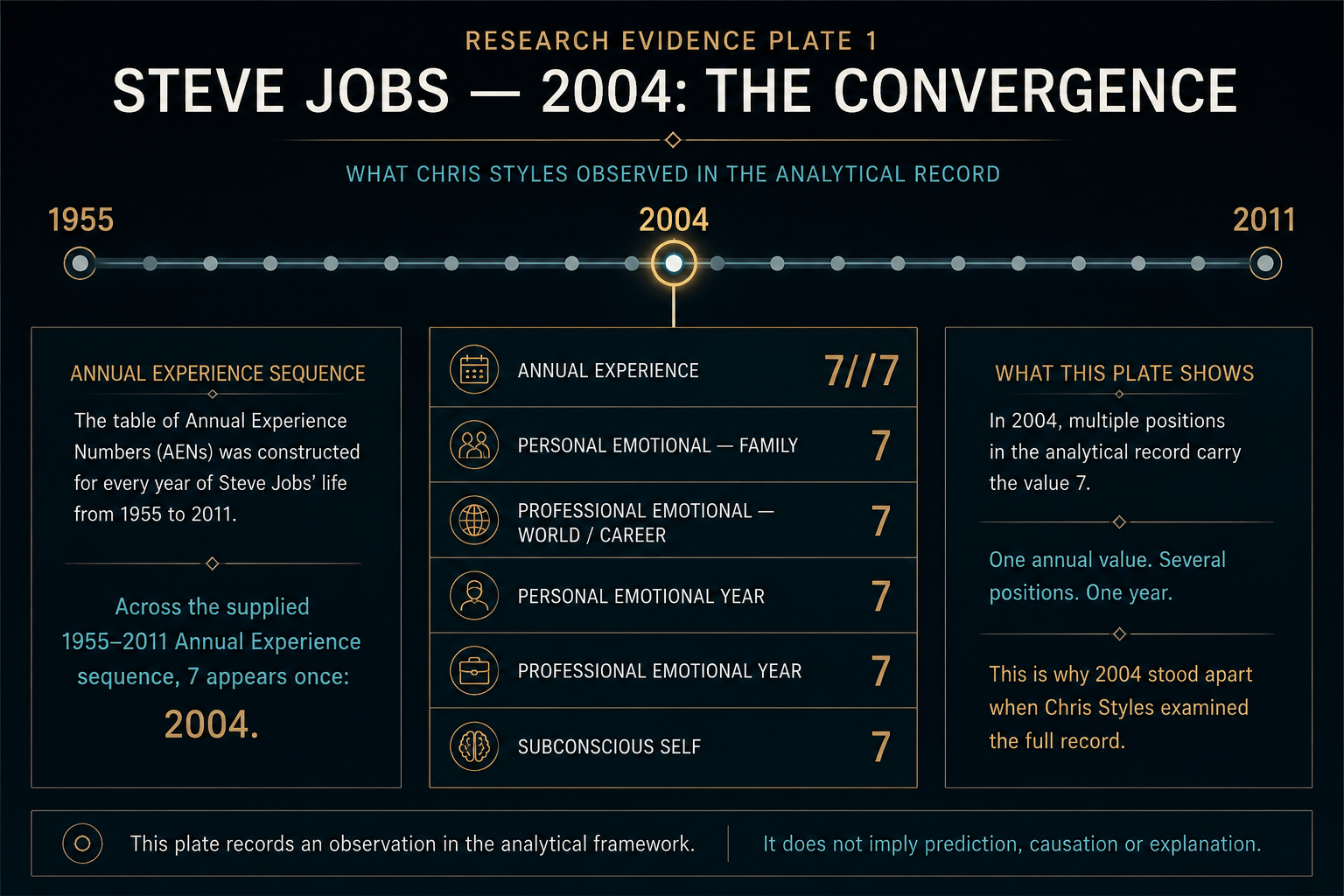
The original research constructed an Annual Experience sequence for every year of Steve Jobs’ life.
Across that entire sequence, Chris identified only one year carrying an Annual Experience 7.
2004: 7//7.
That by itself was enough to make him look more closely. But it was not the only appearance of the same value.
When Chris moved from the longitudinal sequence into Jobs’ underlying analytical structure, he found the same value appearing in several other positions associated with the year.
The recurrence was what caught his attention. Not one isolated number. A concentration. And it was occurring during a period that was already highly consequential in Jobs’ real life.
Jobs had learned in 2003 that he had a pancreatic neuroendocrine tumour. In 2004 he underwent surgery. The analytical framework did not diagnose that tumour. It did not cause it. And the recurrence cannot responsibly be presented as a medical explanation for why Jobs became ill.
That is not the proposition of this Case Study. The interesting question is narrower:
Why did the analytical architecture surrounding 2004 look so unusually concentrated when Chris examined it retrospectively?
What Was Actually Converging?
The strongest way to understand what caught Chris’ attention is not to reproduce pages of historical terminology.
It is to isolate the pattern. For 2004, the original research identified:
- Annual Experience — 7//7
- Personal Emotional — Family — 7
- Professional Emotional — World/Career — 7
- Personal Emotional Year — 7
- Professional Emotional Year — 7
- Subconscious Self — 7
And behind those positions sat the detail Chris found hardest to ignore:
The Annual Experience 7 appeared only once across the entire 1955–2011 annual sequence.
That made 2004 unusual within Jobs’ own analytical record. It did not tell Chris that a particular medical event had to happen. It did not provide a diagnosis.
What it did was focus Chris’ attention on timing. A highly distinctive annual pattern had coincided with an extraordinarily consequential period in Jobs’ life.
That correspondence was enough to keep Chris looking.
The interesting feature was not simply that 2004 contained a 7. It was that the annual 7 occurred nowhere else in Jobs’ lifetime sequence — while several other analytical positions were also carrying the same value.
This is Where the Boundary Matters
Steve Jobs’ health story is particularly vulnerable to hindsight. We know what happened later. Further health problems followed.
- By 2009, Jobs was taking significant time away from Apple.
- In January 2011, he again announced medical leave.
- Then, on 24 August 2011, he resigned as CEO and recommended that Apple implement its succession plan and appoint Tim Cook.
The temptation is to look backwards from that ending and make 2004 appear inevitable. It was not. In 2004, neither Chris nor the framework could have known the entire sequence of events that would follow. And retrospective pattern recognition does not turn correlation into medical causation.
What 2004 does provide is an unusual analytical marker inside a much larger human story.
- A founder whose intensity had helped create Apple.
- A leader whose departure had once separated him from it.
- A returning executive whose performance had made him increasingly central to it.
- And a human being whose physical limits would eventually force one of the world’s most important companies to confront the question of succession.
When The Founder Becomes The Structure
Steve Jobs’ health story is particularly vulnerable to hindsight. We know what happened later. Further health problems followed.
- By 2009, Jobs was taking significant time away from Apple.
- In January 2011 he again announced medical leave.
- Then, on 24 August 2011, he resigned as CEO and recommended that Apple implement its succession plan and appoint Tim Cook.
The temptation is to look backwards from that ending and make 2004 appear inevitable. It was not. In 2004, neither Chris nor the framework could have known the entire sequence of events that would follow. And retrospective pattern recognition does not turn correlation into medical causation.
But the strength of that correlation mattered enormously to Chris.
He was adamant that the concentration he had identified around 2004 corresponded with an exceptionally significant period in Jobs’ life. It was precisely that apparent relationship that intensified his curiosity and pushed the research in a much larger direction.
The question was no longer simply:
What was unusual about Steve Jobs in 2004?
It became:
If a framework could identify years that appeared unusually intense or consequential in one person’s life, what might happen if the same process were applied consistently across hundreds, and eventually thousands, of historical case studies?
That question would become far more important than any single Jobs analysis.
It shifted Chris’ attention away from trying to explain one event and towards testing whether recurring patterns of intensity, transition, pressure and consequence could be observed repeatedly across very different people, organisations and periods.
Steve Jobs therefore became more than an interesting case.
2004 became one of the moments that made Chris want to keep looking.
What 2004 provides is an unusual analytical marker inside a much larger human story.
- A founder whose intensity had helped create Apple.
- A leader whose departure had once separated him from it.
- A returning executive whose performance had made him increasingly central to it.
- And a human being whose physical limits would eventually force one of the world’s most important companies to confront the question of succession.
From Personal Consequence to Organisational Consequence
By August 2011, the question was no longer theoretical.
Jobs wrote to Apple’s board that the day had arrived when he could no longer meet the duties and expectations of the CEO role.
He recommended Tim Cook. Apple followed the succession plan. Jobs became chairman. Cook became CEO. Less than two months later, Steve Jobs died.
For the Apple Case Study, this is the point at which one person’s analytical story begins to become an organisational one.
- The founder had returned.
- The return had helped transform Apple.
- That transformation had made his presence even more consequential.
- Then Apple had to continue without him.
And that creates the question that will travel through every article that follows:
How much of Apple’s later decision environment had already been created by the people who came before?
What This Article Adds to the Case Study
Steve Jobs establishes the longitudinal anchor for the entire Apple Case Study.
His story introduces founder identity, rupture, return, extreme leadership intensity, organisational dependence and succession.
It also establishes an important boundary for everything that follows. Human Futurology is not being used here to explain why Apple’s history happened.
The research asks something more restrained, and potentially more interesting:
what becomes visible when the same developing analytical framework is repeatedly applied to different people and consequential moments inside one organisation?
For Jobs, the first striking observation is 2004. A year that was already significant in the historical record. And, within Chris’ analytical sequence, a year that looked unlike any other.
Now another founder leaves Apple. But for completely different reasons.
Share This Article, Choose Your Platform!
Related Posts






From understanding decisions to informing them.
Beyond the Research
The Business & Leadership archive examines consequential decisions after they have happened.
The Intelligent Mathematical Blueprint and Private Advisory take the underlying Human Futurist thinking into a different environment: helping leaders examine the circumstances surrounding decisions that have yet to be made.