

PREDICTING THE Relationship Breakdown
In 2020, Chris Styles identified 2021–2022 as the critical relationship-ending window.
In 2020, the Ending Had Not Happened
By 2020, Kim Kardashian and Kanye West’s marriage was visibly under pressure.
That matters because the forecast was made while the outcome was still unresolved. Anyone following the couple could see signs of instability. Predicting that everything was perfectly fine would hardly have been the obvious position.
But Chris Styles asked a more difficult question.
Was the turbulence temporary, or was the relationship moving towards an actual ending?
And if it was ending, when would that transition become visible?
Chris did not hedge indefinitely. He identified 2021 and 2022, distinguishing between what he interpreted as emotional endings in the first year and a more physical or formal ending in the second.
That makes the forecast far more interesting than a retrospective celebrity reading.
The outcome was still ahead.
Chris Was Looking for More Than Relationship Pressure
Chris began with Kardashian’s existing architecture.
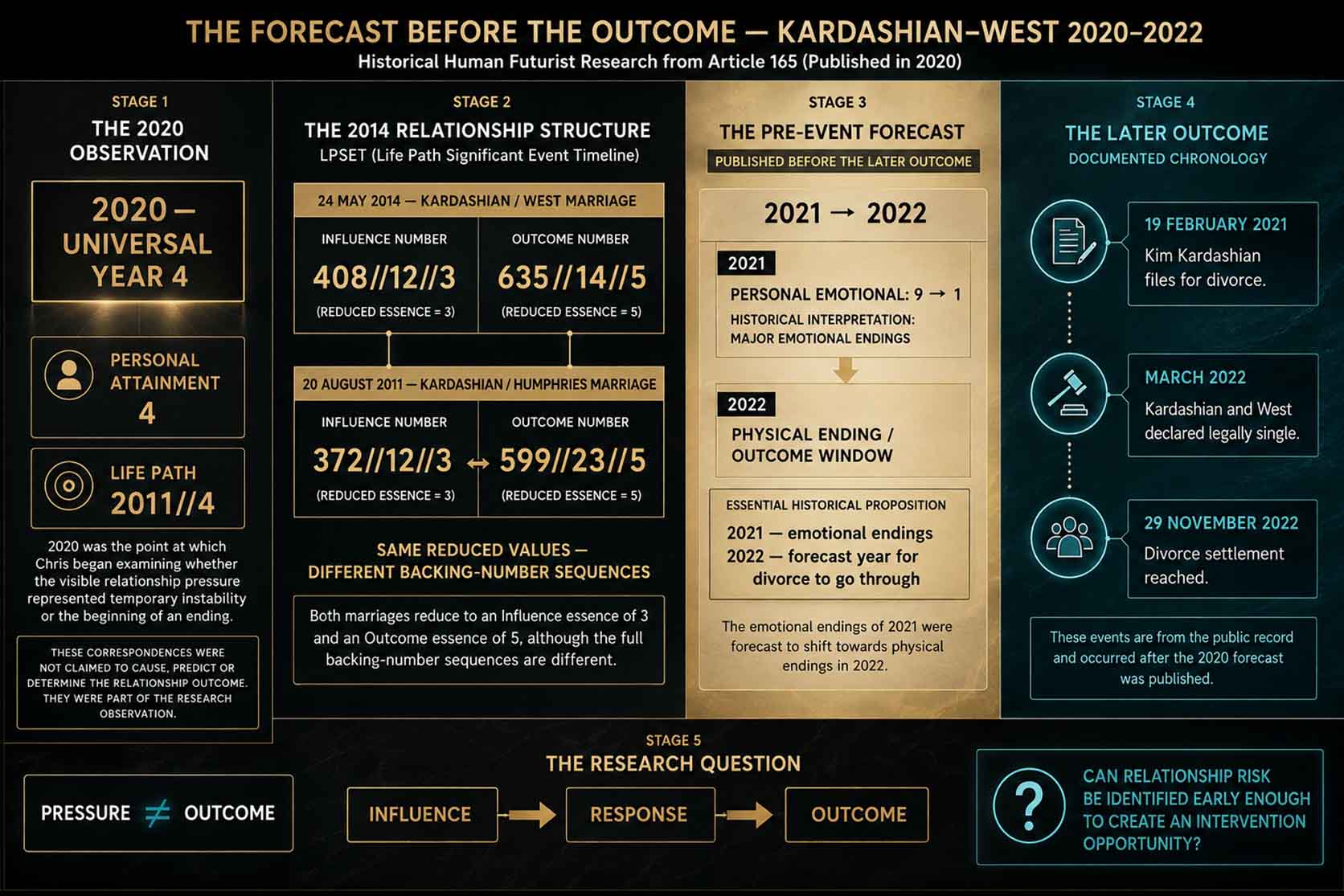
Within the historical model, her date of birth, 21 October 1980, produced a Life Path calculation of 2011//4. Her Personal Attainment position also carried 4.
Then came 2020:
2 + 0 + 2 + 0 = 4.
Chris interpreted this 4-on-4 concentration as significant and used it as a reason to investigate the year more closely. Rather than stopping at the first correspondence, he went deeper into the longitudinal data to see what followed.
The Annual Experience sequence drew his attention towards 2021, associated in the original model with family and endings, and then 2022, which he interpreted as another highly disruptive year.
But there was another layer.
The Earlier Marriage Created an Unexpected Comparison
Chris had been developing a calculation called the Life Path Significant Event Timeline, or LPSET.
Its purpose was to separate two ideas:
Influence Number: conditions surrounding or acting upon an event.
Outcome Number: architecture associated with where that event ultimately leads.
That distinction became particularly interesting when Chris compared Kardashian’s marriage to West with her earlier marriage to Kris Humphries.
For the 2011 Humphries marriage, the model produced:
Influence: 372//12//3
Outcome: 599//23//5
For the 2014 West marriage:
Influence: 408//12//3
Outcome: 635//14//5
The backing numbers are not identical, even though the reduced values repeat.
But both Influence calculations reduce to 12//3, while both Outcome calculations reduce to 14//5. That reduced-value repetition was one of the features Chris considered significant.
It did not prove that the second marriage would reproduce the first.
It gave him another reason to ask whether the model was distinguishing between the forces acting on a relationship and its eventual destination.
The Forecast Was More Specific Than “Something Will Happen”
This is where the forecast becomes genuinely auditable.
Chris did not simply predict a difficult period. Chris stated unequivocally that Kardashian and West would divorce. More importantly, he divided the forecast across two years.
Kardashian’s 9–1 Personal Emotional combination in 2021 was interpreted as a marker of major endings. Chris then proposed that those emotional endings would shift towards a physical ending in 2022.
His explicit forecast was that 2022 would be the year the divorce would go through.
That forecast existed before the later chronology was complete.
The outcome could therefore test the timing claim rather than merely illustrate it in hindsight.
Then the Calendar Began to Catch Up
What happened next can now be separated cleanly from what Chris had written beforehand.
Kim Kardashian filed for divorce from Kanye West on 19 February 2021.
The timing is striking because 2021 was the first year in the specific two-year ending window Chris had identified.
But the legal process did not end there.
In March 2022, a judge declared Kardashian and West legally single while property and custody matters remained unresolved. Then, on 29 November 2022, the former couple reached a divorce settlement.
The later chronology produced an unusually close correspondence with the original forecast:
- 2020 — forecast published during visible relationship instability
- 2021 — divorce filed
- 2022 — legally single and settlement reached
That sequence is the evidential centre of the case.
What the Forecast Got Right and What It Cannot Prove
The forecast deserves to be preserved because it was sufficiently specific to be wrong.
- The marriage could have survived.
- The divorce could have been filed in 2023 or 2024.
- The couple could have reconciled.
- Or the formal process could have fallen materially outside the forecast window.
Instead, the filing occurred in 2021, and the legal dissolution and settlement progressed through 2022.
That makes the case a meaningful prospective hit.
But it does not establish that the numerical architecture caused the divorce, that the outcome was predetermined, or that one successful case validates relationship forecasting generally.
Chris’s original language went much further, presenting the divorce as effectively encoded and inevitable.
The evidence supports a narrower conclusion.
Chris identified the right type of outcome within a comparatively tight period before it occurred.
That correspondence is worth investigating. It is not the same as explaining why the marriage ended.
Pressure Was Not the Same as Outcome
The celebrity story is compelling. The distinction underneath it may be more important.
The comparison separated two ideas that are easy to confuse: the conditions influencing a relationship and the outcome that eventually follows.
- A relationship can experience extraordinary pressure without ending.
- A business can experience financial distress without failing.
- An athlete can enter an extreme pressure window without losing.
- A leader can encounter political crisis without leaving office.
So evidence that something is under pressure cannot automatically be treated as evidence of what happens next.
That distinction can be expressed simply: conditions affecting an event are not automatically indicators of its eventual result.
The harder question is whether the model can tell those two situations apart.
Can the model distinguish:
PRESSURE → RECOVERY
from
PRESSURE → BREAKDOWN?
If it cannot, it may identify consequential periods without actually predicting outcomes.
If it can, that distinction could become considerably more useful.
From Predicting Divorce to Preventing Breakdown
That leads to a more useful question.
Suppose elevated relationship risk really could be identified before a breakdown becomes irreversible.
What should the model be used for? The original instinct was prediction:
Will they divorce?
A more useful Human Futurist question is:
What could people do differently because a period of elevated relationship risk has been identified?
The possibility is a different progression:
SIGNAL → REFLECTION → INTERVENTION → CHOICE → OUTCOME
The purpose would no longer be to tell two people that their relationship is destined to fail.
It would be to identify when communication, behaviour, competing pressures or unresolved conflict may deserve greater attention — and then leave the people involved with agency over what happens next.
The case matters for a reason larger than Kim Kardashian and Kanye West.
In 2020, Chris put a relationship-ending proposition on record. The filing arrived in 2021. Legal dissolution and settlement followed through 2022.
The timing deserves investigation.
But the more valuable question now goes beyond the original prediction:
Can we distinguish relationship pressure from relationship-ending risk early enough for the insight to change what happens next?
That is where prediction begins becoming decision intelligence.
FROM THE HUMAN FUTURIST RESEARCH ARCHIVE
This contemporary feature was developed from the preserved 2020 Human Futurist source, 165 Kim Kardashian divorce numerology predictions.
The original source records the 2021–2022 relationship-ending proposition before Kardashian filed for divorce, including the historical distinction between Influence and Outcome calculations.
Its original terminology and substantially more deterministic claims remain preserved as part of the research record. The public-facing interpretation narrows those claims: the timing correspondence can be audited, but it does not establish numerical causation or explain why the marriage ended.
The original source remains preserved within The Human Futurist Research Archive.
Share This Article, Choose Your Platform!
Related Posts






From understanding decisions to informing them.
Beyond the Research
The Business & Leadership archive examines consequential decisions after they have happened.
The Intelligent Mathematical Blueprint and Private Advisory take the underlying Human Futurist thinking into a different environment: helping leaders examine the circumstances surrounding decisions that have yet to be made.