

When influence scales, so does the cost of getting the message wrong.
The Risk Architecture of Public Communication
The bigger the platform, the greater the consequence carried by a single unexamined message.
When the Teacher Became Part of the Lesson
Tony Robbins built a global career around communication. He does not simply speak for a living: he teaches, challenges, reframes, persuades and attempts to change how people interpret their own experience. That makes language central to his professional architecture. It also creates an unusual asymmetry. When communication works, influence multiplies the benefit. When it fails, influence can multiply the cost.
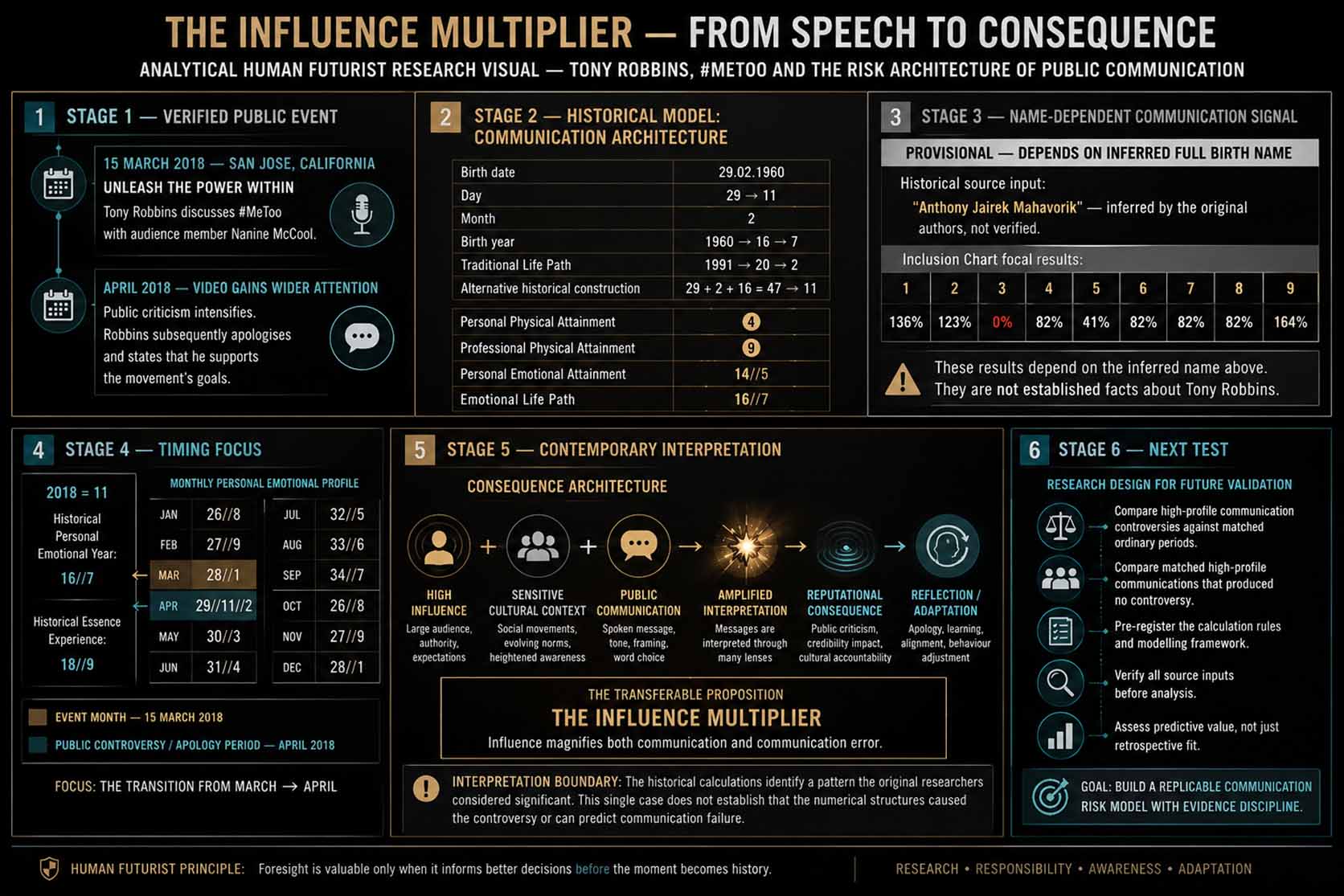
On 15 March 2018, during an Unleash the Power Within seminar in San Jose, Robbins discussed the #MeToo movement with audience member Nanine McCool. The exchange became widely circulated in April. Robbins was criticised for characterising some uses of the movement in terms of “victimhood” and significance, and for an anecdote about a powerful man who had chosen not to hire an attractive woman. He later apologised and said he agreed with the movement’s goals.
Chris was already examining Robbins through the timing framework he was developing. The controversy gave him an unusually visible event against which to compare the model. What caught his attention was not simply that Robbins had entered a difficult public debate, but that communication itself appeared to sit at the centre of the pressure.
A Cultural Movement Meets a Larger-Than-Life Voice
The importance of the case is not that Robbins was uniquely powerful or uniquely wrong. It is that his scale changed the consequence architecture. A private disagreement may disappear. A comparable exchange involving a globally recognised teacher, thousands of people in a room and a rapidly changing cultural debate can travel across media, audiences and countries.
That creates the Influence Multiplier: the proposition that the consequence potential of communication rises with reach, authority and audience sensitivity. The same sentence does not carry the same strategic risk when spoken by everyone.
For leaders, founders, politicians, coaches, athletes and public intellectuals, speech is therefore not merely expression. It can be a high-consequence action.
Then 2018 Began to Stand Out
Chris approached the controversy through the numerical framework he was developing at the time.
Robbins was born on 29 February 1960. The model emphasised;
29 → 11, February as 2, and 1960 → 16 → 7.
A traditional full-date calculation produced 1991 → 20 → 2, while Chris also used an alternative construction, 29 + 2 + 16 = 47 → 11.
Within the four-part architecture:
- Personal Physical Attainment was recorded as 4
- Professional Physical Attainment as 9
- Personal Emotional Attainment as 14//5
- Emotional Life Path as 16//7.
The 2018 Universal Year was 11. Chris considered the recurrence of 11/2 and the 16//7 structure unusually relevant to the year he was examining.
The calculations show what Chris was looking at; they do not establish that those structures caused the San Jose exchange. Their value here is more specific: they identify a pattern that can be compared with other consequential periods rather than treated as an explanation by itself.
The Most Important Number in the Article May Be Zero
Chris then moved from birth-date architecture into a name-based Inclusion Chart. One result dominated the comparison: Number 3 appeared at 0%. Within the framework used at the time, 3 was associated with self-expression and communication. For a man whose profession depends so heavily on speaking, that immediately stood out.
Other reported results included:
- 1 at 136%
- 2 at 123%
- 5 at 41%
- 9 at 164%.
Chris read the combination as a tension between leadership, teaching, intensity, moderation and expression.
That is intriguing, but it also carries a major qualification: the full birth name used to calculate the result was not verified.
Then March Became April
The strongest visual moment comes from the monthly sequence. Chris recorded 2018 as an 18//9 Essence Experience with a 16//7 Personal Emotional Year. Against that background, March calculated as 28//1 and April as 29//11//2.
March was the month of the San Jose exchange. April was when the video gained much wider attention, criticism intensified, and Robbins apologised. In Chris’s interpretation, March marked the start of a new emotional cycle, and April brought the 11 structure directly into the monthly line.
That March-to-April transition is the evidential centre of the case. It matters more than a catalogue of number meanings because it gives us something specific to ask: does a transition of this kind appear disproportionately around consequential communication events?
The Name Problem Changes the Strength of the Claim
Then the analysis encountered a problem. The original authors could not verify Robbins’s complete birth name. They inferred “Anthony Jairek Mahavorik”, partly from the name of his son, and used that inferred input for the name-dependent calculations.
That matters because the model itself depends on precise inputs. The Inclusion Chart and other name-derived findings must therefore remain provisional. A framework that asks to be judged on precision has to apply the same standard to its own source data.
The distinction does not erase the observation; it changes its status. Birth-date calculations can be reproduced from known data. The name-dependent findings remain hypotheses unless the underlying birth record can be independently verified.
From Retrospective Explanation to Decision Intelligence
The most useful idea in the original analysis was practical rather than metaphysical: if a period appeared to deserve greater caution, advance awareness might change how someone acted, spoke or led.
That moves the story away from destiny and towards decision intelligence. If a leader believed a particular period deserved greater communication caution, the useful response would not be fear. It would be governance: slower judgement on sensitive subjects, stronger listening, second-person review, better contextual intelligence and deliberate friction before high-consequence statements.
The model does not need to determine the outcome to be useful. It would need to improve the quality of the decision made before the outcome.
Can We See the Risk Before the Words Leave the Room?
The Robbins controversy makes the underlying mechanism unusually easy to see. But one famous episode cannot tell us whether the timing pattern has wider value.
The next step is straightforward: define the calculation rules in advance, verify the inputs, then compare high-profile communication controversies with ordinary periods and with major public communications that produced no comparable fallout.
Then the question becomes sharper: do the proposed timing structures appear more often around communication breakdowns than around ordinary communication?
The #MeToo exchange is the story that revealed the idea. The Influence Multiplier is what survives beyond Tony Robbins: the larger the platform, the more consequential a communication error can become.
The opportunity is not to claim that a controversy was mathematically inevitable. It is to ask whether heightened communication risk can be recognised early enough to create better judgement before the words leave the room – and before one powerful voice becomes an even more powerful consequence.
From The Human Futurist Research Archive
This contemporary article was developed from historical Human Futurist research preserved as physical Article 20, Tony Robbins Mansplains Me Too. The source remains preserved within The Human Futurist Research Archive. Historical terminology, metaphysical certainty and causal language have been reframed where necessary to distinguish the original interpretation from what the evidence can responsibly support today.
Share This Article, Choose Your Platform!
Related Posts






From understanding decisions to informing them.
Beyond the Research
The Business & Leadership archive examines consequential decisions after they have happened.
The Intelligent Mathematical Blueprint and Private Advisory take the underlying Human Futurist thinking into a different environment: helping leaders examine the circumstances surrounding decisions that have yet to be made.