

The early research asked whether two people can create a relationship pattern neither carries alone.
An Early Co-Joined Model of Attraction, Conflict and Growth
The Relationship Is More Than Two People
Your Content Goes Here
Your Content Goes Here
Why can the same person flourish in one relationship and repeatedly collide in another?
Why can difference create extraordinary attraction in one pairing, yet become a source of persistent conflict in another?
And why do some relationships seem to generate behaviours, pressures and possibilities that are difficult to explain by studying either person independently?
Most compatibility models begin with two individuals.
Chris Styles’ early relationship research began moving towards a different idea: the relationship itself may be a system worth studying.
That shift, from who are these two people? To what do these two people create together? Is what makes this early research interesting today.
It would eventually point towards a much larger Human Futurist proposition: that whenever two human architectures interact, something new may emerge between them.
- Not a predetermined outcome.
- A third system.
Think about two people entering a relationship. Each arrives with their own characteristics, behaviours, strengths, vulnerabilities, ambitions and ways of responding to pressure.
But those characteristics do not operate in isolation. One person’s independence may strengthen another person’s confidence, or make them feel excluded.
One person’s need for structure may provide stability, or feel controlling.
The qualities that make two people fascinating to one another may eventually become the very qualities around which they collide.
That creates an important distinction.
Individual architecture describes the people. Relationship architecture asks what happens between them.
Chris’ early Co-Joined model was an attempt to investigate that second layer.
Rather than treating compatibility as a simple comparison between two individual profiles, he began combining corresponding positions from each architecture and examining the pattern produced by the relationship.
And in one illustrative pairing, something unusual happened.
Then Four Different Paths Converged
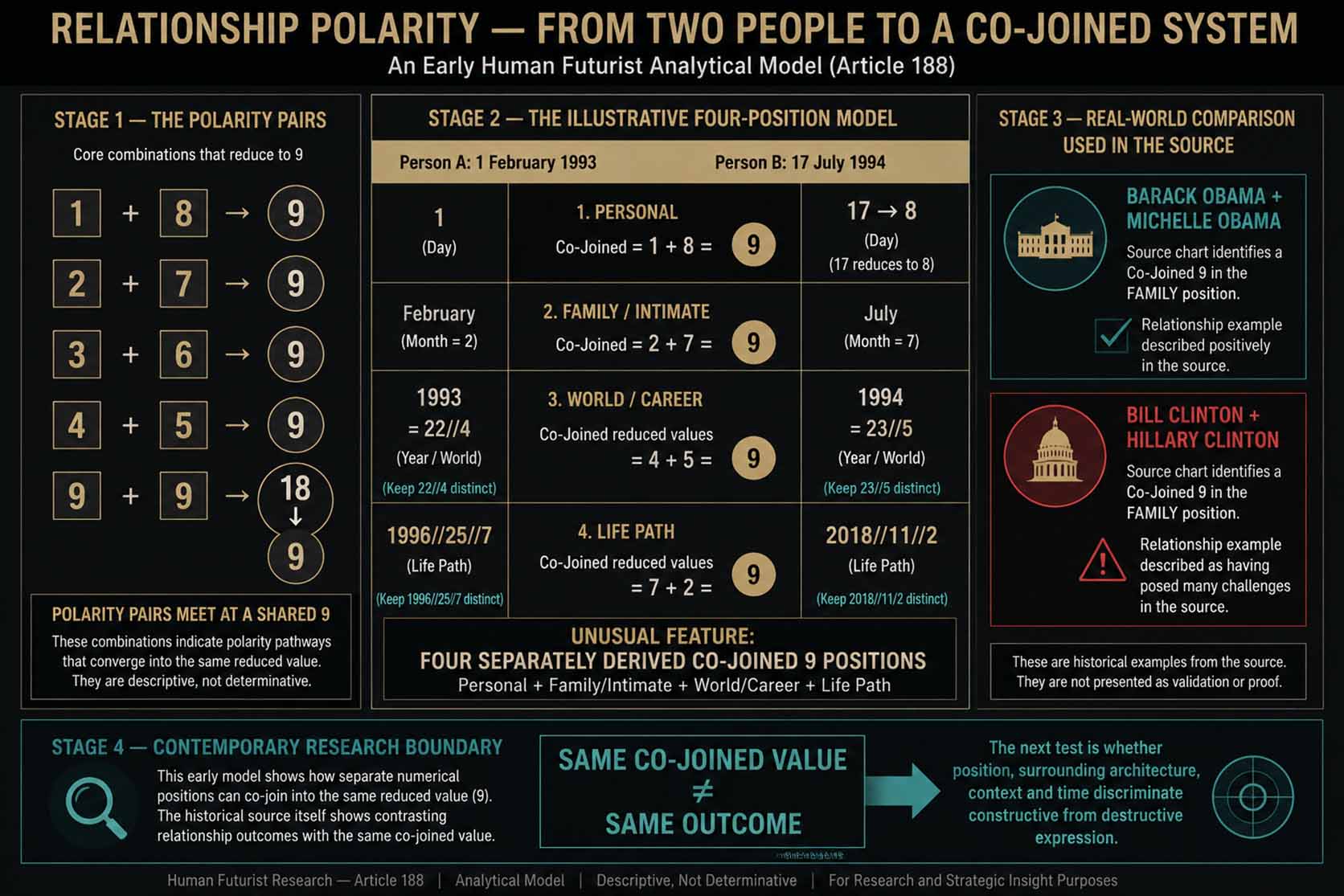
The model used two hypothetical individuals:
- Person A — 1 February 1993
- Person B — 17 July 1994
Chris examined four separately derived positions. The first concerned the personal architecture.
- Person A contributed 1.
- Person B contributed 17 → 8.
Together: 1 + 8 = 9
The second concerned the family or intimate position.
- February contributed 2.
- July contributed 7.
Together: 2 + 7 = 9
Two different calculations had now arrived at the same reduced result. Then it happened again.
For the World/Career position, the research recorded:
- 1993 = 22//4
- 1994 = 23//5
The full backing sequences are different and remain important. But their reduced values combine: 4 + 5 = 9
Finally came what the original research called the Life Path position, terminology retained here only because it identifies the historical calculation.
Person A: 1996//25//7
Person B: 2018//11//2
Again, the full sequences are distinct.
But at the reduced level: 7 + 2 = 9
Four different routes had now converged:
PERSONAL → 9
FAMILY / INTIMATE → 9
WORLD / CAREER → 9
HISTORICAL LIFE PATH → 9
That concentration was the observation. The more important question was what it meant.
Attraction and Conflict May Share the Same Architecture
Chris had noticed a broader structure around these pairings.
- 1 and 8
- 2 and 7
- 3 and 6
- 4 and 5
Each pair reduced to the same shared value.
His early interpretation was that these relationships could generate unusually strong polarity.
People could be intensely attracted to one another while simultaneously possessing characteristics capable of producing considerable friction.
That is an intriguing idea because attraction and conflict are usually treated as opposites.
But relationships rarely behave so neatly. The same difference can produce both.
Someone may initially be attracted to another person’s decisiveness and later experience it as dominance.
Spontaneity can feel exciting until it begins to feel unreliable. Independence can be admirable until one person needs greater connection. Structure can create security until it becomes inflexibility.
The historical research sometimes went considerably further than the available evidence supports, including highly specific probability claims about relationship conflict. Those claims cannot responsibly be treated as established findings.
But the underlying question survives without them:
Could some of the characteristics that draw two people together also become the architecture around which they later experience tension?
That is a question worth investigating.
Then the Pattern Broke Its Own Rule
This is where the research becomes considerably more interesting.
If the repeated combined result represented a fixed relationship outcome, we should expect broadly similar expressions wherever it appeared.
But that is not what Chris’ own examples suggested. The historical research examined Barack and Michelle Obama and identified the same reduced result in their combined Family position. Their relationship was presented positively.
It then examined Bill and Hillary Clinton. Again, the combined Family position produced the same reduced result.
But this relationship was described as having experienced significant challenges.
- Same position.
- Same reduced relationship signal.
- Different relationship stories.
At first glance, that looks like a problem for the model. Scientifically, it may be one of the most useful things in the research. Because the contradiction forces a better question.
If the same signal can appear in relationships with very different outcomes, the signal cannot be the outcome.
Something else has to determine how it is expressed.
Compatibility May Be the Wrong Question
This changes the research proposition substantially. The question is no longer:
Does this pattern mean two people are compatible?
It becomes:
What kind of interaction does this particular combination make more likely, and what determines how the people respond to it?
That opens a much richer field of investigation. Perhaps one relationship contains strong polarity but also excellent communication.
Another contains the same polarity alongside unresolved conflict.
- Perhaps power matters.
- Perhaps emotional regulation matters.
- Perhaps the surrounding individual architectures change the expression.
- Perhaps the position in which the pattern occurs matters.
- Perhaps timing changes what is activated.
- And perhaps two people encountering exactly the same underlying pressure can make completely different decisions.
That moves the model away from compatibility and towards interaction architecture.
The relationship can then be considered as a sequence:
PERSON A + PERSON B → RELATIONAL PATTERN → INTERACTION → RESPONSE → CONSEQUENCE
The distinction between pattern and response is critical. A pattern might identify where pressure could emerge. It does not tell us what someone will do about it.
Pattern Is Not Proof
There is an important evidential boundary around this research.
The four-position example was constructed to demonstrate the Co-Joined model. It was not a longitudinal observation of a real couple.
- The public relationships were selected retrospectively.
- There was no control group.
- There was no pre-registered scoring methodology.
- And the research did not establish how frequently similar configurations occur among relationships that are stable, unstable, highly successful or entirely ordinary.
So the repeated convergence cannot establish that a particular structure causes attraction, conflict, separation or growth. Nor can two public relationships validate the model. But that does not make the observation worthless.
It tells us what needs to be tested next.
The Question Became Bigger
The original research began with intimate relationships. The underlying proposition does not need to stop there.
- Two founders building a company together create an interaction system.
- So do a CEO and chair.
- A coach and athlete.
- A parent and adult child.
- Two political leaders.
- A captain and coach.
- Two executives responsible for making consequential decisions together.
In every case, analysing each person independently may reveal something useful.
But it may miss what emerges between them. That is the larger research opportunity created by this early work.
Instead of asking only:
What is Person A’s architecture? and: What is Person B’s architecture?
Human Futurist research can ask a third question:
What changes when these two architectures meet?
Can We See the Friction Before the Collision?
That is now the test. Freeze the calculation rules before examining outcomes.
Build a sufficiently large sample of relationships and working partnerships.
Compare similar combined structures across radically different outcomes.
Measure relationship quality, conflict, longevity, performance and decision behaviour independently of the Human Futurist model.
Then ask whether particular relational configurations discriminate between productive tension, destructive friction and ordinary difference.
The Obama–Clinton contrast becomes especially important here.
The objective should not be to explain retrospectively why one relationship appeared to work differently from another.
The stronger test is prospective:
Can the model identify the nature of the interaction pressure before we know what happens?
If it eventually can, the practical value would not be in deciding who should marry whom, who should work together or which relationship will survive.
It would be far more useful than that.
It could help identify where two people are likely to reinforce one another, where they may repeatedly misunderstand each other, and where an apparently productive difference could become a source of escalating tension.
- Because insight introduced early enough can change behaviour.
- Behaviour can change decisions.
- And decisions can change consequences.
The most important idea inside this early research may therefore have very little to do with conventional compatibility.
It is the possibility that two people create something neither possesses alone.
And if that emerging relationship architecture can eventually be measured reliably, the question is no longer simply whether two people fit.
It becomes: what can we see between them before they can see it themselves?
FROM THE HUMAN FUTURIST RESEARCH ARCHIVE
This contemporary article was developed from historical Human Futurist research preserved as Physical Article 188, exact source filename “188 Marriage Love Numerology.docx”. The original source remains preserved within The Human Futurist Research Archive. Its historical terminology and certainty claims are retained as provenance where necessary, while the contemporary article focuses on the transferable research proposition: relationship polarity, interaction architecture and the emergence of a third relational system.
Share This Article, Choose Your Platform!
Related Posts






From understanding decisions to informing them.
Beyond the Research
The Business & Leadership archive examines consequential decisions after they have happened.
The Intelligent Mathematical Blueprint and Private Advisory take the underlying Human Futurist thinking into a different environment: helping leaders examine the circumstances surrounding decisions that have yet to be made.