
Chris Styles identified an unusual five-year sequence while it was still unfolding. The consequences came later.
What Did the 2020–2024 Model Actually Identify?
The Five Years That Changed the Stakes
On 24 February 2022, Russia launched its full-scale invasion of Ukraine. Five days later, Chris Styles published Article 215.
By then, one enormous event inside the period he was studying had already happened. That matters. The article cannot be presented today as a prediction of the invasion itself.
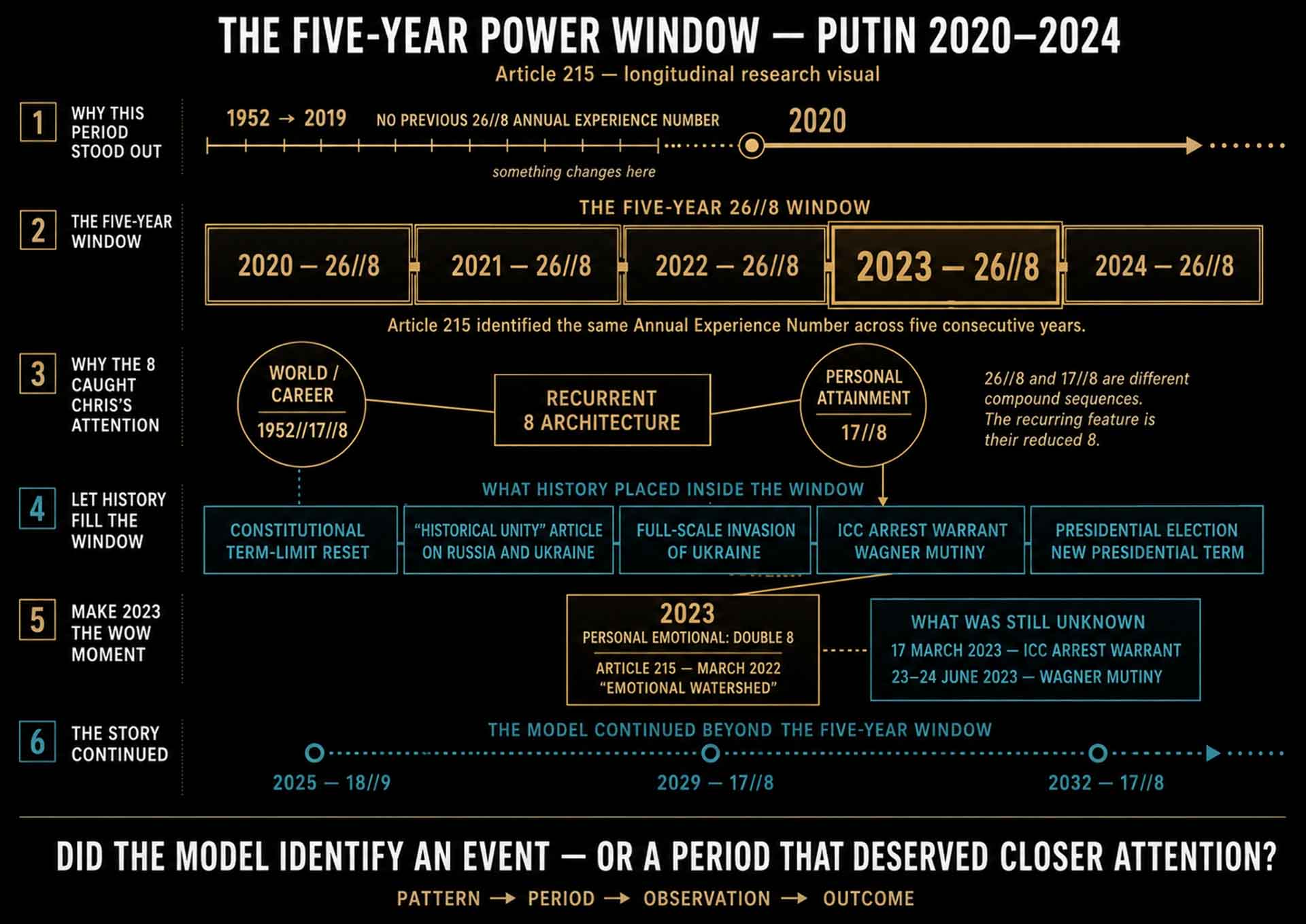
But Chris was looking at something larger than one date. His attention had been caught by a stretch of Vladimir Putin’s longitudinal model that looked unlike anything before it: 2020, 2021, 2022, 2023 and 2024 all carried the same Annual Experience Number — 26//8.
Not one year. Five consecutive years.
The original article argued that this was unique in Putin’s model: 26//8 had not appeared before 2020 and would not appear again in the same extended form. In the language Chris was using at the time, the repeated 8 was associated with power, authority, control and the material exercise of influence.
That was the real hook in Article 215. If the model was pointing to a prolonged power-and-control period rather than a single isolated event, what would those five years eventually contain?
What Chris Saw Before the Window Closed
Chris had built Putin’s Annual Experience Number sequence across the longer life model and was looking for years that behaved differently from the surrounding pattern.
The 2020–2024 run immediately stood out because the same compound value — 26//8 — remained in place year after year. The source did not treat those five appearances as five separate coincidences. It treated them as one sustained period.
That distinction is important because it changes the question. Instead of asking whether one number can point to one event, the case asks whether a prolonged recurrence can describe the character of a whole phase of leadership.
Chris then compared the repeated 8 with Putin’s more stable architecture. Putin’s birth year, 1952, reduces in the historical model to 17//8 and occupies the World / Career position. His Personal Attainment Number, calculated from 7 + 10, is also 17//8.
The backing numbers are different — 26//8 is not the same sequence as 17//8 — but the reduced 8 recurs across the annual window, the career position and the personal-attainment position. That layered recurrence was what made Chris pay attention.
The original article interpreted 26//8 much more aggressively than a contemporary Human Futurist article should. It attached strong psychological claims to Putin and spoke with certainty about motives and future behaviour. Those statements belong to the historical record, but they are not necessary to preserve the central observation.
The compelling part is simpler: Chris found five years dominated by a repeated 8 architecture and published that observation before the period had finished.
The Pattern Behind the Story
Strip away the old numerology language and Article 215 becomes easier to understand.
The model said: watch this period.
From 2020 to 2024, the same Annual Experience Number remained in place. Within Chris’s framework, 8 had long been connected with authority, control, ambition, status and power. Putin already carried 17//8 in both his World / Career position and his Personal Attainment position.
So the interesting feature was not simply the presence of an 8. It was the persistence of it.
Chris was effectively looking at a five-year concentration window in which a theme associated by the historical system with power and control stayed active while Putin was exercising power on a scale that affected Russia, Ukraine and the wider international order.
This is the point at which the research becomes interesting to a reader who knows nothing about the IMB. You do not have to accept the historical interpretation to see why the pattern deserved to be recorded. A rare sequence had been identified in advance of its completion. The next step was to see what history placed inside it.
Five Years, Five Different Expressions of Power
The strongest way to revisit the window now is not to force every year into the same story. It is to notice how differently power appeared across the period.
2020 — rewriting the horizon. Russia adopted constitutional changes that reset Putin’s previous presidential terms for term-limit purposes, creating the possibility of remaining in office beyond the limits that would otherwise have applied. The first year of the 26//8 run therefore opened with a direct question of political continuity and authority.
2021 — the argument becomes explicit. In July, Putin published “On the Historical Unity of Russians and Ukrainians”, setting out his view of the historical relationship between the two countries. At the time it was an ideological and political statement. Seen in the chronology of the next year, it also became part of the road towards a much larger confrontation.
2022 — power moves beyond the border. Russia’s full-scale invasion of Ukraine transformed the five-year window from an interesting numerical proposition into a period of international consequence. Chris’s article was published during the opening days of that war, so this event was already known. The years still ahead were 2023 and 2024.
2023 — power is challenged. The International Criminal Court issued an arrest warrant for Putin in March. In June, Yevgeny Prigozhin and Wagner forces launched a short-lived mutiny that produced the most dramatic internal challenge to Putin’s authority in years.
2024 — power is renewed. Putin won the March presidential election and was inaugurated for another term in May. The window therefore did not end in collapse. It ended with his formal authority re-established and extended.
Taken together, the five years do not tell one simple story of “good” or “bad” 8 energy. They show power being extended, argued, projected, challenged and then consolidated.
The Year Chris Had Marked Before It Arrived
Inside the five-year run, 2023 had an additional feature.
The historical table showed Putin’s Personal Emotional position moving into a double 8. Chris described 2023 as an “emotional watershed” and wrote that power and control would become especially intense themes.
That claim was made in March 2022. The ICC warrant and the Wagner mutiny were still in the future.
This is the article’s genuine prospective moment.
It would be wrong to claim that the model predicted either event specifically. It did not name an arrest warrant. It did not forecast Prigozhin’s rebellion. But Chris had placed a marker on 2023 before those events occurred, and the year did become one in which external legal pressure and internal political pressure converged around Putin personally.
That is a much more interesting observation than retrofitting a precise prediction after the event. The historical record allows us to say exactly what was and was not known when Chris wrote.
It also changes the value of the article. The question is no longer whether 8 “caused” anything. It is whether the model identified a year that deserved unusual attention before the form of that pressure became visible.
The Window Closed. The Model Did Not.
The original Article 215 did not stop at 2024.
It showed the 26//8 run ending after five years and a shift to 18//9 from 2025. It also marked 2029 and 2032 as future years in which 17//8 would return in a more concentrated form, significant in the historical framework because 17//8 exactly matches Putin’s World / Career and Personal Attainment positions.
Those later claims should not be pulled into the 2020–2024 story as though their outcomes are already known. They are more valuable left where they belong: on the record, dated, waiting for future comparison.
That is one of the strongest lessons in the archive. A future-facing model becomes more useful when the forecast is frozen before the result arrives.
The original article also contained a separate prediction about Donald Trump, including a stated probability of more than 80% that he would run again and win the presidency. That is a distinct political forecast about another person and is better audited in the Trump research rather than allowed to distract from the Putin case.
What This Case Really Leaves Us With
Article 215 is strongest when it is not asked to prove too much.
It does not show that numbers caused Putin’s decisions. It does not establish his inner psychological state. And it did not foresee every event that later occurred between 2020 and 2024.
What it did do was identify, while the story was still unfolding, a rare five-year run in Putin’s model and then single out 2023 within that run.
History subsequently filled those years with constitutional change, ideological positioning, war, international legal jeopardy, internal rebellion and renewed presidential tenure.
That is enough to leave a serious question on the table:
Can a longitudinal model identify periods of heightened consequence before we know exactly what the consequence will be?
For the Human Futurist archive, that is the more useful direction. Not certainty. Not prophecy. Not a claim that one sequence explains a war.
Instead: identify the unusual period, record what the model says before the outcome, and then come back later to see whether the period was genuinely different from the years around it.
That is why the five-year Putin window remains worth studying. Chris did not need to know every event in advance for the original observation to matter. The real test is whether a pattern identified before the story ended can repeatedly distinguish the years that later carry the greatest consequence.
FROM THE HUMAN FUTURIST RESEARCH ARCHIVE
This contemporary article has been developed from historical Human Futurist research preserved as Article 215 – Putin’s unique years, published in March 2022 during the opening phase of Russia’s full-scale invasion of Ukraine. The source identified a unique 26//8 Annual Experience Number run from 2020 to 2024, described 2023 as an “emotional watershed”, and recorded later propositions for 2025, 2029 and 2032. The original language was more deterministic than the contemporary archive standard; the present article preserves the historical observations while separating them from later outcomes and from unsupported causal claims.
Share This Article, Choose Your Platform!
Related Posts





From understanding decisions to informing them.
Beyond the Research
The Business & Leadership archive examines consequential decisions after they have happened.
The Intelligent Mathematical Blueprint and Private Advisory take the underlying Human Futurist thinking into a different environment: helping leaders examine the circumstances surrounding decisions that have yet to be made.