

What if creative ability and creative breakthrough are two entirely different problems?
Think And Grow Rich and the Architecture of Creative Attainment
One Book. One Year. A Much Bigger Question.
Most successful books begin long before the world notices them. There is the idea. Then the research. The writing. The abandoned passages. The decisions to continue. The attempt to persuade somebody else that the work deserves to exist. Publication is simply the point at which years of largely invisible activity finally become visible.
For Napoleon Hill, that visible moment came in 1937, when Think and Grow Rich was first published during the Great Depression.
The book became the work most closely associated with his name and ultimately established Hill as one of the most influential figures in the modern success and self-development tradition. The historical Article 72 describes enormous subsequent sales and cultural reach.
But when Chris Styles investigated Hill, the question that emerged was more interesting than another retrospective story about a bestselling author.
Why 1937?
And, underneath that, an even more useful question:
Is creative capability enough to explain exceptional creative achievement?
It sounds obvious that talented writers write successful books. Yet the world is full of people capable of writing who never finish the manuscript, people who finish manuscripts that are never published, published writers who never reach a large audience, and brilliant work that appears at a moment when the world simply does not respond.
Creativity produces possibility. Something else has to convert possibility into consequence. That is what makes Hill worth revisiting.
Chris Wasn’t Looking for a “Success Number”
The original research began with Hill’s date of birth: 26 October 1883.
The historical 365 Pin Code birth chart identified several positions, but only a few matter to this investigation.
Hill’s Professional Attainment Number was 10//1.
His Personal Attainment Number was 9.
His Life Path was calculated as 2, while what the original chart called his Shadow Life Path, described in contemporary Human Futurist terminology as his Emotional Life Path, was 16//7.
His day of birth, 26//8, was interpreted through themes involving material achievement, business, authority and the relationship between ideas and material outcomes.
The historical article made much of those meanings. Contemporary research need not endorse all of them to preserve the more interesting analytical structure.
Chris focused especially on the Professional Attainment 10//1 because the historical methodology associated Number 1 with independence, originality, leadership, initiative and attainment.
He then did something more important than simply matching that number against a successful man’s biography.
He modelled Hill longitudinally.
That shift, from static profile to time sequence, is where Article 72 becomes useful.
Instead of asking only what architecture Hill possessed, Chris asked when particular parts of it became especially active within the model.
The year-by-year data around the publication of Think and Grow Rich gave him an answer he considered unusually striking.
Then 1937 Changes the Pattern
Look at the surrounding period first.
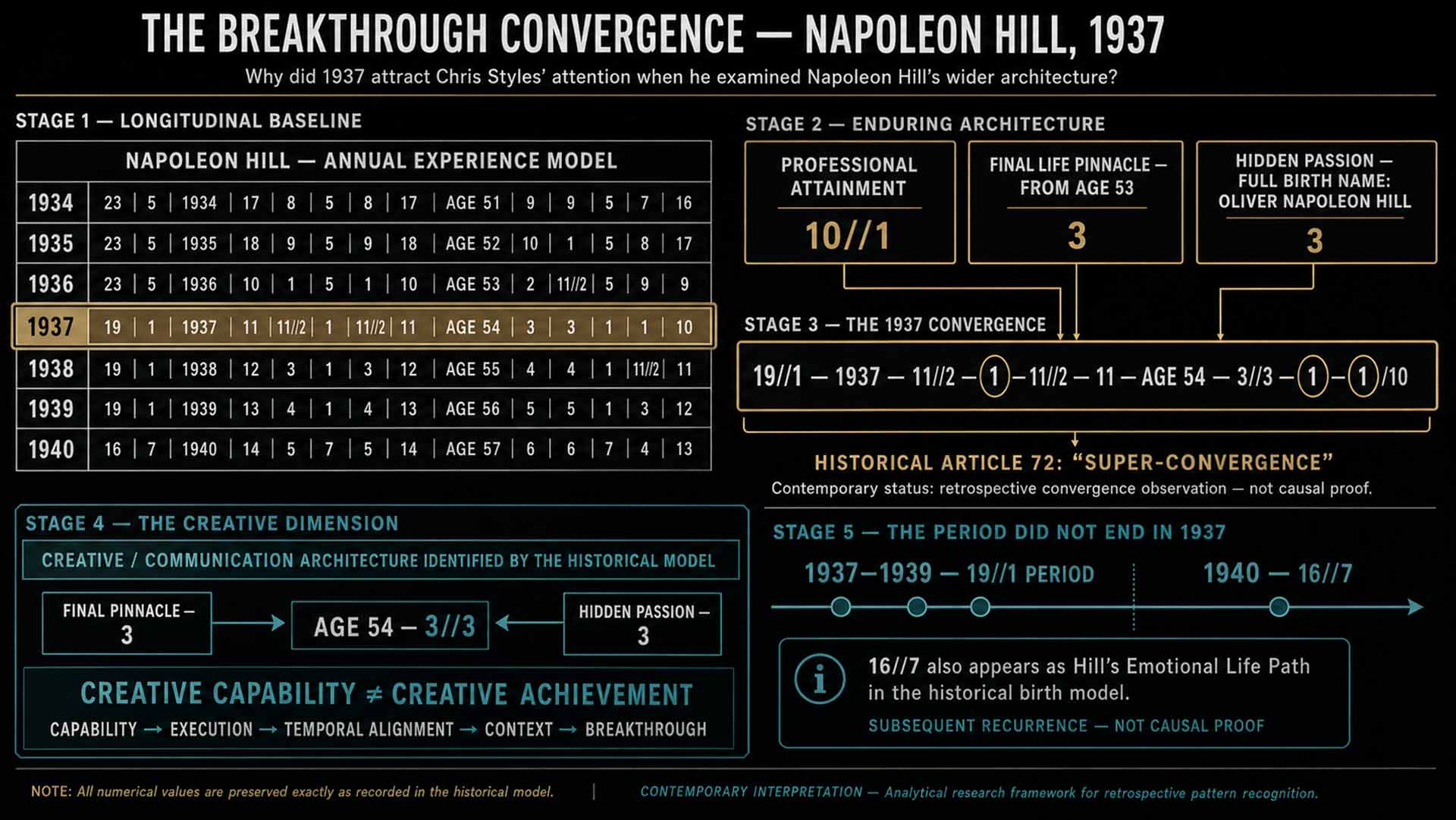
Hill’s annual model moves through:
- 1934 — 23//5
- 1935 — 23//5
- 1936 — 23//5
Then the leading sequence changes.
- 1937 — 19//1
- 1938 — 19//1
- 1939 — 19//1
Before changing again:
- 1940 — 16//7
That means 1937 is not an isolated number pulled from an entire life after the event. It marks the beginning of a three-year 19//1 period within the historical construction.
But the real point that caught Chris’s attention lay inside the full 1937 line:
19//1 — 1937 — 11//2 — 1 — 11//2 — 11 — AGE 54 — 3//3 — 1 — 1//10
The Number 1 Convergence
Article 72 identifies three Number-1-related convergence points inside the 1937 line.
The historical article called this a “super-convergence” and connected it directly with Hill’s existing Professional Attainment 10//1.
In its original language, the source went much further. It treated the convergence as proof that 1937 had effectively been coded as Hill’s moment of greatness.
That is not a conclusion the contemporary archive needs to reproduce. What can be said is narrower, and more interesting.
A year already known for Hill’s defining publication contains several Number-1 occurrences within a model in which Professional Attainment had independently been calculated as 10//1.
That is a legitimate retrospective observation.
Whether that architecture discriminates breakthrough years from ordinary years remains an empirical question.
The Three-Year Window
The broader sequence adds another layer.
The 19//1 structure continues through 1938 and 1939, meaning that the publication year sits at the opening of a larger period rather than standing completely alone.
Then, in 1940, the leading sequence becomes 16//7.
That is noteworthy within the model because 16//7 is also the value recorded for Hill’s Emotional Life Path.
Again, recurrence is not causation. But this is exactly the type of longitudinal relationship the contemporary Human Futurist programme is interested in testing: when enduring architecture reappears in time-specific positions, does anything measurably different happen?
The Hill case cannot answer that question by itself. It can help us formulate it.
Creativity Was Only Half the Story
The Number 1 convergence would already have made 1937 interesting to Chris.
Then he found the 3s. Hill entered his fourth and final Pinnacle at age 53. The value attached to that Pinnacle in the historical methodology was 3.
In 1937 he was 54. The annual line itself contains: AGE 54 — 3//3
And the historical full-name analysis of Oliver Napoleon Hill also identified 3 as his Hidden Passion Number, based on four occurrences of the value within the name calculation.
Within the methodology, Number 3 was associated with creativity, imagination, communication and self-expression.
This creates the article’s strongest intellectual shift.
If Number 3 is treated as a possible architecture of creative expression, it still does not explain why one creative person produces a globally influential work while another does not.
Hill’s model contains a combination.
- Creative-expression architecture — 3.
- Professional-attainment architecture — 10//1.
- A time-specific 1 concentration — 1937.
And an actual act of execution: researching, organising, writing and publishing the book.
That suggests a much more sophisticated research proposition than: “successful authors have a creativity number.”
Instead: “creative capability may be one variable; converting it into consequential achievement may require a different combination of execution, persistence, opportunity, timing and context.”
This is the Creativity–Execution Gap. And it is considerably more useful than trying to find a single numerical signature for success.
What Happened Before the Breakthrough Matters Too
Hill’s own philosophy repeatedly emphasised persistence after defeat.
That makes an interesting behavioural counterpoint to the numerical model.
Whatever one thinks of the historical interpretations, Think and Grow Rich did not appear because 1937 arrived and Hill suddenly became capable of writing it.
The work presented in the historical source is connected to a much longer intellectual journey.
Hill claimed that an important turning point occurred in 1908, when Andrew Carnegie challenged him to investigate the principles underlying exceptional achievement.
Chris therefore went backwards in the model.
The 1908 line contained:
18//9 — 1908 — 18//9 — 9 — 9//18 — AGE 25
This interested him because Hill’s Personal Attainment Number was also 9.
The original Article 72 used this convergence aggressively, arguing that the numerical correspondence supported Hill’s account of 1908.
But that creates an essential evidence problem. A pattern around a claimed historical event cannot verify that the event itself happened. And Hill’s Carnegie story is disputed.
That distinction is critical to the contemporary article.
The Carnegie Problem Cannot Be Solved With Numbers
Article 72 itself acknowledges that Hill’s biography has attracted substantial controversy.
It records doubts over his claimed relationship with Andrew Carnegie and notes that researchers and biographers have questioned whether the famous meeting occurred as Hill later described it.
That cannot be brushed aside because the numerical pattern is appealing.
Nor should the controversy erase the separate historical fact that Think and Grow Rich became an extraordinarily influential work.
These are different questions. Was the book culturally consequential? Yes, that is the historical phenomenon Article 72 is studying.
Are all of Hill’s autobiographical claims independently established? No. The historical source itself acknowledges serious dispute.
Can a 1908 numerical convergence authenticate the Carnegie story? No. The contemporary value of the 1908 observation is therefore methodological rather than biographical.
It shows precisely why retrospective pattern research requires an evidence boundary. A model can be compared with a recorded claim. It cannot convert a disputed claim into verified history.
That is not a weakness in contemporary Human Futurist research. It is part of the discipline required to make the archive more useful.
From Creative Talent to Breakthrough Architecture
The deeper value of Article 72 emerges when Hill is temporarily removed from the picture.
Imagine two people with comparable creative capability.
Both have ideas. Both communicate well. Both can produce original work. One creates something of lasting consequence. The other does not. What explains the difference? Talent alone cannot.
There are too many intervening variables:
- Capability.
- Execution.
- Persistence.
- Completion.
- Exposure.
- Timing.
- Distribution.
- Audience need.
- Historical context.
- Chance.
Think and Grow Rich appeared in 1937, while economies and individuals were still living with the consequences of the Great Depression. A book centred on achievement, prosperity, purpose and personal agency entered a very particular cultural environment.
The Human Futurist Archive Analysis calls this “Contextual Amplification.”
The idea is straightforward. The same capability may produce radically different outcomes depending upon the environment into which it emerges.
That means breakthrough architecture, if such a phenomenon can eventually be demonstrated, cannot simply be located inside the person.
It must involve the interaction between person and moment. A useful contemporary model therefore becomes:
DOMAIN CAPABILITY → EXECUTION → TEMPORAL ALIGNMENT → CONTEXT → BREAKTHROUGH
- Not every talented person completes.
- Not everything completed finds an audience.
- Not every good idea arrives when the surrounding environment is ready to amplify it.
And even an apparently favourable period cannot substitute for action. The opportunity is not the achievement.
The Test That Should Come Next
Article 72 is retrospective. Chris knew that Think and Grow Rich had been published in 1937 before he examined the year. That means the case can generate a hypothesis, but it cannot independently validate one.
The next stage needs to be harder. Take a pre-defined cohort of writers, innovators, entrepreneurs or other creative achievers. Calculate their stable architecture without selecting them because a desired pattern is already known.
- Define breakthrough objectively.
- Compare breakthrough periods with ordinary periods.
- Include people with similar architecture who did not achieve the same outcome.
- Measure how frequently the apparent convergence occurs without a breakthrough.
- Then replicate the work.
Only then can we begin answering the question Article 72 raises. But even before that testing exists, Hill’s case contributes something valuable to the evolution of Human Futurist research.
It changes the question.
From: “What number makes somebody creative?”
To: “What separates creative capability from consequential creative achievement?”
That question applies far beyond authors. It applies to entrepreneurs who can imagine but cannot execute. Researchers who discover but cannot translate.Innovators whose ideas arrive too early. Artists who create but never expose the work. Leaders who possess capability but fail to convert it into an outcome.
The interesting thing about 1937 is therefore not that a set of numbers supposedly made Napoleon Hill successful.
It is that Chris’s retrospective model placed creative expression, attainment architecture and a concentrated professional period around the same historical breakthrough.
That is not proof. It is a research signal.
And the bigger proposition it leaves behind may be much more important than the individual case:
Creativity generates possibility. Execution carries it forward. Context determines what the world can do with it. Breakthrough occurs where those forces meet.
The research becomes more valuable when it stops asking which number creates success and starts asking what has to converge for human potential to become real-world achievement. Hill’s 1937 breakthrough gives us a signal. The next responsibility is to test whether that signal repeats when we do not already know the outcome.”
— Chris Styles
FROM THE HUMAN FUTURIST RESEARCH ARCHIVE
This contemporary Feature Research article has been developed from Article 72 — Numerology of Think and Grow Napoleon Hill, historical Human Futurist / 365 Pin Code research dating from approximately 2019. The original paper retrospectively investigated Napoleon Hill’s numerical architecture around the 1937 publication of Think and Grow Rich, including the 10//1 Professional Attainment structure, the 1937 convergence, Number 3 creative architecture and the disputed 1908 Carnegie narrative. Contemporary terminology and evidential conclusions have been reframed; the original source remains preserved within The Human Futurist Research Archive.
Share This Article, Choose Your Platform!
Related Posts






From understanding decisions to informing them.
Beyond the Research
The Business & Leadership archive examines consequential decisions after they have happened.
The Intelligent Mathematical Blueprint and Private Advisory take the underlying Human Futurist thinking into a different environment: helping leaders examine the circumstances surrounding decisions that have yet to be made.