

The more extraordinary a pattern looks, the harder we should test what it actually means.
A Date That Looks Almost Designed to Be Noticed
Some patterns are easy to dismiss. Others make you look twice.
John F. Kennedy was assassinated in Dallas on 22 November 1963. In Chris Styles’ historical Human Futurology research, the date immediately produced an unusual concentration.
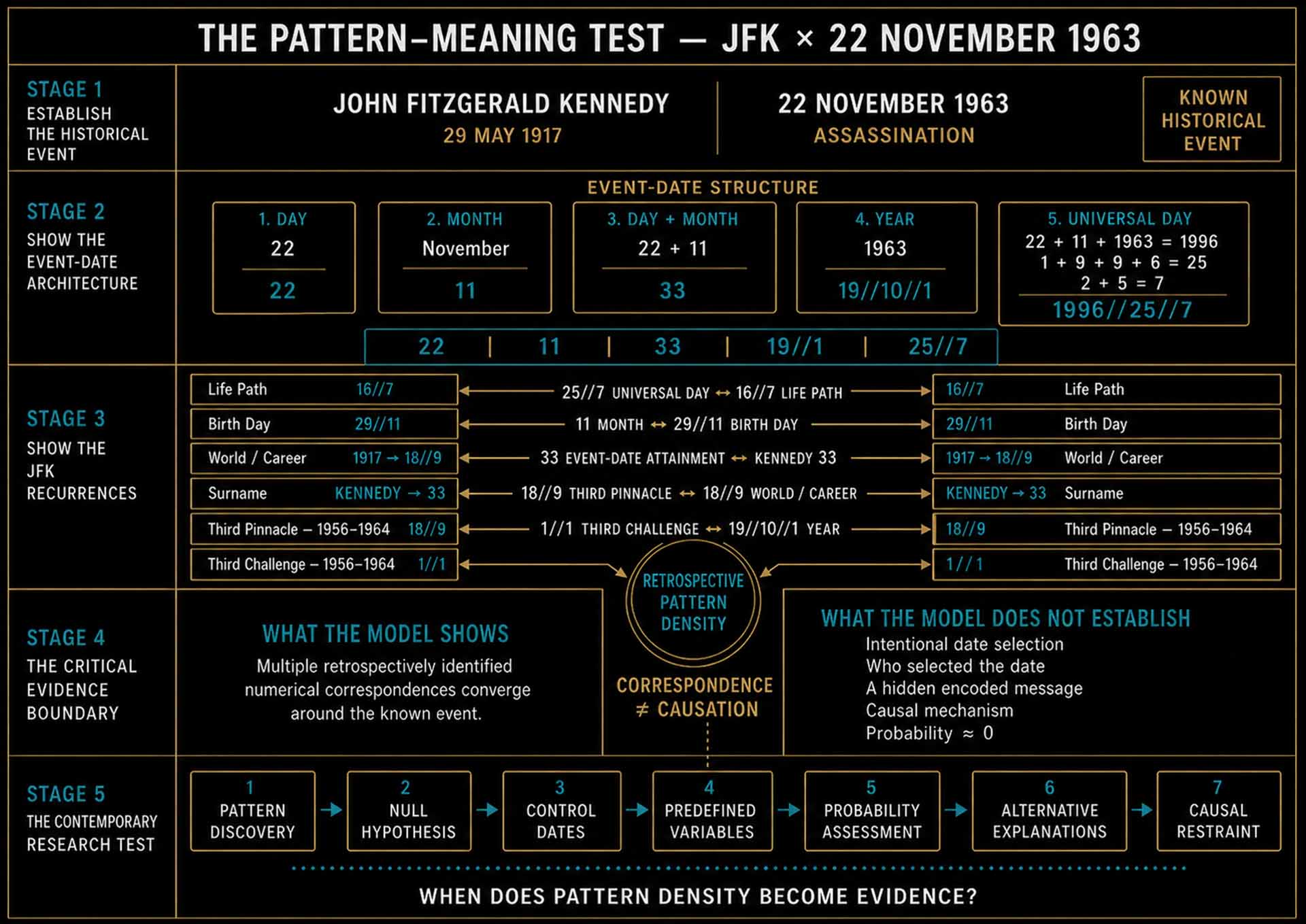
The day was 22. The month was 11. Add them together and the date produces 33. Then calculate the complete date: 22 + 11 + 1963 = 1996 → 25 → 7.
Inside the historical system Chris was using, those were not ordinary values. 11, 22 and 33 were treated as Master Numbers, while 7 already occupied important positions in Kennedy’s underlying architecture. The source therefore opened with an emphatic proposition: all three Master Numbers appeared on the day Kennedy was assassinated.
That is the point at which Article 193 becomes fascinating. It is also the point at which a contemporary researcher should become cautious.
Because the real question is not simply:
How many correspondences can we find?
It is:
What are we entitled to conclude once we have found them?
What Chris Saw When He Mapped the Day
Chris began with Kennedy’s date of birth: 29 May 1917. Within the historical calculation, Kennedy’s Life Path was recorded as 16//7. His birth day, 29, reduces through 29//11//2, introducing 11. His birth year, 1917, reduced through 18//9, creating what the model described as his World or Career position.
Then Chris constructed the numerical architecture of 22 November 1963.
22. 11. 33. And Then 7.
The first layer looked unusually compact:
- Day: 22
- Month: 11
- Day + month: 33
- Year 1963: 19//10//1
- Universal Day: 1996//25//7
The visual chart in the original article made the emphasis explicit. Three red circles drew attention to 33, 22 and 11 on the Personal Physical side of the death-date chart, while 7 occupied its central Universal Day position.
For Chris, this was the first important concentration. Not one occurrence. Several. The date appeared to be generating a cluster.
That distinction matters in Human Futurist research. An isolated occurrence may be interesting. Pattern Density concerns the accumulation of multiple relevant correspondences around the same event or bounded period.
But the date itself was only the beginning.
Then the Pattern Becomes Difficult to Ignore
Chris next compared the event architecture with Kennedy’s existing positions.
The assassination occurred on a 25//7 Universal Day. Kennedy’s historical Life Path calculation was 16//7. November introduced 11.
Kennedy had been born on the 29th, producing 29//11 in the historical model. The combination 22 + 11 generated 33.
Then Chris calculated the surname Kennedy as 33. And the wider life-cycle model produced another recurrence.
According to the original Pinnacle and Challenge table, Kennedy was in his Third Pinnacle from 1956 to 1964. Its value was 18//9, the same compound sequence generated from his 1917 World or Career position.
His concurrent Third Challenge was 1//1, while 1963 itself reduced through 19//10//1.
Now the architecture looked less like one interesting calculation and more like a web of correspondence:
- 7 ↔ 7
- 11 ↔ 11
- 33 ↔ 33
- 18//9 ↔ 18//9
- 1 ↔ 1
This is Article 193’s evidential “wow” moment. Chris was not looking at one number that happened to resemble another. Within the rules of his system, multiple components appeared to converge around a single historically consequential event.
That deserves attention. It does not yet tell us what the pattern means. And that is where the original article crossed an important boundary.
The Dangerous Leap from Pattern to Meaning
The historical source did more than identify correspondence.
It interpreted the concentration as evidence that the assassination date had been intentionally selected to carry a deeper coded message. It subsequently extended the analysis into words and locations such as “Dallas, Texas”, “Conservatives” and “Free Masons”, identifying further numerical relationships. It ultimately stated that the probability of Kennedy’s assassination being random was “around zero”.
And the source does not provide a statistical calculation capable of supporting a probability of randomness “around zero”.
That matters because it changes the most useful question we can ask of the article today.
The interesting discovery is not that Chris found nothing. He found a genuinely striking concentration.
The issue is what happens next.
When a pattern looks this persuasive, how do we distinguish something worth investigating from something we have simply become very good at explaining after the event?
That is what makes Article 193 more valuable now than a straightforward conspiracy argument.
It becomes a case study in the distance between pattern and proof.
When a Pattern Starts to Feel Like Proof
There is something psychologically powerful about accumulation.
One coincidence can be dismissed. Two make us curious.
But when 7 connects with 7, 11 with 11, 33 with 33, 18//9 with 18//9 and 1 with 1, the instinctive reaction changes.
Surely there is too much here for this to be accidental?
That reaction is precisely why this case matters. Chris had found what contemporary Human Futurist research would now describe as Pattern Density: several relevant correspondences concentrating around one historically important moment.
But dense patterns create a second problem. The richer the model becomes, the more places there are to look.
Kennedy can be examined through his birth date, name, Life Path, annual structures, Pinnacles, Challenges and other positions. The assassination can be examined through its day, month, year and combined date. Once locations, words and further contextual material are added, the number of possible comparisons grows again.
That does not invalidate what Chris found. It simply means that the number of opportunities to discover a pattern matters too.
This creates a contemporary Human Futurist question I would retain as a named concept:
The Retrospective Freedom Problem.
When we already know that something extraordinary happened on 22 November 1963, it becomes much easier to search the surrounding architecture for relationships that help explain why that date looks extraordinary.
The stronger test is different:
Would the same model have identified 22 November 1963 as unusual if we did not already know what happened that day?
That one question takes the JFK research somewhere much more interesting.
Could the Pattern Survive a Blind Test?
The next step is conceptually simple. Take Kennedy’s underlying numerical architecture.
Remove the assassination date. Then ask the model to distinguish unusual dates from ordinary ones.
The rules would need to be set in advance: what counts as a recurrence, which relationships matter and how much convergence qualifies as unusual.
Then the same rules would be applied across a much wider period rather than only to the date already known to contain a major historical event.
That creates a much stronger question: Does 22 November 1963 still stand out when it has to compete against all the dates around it?
And then the test can go further.
Do similarly consequential periods around other political leaders produce comparable concentrations?
- Do uneventful periods sometimes produce patterns just as dense?
- Can independent researchers applying the same rules identify the same dates?
- This is where the research visual becomes useful.
PATTERN DISCOVERY → NULL HYPOTHESIS → CONTROL DATES → PREDEFINED VARIABLES → PROBABILITY ASSESSMENT → ALTERNATIVE EXPLANATIONS → CAUSAL RESTRAINT
The reader does not need every methodological detail here.
The important principle is simpler:
A pattern becomes more persuasive when it survives comparison with the places where the pattern should not be.
If the JFK date remains unusually dense under those conditions, the finding becomes considerably more interesting.
If it does not, that tells us something important too. Either result moves the research forward.
Why This Article Is More Valuable Now Than When It Was Written
There is an obvious temptation with an archive like Human Futurist.
- Preserve the successes.
- Show the striking coincidences.
- Emphasise the cases that look extraordinary.
- Quietly leave the difficult methodological questions behind.
- That would make the archive weaker.
Article 193 offers the opposite opportunity.
Chris found something he regarded as extraordinary. The contemporary archive can preserve that discovery while being more restrained about what the discovery proves.
Preserving that progression makes it possible to see how the research standard itself has changed.
The valuable observation survives:
Kennedy’s assassination date generates unusually dense correspondence within the historical model.
The unsupported conclusion does not need to survive with it. That is intellectual progress.
It allows the Human Futurist archive to distinguish three things that earlier research frequently compressed together:
Historical claim – Chris originally interpreted the concentration as intentional numerical design.
Contemporary observation – multiple correspondences can indeed be constructed between Kennedy’s underlying numerical architecture and 22 November 1963.
Research proposition – pattern density may be worth studying systematically, but its significance must be established against controls, predefined rules and alternative explanations.
The distinction strengthens rather than diminishes the research.
From Finding Patterns to Testing Them
The JFK case ultimately leaves us with a much more interesting question than whether someone secretly chose an assassination date because of 11, 22 and 33.
It asks what should happen after a researcher discovers something that looks extraordinary.
Pattern recognition is valuable. It is often where investigation begins. But pattern recognition can also become dangerous when the pattern itself is allowed to supply its own explanation.
The denser the pattern becomes, the greater the temptation to assign meaning. And therefore the greater the obligation to test it.
This makes this article an important Political Leadership study, but its real relevance extends much further.
- Business decisions.
- Sporting performance.
- Career transitions.
- Relationship events.
- Institutional collapse.
- Political change.
Anywhere Human Futurist research finds a high-density convergence, the same question should follow:
Compared with what?
The question becomes whether the same pattern still looks extraordinary when it is compared with ordinary periods, tested by consistent rules and examined by someone who does not already know the answer. Those questions move Human Futurist research from the seduction of correspondence towards the discipline of evidence.
Kennedy remains the historical case.
But Pattern Density versus Evidential Weight is the enduring research proposition.
A remarkable pattern deserves attention. A very remarkable pattern deserves rigorous testing.
Because finding meaning in a pattern and demonstrating that the meaning is real are not the same achievement.
FROM THE HUMAN FUTURIST RESEARCH ARCHIVE
This contemporary article has been developed from historical Human Futurist research preserved as Article 193 Assassination of JFK. Archive ID HF-RA-193.
The original research identified numerous numerical correspondences surrounding John F. Kennedy’s birth architecture and assassination date and interpreted them as evidence of intentional timing and deeper encoded meaning. Those historical claims remain preserved as part of the permanent research record.
The contemporary article does not treat those causal or conspiracy interpretations as established. Instead, it preserves the underlying pattern evidence while repositioning Article 193 around the methodological distinction between Pattern Density and Evidential Weight.
Historical “Shadow” terminology has been replaced by Emotional terminology in contemporary explanatory language where relevant; original chart terminology remains historical evidence.
The original document remains preserved within The Human Futurist Research Archive.
Share This Article, Choose Your Platform!
Related Posts






From understanding decisions to informing them.
Beyond the Research
The Business & Leadership archive examines consequential decisions after they have happened.
The Intelligent Mathematical Blueprint and Private Advisory take the underlying Human Futurist thinking into a different environment: helping leaders examine the circumstances surrounding decisions that have yet to be made.