
Independence, Emotional Pressure and an Early Risk-Management Model
When autonomy meets constraint, the greatest leadership risk may appear before the decision does.
When One Person Can Move an Organisation
By August 2018, Elon Musk had become one of the most visible examples of founder power.
A tweet could move markets. A sudden announcement could create uncertainty for investors. A decision made personally could rapidly become a corporate governance issue.
Chris Styles was interested in something underneath all of that. What if the intense independence that had helped Musk build extraordinary businesses could, under certain conditions, become a source of risk?
And what if those conditions could be seen before the next consequential decision was made?
That question led Chris back into Musk’s numbers.
Three Names. The Same Underlying Number.
Chris began with something unusually simple.
Within the historical 365 Pin Code methodology, each component of Musk’s name was calculated separately:
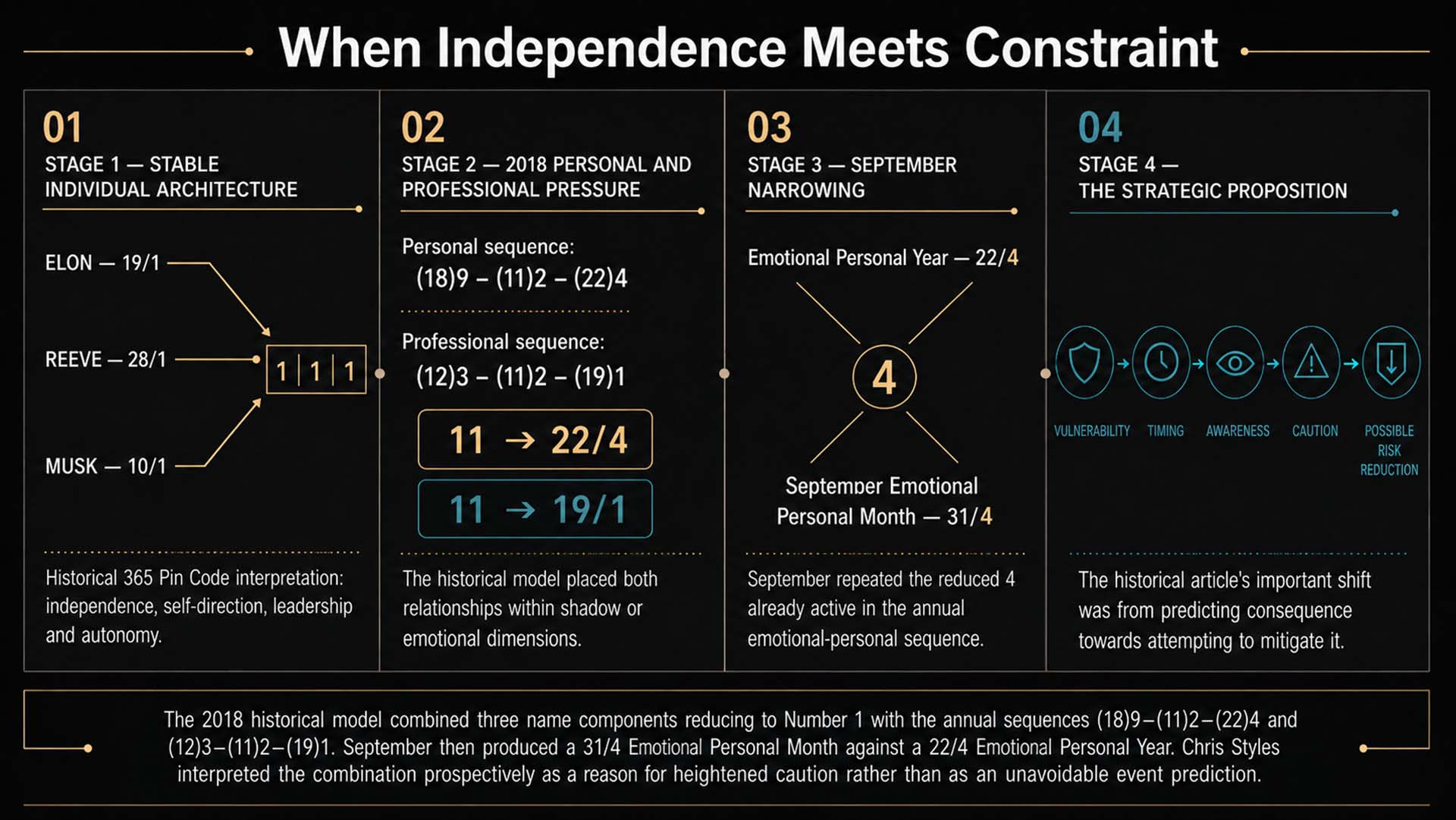
Elon = 19/1
Reeve = 28/1
Musk = 10/1
Three different names. Three different backing numbers.
Yet all three reduced to the same value: ‘1′.
Within Chris’s methodology, Number 1 was associated with independence, leadership, self-direction, attainment and a powerful desire to act autonomously.
One occurrence might not have attracted much attention. Three did. For Chris, the repetition created an unusually concentrated independence theme.
It also raised a fascinating leadership question.
The ability to resist convention can be precisely what allows a founder to do what others believe impossible. But what happens when that same independence begins colliding with boards, shareholders, regulation or governance?
At what point does a strength begin working against the person who possesses it?
Chris believed Musk’s 2018 timing architecture might offer another clue.
Then Chris Looked at 2018
The model Chris was developing did not treat a year as having one simple number.
He was attempting to view several dimensions together — personal, professional and what the historical methodology described as shadow or emotional experience.
For Musk, Chris recorded the 2018 personal sequence as:
(18)9 – (11)2 – (22)4 and the professional sequence as: (12)3 – (11)2 – (19)1
Two relationships stood out. On the personal side sat 11 and 22/4. On the professional side sat 11 and 19/1.
Within the methodology Chris was using at the time, 11 and 22 were treated as particularly intense values. More interestingly, both appeared within areas of the model associated with emotional or shadow experience.
Chris therefore saw something very different from the repeated Number 1 architecture alone. The model appeared to be placing extreme independence inside a period of heightened emotional pressure.
That was where the research became strategically interesting.
The question was no longer simply: What kind of person is Elon Musk?
It became:
What happens when a highly independent decision-maker begins to experience increasing pressure or constraint?
September Added Another Layer
Chris then narrowed the model from the year to the month. Within Musk’s 2018 Shadow Personal Month sequence, September calculated to: 31/4
That caught Chris’s attention because Musk’s Shadow Personal Year was already represented as: 22/4
The same reduced value, 4, was therefore appearing at both the annual and monthly level.
In the historical methodology, Number 4 was associated with structure, restriction, limitation, order and the experience of being constrained.
That created an intriguing opposition.
Musk’s name architecture was dominated by: 1, independence and self-direction.
September was bringing forward: 4, structure and constraint.
Chris saw the possibility of a collision between the two.
Not necessarily a specific event. A decision environment.
A period in which a person strongly inclined towards independence might feel unusually restricted, and therefore be more likely to react against whatever appeared to be limiting them.
The historical article consequently did something important. It warned Musk to exercise caution.
This Was More Than a Prediction
That warning is the most interesting part of the research. Chris was not simply trying to say: “Something difficult may happen in September.”
He was beginning to explore whether advance intelligence could alter what happened next.
If the model suggested that a particular month might combine emotional pressure, perceived constraint and a strong drive for independence, then the useful response was not to sit back and wait for an event.
It was to change how decisions were approached. Pause. Seek another perspective. Avoid acting at the most emotionally charged moment. Recognise that a normal strength may be expressing itself differently under pressure.
That represents an important development in the Human Futurist research.
The model was beginning to move from: description → timing → intervention.
And that changes the purpose of foresight.
What If the Best Prediction Never Comes True?
There is an intriguing paradox here. Suppose a model identifies a period of unusual decision risk. Suppose the person knows about it in advance. And suppose that knowledge causes them to delay a decision, ask for more information or avoid responding impulsively.
The predicted consequence may never occur. Would that mean the intelligence failed? Or would it mean the intelligence worked?
That is a much more interesting question than whether a system can simply announce what is going to happen.
The strategic value lies in whether seeing something earlier changes what the decision-maker does next. Article 35 does not prove that Chris’s model could reliably identify such periods. It represents one historical case and one prospective warning.
But that warning is important because it shows where his thinking was heading. He was no longer interested only in finding patterns after events.
He was beginning to ask whether patterns could become usable intelligence before consequence.
From 365 Pin Code to the IMB
The terminology has changed significantly. The early 365 Pin Code work developed into the much broader Intelligent Mathematical Blueprint, or IMB, a framework through which Chris now examines multiple layers of individual architecture, recurrence, timing and decision pressure together.
But the underlying strategic question visible in the Musk article remains remarkably current. What becomes possible if a leader can see a period of increased pressure before making the decision that carries the consequence?
The IMB does not make that decision for them.
That is not its purpose. Its potential value lies in changing what the decision-maker can see before acting.
And for leaders whose decisions affect companies, capital, employees, families or reputations, that difference may matter enormously.
In 2018, Chris was already beginning to explore it.
Not simply: What will happen next? But something much more useful:
If we can see the pressure coming, what might we do differently because we know?
From the Human Futurist Research Archive
This contemporary article revisits Article 035 — 35 – Elon Reeve and September 2018 (002).docx, written in August 2018 during the 365 Pin Code phase of Chris Styles’ research. The historical article examined Elon Musk’s name architecture, his 2018 personal and professional sequences and a prospectively identified September Shadow Personal Month of 31/4. Its significance lies in the recommendation made before that month unfolded: use the model to increase caution and potentially mitigate decision risk. The supplied source contains the warning but not a later outcome audit, so this edition does not claim retrospective validation.
Share This Article, Choose Your Platform!
Related Posts






From understanding decisions to informing them.
Beyond the Research
The Business & Leadership archive examines consequential decisions after they have happened.
The Intelligent Mathematical Blueprint and Private Advisory take the underlying Human Futurist thinking into a different environment: helping leaders examine the circumstances surrounding decisions that have yet to be made.