

From isolated numbers to an integrated model of the human life path.
From Practical Numerology to Human Futurology
Most people who encounter numerology are introduced to it through a surprisingly small collection of numbers.
- A date of birth is reduced.
- A Life Path number appears.
- A name produces another number.
- Perhaps a few Pinnacles, Challenges or Life Cycles are added.
Then each number is explained.
You are this. You have this tendency. This number means that.
And that is usually where the analysis stops.
Chris Styles became interested in what might be lost when it did. Because if a human life is complex, changing and interconnected, why would the most useful information about it emerge from looking at each variable separately?
That question sits quietly inside an historical 365 Pin Code article called Practical Numerology – for Discerning Original Thinkers.
Looking back from today, it marks something considerably more important than a debate about how numerology should be practised. It records the point at which a “reading began becoming a model.”
The Problem With Reading Numbers in Isolation
Imagine reducing a person to one number. You calculate their Life Path. It becomes 5. The calculation stops there. You now interpret 5.
But Chris had begun questioning what happened to everything that existed before that final reduction. What if the route to 5 mattered?
What if two people could both finish at 5 while arriving there through different numerical sequences? And what if reducing both to the same final number discarded information that could become important when other parts of their numerical architecture were introduced?
The historical article explicitly criticises this kind of reductionism, arguing that conventional Life Path calculations can lose what it calls numerical granularity. Instead, the 365 Pin Code approach retained the underlying sequence because that fuller sequence could subsequently be used inside a wider life-path model.
It sounds like a small technical distinction. It wasn’t. Once Chris began preserving more information, the question changed. It was no longer simply:
What does this number mean? It became: What happens when this number interacts with everything else?
Then the Reading Started Getting Bigger
A detailed conventional numerology reading might already include considerably more than a Life Path.
The historical source lists variables such as Physical, Emotional and Spiritual vibrations, Balance Number, Expression Numbers, Karmic Lessons, Subconscious Self, Keystone and Capstone numbers, Pinnacles, Challenges and Life Cycles.
That sounds comprehensive. Chris still saw a problem. They were generally being interpreted in silos. One number was explained. Then another. Then another. The reader left with a collection of descriptions. But not necessarily with a model. That distinction became central.
The historical research proposed that the useful information might reside not simply in the variables themselves, but in the relationships between them.
In other words: the whole might contain information that the individual parts cannot reveal on their own.
That was the conceptual shift. Numerology had traditionally been used to read individual numbers. Chris was beginning to ask whether those numbers could instead be assembled into an interconnected system.
And this is where the story becomes much more interesting.
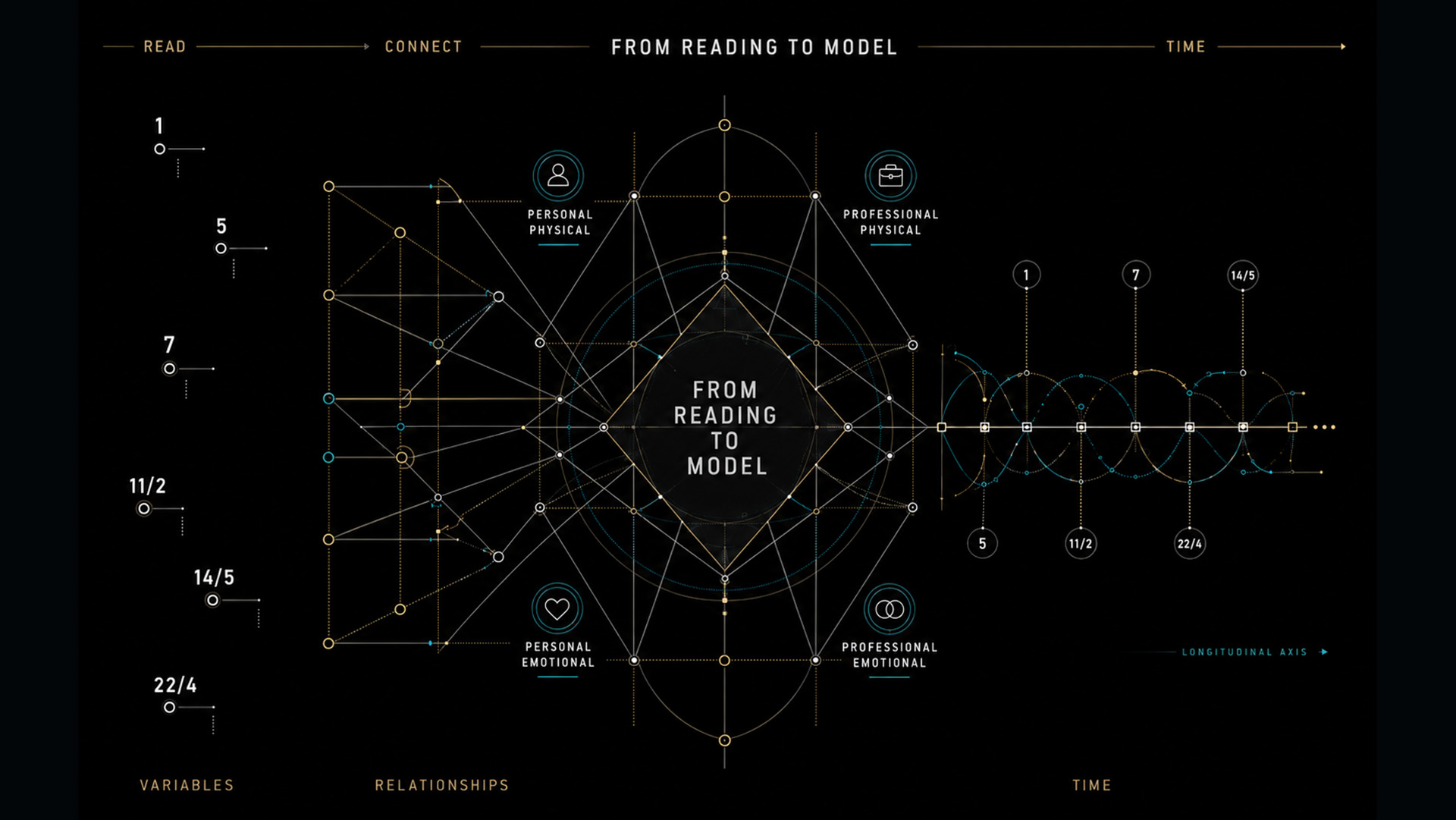
More Than 100 Variables. Four Different Dimensions.
The historical article describes the emerging 365 Pin Code approach as incorporating more than 100 personalised numerical variables.
But the bigger leap was not simply adding more numbers. It was organising them.
Chris began modelling the individual across four interconnected dimensions:
- Personal Physical
- Personal Emotional
- Professional Physical
- Professional Emotional
The historical terminology sometimes described the emotional dimensions as the “shadow” side of the model. The central idea, however, was straightforward.
A person does not have one life happening in one dimension. What is happening personally may differ from what is happening professionally.
What is visible externally may differ from what is happening internally. And all of those dimensions may change over time.
This transformed the research problem. Instead of producing a static description of a person, Chris was attempting to construct a moving architecture.
Not simply: Who are you? But: What patterns are present, how do they interact, when do they recur, and what changes as you move through time?
That is a very different proposition.
When the Reading Became a Model
This may be the most important idea in the entire article. The innovation wasn’t another number. It was integration.
Chris was beginning to treat the various numerical components almost as an ecologist might treat parts of a living system.
One variable can be interesting. But understanding a system requires examining relationships.
- What happens when one factor strengthens another?
- What happens when two components appear to conflict?
- What happens when the same sequence appears independently in several parts of the model?
What happens when an underlying personal pattern reappears inside a particular year, month or other period?
And does any of that correspond consistently with significant events in the person’s actual life?
That final question would eventually become especially important. Because once the model becomes longitudinal, you no longer have only a profile.
You have a timeline. A conventional reading tells you what a number is believed to signify. A longitudinal model asks when particular patterns become active, when they recur and how several dimensions interact at the same time.
That distinction sits near the heart of the later Human Futurist research programme.
Description Was No Longer Enough
There is another important shift hidden inside the old language. The historical article repeatedly emphasises practical numerology.
At the time, Chris was making a deliberate distinction between information that simply described somebody and information that could potentially help them think, plan and make decisions.
That is why the word practical mattered. Knowing that a number is traditionally associated with independence, creativity or responsibility might be interesting.
But what do you actually do with that information?
Can relationships between multiple variables provide greater context? Can a longitudinal model reveal recurring periods? Can patterns seen repeatedly in earlier life help someone recognise a similar environment when it appears again?
And ultimately, can this information improve a real decision? Those questions move the research away from a descriptive reading and towards the much more ambitious idea of decision intelligence.
Not a number telling you what to do. A model potentially changing what you see before you decide.
From Profile to Timeline
Once the research began looking at relationships rather than isolated values, time became increasingly important.
A static profile can describe the architecture associated with a person. But life does not remain static. Different periods bring different circumstances, pressures, choices and consequences.
The next logical step was therefore to map the numerical architecture through time. That meant asking whether certain structures appeared in particular years.
- Whether they became more concentrated during significant periods.
- Whether personal and professional dimensions changed independently.
- Whether emotional and external experiences could be modelled separately.
- Whether patterns seen earlier in somebody’s life returned later.
This is where the research begins moving beyond conventional numerology almost by necessity. The more dimensions Chris added, the less useful it became to think of the work as a series of individual number meanings.
What was emerging instead was an interconnected mathematical architecture travelling through time.
But More Complexity Creates Another Problem
There is an important caution. A more complex model is not automatically a better one.
Adding dozens, or more than 100 variables, creates more possible relationships. That may reveal genuinely interesting patterns.
But it also increases the opportunity to discover connections retrospectively simply because there are so many combinations available.
The historical source claims years of research, development, testing and refinement behind the 365 Pin Code model. What it does not provide within this particular article is controlled testing, comparison groups, statistical performance measures or formal falsification criteria.
That means the contemporary research question cannot simply be:
Is the integrated model impressive? It has to become: Does integration actually add information?
Can a model using complete sequences outperform one using only reduced numbers? Can an integrated model identify significant periods better than isolated indicators? Does adding personal, emotional, professional and temporal dimensions improve discrimination?
And most importantly, can those rules be applied before an outcome is known? Those questions are testable. And that is what makes this historical paper foundational rather than merely historical.
From 365 Pin Code to the Intelligent Mathematical Blueprint
The language has changed substantially since this research was written. The original article speaks openly about numerology, vibrations, metaphysical traditions and a life path extending from birth onwards.
Those origins should not be rewritten out of the story. But something recognisably different was already emerging underneath them.
- Preserve the sequence.
- Retain the granularity.
- Do not analyse variables in isolation.
- Model several dimensions simultaneously.
- Follow them across time.
- Look for relationships, recurrence and convergence.
- Then ask whether any of it has practical decision value.
Those principles would become increasingly visible throughout the later Human Futurist research archive. The Intelligent Mathematical Blueprint did not suddenly appear as a finished idea.
It developed. This study lets us see part of that development taking place. The interesting historical transition is therefore not simply from one form of numerology to another.
It is from:
reading → integration → modelling → longitudinal analysis.
The Bigger Question
Perhaps the most interesting thing about Practical Numerology – for Discerning Original Thinkers is that it quietly begins challenging the very format from which it emerged.
It begins with numerology. But it is already pushing against the limitations of a conventional numerology reading.
Chris was no longer satisfied with being told that somebody was a 1, a 5, a 7 or an 11. He wanted to know what happened when dozens of pieces were connected.
- Then what happened when those relationships changed through time.
- Then what happened when sequences returned.
- Then whether those recurrences corresponded with real events.
And eventually:
- Could knowing that architecture help someone make a better decision before consequence arrived?
That is a much larger research proposition. It still requires validation.
Greater complexity could reveal more meaningful structure, or simply provide more opportunities to find patterns after the event. Determining which is true is part of the continuing research challenge.
A particularly valuable future test would therefore be to translate the historical architecture into explicit variables and determine whether its integrated outputs actually provide more useful information than simpler baseline models.
That is why this paper belongs within Foundational Research. Not because it established that numerology can explain or predict a human life. But because it records a pivotal change in what Chris was trying to build.
The numbers stopped being separate answers. They started becoming parts of a system. And when that happened, a reading began becoming a model.
From the Human Futurist Research Archive
This contemporary article revisits Practical Numerology – for Discerning Original Thinkers. The historical article, which references material published in June 2020, documents an important methodological transition in the 365 Pin Code research: away from interpreting isolated numbers and towards preserving numerical sequences, integrating more than 100 personalised variables and modelling personal, emotional, professional and temporal relationships. Its historical predictive claims remain to be independently validated. Its lasting importance is developmental: it records the emerging integrated architecture that would contribute to Human Futurology and the Intelligent Mathematical Blueprint
Share This Article, Choose Your Platform!
Related Posts





From understanding decisions to informing them.
Beyond the Research
The Business & Leadership archive examines consequential decisions after they have happened.
The Intelligent Mathematical Blueprint and Private Advisory take the underlying Human Futurist thinking into a different environment: helping leaders examine the circumstances surrounding decisions that have yet to be made.