
What if the most important future to understand is the human one?
Foundational Research | Business & Leadership
We forecast economies. We model markets. We analyse political change. We try to understand where technology, artificial intelligence, climate, industries and entire societies might be heading.
But in 2020, Chris Styles began asking a very different question.
What about the people inside all those futures?
A company can anticipate technological disruption years ahead. It can model demand. Track competitors. Run economic scenarios. Prepare for regulatory change. But the decisions that ultimately determine what happens are still made by human beings.
Human beings who change. Who come under pressure. Who make exceptional decisions in one period and poor decisions in another. Who encounter opportunity, loss, conflict, transition, ambition, uncertainty and consequence.
Chris began to wonder whether futures thinking had overlooked its most obvious variable.
The individual human being.
The Missing Human Future
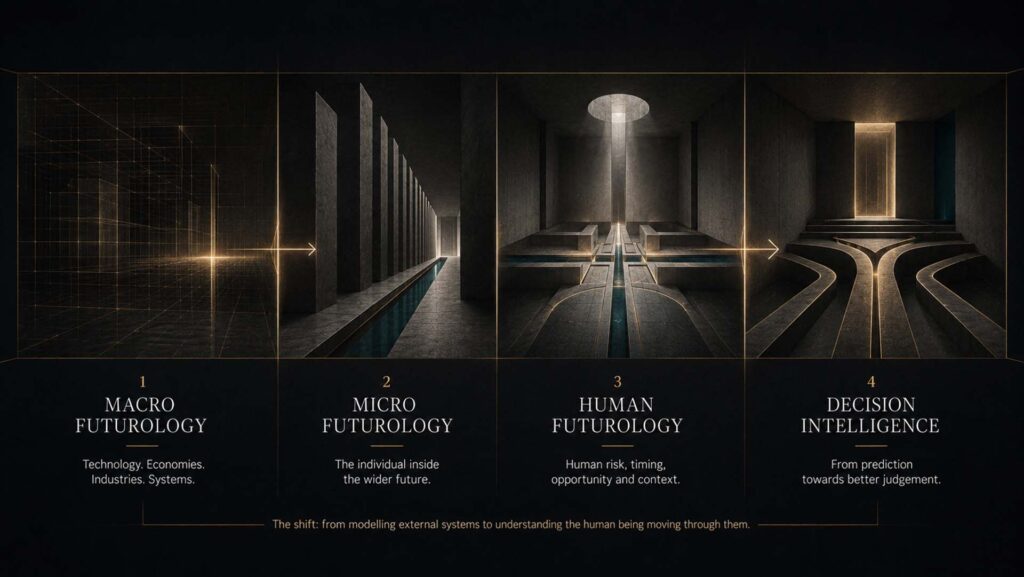
Traditional futurology tends to look outward.
It asks what may happen to economies, technologies, governments, industries, environments and societies.
Chris described this as macro-futurology. There was nothing wrong with that approach. The problem was what appeared to be missing from it.
If organisations were prepared to spend enormous amounts of time trying to understand what might happen to markets and technologies, why weren’t they applying the same curiosity to the people responsible for navigating those changes?
Chris called the alternative micro-futurology. Instead of asking only: What might happen to the world? he began asking: What might happen around the individual?
And perhaps more importantly: Could understanding those changing human circumstances improve the decisions being made today?
That idea would eventually become one of the foundations of what Chris called Human Futurology.
A Very Different Kind of Foresight
The original 2020 article made a bold claim.
At the time, Chris believed the answer might lie in what he called 365 Pin Code Strategic Applied Numerology.
His research used a person’s date of birth, full birth name and additional data points to construct mathematical profiles across time.
The model attempted to examine experience through four dimensions:
- personal physical
- personal emotional
- professional physical
- professional emotional
Chris believed that changes within those profiles might reveal periods associated with unusually significant risk, opportunity, pressure or transition.
That was an extraordinary proposition. And the historical article did not make it cautiously.
It argued that patterns could potentially be identified around events in the lives of people including Steve Jobs, Steve Wozniak, Albert Einstein, Jamie Oliver, Billie Jean King, Kylie Jenner, Khabib Nurmagomedov and Richard Branson.
The archive now contains many of those individual investigations. But twenty-first-century hindsight gives us an advantage the original article did not have.
We can separate the historical claim from the deeper research idea hiding inside it.
The Bigger Idea Was Not Numerology
The most important sentence in this research is no longer:
Numerology is the future of futurology. The much more interesting proposition is: Futures thinking should examine people as seriously as it examines systems.
That changes the entire question because Human Futurology need not prove that someone’s future can be predicted with certainty to be useful.
Imagine instead that a structured model could help identify periods when someone might be experiencing unusual:
- pressure
- change
- conflict
- opportunity
- instability
- transition
- or decision sensitivity
The objective would not necessarily be to announce what will happen. The objective could be to know where to look more carefully.
For a chief executive, that might mean recognising a period when established judgement deserves additional challenge.
For an entrepreneur, it might mean distinguishing genuine opportunity from a moment of impulsive expansion.
For an organisation, it might mean understanding that the human risk surrounding a decision can change even when the financial spreadsheet does not.
For an adviser, coach or leadership team, it might simply create a better question at exactly the right moment.
That is a very different conception of foresight. Not certainty. Preparedness.
From Prediction to Decision Intelligence
This distinction became increasingly important as Chris’s research developed.
Many of the early studies looked retrospectively at extraordinary events and asked whether numerical patterns could be found around them.
That is fascinating. But retrospective pattern detection and prospective prediction are not the same thing. Once you already know that something happened, you also know where to look.
The real test is much harder. Could the same method identify a significant period before anyone knows what is going to happen? And even then, another question follows.
Suppose the model never predicts the exact event.
Suppose instead it identifies a period in which a leader should:
- slow down
- seek independent advice
- challenge assumptions
- avoid unnecessary exposure
- prepare for change
- or pay closer attention to a developing opportunity
If that intelligence contributes to a better decision, it may still have considerable value. This is where the historical idea of Human Futurology begins to move beyond prediction.
Prediction → Preparation → Intervention → Decision Intelligence
The Human Variable Inside Every System
There is another reason this 2020 article matters.
Almost every major future eventually becomes a human problem. Artificial intelligence may transform an industry. But executives must decide how to respond. Economic conditions may change.
But entrepreneurs decide whether to invest, retreat, recruit or restructure. A political environment may become unstable. But individuals still exercise judgement within it.
A business strategy may be technically sound. But people must execute it.
“The future does not simply happen around human beings. It happens through them.”
That makes the human variable difficult to ignore. And perhaps surprisingly, this is where a historical body of research that began with numerology started moving towards something much broader.
Across the archive, the questions increasingly shift from: “What does this number mean?”, towards: “What pattern is appearing?” and “Has it appeared before?”
What tends to happen when these conditions converge? What pressure might the individual be experiencing? What intervention might help? What decision should receive greater scrutiny?
That intellectual journey is central to the development of The Human Futurist.
What Chris Was Really Beginning to Build
Looked at from today’s perspective, the 2020 article reads differently.
It is not simply an argument about numerology. It is an early manifesto for an emerging field of enquiry. Chris was beginning to explore whether an individual could be understood through time, rather than treated as a static collection of personality characteristics.
That is an important distinction. Most assessments tell us something about who a person appears to be.
Human Futurology began asking another question: What happens when that person encounters changing circumstances across time?
Capabilities may become more useful in one environment and less useful in another.
- Strengths may become overused.
- External pressure may alter judgement.
- Certain periods may require action.
- Others may reward restraint.
Relationships between the individual, the environment and the timing of a decision may matter as much as any single characteristic. Those questions ultimately point towards a much richer research problem:
Can human decision contexts be modelled well enough to improve judgement before consequence occurs?
That is a considerably more defensible and potentially more useful ambition than simply claiming to predict the future.
The Research Challenge
There is an important limitation. The historical article made strong predictive claims that the material presented within it cannot, by itself, be established scientifically.
Finding a numerical relationship around an event after it has happened does not prove that the same method could have identified that event beforehand. Nor does one compelling case prove a general predictive capability.
Human Futurology therefore faces exactly the challenge any serious foresight methodology should face.
- The rules need to be explicit.
- The calculations need to be reproducible.
- Predictions need to be recorded before outcomes are known.
- Failures need to remain visible alongside successes.
- Alternative explanations need to be considered.
- And claims need to become testable.
That does not diminish the historical research. It tells us what the next stage of the research needs to become.
Why This Article Matters
Among hundreds of historical Human Futurist research documents, this one occupies a special position. Because here, the field begins to acquire a name.
Human Futurology.
The terminology may have emerged from research into applied numerology, but the intellectual proposition reaches much further.
- The future is not only about technology.
- It is not only about economies.
- It is not only about systems.
It is also about the human beings who must interpret change, exercise judgement and make decisions while those futures are unfolding.
That idea now sits at the centre of the wider Human Futurist research programme.
And it leads to a question that is arguably more interesting than whether the future can ever be perfectly predicted:
What if we could understand enough about the changing human context to make a better decision before the consequences arrive?
That may ultimately prove to be the more important future of futurology.
From the Human Futurist Research Archive
Share This Article, Choose Your Platform!
Related Posts





From understanding decisions to informing them.
Beyond the Research
The Business & Leadership archive examines consequential decisions after they have happened.
The Intelligent Mathematical Blueprint and Private Advisory take the underlying Human Futurist thinking into a different environment: helping leaders examine the circumstances surrounding decisions that have yet to be made.