

The Prediction Nobody Could Explain
At exactly noon on 9 August 1974, Richard Nixon ceased to be President of the United States. For the world, it was the final act of Watergate. For Chris Styles, decades later, it became a puzzle.
Because somewhere before that historic moment, numerologist Kevin Quinn Avery was reportedly making a remarkably precise claim: Nixon would leave office on 9 August 1974, at 12:00 noon.
Not sometime that summer. Not merely in 1974. The date and the hour.
And, according to the account Chris found while researching Avery, the prediction had been made around eleven months beforehand. That immediately caught Chris’s attention. But what fascinated him even more was what he couldn’t find.
How had Avery worked it out? No calculation. No surviving sequence of charts. No documented trail showing how he had travelled from Richard Nixon’s birth information to one exact moment in August 1974. The answer seemed to have disappeared.
So Chris decided to reconstruct it.
How Do You Reverse-Engineer a Prediction?
Chris approached the problem from an unusual direction.
Before Human Futurology, he had worked as a field biologist and ecologist. One principle from that scientific training stayed with him: it isn’t enough to announce a result. Other people should be able to see how you reached it—and ideally be able to reproduce it themselves.
That made Avery’s Nixon prediction irresistible. Here was an apparently spectacular result with the method missing. Chris began building backwards.
He calculated Nixon’s name architecture, date-of-birth numbers, life cycles, personal and professional profiles and what the historical methodology called his shadow or emotional architecture.
Then he started moving through time. First the year. Then the month. Then the day. Finally, the hour.
He was effectively asking:
If Avery really saw 9 August 1974 coming, what might he have been seeing?
And this is where the story gets interesting.
First, 1974 Had to Stand Out
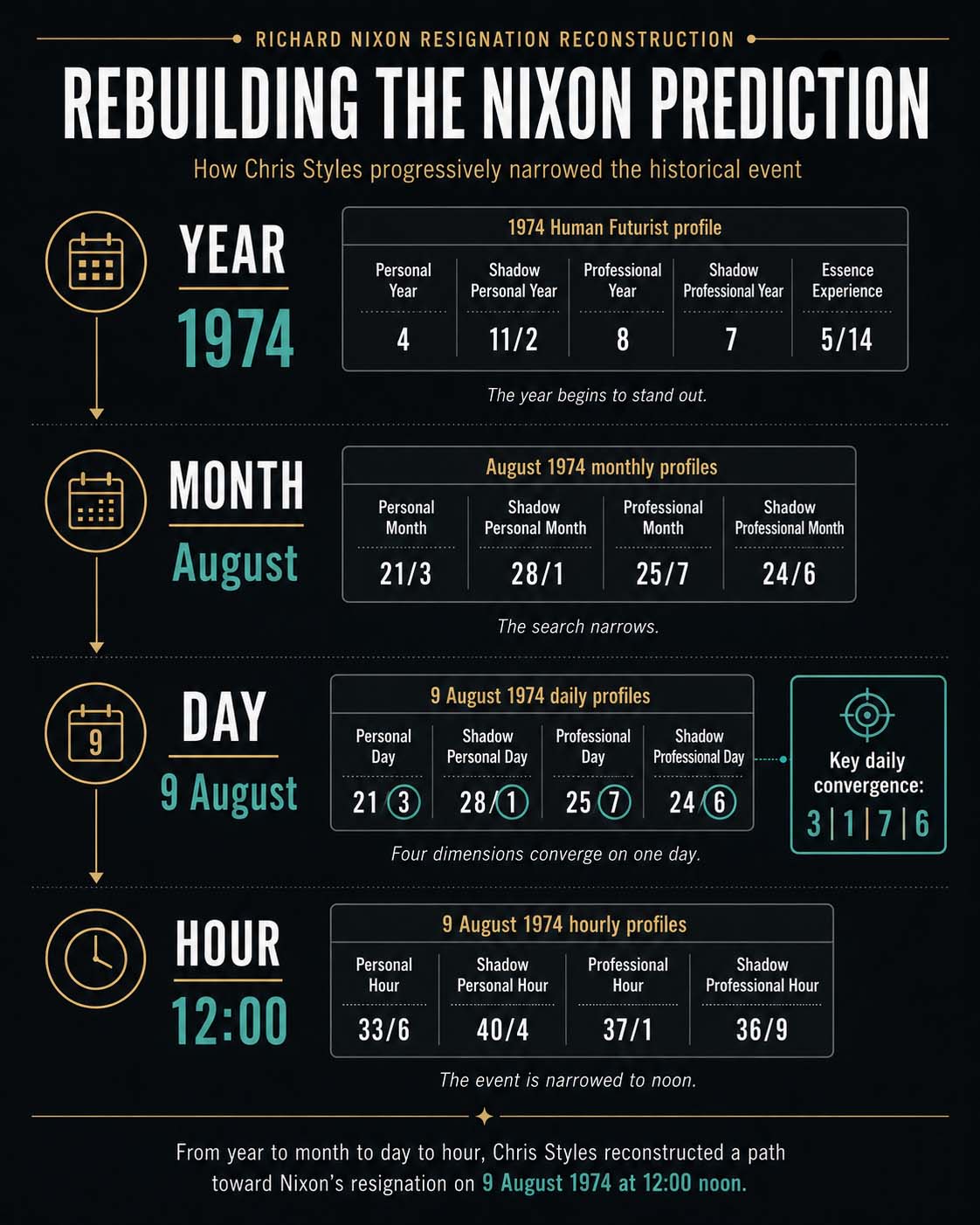
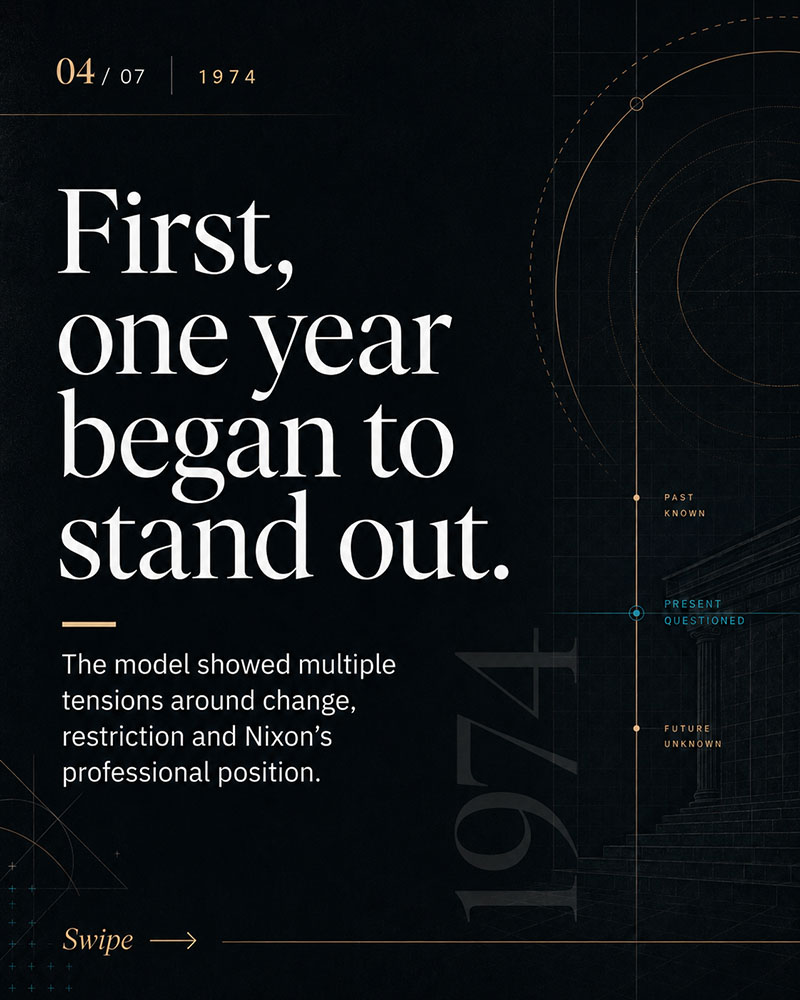
Chris mapped Nixon’s presidency across a year-by-year chart running from 1969 into the mid-1970s.
Within that model, 1974 looked distinctly uncomfortable. Nixon was 61. His Personal Year was calculated as 4, a number the original methodology associates with restriction, discipline, work and limitation.
But 4 was not appearing in isolation. Chris found it repeatedly connected to other important parts of Nixon’s underlying profile. At the same time, Nixon’s 1974 Essence Experience was 14/5, the 5 carrying the themes of major change and personal freedom.
Within the old 365 Pin Code language, Chris saw 4 and 5 pushing against one another: restriction meeting change, containment meeting freedom. On the professional side, the combinations appeared equally difficult. Chris called the resulting pattern “the perfect professional storm.”
Then he looked at 1975. There he found what he regarded as another important clue: a prominent double-5 structure, which the historical system associated with substantial change and regained personal freedom.
Look backwards from that and 1974 began to look, to Chris, like the transition year. The year Avery might have isolated. But a year is still a very long way from 9 August at noon.
Why August?
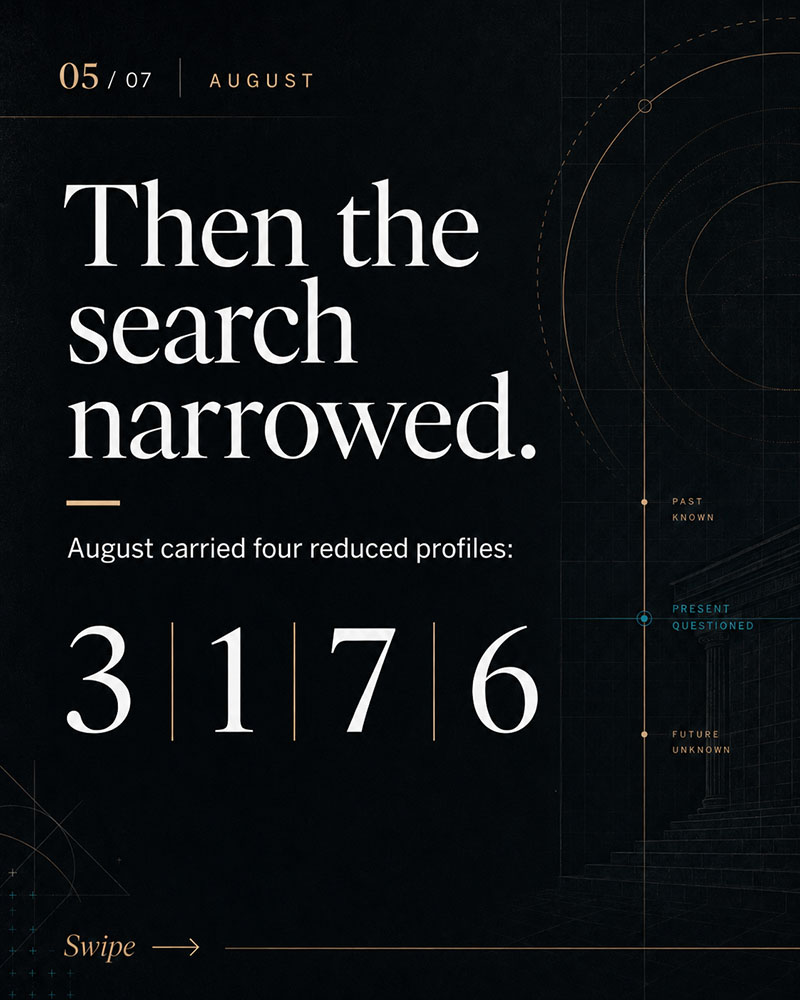
The next step was to calculate Nixon’s month-by-month profile for 1974. And August produced an intriguing combination. On Nixon’s personal side, August carried a 3 profile. On his shadow-personal side, the model Chris used for the more emotional dimension, it carried 1.
Professionally, August carried 7. And on the shadow-professional side, 6.
Those numbers mattered in the original framework because Chris interpreted them as telling a remarkably coherent story around what Nixon was actually facing:
- 1 — a new beginning.
- 3 — release and self-expression.
- 7 — reflection and withdrawal.
- 6 — responsibility.
None of those numbers, by itself, tells us that a president will resign. That is important. But once Chris had already isolated 1974 as a potentially major transition year, August suddenly gave him something much more specific to investigate. And then he calculated the days.
Then the Pattern Repeated
This is the part of the research that deserves attention. Chris ran four separate daily profiles for Nixon:
- personal;
- shadow personal;
- professional;
- shadow professional.
On 9 August, he calculated:
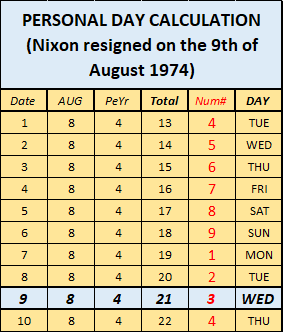
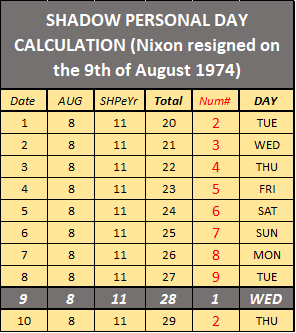
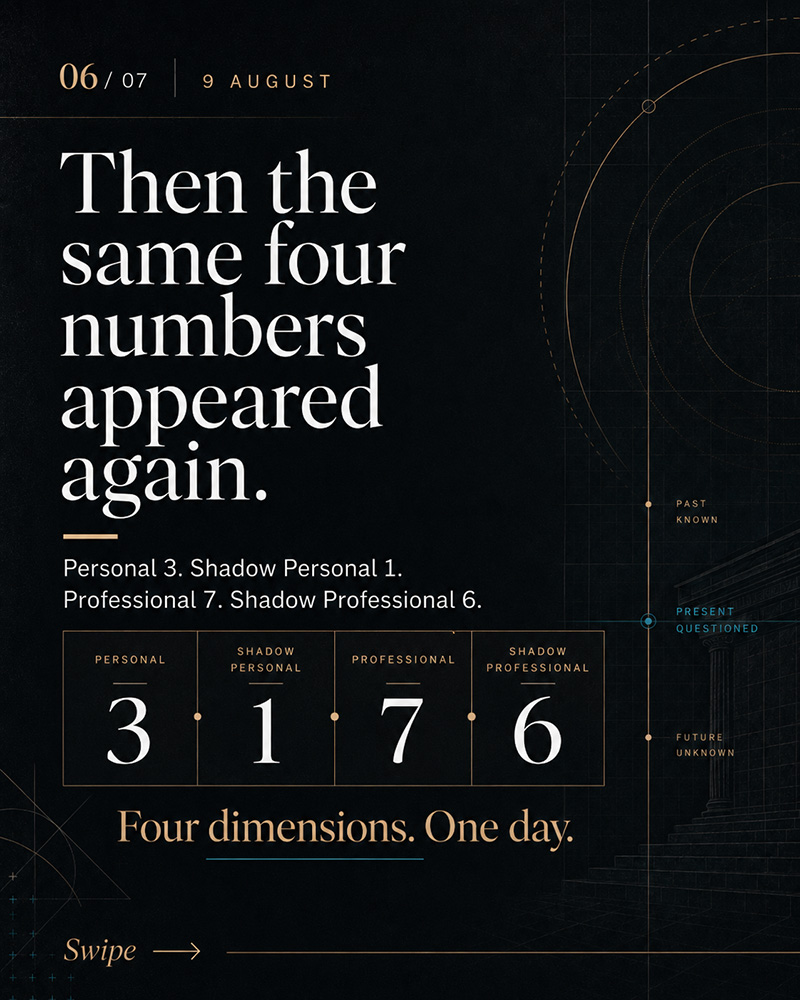
- Personal Day: 21/3. Shadow Personal Day: 28/1.
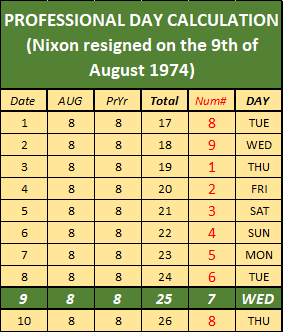
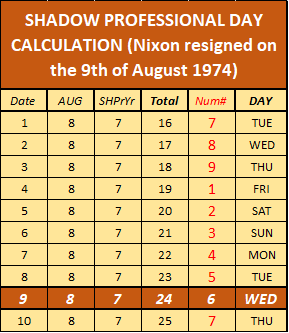
- Professional Day: 25/7. Shadow Professional Day: 24/6.
Now compare the reduced values with August itself:
August Personal Month → 3 / 9 August Personal Day → 3. August Shadow Personal Month → 1 / 9 August Shadow Personal Day → 1
August Professional Month → 7 / 9 August Professional Day → 7. August Shadow Professional Month → 6 / 9 August Shadow Professional Day → 6
Four different layers.
The same four reduced monthly energies appearing again at the daily level on the date Nixon left office. That was the moment Chris felt he had found something important.
One alignment might be easy to overlook. Two would be more interesting.
But the historical analysis identifies the personal, emotional, professional and shadow-professional dimensions all converging on the same day. That is the “hang on…” moment in the Avery reconstruction.
Not because it proves Avery used these calculations. It doesn’t. But because it offers a possible answer to what Avery may have been looking for: convergence. Not one magic number.
Several independently calculated parts of the model tightening around the same point in time.
Four independently calculated profiles converge on 3, 1, 7 and 6 on 9 August 1974
But Avery Didn’t Just Name the Day
There was still one problem. Noon. If the story about Avery was accurate, he had not merely identified the resignation date. He had reportedly identified the hour.
So Chris went one level deeper. He calculated Nixon’s hourly profiles for 9 August.
At 12:00, the historical research produced:
- Personal Hour: 33/6.Shadow Personal Hour: 40/4
- Professional Hour: 37/1. Shadow Professional Hour: 36/9.
Within the original interpretive system, Chris read those four values through themes that were difficult to ignore in the context of Nixon’s resignation: responsibility, limitation and structure, a professional new beginning, and an ending.
Again, that does not establish that noon was mathematically inevitable. It shows how Chris was able to construct a numerical architecture around the known moment.
And that distinction matters.
So Did Chris Solve Avery’s Mystery?
Not quite. And this is where the research becomes more interesting, not less.
Chris knew Nixon resigned on 9 August 1974 at noon before he began the reconstruction.
He was working towards a known answer. That means the study cannot demonstrate that the same process, used prospectively, would necessarily have selected that exact moment.
Nor can it demonstrate that Avery used this particular method. The Completed Archive Analysis makes precisely that distinction. It identifies the Avery–Nixon research as one of the archive’s strongest foundational studies, but emphasises that reverse engineering can generate a hypothesis; it cannot validate itself.
That may sound like a technical caution. It is actually central to the whole story. Because Chris started by asking:
How did Avery predict Nixon’s resignation?
But the deeper question eventually became:
Can we build a method transparent enough to make a prediction before we know the answer, and then see whether it works again?
That is a much bigger research problem.
From Numerology to the Intelligent Mathematical Blueprint
The language in this historical article belongs to an earlier period in Chris’s research.
It openly uses numerology, universal vibrations, karmic numbers and other concepts that were part of the original 365 Pin Code work.
Those origins should not be hidden.
But the investigation also contains something that would become increasingly important in the development of Human Futurology and the Intelligent Mathematical Blueprint: the search for recurrence, sequence, timing and multidimensional convergence.
The Nixon case suggested that the interesting signal might not sit in one isolated calculation.
It might lie in what happens when several layers begin pointing towards the same period.
The Archive Analysis consequently places this study in the Foundational Articles collection and identifies its larger contribution as methodological: prediction should ultimately be documented
The Bigger Question Avery Left Behind
Perhaps Chris never found Avery’s actual calculation. But in trying to find it, he discovered a research question that was arguably more valuable.
What does a genuine predictive methodology have to do before we should trust it?
It has to show its workings. It has to preserve the prediction before the outcome.
It has to record the misses as well as the hits. And ultimately, somebody else has to be able to take the same rules, apply them to another case and see whether the pattern appears again.
That is why the Nixon research still matters. It starts with one extraordinary claim about a president, a resignation and a clock striking noon.
But it ends somewhere much more interesting. With a challenge.
Can the patterns that look remarkable in hindsight be recognised while the future is still unknown?
That is the question Chris Styles kept pursuing. And it is one of the questions sitting underneath the Intelligent Mathematical Blueprint today.
From the Human Futurist Research Archive
This article revisits historical research preserved as Article 016 – How did Avery predict Nixon’s resignation.. Chris Styles’ original study attempted to reconstruct the numerical pathway that may have sat behind Kevin Quinn Avery’s reported prediction of Richard Nixon’s resignation. Avery’s own calculation was not available to Chris, so the reconstruction should not be presented as proof of the method Avery actually used. Its enduring importance lies in the patterns Chris found, and in the research questions about prediction, recurrence and reproducibility that followed.
Share This Article, Choose Your Platform!
Related Posts






From understanding decisions to informing them.
Beyond the Research
The Business & Leadership archive examines consequential decisions after they have happened.
The Intelligent Mathematical Blueprint and Private Advisory take the underlying Human Futurist thinking into a different environment: helping leaders examine the circumstances surrounding decisions that have yet to be made.