Part of the Apple Case Study
One of Apple’s founders stepped away just as the company was becoming something much larger. Why Steve Wozniak left Apple in 1985 became an intriguing question for Chris Styles, particularly when he examined the intersection of creativity, values and organisational fit.
Steve Wozniak was not simply another executive who passed through Apple. He helped create it. That makes his story particularly useful to this Case Study, because his eventual departure presents a very different question from Ronald Wayne’s earlier exit.
Wayne left before anyone could know what Apple might become. Wozniak left after its potential was already impossible to ignore.
The Founder Who Chose Something Else
By 1985, Steve Wozniak no longer needed convincing that Apple could succeed.
He had already helped build the machine that made the company possible. He had watched Apple move from the enthusiast world of early personal computing into a rapidly expanding corporation. He had seen the company go public. He had become wealthy.
And then he stepped away from its day-to-day operation. That is what makes the decision so easy to misunderstand.
Seen from today, when Apple has become one of the most valuable companies in history, almost any voluntary departure from its early story can be framed as an extraordinary financial mistake.
But that assumes everyone was playing the same game. Wozniak never appears to have been.
When his 1985 move was reported at the time, Apple said he would cease his role as a principal engineer but remain on its payroll as a consultant while pursuing a new venture.
Years later, Wozniak described the distinction even more plainly: he did not regard himself as having severed his relationship with Apple completely. He remained connected to the company while choosing to build elsewhere.
So the better question is not simply: Why would somebody leave Apple?
It is: What had Apple become that made leaving feel more attractive than staying?
That was the part of the story that interested Chris Styles.
Apple Had Become a Different Company
The Apple Wozniak helped create was not the Apple he was experiencing by the middle of the 1980s.
- Scale had changed it.
- Processes had changed it.
- Management had changed it.
- And Wozniak’s own role inside it had changed.
In an interview from the period, he described himself fundamentally as an engineer rather than a manager. As Apple expanded, its engineering became organised into departments and the kind of independent designing that had characterised his earlier work became harder to reproduce.
That distinction matters. Wozniak had been central to the creation of the Apple I and Apple II. Yet organisational importance and organisational fit are not necessarily the same thing.
A company can become more successful while becoming less compatible with one of the people who created it.
By 1985, Wozniak was publicly critical of the attention Apple was giving the Apple II.
In a contemporary PBS interview, he argued that the Apple II was not receiving enough attention and that Apple’s increasing bureaucracy made the sort of independent project work he enjoyed much harder.
The issue was therefore larger than a disagreement with Steve Jobs.
It concerned what kind of organisation Apple was becoming — and what kind of work Wozniak wanted to do inside it.
That difference sits at the centre of Chris’s later analysis.
The First Interruption Came in 1981
1985 was not Wozniak’s first movement away from Apple. Four years earlier, his life had already been interrupted dramatically.
On 7 February 1981, Wozniak was involved in a plane crash while piloting a Beechcraft Bonanza. He subsequently experienced a period of amnesia and did not immediately return to Apple. The original Human Futurist source treats this as the beginning of a longer process of separation from the company.
Wozniak himself later explained that the crash provided an opportunity to do something he had already been considering.
He returned to university rather than immediately resuming his former Apple role. In a later interview, he said that Apple had grown to around a hundred engineers and that he no longer felt as essential to the company as he once had.
He eventually returned to Apple in 1983 and became involved again with the Apple II organisation. Historical accounts describe his enthusiasm at being able to work on new Apple II development when he came back.
But the return did not last. Two years later, he stepped away again.
That sequence, involvement, interruption, return and final withdrawal from the day-to-day organisation gave Chris something more substantial to examine than a single resignation date.
Then Chris Looked at 1985
The original research came from an earlier stage in the development of what would later become the Intelligent Mathematical Blueprint.
Its terminology was much more numerology-led than Human Futurology uses today.
But underneath that language was a straightforward research question:
Did the timing pattern surrounding Wozniak’s departure contain anything that corresponded with the kind of experience he was actually having?
One part immediately caught Chris’s attention.
Within the historical model, 1984 and 1985 formed a connected two-year sequence centred on the value 4.
The original research associated that position with ideas including:
- Values
- Work
- Order
- Structure
- Systems
- Practicality
- Discipline
The source regarded this as particularly significant because the same theme was unusually weak or absent in Wozniak’s underlying name-based profile.
Then, in 1985, the year he stepped away from active Apple employment — the pattern appeared again.
The historical article made a much stronger claim. It argued that Wozniak’s departure was effectively predetermined by the pattern. That is not the claim this Case Study needs to make.
The interesting observation is narrower.
Chris had identified a period that, within the framework he was developing, drew attention towards values, structure and the way an individual experiences an organised environment.
And that period corresponded with a documented moment when Wozniak was becoming increasingly uncomfortable with the organisation Apple had become.
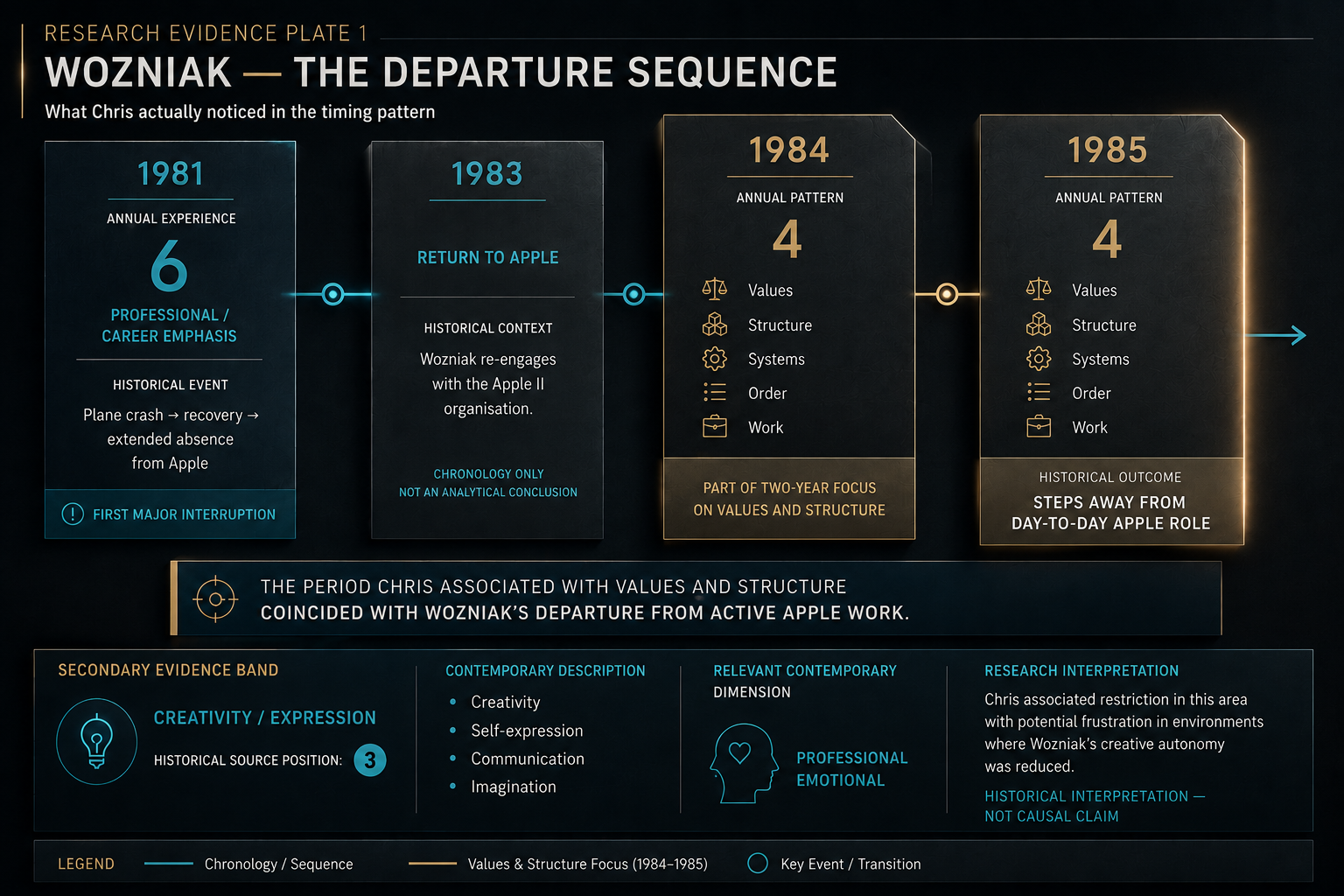
THE PATTERN DIDN’T MAKE THE DECISION. IT CHANGED WHAT CHRIS NOTICED ABOUT THE TIMING.
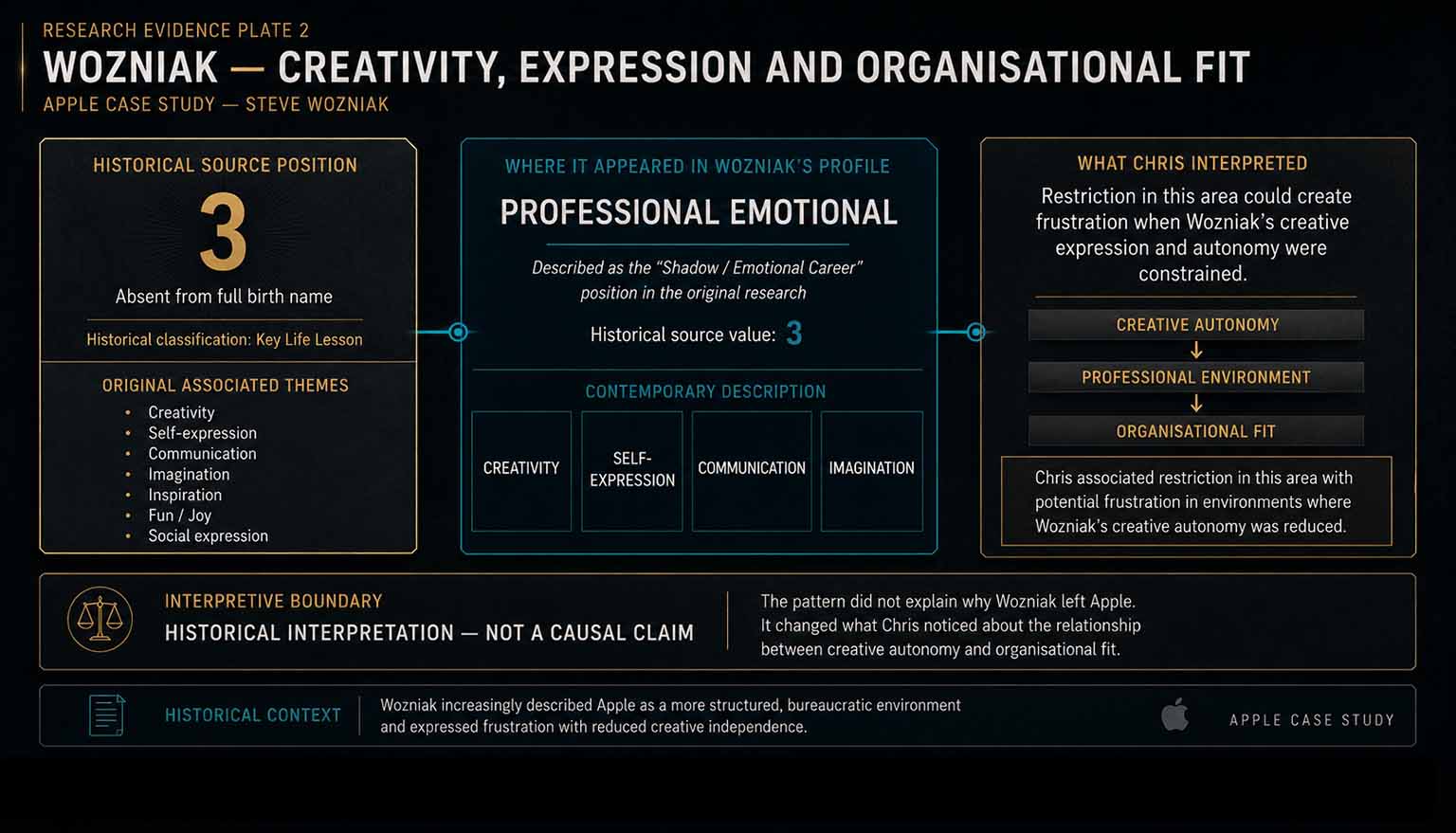
Creativity Was Only Half the Story
There was another part of Wozniak’s historical profile that Chris considered important.
The original source identified a second unusually weak position associated with:
- Creativity
- Self-expression
- Communication
- Imagination
In contemporary Human Futurist language, the relevant career expression sat within what we would now describe as the Professional Emotional dimension.
Chris interpreted this combination as suggesting that environments that restricted creative expression could become especially uncomfortable for Wozniak.
The historical interpretation connected this closely with the kind of creatively constrained environment Wozniak was experiencing.
For this Case Study, the more useful point is not the strength of that earlier claim, but the correspondence itself.
The historical record already gives us something compelling: Wozniak was increasingly uncomfortable with Apple’s changing structure, reduced creative freedom and the kind of work the organisation was asking him to do.
Wozniak repeatedly described himself as an engineer who preferred designing to management. He later explained that he wanted to create real products with small groups of people rather than operate within increasingly formal corporate engineering structures.
And in 1985 he spoke publicly about the approvals, procedures and bureaucracy that came with working inside a company of Apple’s new scale.
This creates a much richer intersection than simply: Wozniak left Apple in a particular numerical year.
What Chris believed he could see was a relationship between three things:
CREATIVITY -> VALUES -> ORGANISATIONAL FIT
The historical events then gave him something against which to compare that interpretation.
What Does Success Actually Mean?
This is where Wozniak’s article changes the Apple Case Study. Because judged purely through financial hindsight, staying seems obvious.
- Apple continued.
- Apple grew.
- Apple eventually became extraordinary.
But financial maximisation is only one definition of a successful decision. The source material repeatedly contrasts Wozniak’s attitude towards money with the more commercially driven story normally associated with Apple. It also points to his generosity towards other Apple employees and his willingness to use his wealth in ways that reflected his own values.
Later interviews support the broader characterisation without requiring us to treat every anecdote in the original article as verified fact.
Wozniak has repeatedly described money as secondary to doing work he enjoyed, and in 2026 again spoke publicly about not wanting money to become the organising value of his life.
That does not make his decisions superior to Jobs’. It makes them different.
Jobs pursued scale, integration, control and eventually an extraordinary second chapter at Apple.
Wozniak increasingly pursued autonomy, engineering, education, experimentation and projects that interested him personally.
Neither route needs to be turned into a moral lesson. But once that difference is recognised, Wozniak’s departure begins to look very different.
Perhaps the important question was never: How much richer could Steve Wozniak have become if he had stayed?
Perhaps it was: How long should someone remain inside a successful organisation once the organisation no longer allows them to work in the way that makes the success meaningful?
That question reaches well beyond Apple.
The Pattern Chris Couldn’t Ignore
There is also a second timing observation in the original research.
Chris went back to 1981. The annual sequence for that year contained a 6, which the historical framework associated in Wozniak’s case with his professional or career world.
The source considered its isolated appearance especially significant.
1981 was also the year of the plane crash, Wozniak’s temporary withdrawal from Apple and the beginning of a period in which his relationship with the company changed substantially.
It would be easy to overstate this. The model did not explain the crash. It did not cause the crash.
And an isolated numerical correspondence cannot establish that a later departure was predetermined.
But Chris was not looking only at the accident.
He was looking at the sequence of organisational separation that followed it:
1981 interruption ->1983 return ->1984–1985 values and structural tension -> 1985 departure from the day-to-day company
Once those events were considered together, 1985 no longer looked like an isolated resignation.
It looked like the culmination of a much longer change in the relationship between Wozniak and the organisation he had helped create.
What This Article Adds to the Case Study
Ronald Wayne introduced the question of risk and lost optionality. Steve Wozniak changes the question.
- He had already experienced Apple’s success.
- He knew what he was leaving.
- And he left anyway.
That introduces something the wider Apple Case Study needs:
Organisational fit.
It shows that the same organisation can represent opportunity to one person, constraint to another and both at different moments in the same career.
It also prevents this Case Study from reducing every decision to wealth, status or corporate survival.
With Wozniak added, Apple’s story becomes more human.
Because sometimes the most consequential decision is not whether an organisation will succeed.
It is whether you still belong inside what it is becoming.
Share This Article, Choose Your Platform!
Related Posts




From understanding decisions to informing them.
Beyond the Research
The Business & Leadership archive examines consequential decisions after they have happened.
The Intelligent Mathematical Blueprint and Private Advisory take the underlying Human Futurist thinking into a different environment: helping leaders examine the circumstances surrounding decisions that have yet to be made.