Four connected people. One turbulent year. Four different routes into the same historical pressure.
Collective Consequence: When One Year Reaches an Entire Network
Four connected people entered the same turbulent year through four different structures, turning an individual model into a question about shared pressure across a network.
In 2018, Chris Styles stopped looking at consequential timing one person at a time. He placed Ajay, Atul and Rajesh Gupta alongside Duduzane Zuma and asked what happened when the same external timing environment met an interconnected group. The answer did not prove a shared numerical cause. It did something more useful: it moved the developing Human Futurist model from individual interpretation towards network-level analysis.
When Consequence Stops Being Individual
Most consequential events are experienced by more than one person. Companies fail through groups. Governments fracture through alliances. Families accumulate influence through relationships. Sporting teams rise and fall through combinations of people whose decisions intersect.
Yet early Human Futurist work was largely individual. A person experienced a crisis, breakthrough or turning point; Chris examined that person’s numerical architecture and asked why that period looked unusual.
The Gupta–Zuma case changed the scale of the question. In 2018, Chris examined Ajay, Atul and Rajesh Gupta alongside Duduzane Zuma four people linked within the same South African political and business controversy against one common temporal variable: 2018 itself.
Chris Changed the Unit of Analysis
Within the historical methodology, 2018 was calculated as;
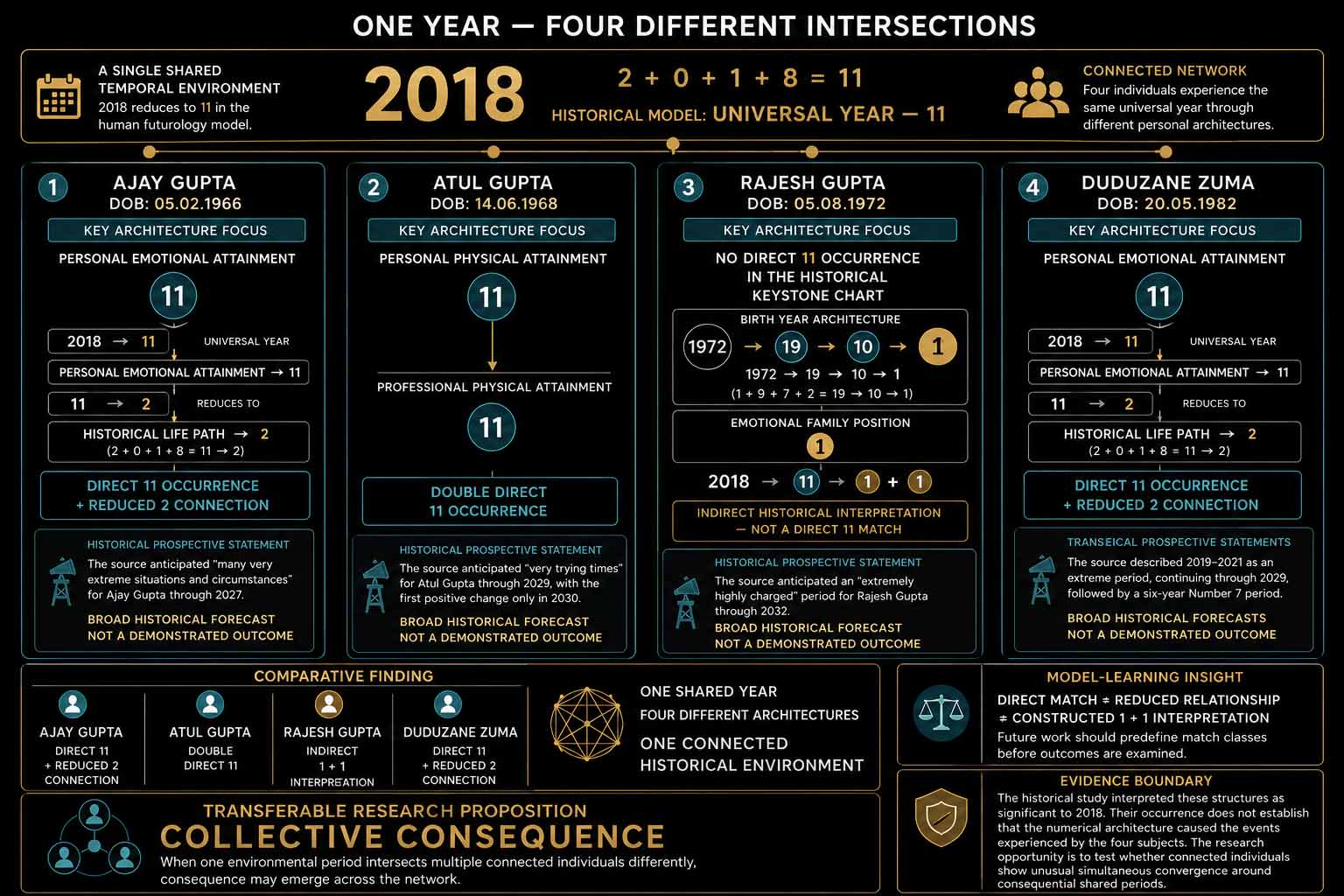
2 + 0 + 1 + 8 = 11 and described as a Universal 11 Year.
At the time, Chris associated 11 with illumination, exposure, teaching and heightened awareness. The original language was far more deterministic than the contemporary Human Futurist standard and treated the year as an active force of accountability.
The durable idea sits underneath that interpretation. Chris took one external timing condition and applied it across four separate individual structures. He was no longer asking only, “Why is this happening to this person?” He was asking whether one shared period could intersect differently with several connected people at once.
That is a genuine methodological shift. The unit of analysis had started to move from the individual towards the network.
The Same Year Did Not Meet Everyone in the Same Way
The comparison was not built from four identical results.
Ajay Gupta’s preserved chart contained 11 as his Personal Emotional Attainment Number. His historical Life Path was 2, the reduced value of 11. The 2018 argument therefore combined a direct 11 occurrence with a secondary 11 → 2 relationship.
Atul Gupta presented the strongest direct concentration. His Personal Physical Attainment and Professional Physical Attainment were both 11. In the logic used at the time, two separate physical dimensions therefore matched the Universal Year value directly.
Duduzane Zuma returned to the structure seen in Ajay: 11 appeared as his Personal Emotional Attainment Number. Three of the four subjects therefore contained at least one direct 11 in an Attainment position, while Atul contained two.
Seen together, that was the evidential centre of the study: one shared year, four different architectures, and several independent routes into what Chris interpreted as the same broad period of consequence.
The Case That Complicates the Pattern
Rajesh Gupta is the most important person in the comparison precisely because his chart did not contain 11.
The historical paper says this explicitly. Instead, it identified two separate 1s: one derived from his birth year, 1972 → 19 → 10 → 1, and another in the Emotional Family position. Because 11 contains two 1s, the article treated those two occurrences as another way in which the 2018 Universal 11 might become relevant.
But that is not the same kind of evidence as a direct 11 match. Nor is an 11 → 2 reduction equivalent to 11 → 11. The original study grouped several different relationship types under one interpretive umbrella.
That complication is valuable. It exposes a rule the later model needs: match strength must be defined before the outcome is examined. A direct occurrence, a reduced relationship and a constructed 1 + 1 interpretation should not quietly carry the same evidential weight.
Then the Forecasts Reached Beyond 2018
The 2018 paper did more than interpret the year in progress. It extended forward.
For Ajay Gupta, it anticipated “many very extreme situations and circumstances” through 2027. For Atul Gupta, it described “very trying times” through 2029, with the first positive change in 2030. For Rajesh Gupta, it forecast an “extremely highly charged” period through 2032. For Duduzane Zuma, it identified 2019–2021 as an especially difficult phase, with consequences continuing through 2029 and a later six-year Number 7 period.
Those statements belong in the record because they show how confidently the early model moved from pattern interpretation into long-horizon prediction. But they are broad windows, not tightly defined event forecasts. They do not specify a single outcome, threshold or decision rule that can now be scored cleanly.
What the Later Record Can and Cannot Tell Us
Later history certainly did not make the Gupta–Zuma story disappear. Duduzane Zuma faced a corruption charge in July 2018; it was provisionally withdrawn in January 2019. Atul and Rajesh Gupta were arrested in the United Arab Emirates in 2022; South Africa’s extradition attempt was unsuccessful, and the legal and extradition process remained active years later. In 2026, the Gupta-linked Nulane matter was re-enrolled after an appeal ruling.
That continuing consequence may appear consistent with the source’s broad expectation of prolonged difficulty. But consistency is not validation. A window stretching many years and allowing many possible forms of adversity is too elastic to discriminate strongly between what the model predicted and what ordinary political or legal analysis might already have expected.
The more useful audit is therefore not “Was Chris right?” It is: what exactly had the model specified in advance, and how much of the later record could genuinely have counted against it?
The Model Had Found a Bigger Question
That question leads back to the article’s most important contribution.
The Gupta–Zuma study was an early attempt to treat connected people as a collective temporal system. It suggested that a consequential environment might become more informative when several individual profiles are examined together rather than separately.
But the Rajesh comparison simultaneously revealed the danger of flexible matching. If direct 11, reduced 2 and two separate 1s can all be interpreted as relevant to the same year, the model risks expanding its rules until almost any chart can be brought into the pattern.
The next stage of Human Futurist work therefore needs both ideas at once: preserve the network-level question, but tighten the discrimination rules.
The Next Test Is a Network Test
A stronger successor study would begin before the consequential period is known.
Define the network first. Define the external timing variable. Freeze the calculation method. Pre-register what counts as a direct match, a reduced relationship and a weaker constructed correspondence. Then calculate every member using the same rules and compare the focal period with ordinary control periods.
The decisive question becomes measurable: do connected groups show more independently calculated convergence during major shared events than during uneventful periods?
If they do not, the collective-consequence hypothesis weakens. If they do, the model has something much more interesting than a retrospective story.
The significance of 2018 is therefore not that four people can be made to fit one number. It is that Chris began looking beyond four separate people and towards the system they formed together. The model had started to ask whether consequence might have an architecture at the level of the network itself.
FROM THE HUMAN FUTURIST RESEARCH ARCHIVE
Physical Article 009. Exact source filename: “9 – The 11 Energy of 2018 and The Guptas and Duduzane Zuma.docx”. Original research date: 2018. The article was a contemporaneous comparative political case study using the historical 365 Pin Code framework. It analysed Ajay Gupta, Atul Gupta, Rajesh Gupta and Duduzane Zuma against the Universal 11 Year of 2018 and also made broad forward-looking claims extending to 2027, 2029/2030 and 2032.
Historical terminology qualification: The source used “Shadow”, “Unconscious Self”, “Master Number”, “Universal Energy”, karma and deterministic cause-and-effect language. Contemporary Human Futurist prose replaces “Shadow” with “Emotional” where the chart position supports that equivalence and preserves the stronger historical interpretations only as part of the record.
Archive classification: Feature Research | Primary Collection: Patterns of Consequence | Secondary Collection: Political Leadership. Physical Article 009 → 9 – The 11 Energy of 2018 and The Guptas and Duduzane Zuma.docx → HF-RA-009 → Recommended Feature Research
Share This Article, Choose Your Platform!
Related Posts





From understanding decisions to informing them.
Beyond the Research
The Business & Leadership archive examines consequential decisions after they have happened.
The Intelligent Mathematical Blueprint and Private Advisory take the underlying Human Futurist thinking into a different environment: helping leaders examine the circumstances surrounding decisions that have yet to be made.