

Two relationships. Two structures. One bigger question.
Nicole Kidman and the Development of Co-Joined Architecture
What If Compatibility Does Not Belong to Either Person?
Nicole Kidman presents an interesting relationship problem.
Analyse her alone and you have one person. Analyse Tom Cruise alone and you have another. Do the same with Keith Urban and again you have two individual profiles.
But that is not how relationships actually behave.
Put two people together and something else begins to happen. Their needs interact. Their habits collide or reinforce one another. One person changes the environment experienced by the other. Strengths can become tensions. Differences can produce attraction, irritation or adaptation. Neither person remains the complete unit of analysis.
That was the more interesting idea hiding inside historical Article 104. The original research called the method Co-Joined Numerology. Today, the more useful Human Futurist description is simpler: the relationship as a Third System.
Chris Changed the Unit of Analysis
The historical study initially examined Kidman’s individual architecture.
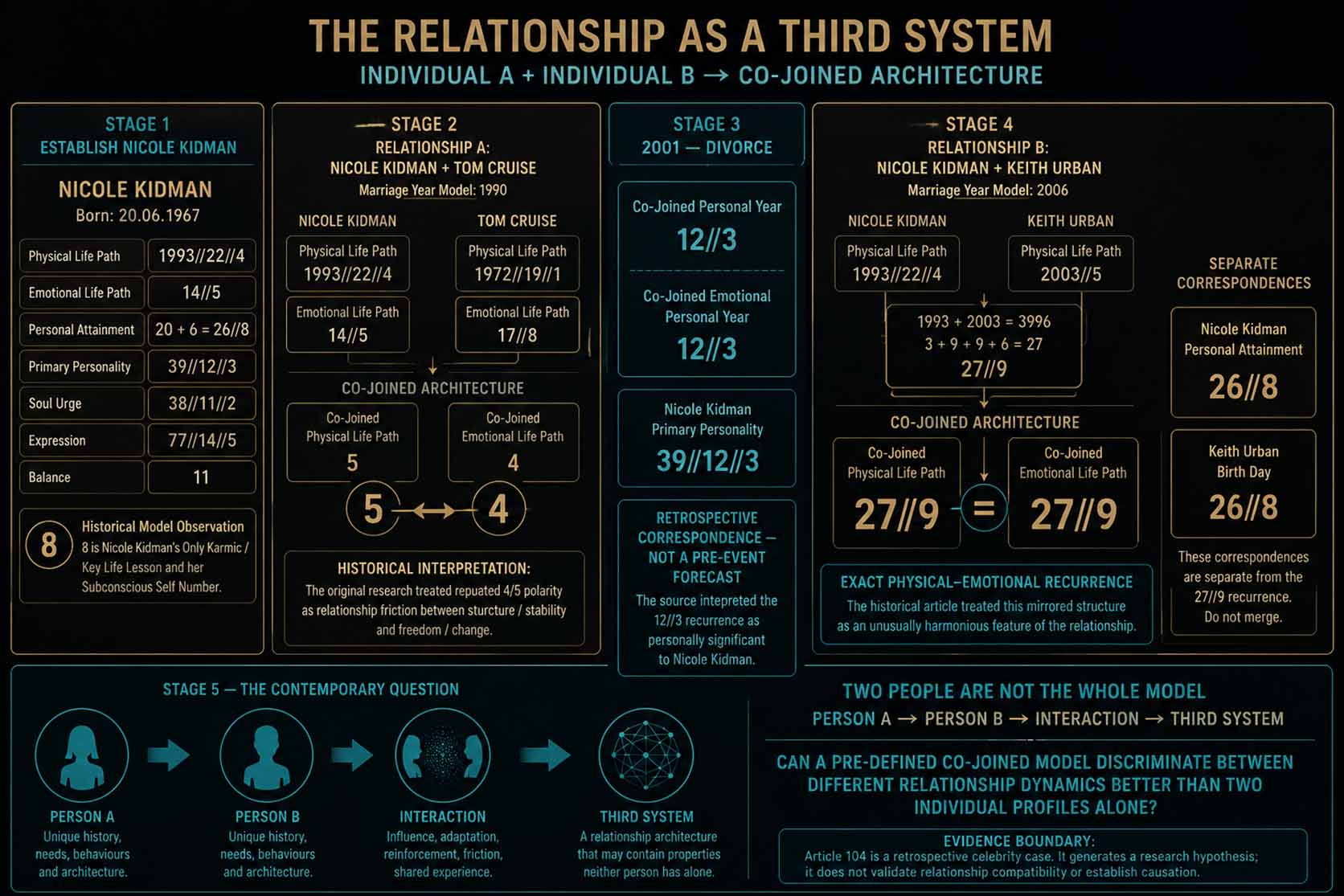
Born on 20 June 1967, her physical Life Path was calculated as 1993//22//4, while the less-visible or Emotional Life Path was 14//5. Her Personal Attainment calculation was 20 + 6 = 26//8.
Her name analysis added several other source values, including a 38//11//2 Soul Urge, 39//12//3 Personality, 77//14//5 Expression and 11 Balance Number. The original Inclusion Chart also identified 8 as both her only Key Life Lesson and her Subconscious Self Number.
Those calculations matter historically, but Article 104 becomes much more interesting when Chris stops asking only, Who is Nicole?
Instead, he asks:
What happens when Nicole’s architecture is mathematically combined with somebody else’s?
That changes the research object. The individual is no longer the whole system.
The First Relationship Produced a Repeating Tension
Kidman married Tom Cruise in 1990.
When Chris later constructed their Co-Joined model, one relationship stood out immediately: 4 and 5 kept appearing against one another across the combined architecture.
The historical chart records Kidman’s physical Life Path as 1993//22//4 and Emotional Life Path as 14//5. Cruise’s source model carries a physical Life Path of 1972//19//1 and an Emotional Life Path of 17//8.
When the two profiles were combined, the relationship-level architecture produced a recurring 5/4 structure. Article 104 described that pairing in strongly deterministic language, treating 4 and 5 as fundamentally incompatible: one representing order, stability and structure; the other freedom, movement and change.
The contemporary archive should preserve the observation without inheriting the certainty.
What Chris actually had was a hypothesis:
Could recurring structural opposition inside a combined model correspond with recurring friction between two people?
There was another retrospective correspondence. In the 2001 model, the year Kidman and Cruise divorced, the Co-Joined Personal Year and its Emotional counterpart were both recorded as 12//3. Kidman’s historical Personality sequence was also 39//12//3.
Interesting? Yes. Proof that the model anticipated or caused the divorce? No.
The calculation was examined retrospectively. The outcome was already known.
Then the Second Relationship Changed the Pattern
Kidman later married Keith Urban in 2006, creating an unusually useful comparison inside the same research case.
The same Nicole Kidman architecture remained in the model. The other person changed. And the combined structure changed with him.
- Kidman’s physical Life Path calculation was: 20 + 6 + 1967 = 1993
- Urban’s was: 26 + 10 + 1967 = 2003
- Combined: 1993 + 2003 = 3996
- Which reduces through: 3 + 9 + 9 + 6 = 27 → 2 + 7 = 9
- Giving: 3996//27//9
- The original article records the Co-Joined Physical Life Path as 27//9.
- Directly beneath it, the Co-Joined Emotional Life Path was also 27//9.
That gives the case its clearest visual moment:
PHYSICAL — 27//9
EMOTIONAL — 27//9
Not merely the same reduced 9, but the same 27//9 backing sequence.
The historical source interpreted that exact mirroring as unusually favourable. It also highlighted another separate correspondence: Kidman’s Personal Attainment is 26//8, while Urban was born on the 26th, giving him the same 26//8 day sequence.
Again, the contemporary interpretation needs to stop short of declaring that those relationships were numerically destined.
But the contrast itself is worth preserving.
The Most Interesting Finding Is Not “Who Was Better?”
The historical article ultimately concluded that Urban was a much better numerical fit for Kidman than Cruise.
That is not the strongest contemporary proposition.
A relationship cannot responsibly be reduced to a compatibility score derived from birth dates. People change. Relationships exist inside culture, opportunity, communication, health, family, work, behaviour, values, choices and thousands of events no numerical model contains.
The more durable insight is methodological. Kidman remained the constant. The second person changed. The relationship-level architecture changed as well. That is precisely what a Third System model should do.
If combining Kidman with Cruise had produced essentially the same result as combining Kidman with Urban, the method would reveal little discrimination.
Instead, the historical model generated visibly different combined structures. That does not establish that those structures caused either relationship outcome. It does create something testable.
From Celebrity Compatibility to Relationship Intelligence
The idea extends far beyond marriage.
- A founder and co-founder create a Third System.
- A chief executive and chair create one.
- A coach and athlete create one.
- A captain and coach create one.
- Two political leaders forced to govern together create one.
- A parent and child create one.
Each person contributes characteristics to the interaction, but the behaviour of the partnership cannot always be understood by studying either participant independently.
This proposition later reappears elsewhere in the Human Futurist archive, including team and working-relationship research. The Master Archive now identifies The Third System as a cross-archive research programme spanning relationships, teams and partnerships.
Article 104 therefore matters for a reason the original celebrity framing could not fully reveal.
It marks an early shift from individual architecture towards interaction architecture.
How the Third System Could Be Tested
Nicole Kidman, Tom Cruise and Keith Urban give the archive an intriguing historical comparison.
They do not give it validation.
The next research stage should remove celebrity hindsight as far as possible.
Define the Co-Joined calculations before examining outcomes. Recruit a much larger relationship sample. Include stable relationships, high-conflict relationships, separated couples and relationships whose outcomes are not yet known. Freeze the scoring rules. Have analysts evaluate the combined architecture without knowing the outcome category.
Then ask the question Article 104 could only begin to pose: does the Third System discriminate meaningfully between different relationship dynamics — and does it add information that analysing the two individuals separately does not?
If it does, the implications could reach considerably beyond romantic compatibility.
Relationship intelligence would become less about declaring two people “good” or “bad” for one another and more about identifying the architecture created between them.
That is the research proposition worth carrying forward.
FROM THE HUMAN FUTURIST RESEARCH ARCHIVE
This contemporary article was developed from historical Human Futurist research preserved as Article 104: Nicole Kidman Relationship Numerology Compatibility.
The original source used the historical term Co-Joined Numerology and made substantially stronger claims about compatibility, attraction and numerical causation than the contemporary article does. Those claims remain preserved as part of the research record.
The contemporary interpretation reframes the strongest surviving proposition as Third System/relationship architecture: the possibility that the interaction between two people can be studied as a distinct analytical system.
The original source remains preserved within The Human Futurist Research Archive.
Share This Article, Choose Your Platform!
Related Posts






From understanding decisions to informing them.
Beyond the Research
The Business & Leadership archive examines consequential decisions after they have happened.
The Intelligent Mathematical Blueprint and Private Advisory take the underlying Human Futurist thinking into a different environment: helping leaders examine the circumstances surrounding decisions that have yet to be made.