

The breakthrough looked sudden. The work behind it had been unfolding for more than a decade.
Persistence, Recurrence and the Timing of Creative Achievement
Ten Years of Work. Then Everything Changed.
In September 2004, Susanna Clarke became the kind of publishing story that can make success look almost instantaneous.
Her debut novel, Jonathan Strange & Mr Norrell, arrived with enormous confidence behind it. Bloomsbury had reportedly offered Clarke a £1 million advance. A quarter of a million hardcover copies were printed across Britain, the United States and Germany. Translations were already under way before the English-language edition had even appeared.
The book reached number three on the New York Times bestseller list, remained there for eleven weeks, was longlisted for the 2004 Man Booker Prize and, the following year, won the Hugo Award for Best Novel.
Look only at 2004 and 2005 and the story resembles a spectacular creative breakthrough. But that is not really where this story begins. Clarke had started working on the novel in 1992. The apparent overnight success had taken more than a decade to become visible.
And it was that long, largely unseen road that made Chris Styles’ historical research into Clarke far more interesting than a simple analysis of a bestselling author.
The real question became:
What happens if we stop studying breakthrough as a moment and begin studying everything that had to survive before the moment could exist?
The Part of the Success Story We Usually Leave Out
The early idea arrived while Clarke was teaching in Bilbao. She later described having a vivid waking image of a man in eighteenth-century clothing, somewhere resembling Venice, with the strong feeling that magic lay somewhere behind him.
That was inspiration. Execution proved considerably harder.
After returning from Spain, Clarke began developing the idea seriously. She attended a fantasy and science-fiction workshop and extracted a short story, The Ladies of Grace Adieu, from the material she had accumulated.
That story began opening doors. Colin Greenland sent it, without Clarke knowing, to Neil Gaiman. It eventually reached editor Patrick Nielsen Hayden and was published in Starlight 1 in 1996.
There were other stories, other anthologies and encouraging signs. But the novel itself remained unfinished.
Clarke continued working on it in her spare time for years. She attempted to write for three hours each morning from 5:30am. She wrote the book in fragments rather than sequentially and then tried to fit those fragments together.
Most importantly, she did not know whether the method would work. She later acknowledged that if she had known at the beginning that the book would take ten years, she might never have started it. That admission changes the texture of the success story.
Because persistence looks very different before there is evidence that persistence will be rewarded.
By around 2001, the historical source records that Clarke had “begun to despair”. She still did not know whether the novel would ever be finished. That year became particularly interesting to Chris.
Then Chris Looked at the Years Before the Breakthrough
The original 365 Pin Code research was interested primarily in the numerical architecture surrounding Clarke’s success.
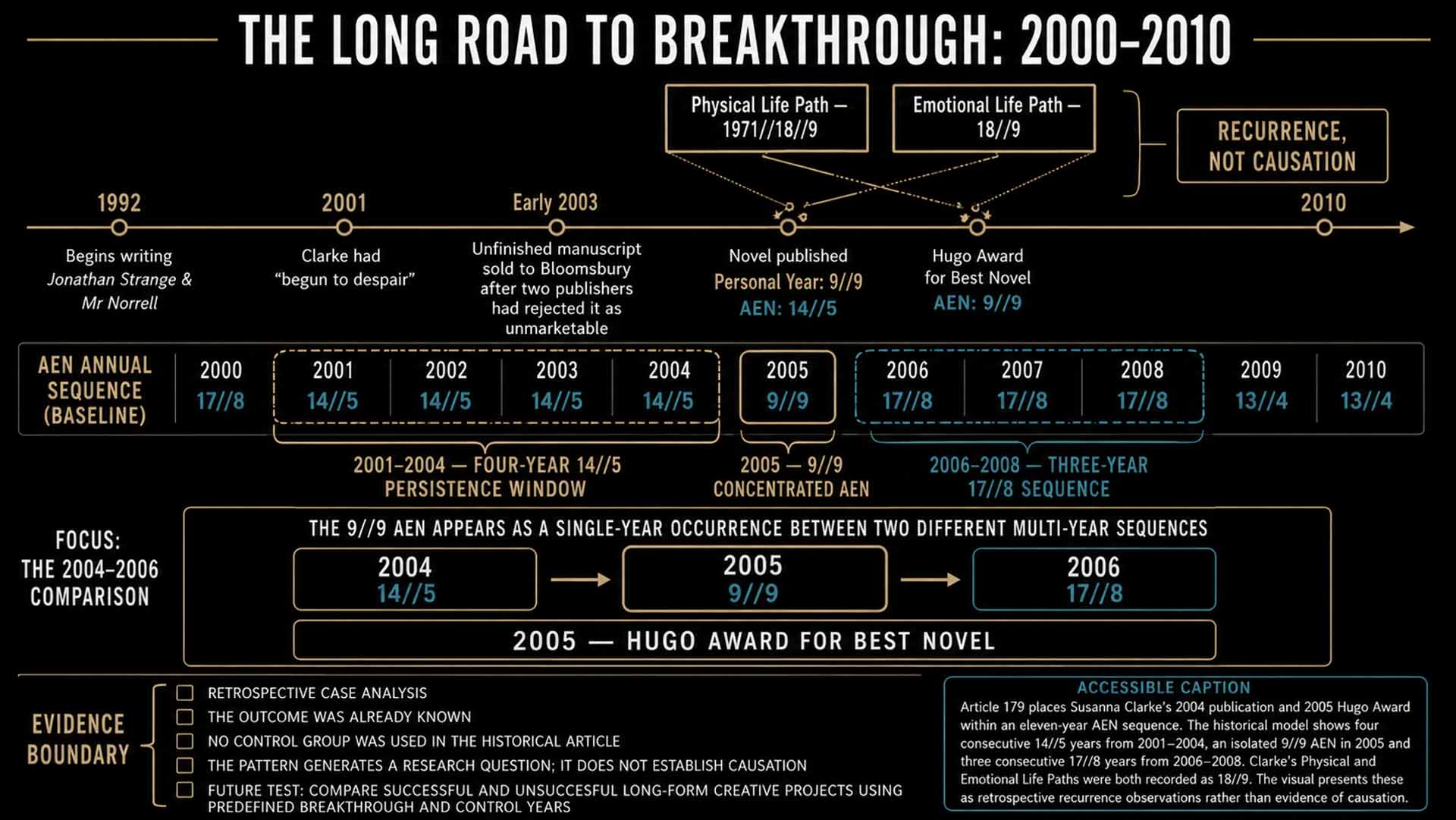
It recorded her Physical Life Path as 1971//18//9 and her Emotional Life Path ,[called the “Shadow Life Path” in the historical terminology] as 18//9.
It then mapped Clarke’s annual sequences across the years surrounding publication. And this is where the story became unexpectedly more interesting.
According to the historical table, the Annual Experience Number running through 2001, 2002, 2003 and 2004 was exactly the same:
14//5 → 14//5 → 14//5 → 14//5 Four consecutive years.
The original article interpreted 14//5 through its historical numerological framework as a testing period centred on discipline, persistence, focus and eventual change.
That interpretation should not simply be treated today as established fact. But look at what was happening in Clarke’s actual creative journey during the same period.
In 2001 she was losing confidence that she could finish.
- Yet she continued.
- She looked for help.
- Literary agent Giles Gordon eventually took on the unfinished manuscript.
- Two publishers reportedly rejected it as unmarketable.
- Still the process continued.
In early 2003, Gordon sold the unfinished manuscript to Bloomsbury. And Clarke kept working. Then came 2004.
Her Personal Year in the historical model had moved to 9//9, while the four-year 14//5 AEN sequence was reaching its final year. The novel that had consumed more than a decade of her life was finally published.
From the outside, 2004 was the breakthrough. From inside the process, it was the end of an extraordinarily long execution phase.
That distinction matters.
And Then 2005 Changes the Pattern
Chris’ longitudinal table becomes even more interesting when 2004 is placed beside the years immediately around it.
The AEN sequence reads:
2004 — 14//5
2005 — 9//9
2006 — 17//8
The 9//9 AEN occupies a single year between two completely different sequences.
Look further out and the contrast becomes clearer.
- From 2001 through 2004, the AEN remains 14//5.
- From 2006 through 2008, it becomes 17//8.
- Only 2005 carries the 9//9 AEN inside that immediate eleven-year window.
And 2005 was the year Jonathan Strange & Mr Norrell won the Hugo Award for Best Novel.
That caught Chris’ attention because the underlying model already contained Clarke’s Physical and Emotional Life Path positions at 18//9.
The original article therefore saw 2005 as a concentrated recurrence of her underlying 9 architecture, and interpreted the recognition that followed as confirmation of the model.
The contemporary reading needs to be more careful. The outcome was already known when the analysis was performed. That makes this a retrospective recurrence, not a prediction. But it is still a legitimate observation.
The question is whether this kind of recurrence appears disproportionately around genuine creative breakthrough and recognition — or whether we simply notice it because we already know which year mattered.
That is now the more important research problem.
The Most Interesting Finding Is Not the Number 9
It would be easy to make Article 179 about the apparent recurrence of 9. That would miss its strongest idea.
What makes Susanna Clarke’s case worth keeping in the contemporary Human Futurist archive is the relationship between the visible success and everything required to reach it.
The chronology looks something like this:
CREATIVE CONCEPTION → SUSTAINED EXECUTION → UNCERTAINTY → RESISTANCE → PERSISTENCE → COMPLETION → EXTERNAL RECOGNITION
The breakthrough does not sit at the beginning. It sits almost at the end. And that creates what the Archive Analysis identifies as the Creativity–Execution Gap.
Having an extraordinary idea is one capability. Remaining with that idea while the outside world provides little evidence that it will succeed is another.
Clarke’s story contains years during which the market had not validated the project, the book remained unfinished and even she was uncertain whether she would complete it.
- Yet substantial creative development was still taking place.
- The absence of visible success did not mean the absence of progress.
- That is the deeper lesson hidden inside the chronology.
What the Historical Research Can, and Cannot, Tell Us
Article 179 is a retrospective case. The historical numerical relationships are genuine features of the model Chris constructed, but this single case cannot establish that 14//5 produced Clarke’s persistence or that 9//9 produced her award-winning year.
Nor does the original study compare Clarke with writers who spent ten years on books that never succeeded.
- There is no control group.
- There is no test of how often the same sequences appear during unremarkable years.
- And because the breakthrough years were already known, hindsight remains an unavoidable variable.
Those limitations do not make the research worthless. They tell us what the next research question has to be.
Instead of asking:
“Do Clarke’s numbers explain her success?”
ask:
“Can a model distinguish the long execution phase, the breakthrough phase and ordinary control periods without first being told which years”
That is testable. And considerably more interesting.
The Creativity–Execution Gap
There is another reason this research survives its original framing. The problem it exposes is not limited to novelists.
Researchers live through it. Entrepreneurs live through it. Scientists live through it. Inventors, artists, filmmakers, designers and anyone attempting to create something genuinely new can experience the same uncomfortable distance between having the idea and producing the result.
During that interval, conventional measures often tell you very little.
- Revenue may be zero.
- Recognition may be absent.
- The work may look unfinished.
- Progress may be fragmented.
- The creator may themselves doubt whether the project will ever work.
- And yet the project may be changing every day.
The Archive Analysis gives this a second useful name: Invisible Progress. It describes developmental movement that exists before conventional outcome measures can see it.
That may ultimately be one of Article 179’s most useful contributions.
The Bigger Question Beyond Susanna Clarke
Susanna Clarke gives the Human Futurist archive an unusually clear creative-achievement case because the gap between conception and breakthrough is so long.
A future research programme could compare writers, researchers, founders and other creators whose major work required years of development.
Their timelines could be built first. Breakthrough years and control years could then be defined independently.
The question would no longer be whether an interesting sequence can be found around a famous success.
It would be whether the architecture genuinely helps distinguish preparation, persistence, breakthrough and recognition across multiple cases.
That is the journey Article 179 now points towards.
Not: success was destined.
But: what can the years before success teach us about how breakthrough actually develops?
Because when we remember only the publication, the prize or the bestseller list, we see the moment when the world finally noticed.
The research becomes much more interesting when we look at all the years in which there was almost nothing for the world to notice yet.
FROM THE HUMAN FUTURIST RESEARCH ARCHIVE
This contemporary Feature Research article revisits physical Article 179, AK Susanne Clarke debut bestseller 2004, preserved within The Human Futurist Research Archive.
The historical article examined Susanna Clarke’s Jonathan Strange & Mr Norrell through the 365 Pin Code methodology and argued that her 2004–2005 literary success corresponded with recurring number-9 architecture.
The original remains preserved as part of the historical research record.
This contemporary article retains the chronology, calculations, annual sequences and original interpretations that matter to the research while reframing deterministic historical claims as retrospective observations and research propositions. Contemporary “Emotional” terminology replaces historical “Shadow” language in the surrounding explanation without altering the original calculation structure.
Archive Identifier: HF-RA-179
Research Classification: Recommended Feature Research
Research Status: Retrospective / Hypothesis-Generating
Share This Article, Choose Your Platform!
Related Posts





From understanding decisions to informing them.
Beyond the Research
The Business & Leadership archive examines consequential decisions after they have happened.
The Intelligent Mathematical Blueprint and Private Advisory take the underlying Human Futurist thinking into a different environment: helping leaders examine the circumstances surrounding decisions that have yet to be made.