
In 2021, Bill Gates was already one of the most scrutinised people on Earth.
Bill Gates and the Long-Horizon Test
In 2021, Chris Styles put a marker on Bill Gates 2029. The outcome still does not exist.
In 2021, Bill Gates was already one of the most scrutinised people on Earth.
COVID-19 had pushed global public-health policy into everyday conversation. Gates’s philanthropy had placed him prominently within that debate, while conspiracy theories had transformed that visibility into something considerably darker. Around the same period, the breakdown of his marriage to Melinda French Gates and renewed reporting about his private and professional behaviour were bringing a different kind of scrutiny.
It would have been easy for a Human Futurist article written at that moment to concentrate entirely on what was already happening.
Chris Styles did something different. He looked almost a decade ahead.
The historical Article 212 identified 2029 and 2030 as the period that deserved particular attention in Gates’s longer-term model. More strikingly, it made a statement that remains frozen in the archive today:
2029 would be “THE YEAR when much is revealed, one way or another” about Bill Gates.
2029 has not happened. And that changes the nature of the research.
The Most Interesting Event Hasn’t Happened Yet
Most retrospective pattern research begins with an event. Something extraordinary happens. The researcher goes back through the data and asks whether anything in the preceding structure appears unusual.
That can produce interesting observations, but it also creates an unavoidable problem: the researcher already knows where to look.
Article 212 is different. Its central research period lay approximately eight years beyond the article’s 2021 publication context.
Chris knew Gates’s history. He knew the public controversies already surrounding him. But he did not know what 2029 would contain.
That makes Article 212 unusually valuable within the Human Futurist Research Archive, not because its prediction has been validated, but because it has not yet had the opportunity to be validated.
The forecast is sitting in front of the outcome. That is exactly where a future-facing research proposition should be.
What Chris Put on the Record in 2021
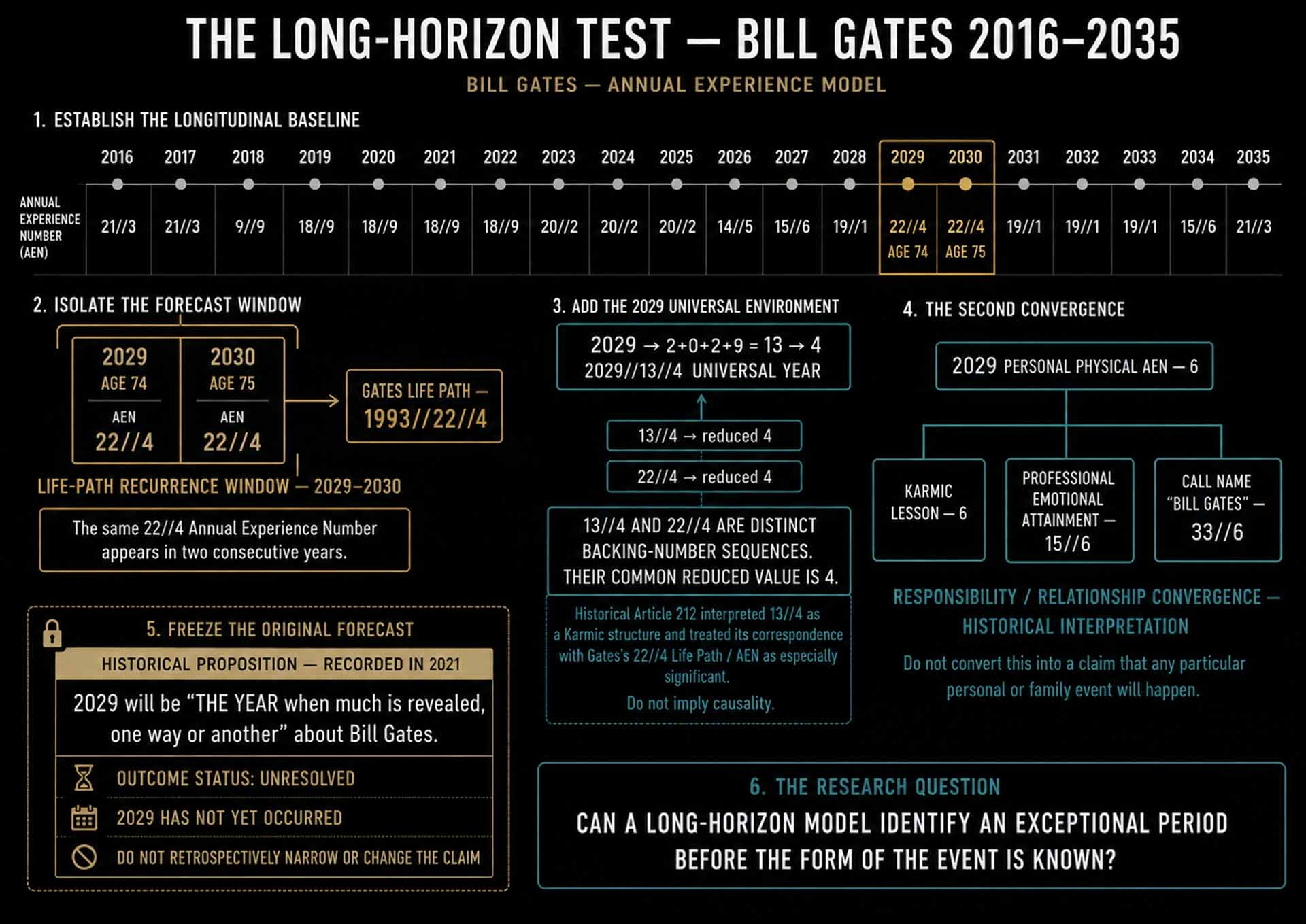
The historical article contains a substantial amount of Bill Gates modelling: name architecture, date-of-birth positions, Personal and Professional structures, Emotional positions and a longitudinal Annual Experience table extending from 2016 to 2035.
Not all of that needs to dominate a contemporary article. The decisive observation is much narrower.
Chris calculated Gates’s Life Path as:
1993//22//4 In the historical methodology, 22//4 was treated as a particularly important enduring structure. The longitudinal model then placed exactly the same 22//4 Annual Experience Number into:
2029
and again into:
2030.
This produced a two-year recurrence of an enduring Gates structure inside his time-specific model.
The surrounding years were different. The table moves from 15//6 in 2027, to 19//1 in 2028, then into 22//4 in both 2029 and 2030, before moving back to 19//1 from 2031 to 2033.
Whatever one thinks the sequences mean, the underlying observation can be stated without drama:
2029–2030 form a distinct two-year 22//4 window within the preserved longitudinal model.
That was the first reason Chris paid attention.
Why 2029 Became the Year to Watch
Then came a second relationship.
The year 2029 itself calculates:
2 + 0 + 2 + 9 = 13 → 4
or:
2029//13//4
The historical article treated 13//4 as materially different from 22//4. They share the reduced 4, but they are not the same backing-number sequence.
That distinction matters. A contemporary Human Futurist article should not flatten both to “4” and call them identical.
What Chris identified was a correspondence between Gates’s 22//4 Life Path, a 22//4 Annual Experience Number in 2029 and a wider 13//4 universal-year environment.
The historical interpretation was considerably stronger. It described 13 as a Karmic octave of 22 and therefore treated 2029 as a potentially demanding year.
Today’s archive does not need to endorse that conclusion as fact.
What deserves preservation is the architecture of the forecast: enduring 22//4 structure → future 22//4 recurrence → 13//4 external year
That is the research configuration that existed before the outcome.
One Future Window, Several Independent Connections
Article 212 did not stop there.
The 2029 line also carries a Personal Physical Annual Experience Number of 6.
That interested Chris because the historical name analysis identified 6 as Gates’s only Karmic Lesson. The same number appeared elsewhere in the model.
His Professional Emotional Attainment position was calculated as: 15//6
And his everyday name:
BILL GATES was calculated as: 33//6.
The historical article associated this group of 6 structures with relationships, family, responsibility, loyalty, community and matters of the heart.
Again, the contemporary distinction is important.
This does not mean that Article 212 successfully predicted a divorce, family crisis, philanthropic event or public revelation in 2029. It did not specify one.
Instead, the model placed several independently derived 6-related positions beside the already unusual 22//4 configuration.
For research purposes, that is the intriguing feature:
not one number, but several separate parts of the construction becoming relevant within the same future period.
It raises a question that appears repeatedly across the Human Futurist archive: Does convergence carry more information than occurrence?
What Does “Much Will Be Revealed” Actually Mean?
Here Article 212 becomes both stronger and weaker.
Stronger, because the original statement survives. We know what it said. Weaker, because the phrase itself is broad. “Much is revealed, one way or another” does not define the domain of the predicted outcome.
Revealed about what?
- Business?
- Philanthropy?
- Family?
- Reputation?
- Relationships?
- Power?
- Public scrutiny?
- Health?
Nothing in the historical statement narrows the outcome sufficiently to one measurable event.
That limitation should not be repaired after the fact. If something dramatic happens to Gates in 2029, the archive must not pretend that Article 212 named it specifically.
And if almost nothing unusual happens, it would be equally inappropriate to search through minor events until something can be made to fit.
A prospective forecast becomes credible only when the rules governing its evaluation are decided before the result is known.
Article 212 therefore provides a useful lesson in prediction design. A future forecast should ideally identify not only when, but also what constitutes a meaningful outcome domain, how wide the forecast window is and what evidence would count against the original proposition.
Why an Unresolved Prediction Can Be More Valuable
There is an understandable temptation to value prediction research according to whether it was right.
But before an outcome arrives, another form of value exists. Integrity of provenance. Article 212 is preserved. Its calculations are preserved. The 2016–2035 longitudinal sequence is preserved. Its emphasis on 2029–2030 is preserved. And its strongest statement about 2029 is preserved. None of those things needs to be reconstructed from memory in 2030. That is significant.
Human beings are remarkably good at remembering forecasts differently after events occur. Uncertainty disappears. Broad claims become precise. Weak impressions become confident predictions. Failed alternatives are forgotten.
The research archive provides a countermeasure.
Freeze the proposition. Wait. Then compare.
The Rule That Must Not Change in 2029
When 2029 arrives, Article 212 should not be rewritten.
- Its interpretation can be revisited.
- Its outcome can be analysed.
- Its claims can be classified as supported, partially supported, ambiguous or unsupported.
But the original proposition should remain exactly where it is.
That means retaining the two-year 2029–2030 22//4 window. It means retaining the distinctive 2029//13//4 external environment. It means retaining the historically identified 6 convergences. And it means retaining the sentence that 2029 would be the year when “much is revealed, one way or another.”
Only then can the case become a genuine predictive audit. The strongest outcome would not necessarily be a dramatic confirmation. A clear failure would also be valuable.
- If the future proves unremarkable relative to surrounding years, that challenges the model.
- If something substantial occurs but outside the anticipated domains, the interpretation needs refinement.
- If the 2029–2030 period is objectively exceptional in ways consistent with the pre-recorded proposition, the finding becomes more interesting — but still requires comparison against other predicted and non-predicted periods.
Research advances in every one of those scenarios. It advances only if the record stays still while the future moves.
From Prediction to Prospective Research
Bill Gates is what makes Article 212 immediately interesting. But he is not what makes it enduring.
The larger proposition is the possibility of long-horizon prospective modelling.
- Can an individual mathematical model identify a future period as unusually important several years before anyone knows what that importance might look like?
- Can the forecast remain sufficiently fixed to be audited fairly?
- Can predicted windows be compared with ordinary years rather than judged in isolation?
- And can the same methodology produce meaningful discrimination across many people rather than one famous individual?
Those are considerably more demanding questions than asking whether Bill Gates will have an eventful 2029.
Article 212 has not answered them. It has done something potentially more useful. It has created a future test. The data was calculated. The window was identified. The proposition was recorded. And the outcome remains beyond the horizon.
For once, there is no need to reconstruct what the researcher might have said before the future arrived.
We already know.
Now the research has to wait.
FROM THE HUMAN FUTURIST RESEARCH ARCHIVE
This contemporary article has been developed from historical Human Futurist research preserved as Article 212: What the future holds for Bill Gates — Archive ID HF-RA-212.
The original article dates from the 2021 research period and identifies 2029–2030 as a significant future window within Bill Gates’s longitudinal model. It specifically records the proposition that 2029 would be “THE YEAR when much is revealed, one way or another”.
The original source uses earlier 365 Pin Code terminology and makes several claims in more deterministic language than the contemporary Human Futurist research standard. The present article preserves the calculations and historical forecast while separating them from unsupported causal conclusions.
The principal prediction remains unresolved. The original Article 212 remains preserved within The Human Futurist Research Archive so that the 2029–2030 outcome can eventually be audited against the record that existed before it occurred.
Share This Article, Choose Your Platform!
Related Posts






From understanding decisions to informing them.
Beyond the Research
The Business & Leadership archive examines consequential decisions after they have happened.
The Intelligent Mathematical Blueprint and Private Advisory take the underlying Human Futurist thinking into a different environment: helping leaders examine the circumstances surrounding decisions that have yet to be made.