

One Year, an Extraordinary Concentration of Ideas
Albert Einstein 1905, Annus Mirabilis Year
Some years are productive. Others divide history into before and after.
For Albert Einstein, 1905 came remarkably close to the latter.
He was 26 years old and working at the Swiss Patent Office in Bern. Yet during that year he produced work dealing with light quanta and the photoelectric effect, Brownian motion, special relativity and the relationship between mass and energy, contributions that helped reshape twentieth-century physics. The American Physical Society describes 1905 as Einstein’s annus mirabilis, while the Nobel Foundation records that his later Nobel Prize in Physics for 1921 particularly recognised his discovery of the law of the photoelectric effect.
That historical importance is not in dispute. The interesting Human Futurist question begins somewhere else. Why should so much consequential intellectual output become concentrated in one year?
And if a timing model claims to reveal periods of unusual potential, what would 1905 look like inside it? That was the question Chris Styles explored retrospectively in the historical research article
Chris Asked a Different Question
The original article belongs to an earlier period of Human Futurology. Its language is often emphatic. It describes 1905 as having been “hard coded” for greatness and interprets Einstein’s numerical architecture through traditional numerological meanings.
The contemporary article cannot simply repeat that conclusion. Instead, it preserves the actual calculations and asks what can reasonably be investigated from them.
Chris began with Einstein’s underlying date-of-birth architecture.
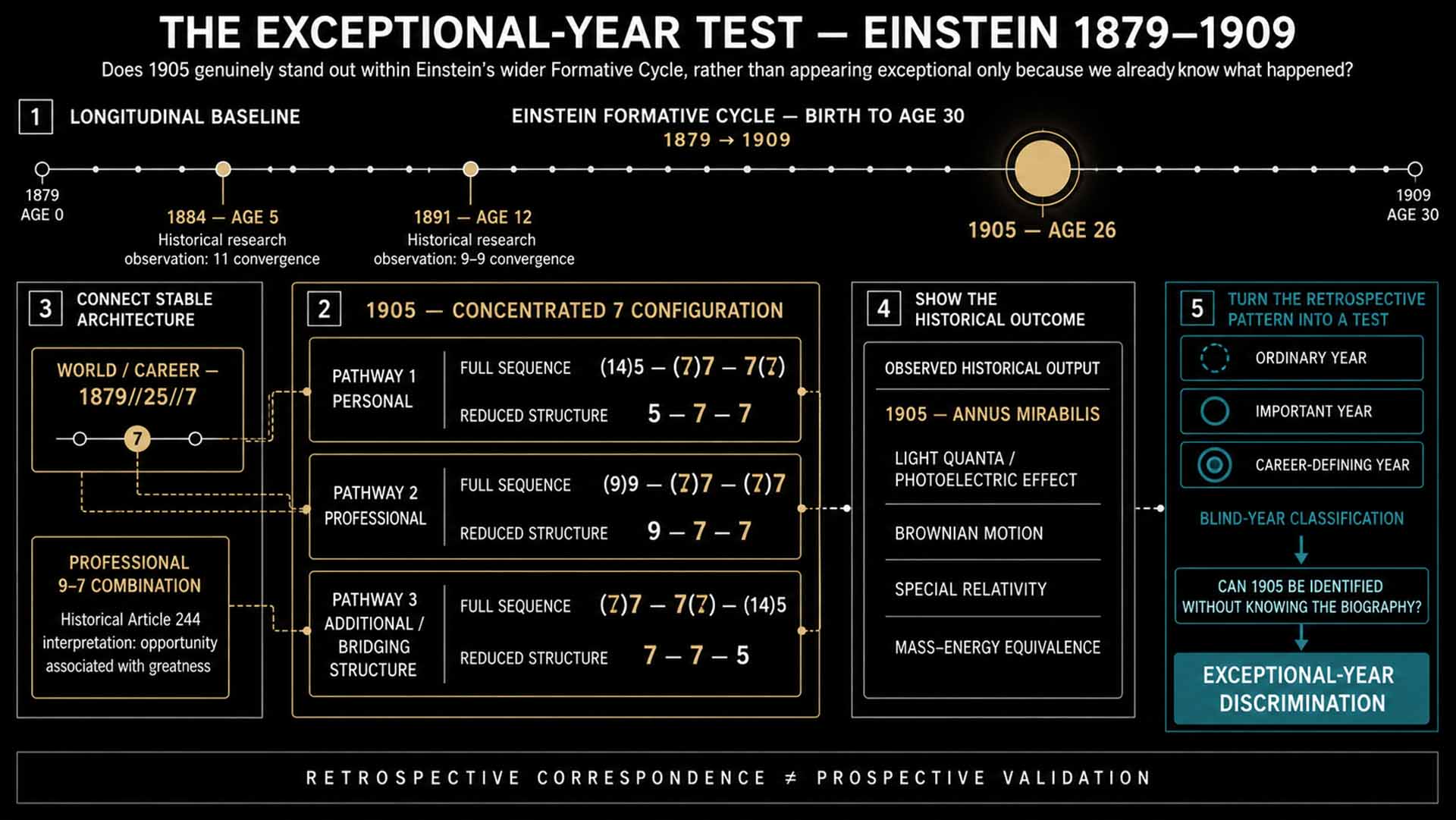
Within the historical system, Einstein’s birth year, 1879, produces 1879//25//7, placing 7 in what the methodology calls the World/Career position. His birth date of 14 March 1879 was also used to derive a wider set of personal, professional and attainment positions.
Most of those numbers are not necessary to understand this story.
One is. 7.
Because when Chris moved from Einstein’s stable architecture into the year-by-year model, 7 began appearing unusually densely around the year already famous for exceptional scientific output.
But 1905 was not the first historical year Chris noticed.
Before 1905, Two Earlier Years Had Already Caught His Attention
The article maps Einstein’s Formative Cycle from birth to age 30 rather than analysing 1905 entirely in isolation. That longitudinal context matters because a supposedly exceptional year means little unless there is something to compare it with.
The historical research highlights 1884, when Einstein was five.
The annual model contains what Chris described as an 11 convergence. The article retrospectively connects that period with Einstein’s childhood fascination with a compass and the mystery of the invisible force moving its needle.
It then highlights 1891, at age 12. Here the model contains a 9–9 convergence, which the historical paper associates with Einstein’s intense interest in geometry.
Neither correspondence proves that the numerical configuration produced the childhood experience.
That distinction matters.
But the two examples show what Chris was trying to do: place significant episodes against a continuous temporal model and look for concentrations, recurrences or changes in structure. Then he arrived at age 26. And the annual pattern became considerably more striking.
Then 1905 Changes the Density
Einstein’s 1905 sequence is the evidential centre of Article 244. The historical model records:
Personal
(14)5 — (7)7 — 7(7) Reduced to: 5 — 7 — 7
Professional
(9)9 — (7)7 — (7)7 Reduced to: 9 — 7 — 7
Bridging:
(7)7 — 7(7) — (14)5 Reduced to: 7 — 7 — 5.
Look at those three lines together:
5–7–7 | 9–7–7 | 7–7–5
That is the visual moment at the centre of the research.
The source does not merely identify a single 7 and attach significance to it. Multiple 7 occurrences sit across separately calculated parts of the 1905 model while Einstein’s underlying World/Career position is itself 25//7.
Within Chris’s historical framework, 7 was associated particularly with analysis, knowledge, research and the mind.
The paper also singled out the 9–7 professional combination, interpreting it as an opportunity associated with unusual greatness.
And there was another observation. All three reduced sequences consist entirely of odd values — 5, 7 and 9 — separated by no more than two points. The original article treated that compact odd-number structure as another characteristic of what it called a “golden year”.
That was Chris’s historical interpretation. The contemporary question is what to do with it.
The Historical Article Went Further
The original source concludes that 1905 was not accidental. It presents Einstein’s opportunity for greatness as something already encoded within his numerical timeline.
That conclusion goes further than the evidence presently establishes.
We know the historical outcome first. We know that 1905 became Einstein’s annus mirabilis. We know that he produced several landmark papers during the year. We know his work on the photoelectric effect later formed the specifically cited basis of his 1921 Nobel Prize in Physics.
Chris then examined the model around that already famous year.
That means the original article is retrospective. It is not a record of somebody calculating Einstein’s future in 1904 and declaring that 1905 would be his extraordinary scientific year.
That does not make the exercise uninteresting. It changes what it can prove.
But Knowing the Answer Changes the Test
Imagine being shown a target after the arrow has already landed. You can study why that particular path appears to lead towards the bullseye. But you cannot then claim that the same path would necessarily have told you where to aim beforehand.
That is the methodological problem hidden inside the Einstein case. If researchers begin with the knowledge that 1905 was extraordinary, they may naturally pay greater attention to whatever features make 1905 look unusual.
This creates the possibility of hindsight bias. The Archive Analysis therefore reframes the enduring value of Article 244.
The important proposition is no longer:
Do Einstein’s numbers explain why he was destined for greatness in 1905?
It becomes:
Can a pre-defined temporal model discriminate an exceptional scientific-output year from ordinary years without being told where the exceptional year occurs?
That is a very different research problem. And a far stronger one.
The Stronger Question: Could 1905 Be Found Blind?
Suppose a researcher were given Einstein’s annual sequences from across his working life.
- Remove the dates.
- Remove the biography.
- Remove the paper titles.
- Remove the knowledge that 1905 has any special historical significance.
Then ask the researcher to rank the years.
- Which appear ordinary?
- Which appear unusually important?
- Which one or two appear most likely to contain career-defining scientific output?
Only after those rankings have been frozen would the historical dates be revealed.
If 1905 consistently emerged near the top, the result would be considerably more interesting than a retrospective explanation of a year already known to be famous. If many other years produced equally strong “golden” configurations without corresponding exceptional output, that would matter just as much.
The question therefore becomes one of discrimination. Not whether a meaningful story can be built around 1905 after the event.
Whether the model can distinguish it from the rest.
The Article 244 Archive Analysis names this emerging concept: Exceptional-Year Discrimination.
From Einstein to Exceptional-Year Discrimination
This moves the research beyond Albert Einstein.
A scientifically famous year is useful because its outcome is unusually clear. But the same research design could be applied across different forms of exceptional human output.
- Take a scientist with several decades of published work.
- A novelist with one extraordinary creative period.
- An entrepreneur whose most consequential innovations cluster within a few years.
- An elite athlete with identifiable performance peaks.
The question remains the same:
Can time-specific Human Futurist architecture distinguish ordinary, important and career-defining periods before the outcome labels are revealed?
The Master Research Archive identifies this as one of the principal opportunities inside the Science, Technology & Innovation collection: exceptional-output periods can be treated as a concentration problem, while retrospective breakthrough cases require control years before claims of exceptional-year discrimination become persuasive.
This is where Article 244 becomes more than an Einstein story. It provides a prototype for a test. Einstein’s 1905 is the known case. The next stage is to remove the knowing.
Why This Case Still Matters
The historical article wanted to answer a dramatic question:
Why was 1905 Einstein’s miracle year?
The contemporary research asks something more useful.
Could we have recognised that 1905 was unusual without being told what happened?
There is an important difference between the two. The first looks backwards and searches for correspondence. The second creates the possibility of falsification.
Perhaps the concentrated 7 architecture really does occur disproportionately around exceptional analytical or scientific output. Perhaps the proposed 9–7 professional structure distinguishes major opportunity periods. Perhaps similar-looking configurations appear repeatedly without anything exceptional happening at all.
Every one of those results would teach us something. That is why Einstein remains such a valuable Human Futurist case. Not because Article 244 proves that numbers produced the breakthroughs of 1905.
It does not.
It matters because a historically extraordinary year sits beside a specific, visible and unusually concentrated model configuration. That gives the research something concrete to test.
And it turns one of the most famous creative-scientific years in modern history into a much larger question:
Can we distinguish an exceptional human-performance window before we know it was exceptional?
That is where retrospective fascination becomes research.
FROM THE HUMAN FUTURIST RESEARCH ARCHIVE
This contemporary article has been developed from historical Human Futurist research preserved as Article 244, Blog No 36 – Albert Einsten and 1905 Annus Mirabilis, Archive ID HF-RA-244.
The original document remains preserved within The Human Futurist Research Archive.
The historical source presents 1905 in deterministic language and describes Einstein’s extraordinary year as having been numerically “hard-coded”. The contemporary publication preserves the original calculations and research observations while reframing that conclusion as a retrospective correspondence and a testable research proposition.
Article 244 is entirely retrospective. It is not presented as evidence that Chris Styles predicted Einstein’s 1905 output before the event.
Contemporary factual checking also distinguishes the original source wording from the verified historical record. Albert Einstein was awarded the 1921 Nobel Prize in Physics, which was presented in 1922, particularly for his discovery of the law of the photoelectric effect.
Share This Article, Choose Your Platform!
Related Posts






From understanding decisions to informing them.
Beyond the Research
The Business & Leadership archive examines consequential decisions after they have happened.
The Intelligent Mathematical Blueprint and Private Advisory take the underlying Human Futurist thinking into a different environment: helping leaders examine the circumstances surrounding decisions that have yet to be made.