

Part of the Rugby World Cup 2019 Case Study
The earlier chapters followed the research across coaches, captains, teams and tournament stages. Now there was nowhere left for the analysis to hide inside a large field. Only four nations remained, and the next two matches would decide the Final.
By semi-final weekend, the Rugby World Cup 2019 had become brutally simple.
By semi-final weekend, Rugby World Cup 2019 had become brutally simple.
England would face defending champions New Zealand in Yokohama. South Africa would face Wales the following day. Two matches. Four teams. Two places in the Final.
Chris had already spent the tournament comparing the coach-and-captain patterns behind each side. Now he brought those strands together and published a set of predictions that could be resolved within days.
The calls were not buried in general language. They were explicit.
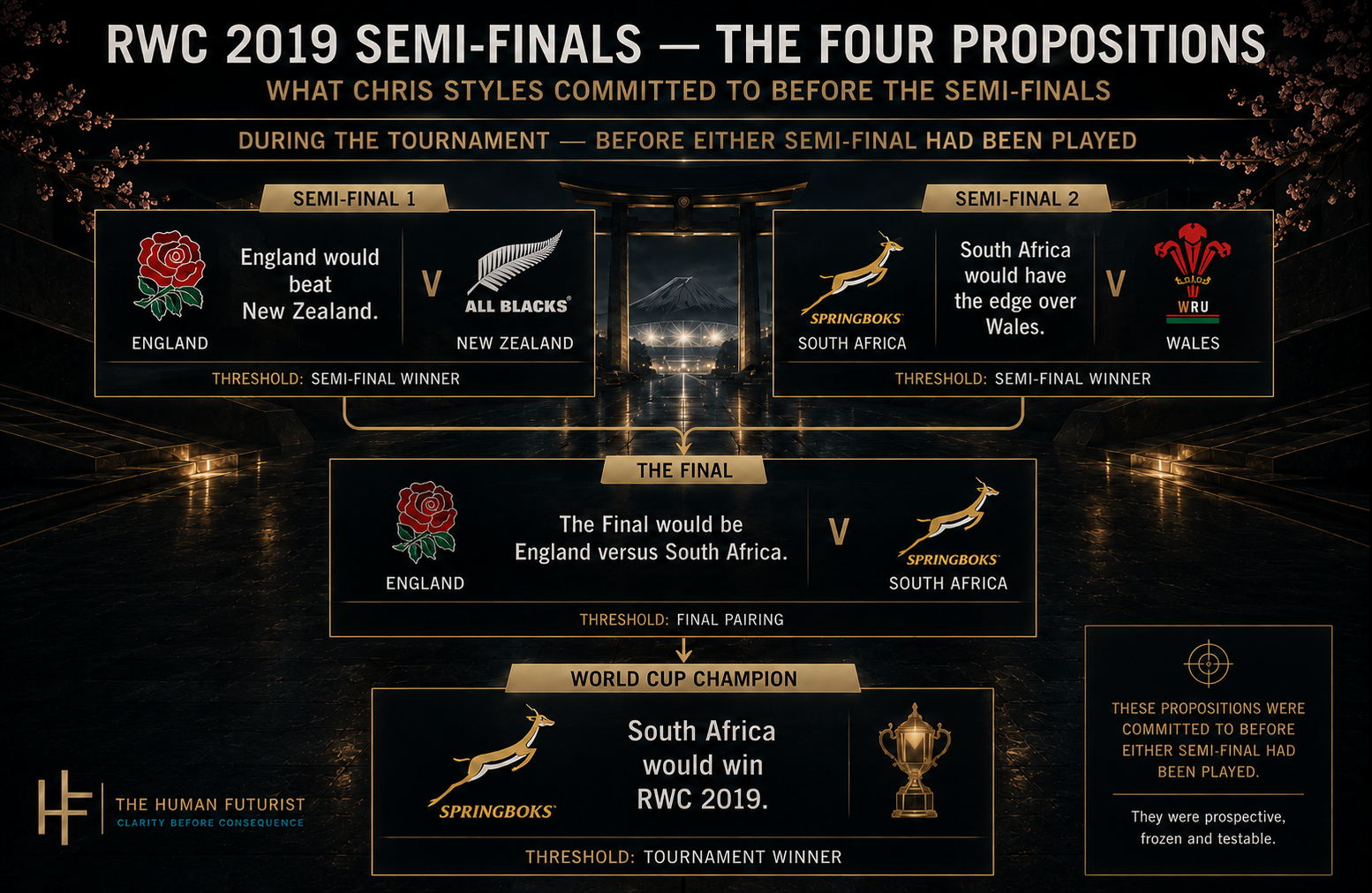
England over New Zealand
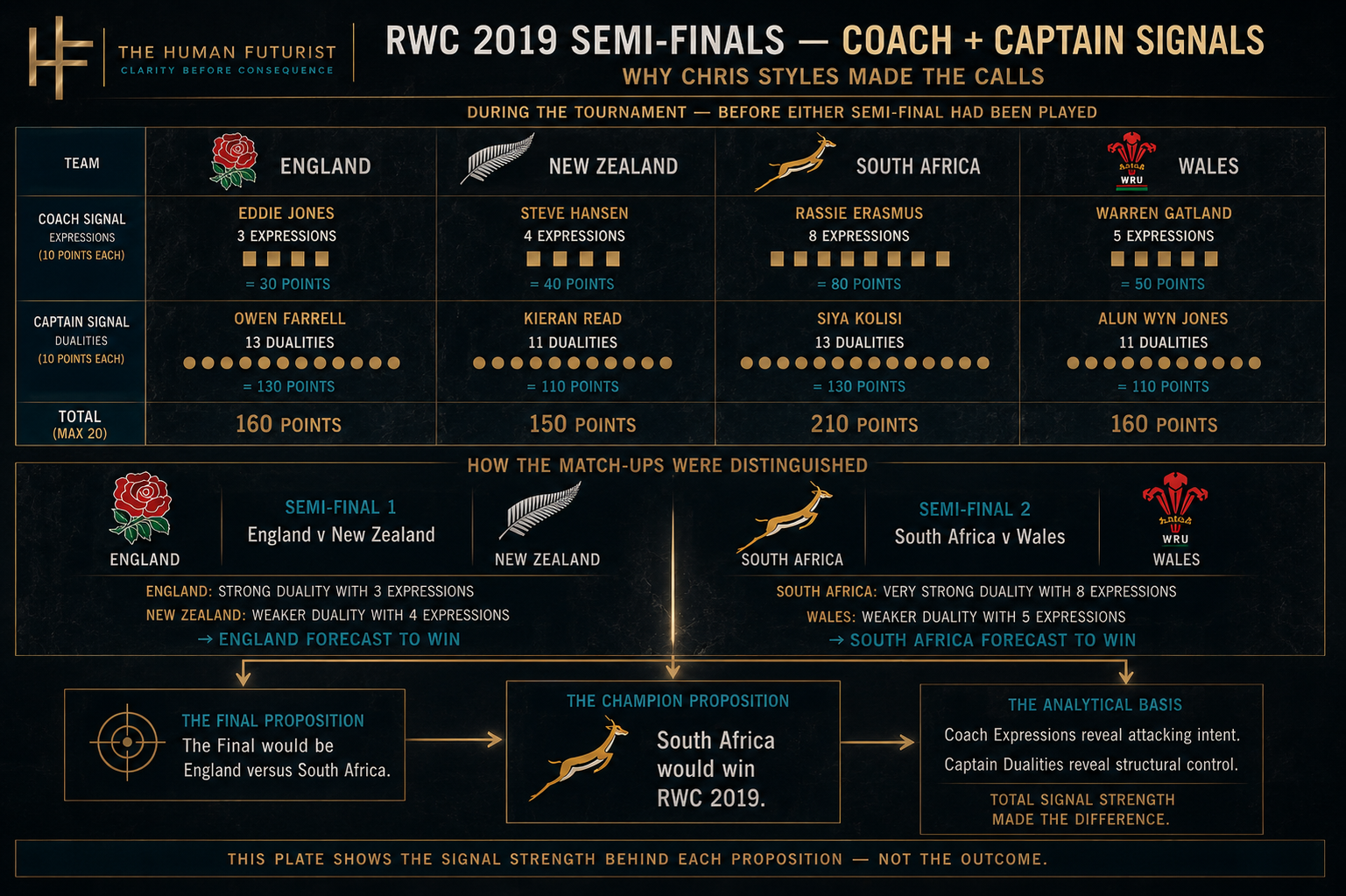
The first semi-final placed Eddie Jones and Owen Farrell against Steve Hansen and Kieran Read.
In Chris’s 2019 analysis, Jones and Farrell produced a combined result of two dualities and no Expression appearances. Hansen and Read produced one Expression appearance and no dualities.
That comparison led to the historical call: “England Win – only just.”
It was a significant proposition. New Zealand were the reigning back-to-back world champions and had not lost a Rugby World Cup match since 2007. Chris was forecasting that their run would end before the Final.
South Africa over Wales
The second semi-final was closer inside Chris’s framework.
Rassie Erasmus and Siya Kolisi produced a combined total of three: two Expression appearances and one duality. Warren Gatland and Alun Wyn Jones also produced three: one Expression appearance and two dualities.
The totals were level, but their composition was not. Chris’s interpretation gave greater weight to the Expression appearances. On that basis, the published call was South Africa to beat Wales.
So, before the weekend began, the two sides Chris expected to emerge were England and South Africa.
And then Chris went one step further
Calling both semi-finals would already have created a clean prospective test. Chris went beyond that.
The original article states: “Our England versus South Africa final prediction stands.”
He then made the tournament-level proposition unmistakable: “South Africa will be crowned the 2019 Rugby World Cup champions.”
This was not written after the semi-finals. England had not yet beaten New Zealand. South Africa had not yet beaten Wales. The Final pairing itself was still only a forecast.
Within one article, Chris had therefore put four connected propositions on the record: two semi-final winners, the identity of both finalists and the eventual champion.
What happened over the next eight days
On 26 October, England beat New Zealand 19–7 in Yokohama. The first call landed.
On 27 October, South Africa beat Wales 19–16. The second call landed, and the forecast England–South Africa Final was confirmed.
On 2 November, the two teams met in Yokohama. South Africa beat England 32–12 and became Rugby World Cup champions.
The sequence Chris had published before the semi-finals had played out from the last four to the trophy: England over New Zealand. South Africa over Wales. England against South Africa. South Africa world champions.
Why this chapter matters
There had been successful calls earlier in the Case Study, but the semi-finals created a different kind of test.
The tournament field was now small. The time horizon was short. The propositions were specific. And the consequences arrived almost immediately.
There was also a methodological development behind the scenes. After reviewing the quarter-final work, Chris had sharpened the way he weighted Expression appearances and dualities in the coach-and-captain comparisons. That refinement informed the semi-final analysis, but it is not the headline of this chapter. The headline is what the revised analysis was asked to do next.
- It was asked to choose between England and New Zealand. It chose England.
- It was asked to choose between South Africa and Wales. It chose South Africa.
- It was asked to identify the Final. It identified England against South Africa.
- And it was asked to identify the champion. It identified South Africa.
For the Case Study, that concentration of prospective calls is the important evidence. The predictions were visible before the outcomes and can therefore be judged against what happened next without changing the threshold afterwards.
From four teams to one
The original article closed with a strikingly specific picture of what Chris believed was about to happen: Rassie Erasmus would join Kitch Christie and Jake White as South African World Cup-winning coaches, while Siya Kolisi would join Francois Pienaar and John Smit as Springbok captains who had lifted the title.
Eight days later, that was the historical record.
The next chapter takes the Case Study into its final match: England against South Africa, where the last forecast could be examined against the last result.
What this article adds to the Case Study
This is the point at which the research reaches maximum tournament compression. Four teams remained, and Chris made four connected, prospective propositions before the semi-finals began. Both match winners, the Final pairing and the eventual champion, were subsequently correct. It is one of the clearest final-stage tests in the RWC 2019 research sequence.
Share This Article, Choose Your Platform!
Related Posts





From understanding decisions to informing them.
Beyond the Research
The Business & Leadership archive examines consequential decisions after they have happened.
The Intelligent Mathematical Blueprint and Private Advisory take the underlying Human Futurist thinking into a different environment: helping leaders examine the circumstances surrounding decisions that have yet to be made.