

An Exceptional Day at Ascot
Seven races. Seven victories. And a retrospective pattern Chris Styles had never encountered before.
Seven Races. Seven Winners. One Almost Impossible Day. Winning one race at a major Ascot meeting is an achievement. Winning two is a very good afternoon.
By the time Frankie Dettori had won his fourth consecutive race on 28 September 1996, something unusual was happening. When Fatefully made it five from five, and Lochangel delivered number six, the possibility of a clean sweep had moved from fantasy to the edge of reality. Then came Fujiyama Crest.
The horse had been available at 12-1 earlier in the day. By race time, the weight of money following Dettori had helped drive him to 2-1 favourite. And Dettori won again.
Seven races. Seven rides. Seven winners.
Wall Street. Diffident. Mark Of Esteem. Decorated Hero. Fatefully. Lochangel. Fujiyama Crest.
The Magnificent Seven had become racing history.
Years later, Chris Styles approached that extraordinary day from an entirely different direction.
He already knew the result. His question was therefore not whether his developing methodology could have predicted Dettori’s seven victories.
It was: When an athlete produces an extreme performance, does anything unusual appear in the surrounding mathematical architecture?
What he found became more interesting than a simple retrospective explanation. It introduced a pattern he had never previously identified.
What Caught Chris Styles’ Attention
Chris began with Dettori’s underlying personal architecture and then mapped the year in which the Ascot performance occurred.
One combination quickly became important:
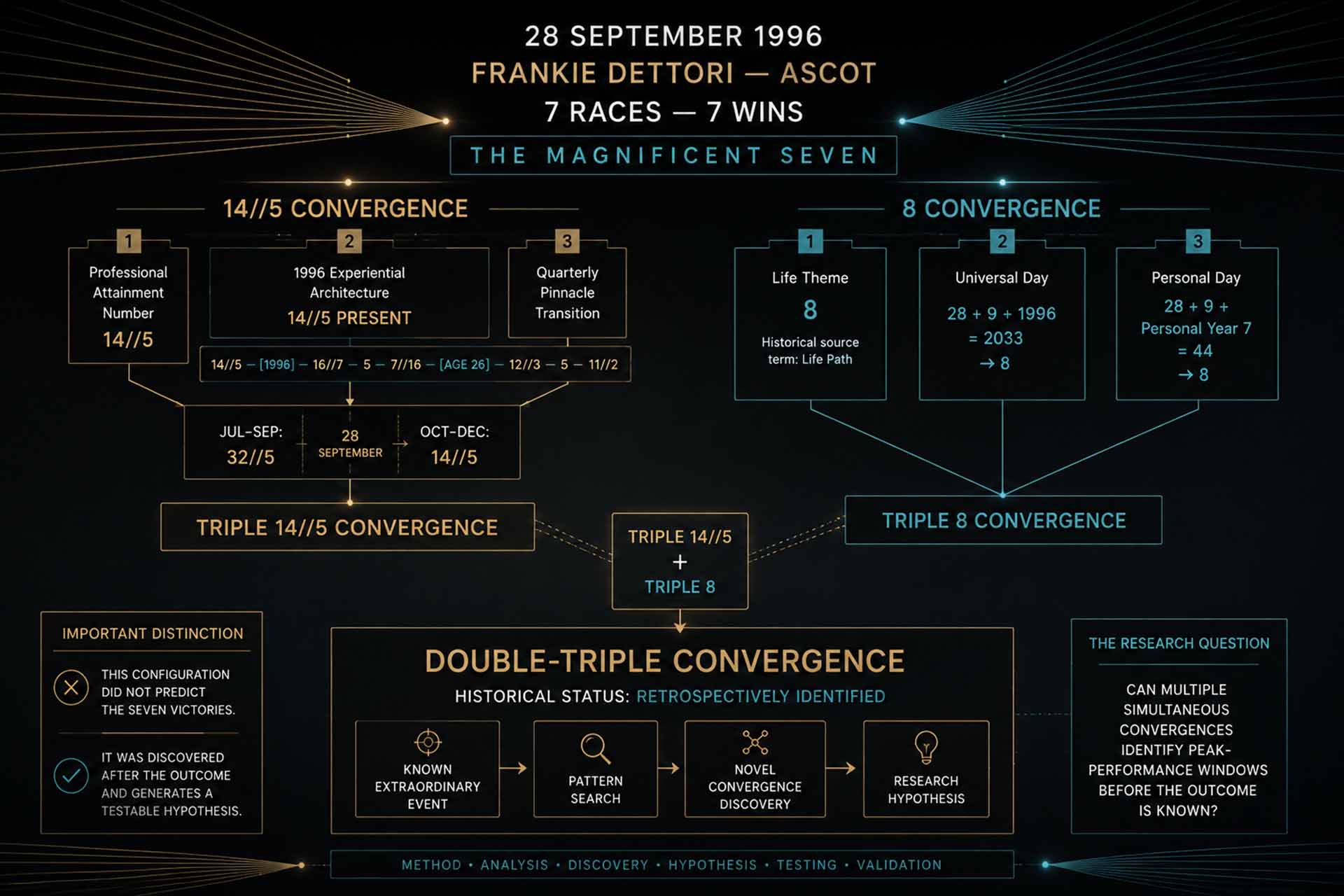
14//5. In the historical methodology, Dettori’s Professional Attainment Number was calculated as 14//5.
The terminology matters less than the structural question underneath it: could a stable career-related position in the model become more relevant when the same value resurfaced in the surrounding time architecture?
For Dettori, 1996 appeared to do exactly that. The historical model recorded his 1996 line as:
14//5 — [1996] — 16//7 — 5 — 7//16 — [Age 26] — 12//3 — 5 — 11//2.
The original article interpreted the appearance of 14//5 within that year as a reactivation of the same structure already present in Dettori’s professional architecture.
Interesting. But still only two pieces. Then Chris narrowed the period further.
The First Pattern: 14//5 Appears Three Times
A Career Position Already Present
The first component was stable:
Professional Attainment: 14//5.
This belonged to Dettori’s underlying architecture rather than being calculated from the Ascot date.
1996 Brings the Same Structure Into the Year
The second component appeared within the longitudinal model for 1996. Again: 14//5.
That created a recurrence between an enduring professional position and the time-specific architecture of the year.
Then the Quarter Tightens Around September
Chris next examined the quarterly model. July to September 1996 was calculated as 32//5. October to December became 14//5.
Dettori’s seven victories happened on 28 September — effectively at the boundary between those two consecutive Number 5 quarters.
More importantly for the historical interpretation, the incoming quarterly structure carried the exact 14//5 backing combination already identified in Dettori’s Professional Attainment position and the 1996 model.
Chris now had three related occurrences:
- Professional Attainment → 14//5
- 1996 architecture → 14//5
- Quarterly transition → 14//5
The original article called this a triple convergence. That alone would have made the case worth preserving. But then Chris looked at the day itself.
Then Chris Found It Again, in a Completely Different Form
The second structure centred not on 14//5, but on 8.
Dettori’s Enduring 8
Within the original birth architecture, Dettori’s primary Life Path was calculated as 8, a position we would describe more neutrally in contemporary Human Futurist language as an enduring Life Theme while preserving “Life Path” as the historical term.
So again there was a stable position in the model: Life Theme: 8.
An 8 Day
Now calculate 28 September 1996:
28 + 9 + 1996 = 2033 | 2 + 0 + 3 + 3 = 8
The date itself therefore produced a Universal Day of 8 within the historical system. That was the second occurrence.
A Personal 8 Day
Chris then calculated Dettori’s Personal Day. His Personal Year for 1996 was 7.
So: 28 + 9 + 7 = 44 | 4 + 4 = 8
A third 8 appeared. That produced:
Life Theme → 8. Universal Day → 8. Personal Day → 8
Another triple convergence.
The unusual part was no longer simply that three related structures had converged.
It was that two different three-part convergences appeared around the same extraordinary performance.
From One Triple Convergence to Two
Chris had therefore identified:
14//5 + 14//5 + 14//5 and separately: 8 + 8 + 8 around Dettori’s Magnificent Seven.
The historical article records this as the first time Chris had encountered what he called a:
Double-Triple Convergence
That is the real research asset within Article 69.
- Not that Number 5 “made” Dettori win.
- Not that Number 8 “caused” seven victories.
- And not that the existence of the pattern proves an underlying predictive mechanism.
What matters is that an extreme observed performance led to the identification of a previously unrecognised structural configuration within the developing model.
That is how hypotheses are often born.
- Something unusual happens.
- A researcher examines it.
- A pattern appears that was not previously part of the working framework.
- The pattern is defined.
- And then the real research begins.
The Most Important Word Is Retrospective
Article 69 becomes considerably stronger when one limitation is made explicit.
Chris already knew that Dettori had won seven races before he analysed the event.
The Double-Triple Convergence was therefore discovered after the outcome. That matters enormously.
A rare sporting achievement plus an interesting retrospective pattern does not demonstrate that the pattern itself is rare.
Nor does it establish that the configuration could have identified Dettori’s performance beforehand.
To know that, several additional questions have to be answered.
- How often do Double-Triple Convergences occur?
- How often do they occur when nothing exceptional happens?
- Are the three elements within each convergence genuinely independent, or partly produced by related calculations?
- Do comparable structures occur around poor performances as well as brilliant ones?
And most importantly:
What happens when one is identified before the athlete competes?
The Archive Analysis therefore classifies Article 69 not as predictive validation, but as a methodological discovery case.
Its development pathway is more clearly expressed as:
KNOWN EXTRAORDINARY EVENT → PATTERN SEARCH → NOVEL CONVERGENCE DISCOVERY → NEW RESEARCH HYPOTHESIS.
That distinction does not weaken the Dettori case.
It tells us precisely what the case is useful for.
From Discovery to a Testable High-Performance Hypothesis
The next stage is obvious. Search for the configuration prospectively.
Before an event begins, identify athletes whose architecture contains multiple simultaneous convergences.
- Record the calculations. Define what would count as exceptional performance.
- Record the forecast window.
- Then record the outcome: whether the athlete excels, performs normally or fails.
Do that across enough cases and an intriguing retrospective observation starts becoming testable research.
This also produces a broader Human Futurist proposition that extends beyond Frankie Dettori:
Alignment and Amplification
The working hypothesis is that several relevant structures becoming congruent at the same time may correspond with amplified expression.
In high performance, that could mean an unusually favourable performance window. But the same principle cannot simply be assumed to be positive.
A dense convergence might theoretically coincide with pressure, overreach, poor judgement or vulnerability under different circumstances.
That is why future testing must measure outcomes rather than interpret every convergence as evidence of success.
The model should have to earn the conclusion.
Why Article 69 Matters Now
Frankie Dettori’s seven victories require no numerical model to make them extraordinary. The sporting achievement stands entirely on its own.
What gives Article 69 its place in the Human Futurist Research Archive is what happened when Chris investigated it. He discovered something the existing framework did not yet contain. Two separate three-part structures appeared around one extreme-performance event.
He named the phenomenon. Double-Triple Convergence.
The historical article treated the pattern much more confidently than the contemporary research standard permits. Today, the stronger position is also the more interesting one.
We do not need to claim that the configuration explains why Dettori won seven races. We can ask something better.
Was 28 September 1996 simply an extraordinary sporting day around which an interesting pattern can be constructed retrospectively?
Or had Chris stumbled upon a measurable feature of peak-performance architecture that might recur elsewhere?
There is only one convincing way to find out. Find the next Double-Triple Convergence before the extraordinary outcome happens.
Then watch what the performer does. That is the point at which an exceptional historical story becomes a research programme.
FROM THE HUMAN FUTURIST RESEARCH ARCHIVE
This contemporary article revisits Article 69, written during the 365 Pin Code phase of Chris Styles’ research.
The historical article examined Frankie Dettori’s seven victories at Ascot on 28 September 1996 and recorded the first research observation Chris termed Double-Triple Convergence: one three-fold alignment centred on 14//5 and another centred on 8.
The original article interpreted those relationships more deterministically than the contemporary Human Futurist research standard permits. The present article preserves the calculation and methodological discovery while reframing the case as retrospective hypothesis generation rather than predictive validation.
The original document remains preserved within The Human Futurist Research Archive as part of the permanent historical research record.
Share This Article, Choose Your Platform!
Related Posts






From understanding decisions to informing them.
Beyond the Research
The Business & Leadership archive examines consequential decisions after they have happened.
The Intelligent Mathematical Blueprint and Private Advisory take the underlying Human Futurist thinking into a different environment: helping leaders examine the circumstances surrounding decisions that have yet to be made.