

Risk Calculation and Leadership Consequence
Being able to understand the risk does not mean you will refuse to take it.
One Decision, an Entire Career Reframed. In March 2018, Steve Smith was one of the finest batsmen in world cricket and captain of Australia. The Steve Smith ball tampering scandal would change that almost overnight.
Then, during the third Test against South Africa in Cape Town, Cameron Bancroft was caught attempting to alter the condition of the ball. Smith admitted that he had been party to the decision. Cricket Australia later found that he had knowledge of the plan and failed to stop it. Smith and David Warner received 12-month bans; Smith was also removed from the captaincy and barred from leadership for a further period.
The scale of the consequence was extraordinary because Smith’s cricketing ability had not suddenly disappeared. This was not a story about an athlete who could no longer perform. It was a leadership judgement failure inside an elite-performance environment.
That distinction is what makes Article 15 more interesting now than its original 2018 framing.
Chris Was Interested in a Different Question
The historical article was written in the immediate aftermath of the scandal. Its language belongs to an earlier phase of the research and is often far more deterministic than the contemporary Human Futurist standard.
But underneath that language was a genuinely useful question.
Chris Styles was not simply asking whether 2018 looked difficult in Smith’s numerical model. He was also looking at the kind of person the model described.
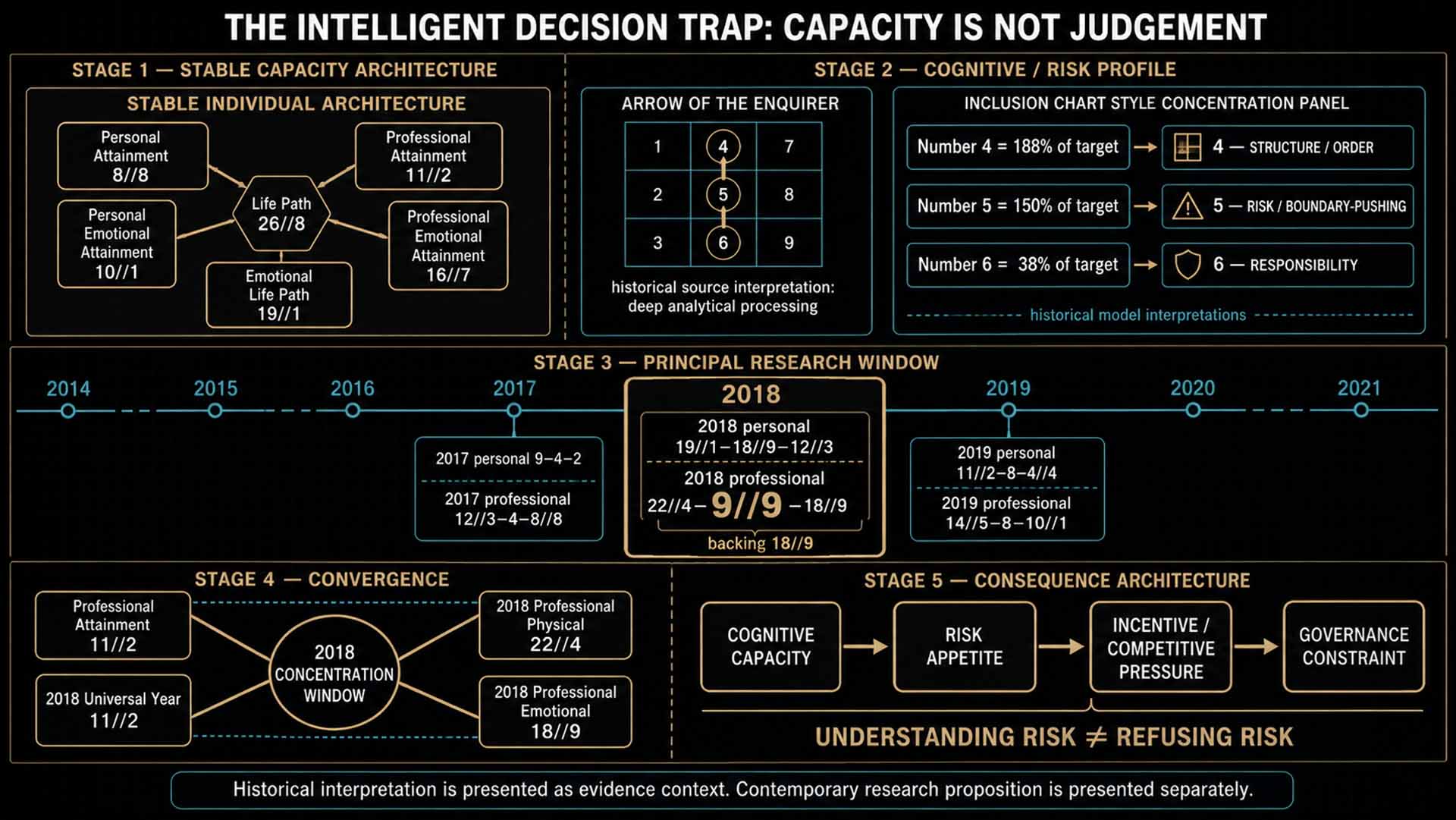
Smith’s underlying architecture contained an 26//8 Life Path, an 8//8 Personal Attainment position, an 11//2 Professional Attainment position, a 10//1 Personal Emotional Attainment position, a 16//7 Professional Emotional Attainment position and a 19//1 Emotional Life Path.
The original interpretations associated those values with ambition, authority, independence, analysis, attainment and professional intensity.
On their own, none of those values explains a cricket scandal. The contemporary question is more disciplined: what happens when exceptional capacity, competitive drive and risk appetite sit inside the same decision-maker at a moment of pressure?
The Enquirer Changes the Story
The most important part of the historical article may not be the 2018 timing sequence at all. It is Smith’s Pythagorean Square.
The source identifies only one arrow: the Arrow of the Enquirer. Within that methodology, Chris associated it with deep thinking — someone inclined to interrogate a problem repeatedly, examine it from several angles and understand the risk-versus-reward structure before acting.
That creates the paradox. If the model is describing an impulsive person who acts first and thinks later, the scandal is easy to frame as a loss of control.
But the historical model describes almost the opposite. It suggests a person for whom analysis itself is a strength.
The enduring research question therefore becomes sharper: can analytical ability help someone understand a risk without preventing them from deliberately accepting it?
That is the beginning of what the Archive Analysis later named the Intelligent Decision Trap.
Structure, Risk and Responsibility
Smith’s Inclusion Chart adds a second layer. Within the historical calculation, Number 4 appeared at 188% of the normalised target and Number 5 at 150%. Number 6 appeared at only 38%.
Chris interpreted the elevated 4 through order, structure and a preference for doing things in a particular way. He interpreted the elevated 5 through freedom, experimentation and a willingness to push boundaries when the perceived reward appears worth the risk. The low 6 was linked in the original system with responsibility and community.
Those are historical model interpretations, not established psychological measurements.
What makes them useful for contemporary research is the tension they create when read together:
- a strong capacity for structure;
- a strong tolerance for risk;
- and a question about how responsibility is weighted when competitive reward becomes unusually important.
That is a much more transferable idea than a catalogue of numbers.
In leadership, the dangerous combination is not always ignorance plus recklessness. Sometimes it is competence plus confidence plus a risk calculation that has become distorted by the objective.
Then 2018 Becomes Much More Interesting
The historical paper then moves from Smith’s stable architecture into time.
The focal year was 2018, when Smith turned 29. His personal line was recorded as 19//1 – 18//9 – 12//3. His professional line was 22//4 – 9//9 – 18//9.
Two features caught Chris’s attention.
First, Smith’s Professional Attainment Number was 11//2, while 2018 was itself an 11//2 Universal Year in the original system. Chris treated that as a recurrence between a stable professional position and the external year.
Second, the professional side of the 2018 Quadratic contained what the original article described as a “double 9” structure, with the backing number 18 repeating. In the historical language, 18 was associated with material moving from the unseen or emotional domain into visibility.
The original article made much stronger claims about these combinations than should be repeated today. What can responsibly be observed is that Chris did not isolate a single convenient number after the event. He was looking at several independently derived positions that concentrated in the same professional year.
The surrounding baseline matters. In the historical table, 2017, 2018 and 2019 are visibly different. The 2018 line contains the 19//1 personal opening, the 18//9 annual essence, the 22//4 professional value and the repeated 9//9 / 18//9 professional-emotional structure. That makes 2018 a legitimate concentration window within the internal logic of the source model.
It does not establish that those values caused Smith’s decision. It establishes what Chris saw and why the year became analytically interesting.
What Happened After the Fall
The historical article was written while the consequences were still unfolding, and it anticipated a long period of reflection and rebuilding.
The subsequent cricket record is important because it prevents the story from ending in disgrace.
Smith accepted Cricket Australia’s 12-month sanction. When he returned to Test cricket in the 2019 Ashes, he produced one of the great comeback series: 774 runs from seven innings at an average above 110. He later again served Australia in leadership roles, including as stand-in Test captain.
That later history changes the meaning of the case.
The 2018 event did not reveal an absence of high-performance capacity. Smith’s subsequent batting demonstrated that the capacity remained exceptional.
Instead, the scandal and comeback sit beside one another:
- elite capability;
- catastrophic judgement;
- public consequence;
- re-entry;
- elite performance again.
That sequence is exactly why the case is so valuable for High Performance research. The same individual can contain extraordinary technical capacity and still require behavioural constraint, challenge and governance at the point of decision.
The Intelligent Decision Trap
The Archive Analysis reframed Article 15 around four variables:
- Cognitive Capacity: can the person understand complexity?
- Risk Appetite: how much downside are they willing to accept?
- Incentive Pressure: what becomes sufficiently valuable that normal restraint weakens?
- Governance Constraint: what stops an unacceptable decision when intelligence does not?
The distinction is simple but powerful. Intelligence protects against not understanding the risk. It does not automatically protect against choosing the risk. That is the Intelligent Decision Trap.
For executives, founders, investors, captains and elite performers, this is strategically important because high achievement can increase rather than reduce exposure. Success creates confidence. Authority creates discretion. Expertise can make a person better at constructing reasons why an exceptional risk is manageable.
The stronger the individual, the more important it may become to separate “Can this person analyse the decision?” from “What stops this person crossing the boundary?”
From Sporting Scandal to Decision Intelligence
Article 15 does not prove that a numerical model can predict misconduct. It does not demonstrate that Smith’s 2018 architecture caused the Cape Town decision. And the original article’s deterministic language should remain part of the historical record rather than the contemporary claim.
Its enduring contribution is the research problem it leaves behind.
Why do smart, highly analytical people knowingly make decisions that later look indefensible?
Could a Human Futurist decision-risk model distinguish capacity from risk appetite, competitive pressure and governance need?
And if a future model could identify periods when those variables become unusually concentrated, could the practical response be stronger coaching, clearer challenge, reduced autonomy around specific decisions, or an explicit governance countermeasure before consequence occurs?
That moves the research beyond retrospective explanation. The useful future framework is not:
“Will this person make a bad decision?”
It is:
“Where might this person’s greatest strength stop being sufficient protection — and what should be put around them when it does?”
Steve Smith’s 2018 crisis is a compact sporting case. The research question is much larger. The smartest person in the room may still need the strongest decision architecture.
FROM THE HUMAN FUTURIST RESEARCH ARCHIVE
This contemporary article has been developed from historical Human Futurist research preserved as Article 15, originally produced in 2018. The original document remains preserved within The Human Futurist Research Archive. Contemporary terminology has replaced “Shadow” with “Emotional” in explanatory prose, while the historical numerical values and original chart architecture have been retained where material. The contemporary article reframes deterministic historical claims as observations and research propositions rather than causal conclusions.
Share This Article, Choose Your Platform!
Related Posts






From understanding decisions to informing them.
Beyond the Research
The Business & Leadership archive examines consequential decisions after they have happened.
The Intelligent Mathematical Blueprint and Private Advisory take the underlying Human Futurist thinking into a different environment: helping leaders examine the circumstances surrounding decisions that have yet to be made.