

Part of the Rugby World Cup 2019 Case Study
This Case Study follows a research question as it moved from retrospective pattern recognition into live tournament forecasting. By this point, the quarter-finals and semi-finals were over. The forecasted Final pairing had become real; the champion had not yet been decided.
That distinction matters. This chapter is not the conclusion to the Case Study. It is the final historical moment inside it: the point at which Chris moved from having the two finalists in front of him to making one last, testable call.
Rassie, The boks and England, and one call left
The final had arrived
There was no longer a bracket to imagine. No projected route. No question about who might survive the semi-finals. England and South Africa were going to meet in Yokohama on 2 November 2019.
For Chris Styles, that changed the character of the analysis. Earlier forecasts had contained multiple moving parts: possible opponents, progression thresholds and conditional routes through the draw. Now there was one match and one remaining proposition.
The historical article stated it without ambiguity: “Boks and Rassie Erasmus to Win RWC 2019 Final.” It also connected that call to an earlier “Boks to Win” position made during the pool stage. The final chapter of the tournament research was therefore not about discovering South Africa at the last moment. It was about deciding whether the earlier signal still held when the opponent was finally known.
And the opponent mattered. England had just beaten New Zealand 19–7 in the semi-final. South Africa had edged Wales 19–16. The two teams had reached the same destination by very different routes.
Why England was still formidable
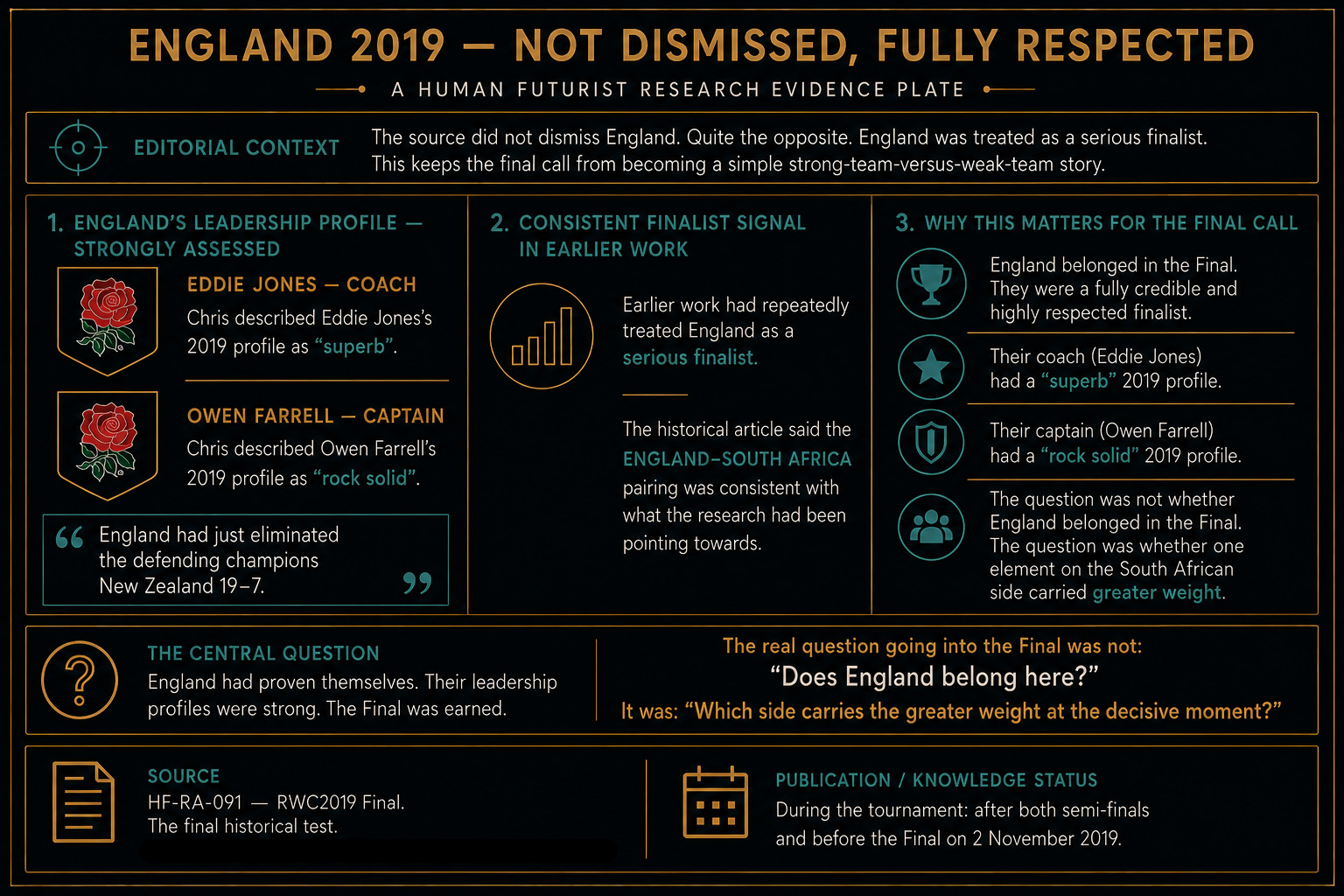
The source did not dismiss England. Quite the opposite. Chris described Eddie Jones’s 2019 profile as “superb” and Owen Farrell’s as “rock solid”. Earlier work had repeatedly treated England as a serious finalist, and the historical article said the England–South Africa pairing was consistent with what the research had been pointing towards.
That is important because it keeps the final call from becoming a simple strong-team-versus-weak-team story. England had just eliminated the defending champions. Their coach and captain had both presented strongly in Chris’s analysis. The question was not whether England belonged in the Final. The question was whether one element on the South African side carried greater weight.
Chris’s answer was Rassie Erasmus.
The signal Chris kept returning to
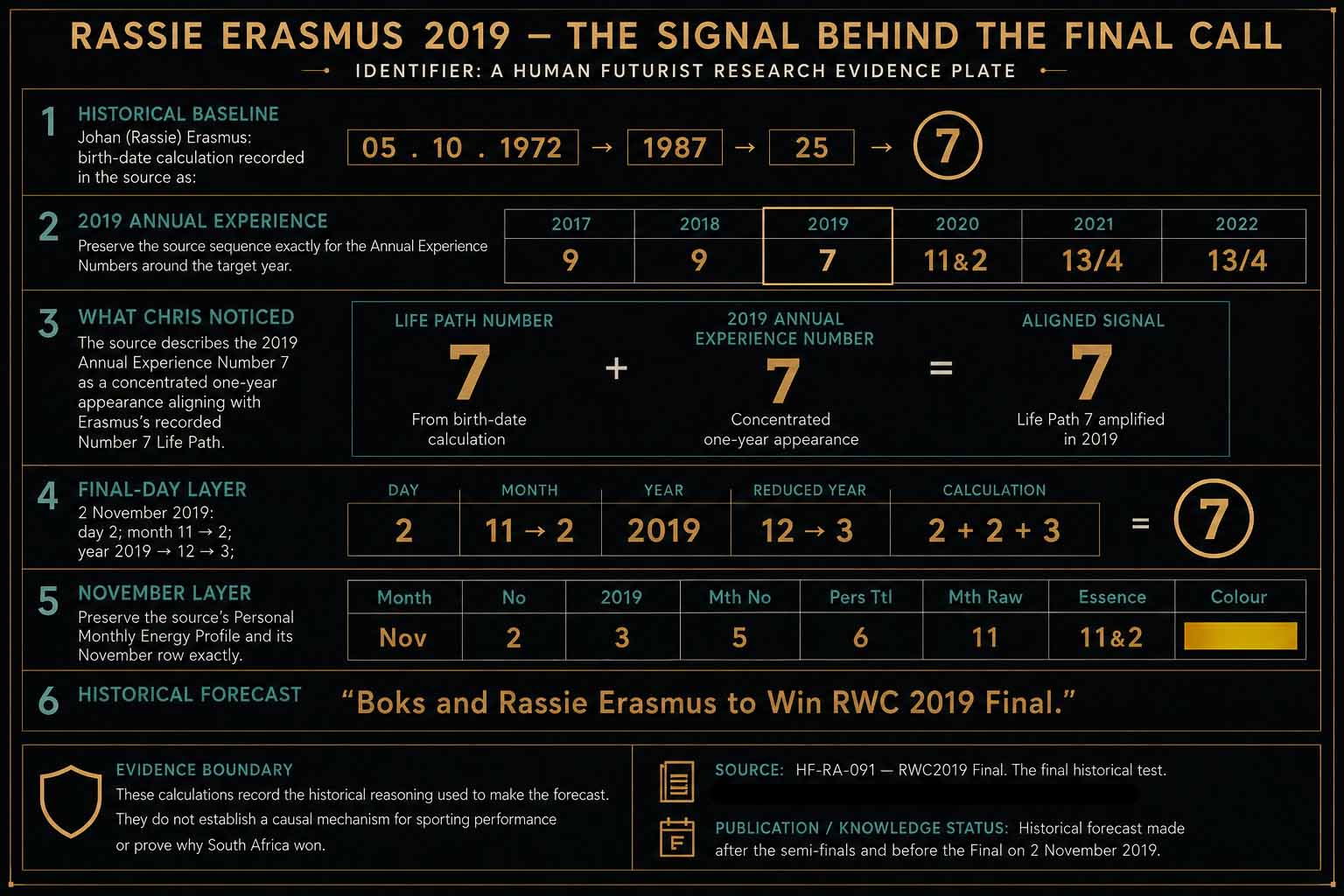
The historical reasoning centred on a recurring 7 in Erasmus’s 2019 profile. In the terminology used at the time, Erasmus’s birth-date calculation produced a Life Path value of 7: 05.10.1972 → 1987 → 25 → 7.
The year-on-year coding then placed a 7 in the Annual Experience position for 2019. The surrounding sequence recorded in the source was:
9 in 2017, 9 in 2018, 7 in 2019, 11&2 in 2020, then 13/4 in both 2021 and 2022.
Chris treated the single-year appearance of the 7 as significant because it aligned with the 7 already present in Erasmus’s baseline. In the historical language, this was a “Concentrated Experience”: a number appearing for one year rather than extending across several.
The terminology is dated, but the research question underneath it is clearer: when one signal became unusually concentrated around the coach who already looked strongest in the comparison, should it be given more weight than the otherwise strong profiles on the other side?
By the time the Final arrived, Chris’s answer was yes.
The date added another layer
The match date created a second correspondence within the historical framework. The Final was scheduled for 2 November 2019. The source reduced the day to 2, November as the eleventh month to 2, and 2019 to 3. Added together, 2 + 2 + 3 produced 7.
Again, this was not presented as a mechanism that could make a rugby team win. It was another alignment inside the analytical system Chris was using at the time, and, because the same 7 had already become central to his reading of Erasmus’s year, it strengthened his confidence in the South African call.
The historical article asked whether it could “get any better” for Erasmus within that framework. Its answer was no.
November brought the second line into view
There was one further layer. The source’s Personal Monthly Energy Profile placed November at an Essence of 11&2 and connected the 2 back to what was then called Erasmus’s “Shadow / Emotional Life Path”. In current Human Futurist language, that historical label is treated as the Emotional line.
The significance Chris attached to November was therefore not that a new prediction suddenly appeared. It was that both of the life-path lines he was tracking, 7 and 2, appeared in the month of the Final.
That was the analytical build-up behind the last call. England remained strong. Siya Kolisi’s 2019 profile was described positively. But the historical article explicitly said the decisive insight, in Chris’s view, lay with the head coach.
One forecast, one threshold
At this point the proposition can be frozen cleanly. The Final pairing was already known. The claim was not merely that South Africa would reach the Final; they had already done that. Nor was it a vague statement that Erasmus looked strong.
The threshold was victory: South Africa to beat England and win Rugby World Cup 2019.
That makes this one of the cleanest prospective tests in the entire sequence. There is no need to reinterpret what counted as success after the event. The historical wording and the sporting outcome can be placed side by side.
What happened next
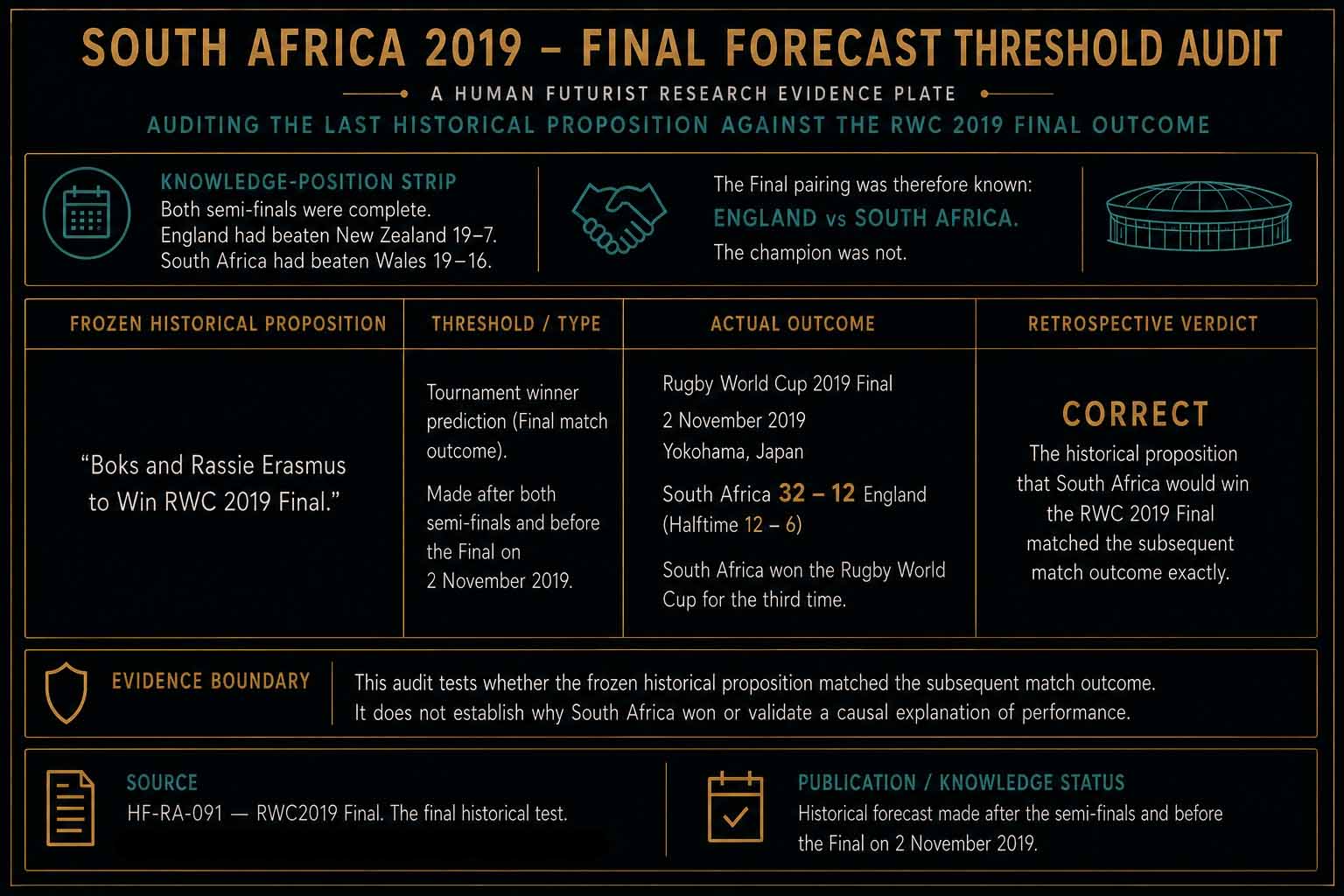
On 2 November 2019 at International Stadium Yokohama, South Africa beat England 32–12 and became Rugby World Cup champions. The final forecast therefore matched the outcome at the winner threshold.
The result also completed the Final pairing that the historical article said the research had repeatedly anticipated: England versus South Africa.
But the importance of this chapter is not that a correct result retroactively makes every earlier interpretation correct. It is that the last proposition was made before the match, with a clear target and a clear success condition, and can therefore be audited without moving the goalposts.
What the result can and cannot tell us
South Africa’s 32–12 victory is a real outcome against which the historical forecast can be tested. It supports the narrow statement that the final winner call was correct.
It does not prove that the numerical correspondences caused the result. It does not show that Erasmus’s profile explains South Africa’s tactics, physical dominance, selection decisions or execution on the day. And it does not erase the incorrect or ambiguous calls elsewhere in the wider tournament research.
Those questions belong to the separate Case Study synthesis, where the entire portfolio can be assessed together.
Here, the historical moment is simpler and more compelling. The tournament had reduced every earlier possibility to one match. Chris had two finalists in front of him, both supported by elements of the research, and he chose the signal he believed carried the greatest weight.
Then the match happened.
What this article adds to the Case Study
This chapter closes the historical tournament sequence at the correct knowledge position: after the finalists were known but before the champion was decided. It preserves the final South Africa winner proposition, the Erasmus-centred reasoning used to support it, and the subsequent 32–12 outcome without turning that result into a claim that the whole methodology has been proved.
The next step is different. With the historical sequence complete, the Case Study can finally step outside the tournament chronology and examine the successes, misses, partials, ambiguities, refinements and limitations together.
Share This Article, Choose Your Platform!
Related Posts






From understanding decisions to informing them.
Beyond the Research
The Business & Leadership archive examines consequential decisions after they have happened.
The Intelligent Mathematical Blueprint and Private Advisory take the underlying Human Futurist thinking into a different environment: helping leaders examine the circumstances surrounding decisions that have yet to be made.