
Part of the Rugby World Cup 2019 Case Study
This Case Study follows a research question as it moved from retrospective pattern recognition into live tournament forecasting, comparison, error, refinement and retesting. The preceding chapters had examined teams largely one at a time. Here, the field narrowed and those separate judgements had to interact.
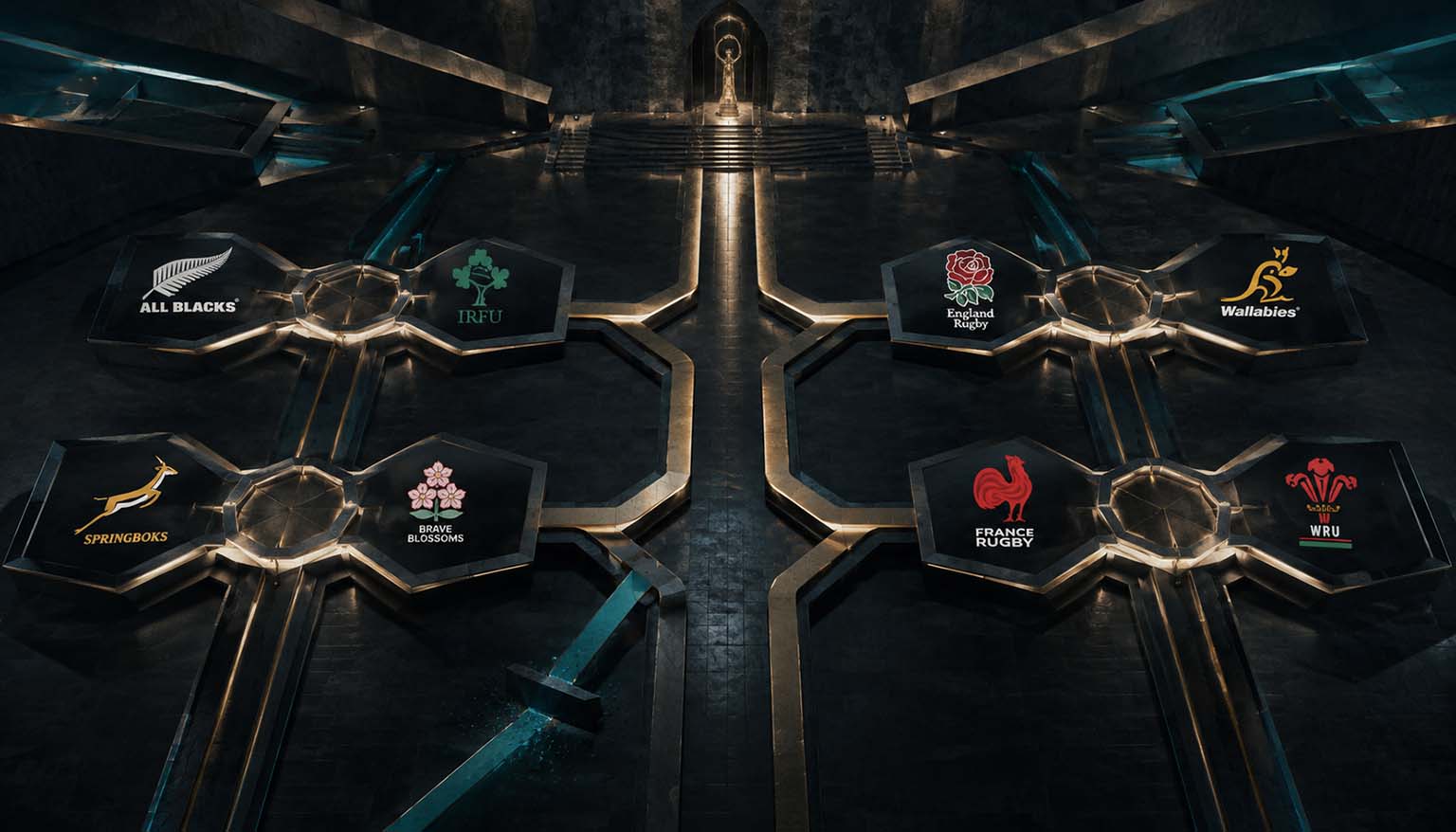
The timing is essential. The quarter-final fixtures were already known: England would play Australia, New Zealand would play Ireland, Wales would play France, and South Africa would play Japan. The matches themselves had not yet happened. This was not a pre-tournament forecast, and it was not a retrospective reconstruction.
From Individual Teams to One Weekend of Consequence
Eight teams. Four matches. No room to hide.
A single prediction can always look unusually impressive, or unusually poor. Four predictions made at the same decision point are harder to romanticise.
That is what makes this stage of the RWC 2019 research different. Chris Styles was no longer asking whether one coach-and-captain pairing looked strong in isolation. He had to take the positions developed across the tournament, compare opponents directly and commit to a set of outcomes that could all be checked within one weekend.
The historical source began by revisiting the earlier conclusions. Rassie Erasmus remained the strongest coaching case in the field. Alun-Wyn Jones remained the standout captain case. England’s Eddie Jones and Owen Farrell had been read as a powerful combination. Australia had been judged comparatively weak. New Zealand had been capped below the final. Ireland had carried conflicting coach-and-captain signals. Japan had just been backed to reach its first quarter-final.
Now those strands collided.
Seven earlier studies now had to work together
The important change was methodological. Earlier chapters could be read as separate team stories. This one created a portfolio.
That matters because a portfolio imposes discipline. Every call has to remain visible. A successful South Africa forecast cannot erase a failed Ireland forecast. A correct final pairing cannot retroactively repair an incorrect route. Each proposition has to be frozen at the threshold actually stated and judged against what happened next.
The four calls
England v Australia
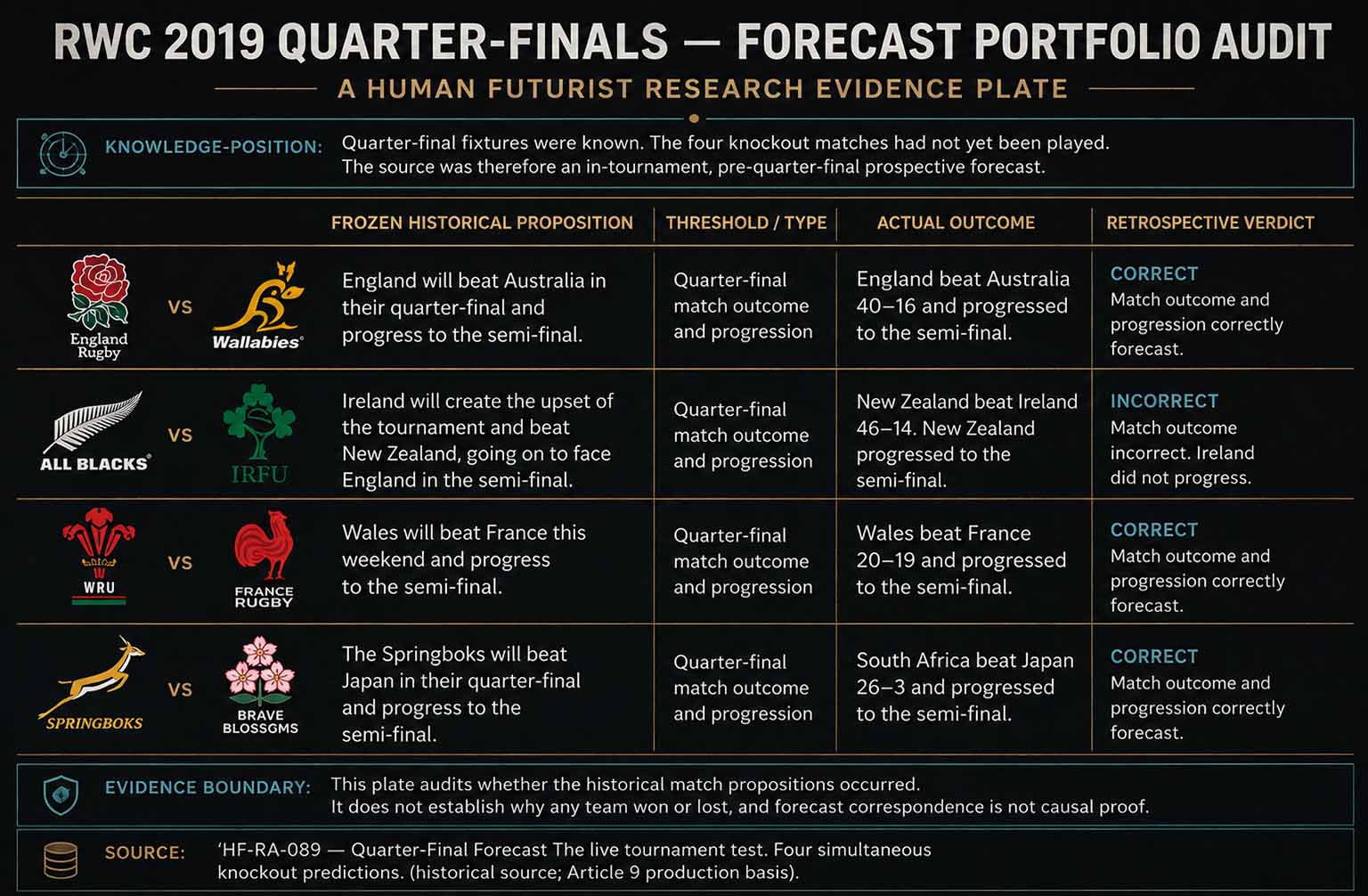
The source treated this as the clearest comparative call. England’s coach-and-captain combination was described as materially stronger than Australia’s. The forecast was explicit: England would beat Australia and progress to the semi-final.
The source then extended the route one step further, expecting England to face Ireland. That second proposition depended on a different quarter-final and therefore had to stand or fall separately.
New Zealand v Ireland
This was the boldest call and the one that would matter most to the next stage of the research.
Earlier work had already argued that Steve Hansen and Kieran Read did not present a convincing 2019 combination and had placed a semi-final as New Zealand’s likely ceiling. Ireland’s Joe Schmidt had looked strong, while Rory Best had not. Once the actual quarter-final pairing was known, Chris compared the two leadership combinations and changed the immediate match conclusion: Ireland were forecast to beat New Zealand and create the upset of the tournament.
In hindsight, Chris now believes this was not his cleanest analytical decision. The evidence had not shifted decisively enough to justify overturning the earlier position that Ireland were unlikely to reach the semi-final. Looking back, he considers the Ireland call to have been influenced more by hope and instinct, a heart-led judgement than by a purely scientific analytical reading of the evidence.
That matters because it explains why this forecast became so important to the development of the research. The later match-specific call sat in tension with the earlier Ireland conclusion, and the eventual result exposed that tension clearly. Rather than smoothing over the contradiction, this chapter preserves it as part of the chronology: a point where interpretation moved beyond what the underlying analysis could confidently support.
Wales v France
France created an evidence limitation. The historical research had not run the same coach-and-captain analysis for the French side. The Wales call therefore rested primarily on the strength previously attributed to Warren Gatland and, especially, Alun-Wyn Jones.
The conclusion was nevertheless unequivocal: Wales would beat France and move into a semi-final against South Africa.
South Africa v Japan
Japan had already delivered the breakthrough forecast in the previous chapter by reaching the quarter-finals for the first time. The next question was whether the run would continue.
The historical answer was no. Chris judged the Erasmus–Kolisi combination stronger than Jamie Joseph and Michael Leitch and forecast South Africa to beat the hosts, then meet Wales in the semi-final.
The forecast extended beyond the quarter finals
The source did not stop with four winners. It projected a tournament pathway.
One semi-final was expected to be England against Ireland. The other was expected to be South Africa against Wales. From there, the article kept England vs South Africa in the final and gave South Africa the edge to become world champions, with the Erasmus 2019 pattern carrying the most weight.
That creates several different tests, not one. The quarter-final winners are match predictions. The semi-final pairings are route predictions. England vs South Africa is a final-pairing prediction. South Africa as champion is a tournament-winner proposition. They should not be compressed into a single retrospective score.
The forecast extended beyond the quarter-finals
The source did not stop with four winners. It projected a tournament pathway.
One semi-final was expected to be England against Ireland. The other was expected to be South Africa against Wales. From there, the article retained an England–South Africa final and gave South Africa the edge to become world champions, with the Erasmus 2019 pattern carrying the greatest weight.
That creates several different tests, not one. The quarter-final winners are match predictions. The semi-final pairings are route predictions. England–South Africa is a final-pairing prediction. South Africa as champion is a tournament-winner proposition. They should not be compressed into a single retrospective score.
Then the tournament answered
The quarter-finals produced a clean set of outcomes. England beat Australia 40–16. New Zealand beat Ireland 46–14. Wales edged France 20–19. South Africa beat Japan 26–3.
Three of the four match calls therefore landed: England, Wales and South Africa. The Ireland-over-New Zealand call did not.
The route forecasts split in the same way. South Africa versus Wales became a semi-final exactly as projected. England versus Ireland did not, because New Zealand, not Ireland, advanced.
Three calls landed. One did not.
The temptation at this point would be to celebrate the three correct quarter-final calls and the eventual final pairing. That would miss the most useful evidence in the chapter.
The New Zealand–Ireland error is not a blemish to be edited around. It is the event that turns the portfolio into a genuine learning point. A model that only preserves its successes cannot improve honestly. A model that keeps the miss visible can ask what it failed to weight, what assumption broke, and whether any later adjustment was genuinely prospective rather than a post-hoc explanation.
Why the Ireland–New Zealand miss matters
The next historical article did exactly what a research programme should do after an error: it went back to the work.
The quarter-final portfolio was later described by the researchers as three correct calls from four. More importantly, they treated that as insufficient and re-examined the variables they had been using before making the semi-final forecasts.
That is the bridge from this chapter to the next. The value of the quarter-finals is not simply that the portfolio contained more hits than misses. It is that the miss created pressure to refine the method while the tournament was still live and before the next outcomes were known.
The final pairing survived the broken route
There is one further distinction worth preserving. The projected England–Ireland semi-final failed because Ireland lost. Yet the larger England–South Africa final projection still survived.
England reached the final through New Zealand instead. South Africa reached it through Wales. That means the destination was correctly identified even though one branch of the forecast route was wrong.
For decision intelligence, that distinction is more useful than a binary right-or-wrong label. Forecasts often contain nested thresholds: direction, route, timing, opponent, stage and who plays in the final, outcome. Good retrospective analysis separates them so that a correct endpoint does not conceal a faulty path, and a faulty path does not erase an independently correct endpoint.
What this article adds to the Case Study
This chapter changes the scale of the RWC 2019 research. Seven team studies become one comparable set of live knockout calls. The result is mixed but highly informative: three correct quarter-final winners, one clear miss, one correct semi-final pairing, one broken semi-final route, the correct final pairing and a South Africa champion lean that remained alive.
Most importantly, the miss was not the end of the process. It became the input for the next one.
Share This Article, Choose Your Platform!
Related Posts






From understanding decisions to informing them.
Beyond the Research
The Business & Leadership archive examines consequential decisions after they have happened.
The Intelligent Mathematical Blueprint and Private Advisory take the underlying Human Futurist thinking into a different environment: helping leaders examine the circumstances surrounding decisions that have yet to be made.