

Part of the Rugby World Cup 2019 Case Study
This chapter belongs to The Human Futurist’s Rugby World Cup 2019 Case Study: a chronological reconstruction of how an emerging analytical idea moved from retrospective pattern recognition into live prospective testing, comparison, error, refinement and retesting. At this point in the chronology, the tournament was still unfolding. Ireland had beaten Scotland. The quarter-final line-up was not fixed. South Africa’s eventual title was not yet known. The historical forecast therefore has to be read from that knowledge position, not rewritten through hindsight.
What happens when coach and captain point in different directions?
The Ireland Rugby World Cup 2019 Semi-Final Question
Ireland’s problem was not lack of progress. Under Joe Schmidt they had won three Six Nations Championships, including the 2018 Grand Slam, and had recorded their first victories over New Zealand. They entered the 2019 tournament as one of the leading sides in world rugby. Yet the World Cup carried a stubborn historical ceiling: Ireland had never moved beyond the quarter-finals.
That made the success threshold unusually clean. This was not initially a forecast about lifting the Webb Ellis Cup. The article asked whether Ireland could achieve a first-ever semi-final. In case-study terms, it was a breakthrough test: could the emerging coach-and-captain framework say something useful about a specific historical milestone rather than only about tournament victory?
One Win Made the Route Look Plausible
The source was written immediately after Ireland opened their campaign with a 27–3 defeat of Scotland in Yokohama. In wet conditions, the bonus-point victory placed Schmidt’s side in what the article described as the “box seat” in Pool A. From there, the historical reasoning assumed that topping the pool would probably send Ireland into a quarter-final against South Africa.
That route mattered because South Africa had already lost their opening match to New Zealand. The source treated the Springboks as wounded but dangerous, and it explicitly rejected the idea that the pool defeat had ended their title chances. Chris was already comparing the likely Irish quarter-final against another team whose leadership profile he regarded as exceptionally strong for 2019.
There was, however, an important uncertainty embedded in the article: the quarter-final pairing was still a projection. Ireland had not yet secured Pool A. South Africa had not yet secured the corresponding position in Pool B. The later case-study audit therefore has to separate the forecast about Ireland’s maximum progression from the assumed route used to reach that conclusion.
But the Real Test Was Leadership Alignment
The previous All Blacks chapter had already pushed the research towards a relational question. Rather than treat a national side through one individual, Chris compared the head coach and captain as two leadership positions inside the same competitive unit. Ireland made that idea more difficult, and therefore more interesting, because the two profiles did not reinforce one another.
Joe Schmidt looked exceptionally strong in 2019. Rory Best did not. The forecast depended on how that disagreement was interpreted.
This matters because a model is easiest to use when every indicator points the same way. Real decisions are rarely that tidy. Ireland introduced a conflict inside the evidence itself. The research had to decide whether Schmidt’s strong annual pattern was enough to outweigh the weaker alignment identified for Best, or whether the lack of agreement between coach and captain reduced the case for an historic breakthrough.
Why Joe Schmidt Looked So Strong in 2019
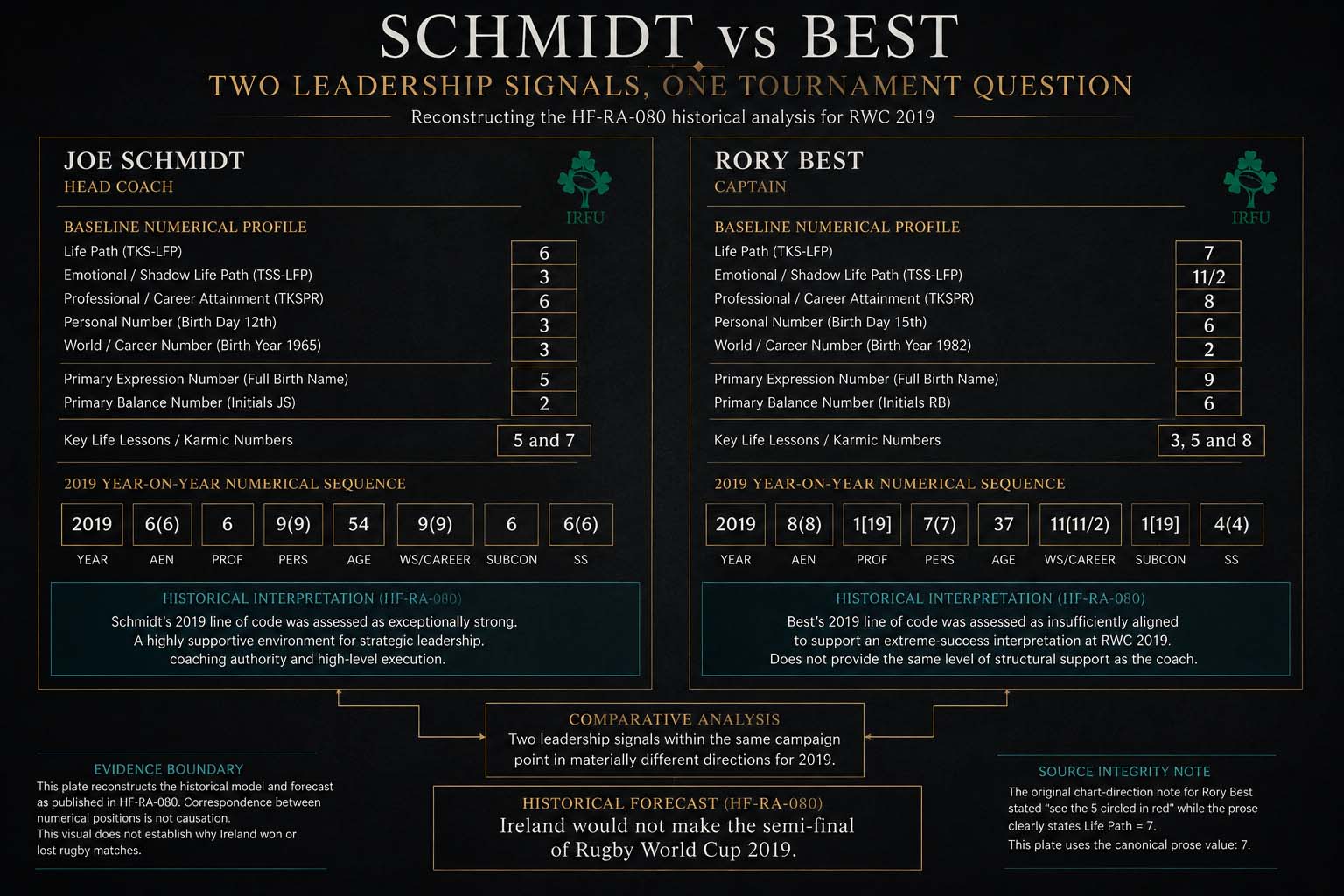
The source first established Schmidt’s baseline positions. Using the terminology of the historical 365 Pin Code system, it recorded:
- Life Path: 6
- Emotional Life Path: 3
- Professional / Career Attainment: 6
- Personal Number: 3
- World / Career Number: 3
- Primary Expression Number from Josef Schmidt: 5
- Primary Balance Number from the initials JS: 2
- Key Life Lessons identified from the full birth name: 5 and 7
The point of preserving these values is not to ask the reader to accept their interpretation as causal. It is to reconstruct what Chris was comparing at the time. Within the historical model, repeated correspondence between an annual sequence and values already treated as personally significant was considered evidence of a more consequential year.
The Schmidt Sequence
2019[YEAR] – 6(6) – 6 – 9(9) – 54[AGE] – 9(9) – 6 – 6(6)
The source focused on the repeated 6. It stated that the value appeared four times and linked Schmidt’s 2019 Personal Experience Number with his Emotional Personal Year and Emotional Professional Year. Because 6 was also his recorded Life Path and Professional / Career Attainment value, the article treated the repetition as unusually significant.
The historical language was emphatic: Schmidt’s 2019 position was described as “RED-HOT”. A contemporary Human Futurist reconstruction needs a firmer evidence boundary. The repeated correspondence is a feature of the model; it is not independent proof that Ireland should win matches, and it does not explain the causes of elite sporting performance. What can be stated accurately is that, before Ireland’s tournament outcome was known, Chris regarded Schmidt’s 2019 sequence as one of the strongest leadership signals in the field.
Then Rory Best Changed the Picture
Rory Best brought a very different problem. He was Ireland’s captain, one of the most experienced players in the squad and, according to the source, central to the leadership and training culture around the team. The historical analysis therefore repeated the same process used for Schmidt rather than assuming that a strong coaching profile automatically represented the entire competitive unit.
The source recorded Best’s baseline positions as:
- Life Path: 7
- Emotional Life Path: Master Number 11/2
- Professional / Career Attainment: 8
- Personal Number: 6
- World / Career Number: 2
- Primary Expression Number from Rory David Best: 9
- Primary Balance Number from the initials RDB: 6
- Key Life Lessons identified from the full birth name: 3, 5 and 8
The Best Sequence
2019[YEAR] – 8(8) – 1[19] – 7(7) – 37[AGE] – 11(11/2) – 1[19] – 4(4)
The historical article concentrated on Best’s 2019 Yearly Experience Number, 1[19], and observed that 19 did not appear elsewhere in the birth chart or name analysis. The source then set out its internal benchmark for exceptional performance: it expected one or more of Best’s major values — particularly Expression 9, Life Path 7 or Professional Attainment 8 — to be powering the year more strongly.
Some of those values do appear in the sequence: 8 and 7 are visible. Yet the article’s judgement was comparative rather than mechanical. It concluded that there were not enough of Best’s key numbers present with sufficient strength to support the image of Ireland’s captain lifting the Webb Ellis Cup.
That sentence is worth noticing because it introduces a limitation in the original reasoning. The article’s headline question concerned a first semi-final, but part of the captain assessment shifted to the more demanding threshold of winning the tournament. Those are not the same endpoint. A contemporary audit should not hide that mismatch. It is evidence of how the research question was still being refined in real time.
Two Leaders. One Team. Conflicting Signals.
The conclusion did not come from finding two weak profiles. It came from disagreement.
Schmidt’s 2019 line looked unusually strong inside the model. Best’s did not look strong enough to Chris for the level of exceptional performance being tested. The source explicitly acknowledged that a Rugby World Cup squad contains far more than two people, but treated coach and captain as the “lead-energies” of the competitive unit and therefore pivotal to the forecast.
Translated into contemporary decision-intelligence language, the article was testing whether leadership alignment mattered. If one senior position showed strong correspondence but the other did not, should the team still be classified as an extreme-success case? Chris chose caution. The historical conclusion was that Ireland would not make the semi-final.
Freeze the Forecast Before Looking at the Result
Before introducing anything that happened later, the historical calls need to be frozen at their original level of specificity. The source contained more than one forecast, and they do not all deserve the same verdict.
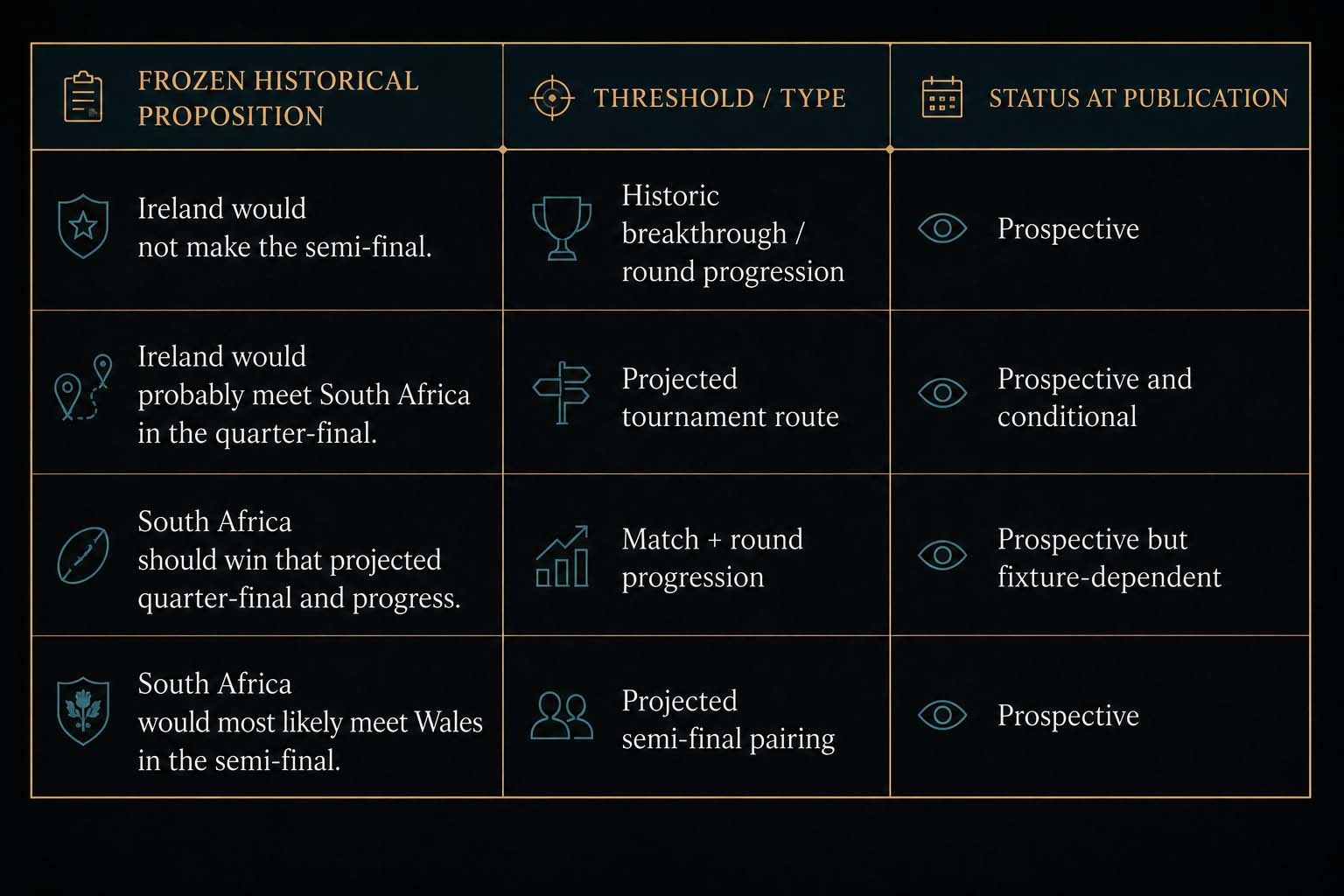
This separation prevents the later outcome from turning the entire article into one clean “correct” prediction. The strongest headline call can be right while parts of the route can be wrong or never become testable.
The Route Chris Expected Did Not Happen
The first disruption came before the knockout stage. Ireland did not top Pool A. Japan went unbeaten in the pool, including a win over Ireland, and finished first. Ireland finished second. That changed the quarter-final architecture entirely.
Instead of facing South Africa, Ireland faced New Zealand. The projected Ireland–South Africa quarter-final never occurred, which means the source’s associated claim that South Africa should beat Ireland “on the day” cannot be scored as a match prediction. The fixture needed for the forecast did not exist.
This is exactly the kind of distinction a predictive audit needs. A conditional statement can fail because its precondition fails, not because the predicted winner necessarily would have been wrong. Treating that as a successful South Africa match call would be hindsight. Treating it as an ordinary incorrect match call would also blur what was actually said. The responsible verdict is: not testable because the projected fixture did not occur.
Ireland Still Did Not Reach the Semi-Final
The headline breakthrough forecast was nevertheless exposed cleanly to an outcome. Ireland reached the quarter-final and lost 46–14 to New Zealand. Their search for a first Rugby World Cup semi-final continued.
South Africa, meanwhile, reached the semi-final by beating Japan and then faced Wales — the opponent the historical article had identified as the most likely semi-final matchup. The Springboks won 19–16. Those later results do not rescue the Ireland–South Africa quarter-final projection, but they do allow the separate round-progression and opponent calls to be audited on their own terms.
What the Forecast Got Right, and What It Did Not
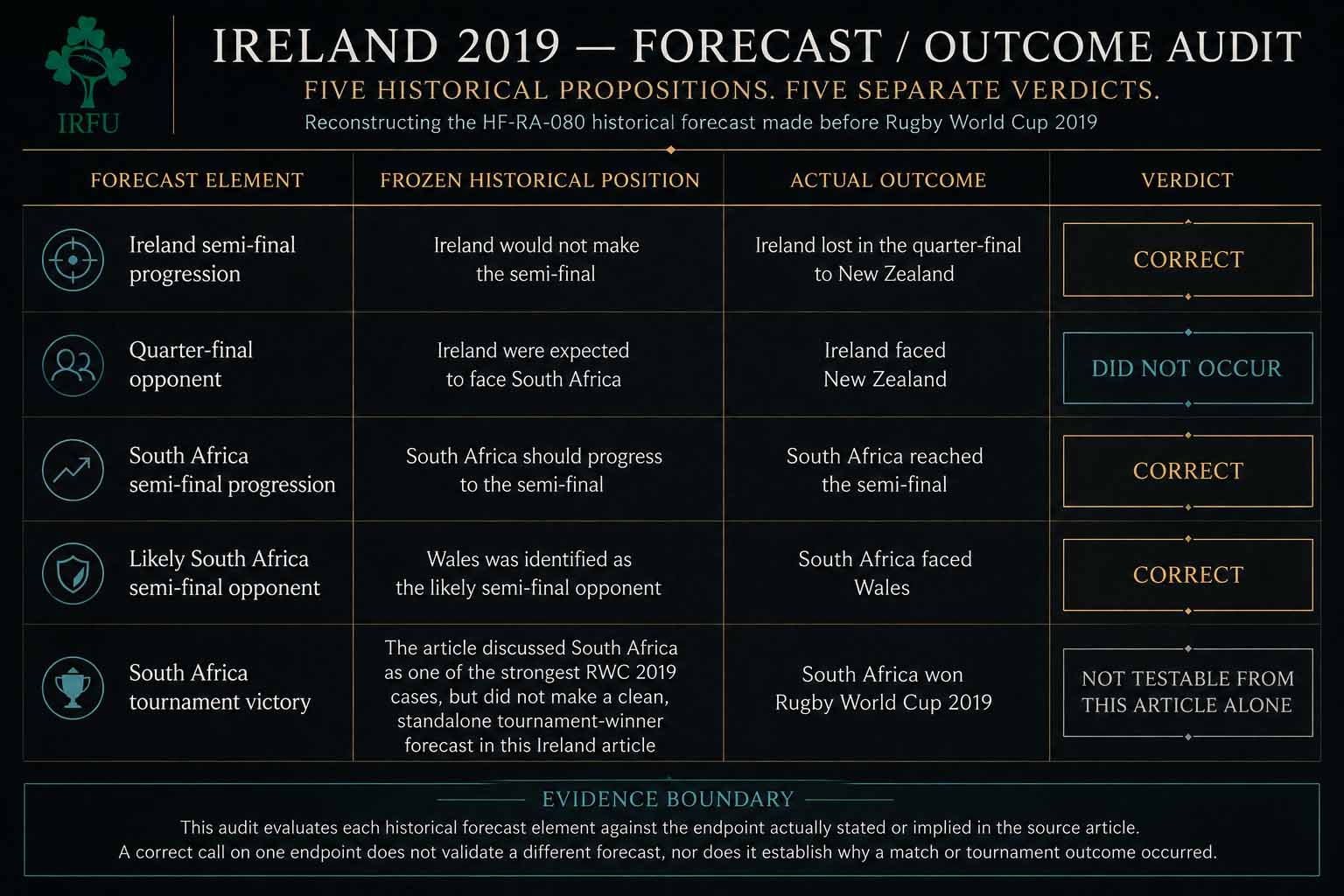
The portfolio view is more informative than a single success label. The central Ireland forecast survived. The assumed route did not. One conditional match call became untestable. Two separate South Africa progression/pairing calls matched what followed. That mixture is the evidence.
Why This Chapter Matters Beyond Ireland
At first glance, Ireland Had Never Reached a Rugby World Cup Semi-Final. Could 2019 Be Different? looks like a simple sporting prediction: Ireland will not make the semi-final. Its deeper value in the Case Study is that it exposes three methodological problems that any forecasting system eventually has to face.
First, success must be defined before the result. A first semi-final is not the same as winning the World Cup. Best’s historical analysis drifted between those thresholds, and the contemporary reconstruction makes that visible rather than smoothing it away.
Second, a forecast can contain both a destination and a route. The destination can be right while the route is wrong. Ireland did fail to reach the semi-final, but not because South Africa eliminated them. That distinction matters whenever a model is used to support real decisions: knowing that an outcome may fail is not the same as knowing exactly how it will fail.
Third, disagreement inside a model is itself information. Schmidt looked strong; Best looked weaker. Instead of forcing those signals into false certainty, the better contemporary question is what weight should be assigned to each leadership position, and whether the model had enough evidence at that stage to know.
That is where the RWC 2019 Case Study begins to move beyond prediction. It becomes a record of model exposure: what was seen, what was forecast, what actually happened, and what the difference between those things forced the research to confront.
What This Article Adds to the Case Study
This chapter is the first clear breakthrough test in the RWC 2019 sequence. It adds four developments to the programme:
- It defines a success threshold other than tournament victory: Ireland’s first Rugby World Cup semi-final.
- It exposes a genuine conflict between coach and captain rather than relying on a neat convergence.
- It demonstrates why destination, route and conditional match forecasts must be audited separately.
- It reveals an early threshold problem in the historical reasoning — semi-final progression and trophy-winning were not always kept perfectly distinct — creating a concrete reason for tighter outcome definitions later in the Case Study.
The next chapter widens the comparison again. If Ireland’s conflicting leadership signals pointed away from a breakthrough, what did the same research framework suggest about England — a team entering Japan with a very different World Cup history and a far more ambitious endpoint?
CASE STUDY NAVIGATION
Share This Article, Choose Your Platform!
Related Posts






From understanding decisions to informing them.
Beyond the Research
The Business & Leadership archive examines consequential decisions after they have happened.
The Intelligent Mathematical Blueprint and Private Advisory take the underlying Human Futurist thinking into a different environment: helping leaders examine the circumstances surrounding decisions that have yet to be made.