
Part of the Rugby World Cup 2019 Case Study
This chapter belongs to The Human Futurist’s Rugby World Cup 2019 Case Study: a chronological reconstruction of how an emerging analytical idea moved from retrospective pattern recognition into live prospective testing, comparison, error, refinement and retesting.
At this point, England’s tournament outcome was still unknown. The historical research had identified a strong coach/captain pattern around Eddie Jones and Owen Farrell and placed England firmly among the leading contenders. What happened next must therefore be judged against what was actually forecast at the time, not rewritten through hindsight.
Four Forecasts. One Tournament Test.
In September 2019, England were not simply described as contenders. The research made several unusually testable propositions:
England should reach the final; they should beat New Zealand if the teams met in a knockout match; and there was a “very high probability” they could go all the way, meaning, in Chris’s language, all the way to the Final. The closing projection then anticipated England–South Africa and described that match as “anybody’s game”. Looking back now, those statements should be read in that original sense rather than converted retrospectively into an England tournament-winner prediction.
Three Questions Hidden Inside One Prediction
“Will RWC2019 be Webb Ellis Cup Number 2 for England?” was the question at the top of the original research. It sounds like a single yes-or-no proposition. It was not.
Inside the article were at least three distinct tests. Would England reach the final? If England met New Zealand in a knockout match, would England win? And, beyond those two stage-specific calls, would England actually become world champions for the second time?
That distinction matters because hindsight has a habit of compressing a tournament into its final result. England did not win the 2019 Rugby World Cup, but the historical proposition being tested here was not a settled England winner call. Chris used “go all the way” to mean reaching the Final; once he projected England against South Africa, he explicitly left the result open as “anybody’s game”.
The value of this chapter is therefore not a story about “getting the route right and the winner wrong”. At the time, Chris did not know who England would ultimately face in the final, and when the source later projected England versus South Africa it explicitly called that prospective final “anybody’s game”. The stronger England-winner language and the unresolved final-pairing language are both part of the record and must be audited on their own terms.
A useful forecast is not audited by asking whether it “felt close”. Each claim has to be frozen at the threshold it actually set before the outcome was known.
Part of the Rugby World Cup 2019 Case Study
This chapter belongs to The Human Futurist’s Rugby World Cup 2019 Case Study: a chronological reconstruction of how an emerging analytical idea moved from retrospective pattern recognition into live prospective testing, comparison, error, refinement and retesting.
At this point, England’s tournament outcome was still unknown. The historical research had identified a strong coach/captain pattern around Eddie Jones and Owen Farrell and placed England firmly among the leading contenders. What happened next must therefore be judged against what was actually forecast at the time — not rewritten through hindsight.
Why England Looked Different Before the Knockouts
England entered Japan under Eddie Jones with a profile that already made them credible contenders in conventional rugby terms. Jones had taken Australia to the 2003 final, had been part of South Africa’s 2007 World Cup-winning coaching group and had led Japan to their famous victory over South Africa in 2015. Owen Farrell, England captain since 2018, brought elite club and international experience into the same leadership pairing.
The historical article did not use those credentials as the forecast itself. They supplied the real-world context. Chris then compared the 2019 analytical lines for Jones and Farrell and asked whether the leadership combination carried the kind of pattern he had been tracking elsewhere in the Rugby World Cup research.
The answer in the source was emphatic. Jones’ line was described as “RED HOT”. Farrell’s was described as “ROCK SOLID”. The language belongs to the historical article and is stronger than the contemporary Human Futurist voice would use today, but it is important not to sanitise it retrospectively. The research was confident at the time.
Eddie Jones: A 2019 Line the Research Read as “Red Hot”
The original research recorded Jones’ significant baseline values as a 2 Life Path, 16//7 Emotional Life Path, 10//1 Professional/Career Attainment Number, 3 Personal Number and 16//7 World/Career Number. It then focused on his 2019 year line:
2019[YEAR] – 15(6) – 1(10) – 7(16) – 59[AGE] – 12(3) – 1(10) – 1(19)
The source interpreted Jones’ 2019 Experience Number as 10//1 and highlighted its correspondence with his 10//1 Professional Attainment Number. In the historical interpretation, 2019 therefore aligned strongly with the professional “Number 1” theme the model associated with achievement and leadership.
The same line also contained 16//7, which the source connected with Jones’ Emotional Life Path and World/Career Number. A repeated 1 pattern was interpreted as a significant professional and emotional leadership experience.
None of that establishes why a rugby team wins. It does not replace selection, preparation, tactics, physical performance or the quality of the opposition. The evidential question in this case study is narrower: did the pattern lead to a clear forecast before the relevant matches, and what happened when that forecast was tested?
Owen Farrell: A Different Pattern, the Same Direction
Farrell’s baseline profile was different. The historical article recorded an 8 Life Path, 19//1 //4 Emotional Life Path, 8 Professional/Career Attainment Number, 6 Personal Number and 2 World/Career Number. His 2019 line was:
2019[YEAR] – 9(9) – 6(15) – 6(6) – 28[AGE] – 11(11//2) – 6 – 4(4)
The source interpreted Farrell’s 15//6 Experience Number through themes of responsibility, relationship and community, noting that 6 also appeared as his Personal Number through his birth date. His Professional Year of 11//2 was connected with the 2 in his World/Career position. The repeated 6s were read as evidence of the personal and emotional weight of captaincy.
Again, the important case-study point is not that Jones and Farrell shared the same numbers. They did not. The historical reasoning treated two different profiles as independently supportive of the same sporting proposition: England had a leadership combination capable of going deep into the tournament.
That is why the article moved beyond “England are dangerous” and made a forecast that could later be audited.
The Forecast Was More Specific Than “England Will Do Well”
The historical England Rugby World Cup 2019 forecast contained four material England-facing propositions.
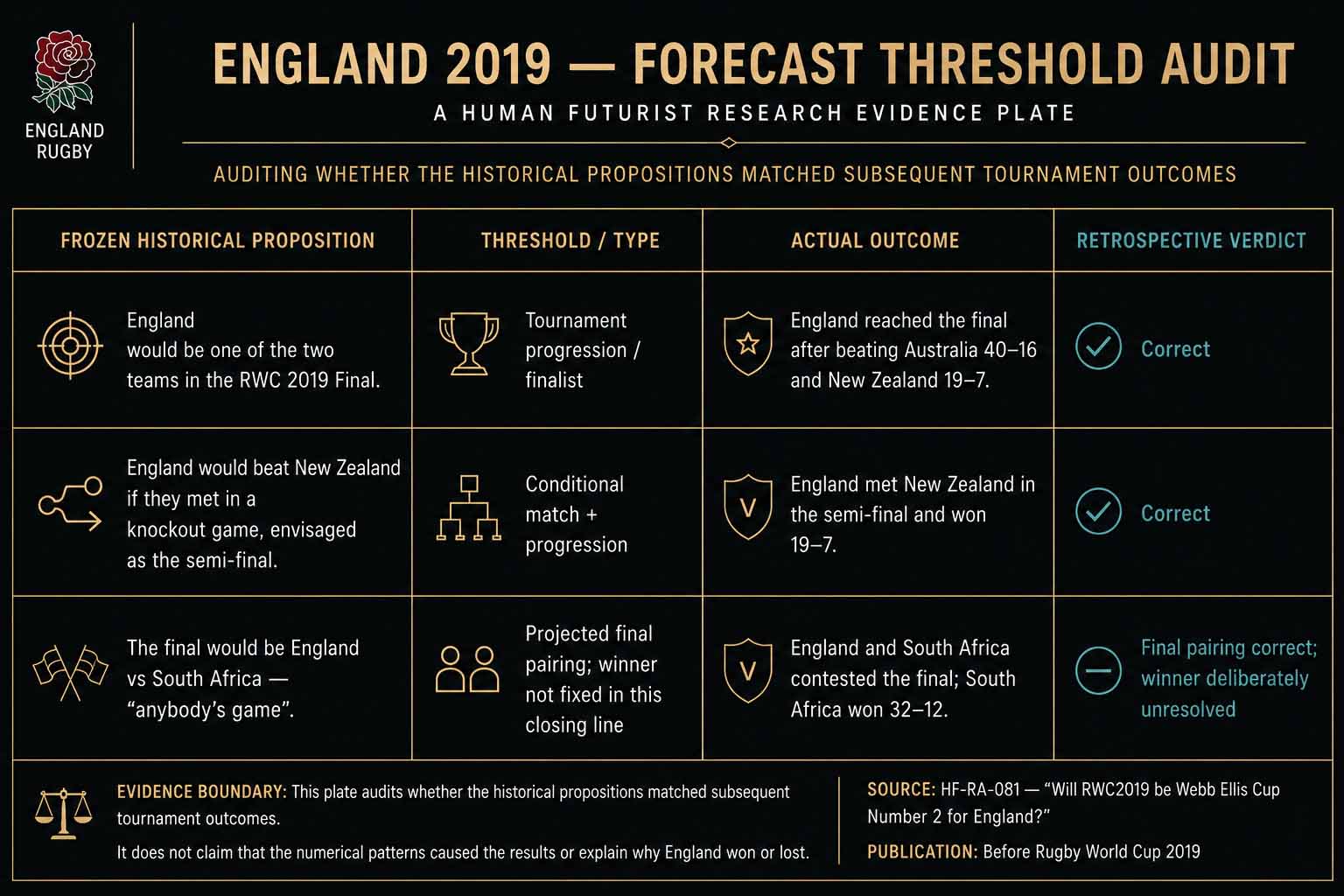
First, from the coach-and-captain analysis, the article said England would be one of the two teams in the final. Second, it stated that if England and New Zealand met in a knockout match, specifically envisaging the semi-final, England would beat the All Blacks. Third, it said there was a “very high probability” England would go all the way; in Chris’s intended usage, that meant progressing all the way to the Final. Finally, it projected that Final as England versus South Africa while calling the match itself “anybody’s game”.
Those statements should not be merged. “Reach the final” is a lower threshold than “win the World Cup”. “Beat New Zealand if they meet” is conditional on the draw producing that match. “England versus South Africa” is a separate route forecast. The original article happened to contain all of them.
Then the Tournament Tested It
England moved through the pool stage and then beat Australia 40–16 in the quarter-final. New Zealand defeated Ireland 46–14. The conditional match named in the historical article was no longer hypothetical: England and the All Blacks would meet in Yokohama for a place in the final.
That is the point at which the forecast became unusually clean to test. The article had not merely suggested England might trouble New Zealand. It had said England would beat them if the sides met in a knockout match.
On 26 October 2019, England won 19–7. New Zealand’s run of 18 consecutive Rugby World Cup victories ended, and England advanced to the final.
The Semi-Final Call Landed
The temptation, with a result like that, is to let the successful call dominate the retrospective story. It should not.
It was nevertheless a material success. New Zealand were the double defending champions. The original research had already argued elsewhere in the case study that the Steve Hansen–Kieran Read leadership combination would not lift the trophy. The England article then went further and named the team it believed could remove them if the bracket brought them together.
That happened, at the stage the article had explicitly contemplated. As a prospective match-and-progression forecast, the England–New Zealand call was correct.
The Final Adds an Important Distinction
South Africa beat Wales 19–16 in the other semi-final. The historical article’s projected final pairing, England versus South Africa, was therefore also correct.
On 2 November 2019, South Africa won the Final 32–12 and England finished as runners-up. That result does not invalidate the earlier “very high probability” statement, because Chris’s intended meaning of “go all the way” was that England would progress all the way to the Final — which they did. The title asked whether this might become Webb Ellis Cup number two, but the specific projected England–South Africa Final was subsequently described as “anybody’s game”.
It does not, however, follow that the research had made a settled England-over-South Africa final prediction. The closing line of the historical article projected “England vs South Africa” and immediately described that prospective final as “anybody’s game”. At that point Chris was projecting the pairing, not fixing the winner of that specific match
What the England Forecast Actually Said, and What Happened
Looked at as a portfolio of propositions rather than a single headline, the England article produced a notably specific prospective sequence. England reached the Final. England met New Zealand in the semi-final and won 19–7. England and South Africa then formed the projected Final pairing. The “very high probability” that England would “go all the way” was therefore realised in the sense Chris intended: England progressed all the way to the Final. The outcome of that Final had been left open as “anybody’s game”.
That is more revealing than forcing the article into a success-versus-failure frame. The historical analysis made distinct prospective calls about tournament progression, a conditional knockout result and the Final pairing; it did not fix the winner of the projected England–South Africa Final.
The research therefore offers a useful prospective test: several increasingly specific tournament propositions aligned with what later happened, culminating in the projected England–South Africa Final. The source itself also retained uncertainty over the imagined England–South Africa final. That combination is the evidence; the retrospective article should not simplify it further.
The strongest lesson is that prospective language must be preserved in the sense intended at the time: England were forecast to reach the Final, while the projected England–South Africa Final itself remained “anybody’s game”.
Why the Distinction Matters
A serious case study should preserve successful, unsuccessful and internally qualified propositions with equal care. Here, the most important discipline is not to manufacture a cleaner winner call than the historical source actually contained.
The England analysis raises a more useful question: how should a forecasting framework handle multiple statements made at different levels of specificity when those statements do not all carry the same degree of certainty?
That question points towards refinement. Tournament-level leadership patterns may help identify unusual strength or vulnerability, while a projected final pairing and a match-specific winner are different analytical tasks. The England source reached the prospective final pairing, but its own closing words left that match unresolved.
For the wider Case Study, the distinction matters because the retrospective account must preserve Chris’s intended meaning rather than impose a stronger claim after the event. England were projected to reach the Final, backed to beat New Zealand if they met in the knockouts, and ultimately paired with South Africa in a Final explicitly described as “anybody’s game”.
What This Article Adds to the Case Study
The England chapter adds a particularly strong prospective test to the Rugby World Cup 2019 Case Study. Before the tournament was resolved, the research placed England in the Final, backed them to beat New Zealand if they met in a knockout match and ultimately anticipated an England–South Africa Final. It also shows why authorial meaning matters: “go all the way” referred to reaching the Final, while “anybody’s game” left the trophy itself unresolved.
The Next Question
England reached the Final. England beat New Zealand in the knockout encounter the historical article had contemplated. England then met South Africa in the Final pairing the research had projected. South Africa won 32–12, but the England analysis had already described that prospective Final as “anybody’s game”, rather than fixing England as the winner.
The next useful question is what happened when the developing framework turned to the other side of that projected Final. England’s analysis had taken the research to the correct pairing; the South Africa analysis would provide the next comparison and the next stage in the chronology.
The England chapter therefore closes not on a model failure, but on a live analytical handover: the Final had been anticipated, its winner had not yet been resolved here, and the next research chapter would examine what the South African evidence added.
Share This Article, Choose Your Platform!
Related Posts






From understanding decisions to informing them.
Beyond the Research
The Business & Leadership archive examines consequential decisions after they have happened.
The Intelligent Mathematical Blueprint and Private Advisory take the underlying Human Futurist thinking into a different environment: helping leaders examine the circumstances surrounding decisions that have yet to be made.