
The person with the most relevant expertise may still not control the decision.
Anthony Fauci and the Problem of Influence Without Authority
When the Expert Does Not Control the Decision
In the spring of 2020, Anthony Fauci appeared to be everywhere. He stood at White House briefings. He explained an unfamiliar virus to millions of Americans. Governors, journalists and the public looked to him for answers at a moment when answers were changing almost as quickly as the crisis itself.
Yet one fact defined his position more than almost anything else. Anthony Fauci was an adviser.
- He could study.
- He could interpret.
- He could recommend.
- He could warn.
- But he could not make the final political decision.
That distinction is what makes a Human Futurist article written on 6 April 2020 considerably more interesting now than its original title, Two Reasons why President Trump should Listen to Dr Anthony Fauci, might suggest. The historical article was written during the opening months of COVID-19 and concentrated heavily on the numerical architecture Chris Styles associated with responsibility, research and extraordinary professional demand.
The contemporary question is broader. What happens when the person with the most relevant expertise has influence, but not authority?
That problem did not begin with Fauci, Trump or COVID-19. It exists in boardrooms, hospitals, governments, investment committees, intelligence agencies and almost every organisation where specialists advise people who ultimately control the decision.
Chris Was Looking at Responsibility and Expertise
Chris did not begin the original investigation by attempting to model the entire American response to COVID-19.
He began with Fauci. The historical source focuses particularly on two numbers in Fauci’s architecture: 6 and 7.
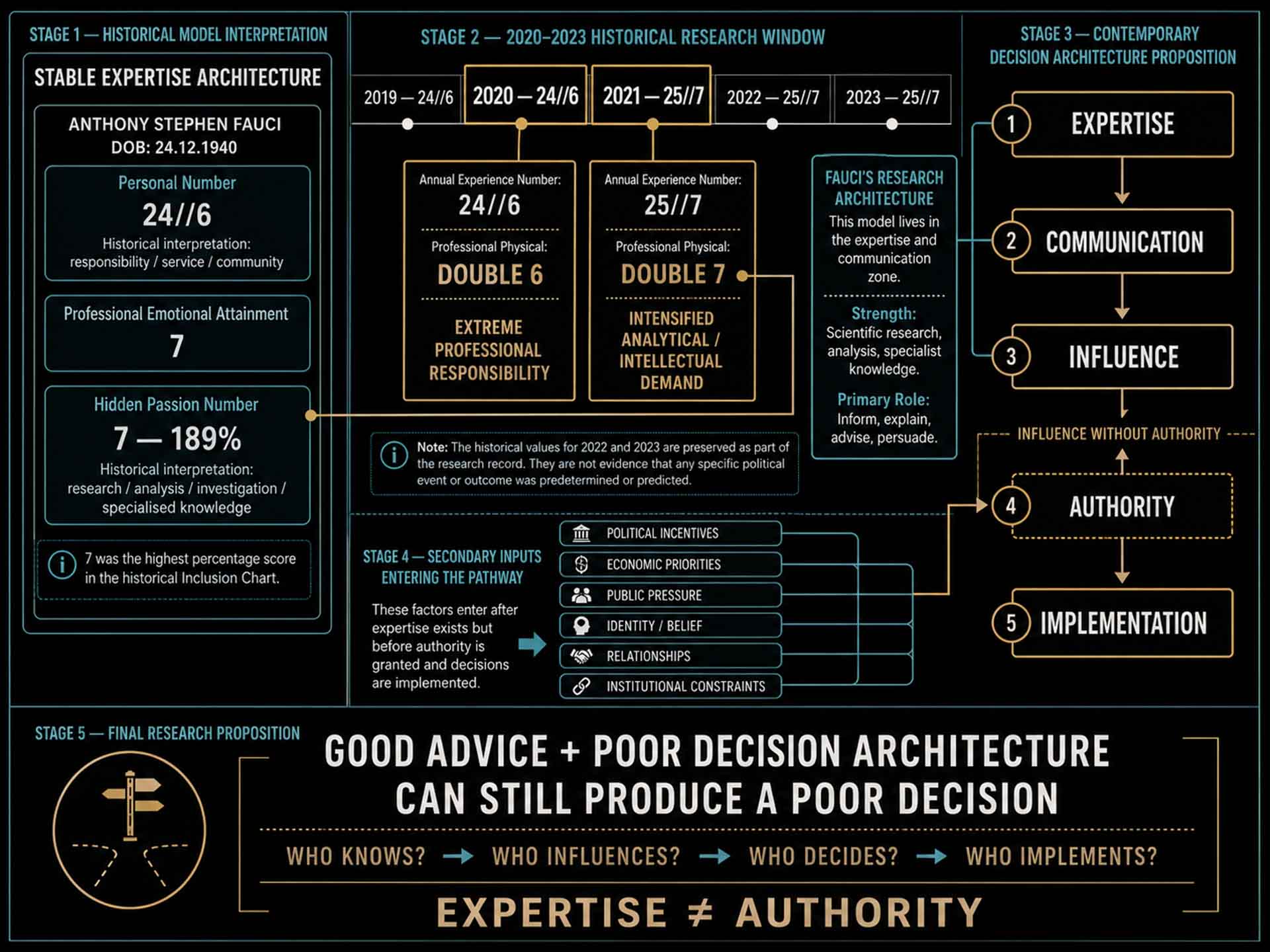
Fauci was born on 24 December 1940. Within the historical methodology, his birth day was therefore recorded as 24//6. Chris associated the 6 with responsibility, service, community, care and obligation towards others.
The second number was 7.
The original birth architecture placed 7 in what was then called Fauci’s Shadow Professional Attainment position. Under the contemporary Human Futurist terminology, this becomes his Professional Emotional Attainment position.
More strikingly, the Inclusion Chart generated from the name Anthony Stephen Fauci recorded Number 7 at 189% of the normalised target, the highest percentage of any number in the chart. The historical framework labelled it his Hidden Passion Number and interpreted it through research, analysis, investigation, specialist knowledge and a need to understand problems in depth.
Those interpretations are part of the historical methodology. They are not validated psychological measurements.
What matters for the contemporary article is why Chris noticed them.
- One part of the model emphasised responsibility.
- Another emphasised specialised analytical work.
Then both became unusually prominent in the precise period in which Fauci found himself at the centre of the largest public-health emergency of his career.
Why 6 and 7 Caught His Attention
By the time Chris wrote the article on 6 April 2020, Fauci was already serving on the White House Coronavirus Task Force. Official White House records from the period show him repeatedly appearing as the NIAID director and scientific specialist within an executive decision structure led by President Donald Trump and Vice President Mike Pence.
That organisational structure matters.
- Fauci possessed expertise.
- Trump possessed presidential authority.
- The task force sat between knowledge and executive action.
The historical article framed this relationship much more personally. It explicitly suggested that Fauci could face difficult professional conditions because powerful political figures might resist advice that conflicted with economic priorities or electoral considerations.
That wording belongs to a politically charged moment and should not simply be reproduced as contemporary fact.
But beneath it was a very important structural observation.
The effectiveness of expert advice depends partly on the person and system receiving it. That begins to move the research beyond Fauci’s individual architecture.
Then 2020 and 2021 Tightened the Pattern
The most interesting historical evidence appears in Fauci’s longitudinal model.
For 2020, the original article records an Annual Experience Number 6, with the backing sequence later shown as 24//6.
More importantly, Chris identified a double 6 inside Fauci’s Professional Physical line for the year.
The source interpreted this as an unusually concentrated period of professional responsibility and potentially difficult professional relationships.
Then the structure changed. For 2021, the double 6 was replaced by a double 7 in the Professional Physical line.
Chris connected that recurrence directly to Fauci’s existing Number 7 Hidden Passion and interpreted 2021 as a year of exceptional intellectual and analytical demand.
The contemporary significance lies in the sequence:
stable 6 architecture → 2020 double 6 professional concentration
followed by:
stable 7 architecture → 2021 double 7 professional concentration
Chris was not merely spotting an isolated 6 or 7 after the event. He was comparing enduring positions in the model with annual structures appearing during a specific professional period.
That is the evidential “wow” in the historical study.
It does not demonstrate that those numbers caused Fauci’s responsibilities.
It does explain why Chris regarded 2020–2021 as an unusual professional concentration window.
But Fauci Could Not Make the Decision
And this is where the contemporary article departs most significantly from the 2020 blog.
- Suppose an expert correctly identifies a risk.
- Suppose the analysis is excellent.
- Suppose the evidence is strong.
- Suppose the expert communicates it clearly.
None of that guarantees that the recommended action will happen. Between evidence and outcome sits another system.
The Archive Analysis captures that problem through a deceptively simple phrase:
Influence Without Authority.
Fauci could advise. Other people could accept, modify, delay, reject or politically reinterpret that advice.
The strategic problem is therefore not simply:
Was the expert right?
It is:
How does specialist knowledge travel through a system until somebody with authority makes a consequential decision?
That is a much richer Human Futurist question.
The Missing Variable Was the Decision System
The Archive Analysis identifies a further concept emerging from Article 131:
Decision Architecture. A working definition is:
the structural pathway through which information, expertise, influence, authority, incentives and implementation combine to produce a consequential decision.
That immediately gives us four questions.
Who Knows?
Who has the deepest relevant expertise? Not who holds the most senior title. Not who speaks most confidently. Who actually understands the problem?
Who Influences?
Can the expert translate specialist knowledge into language that changes the thinking of those around them? Expertise that remains inside technical language may never enter the decision.
Who Decides?
Who possesses the formal or practical authority to choose? This may be a president, CEO, board, investment committee, commander or client.
Who Implements?
Even authority is insufficient if execution fails. A decision can be technically sound and still collapse through weak implementation, institutional resistance or conflicting incentives.
The result is an important contemporary proposition:
good advice inside a poor decision architecture can still produce a poor outcome.
What Happened After the Original Article
The historical article did not expect Fauci’s importance to disappear quickly. Its research window extended beyond 2020, with particular emphasis on the analytical intensity of 2021 and continued significance through the following period. The Archive Analysis accordingly places the case in the formal Predictive Audit Register.
The subsequent record confirms that Fauci remained institutionally important well beyond April 2020. He continued participating in the federal COVID response and vaccine discussions through the remainder of the Trump administration. He then became Chief Medical Advisor to President Joe Biden while continuing as NIAID director. Fauci ultimately announced in August 2022 that he would step down from both roles in December 2022.
That matters because the original article’s central expectation, that 2020 would not mark a short-lived professional episode, was directionally reasonable.
But the audit should remain disciplined.
The Prediction Requires a More Careful Audit
The historical source connected Fauci’s 2020–2023 architecture with the proposition that COVID-19 itself would remain consequential rather than simply disappearing after its opening phase.
The contemporary archive should not convert that broad statement into a perfect forecast.
Fauci’s direct government role continued through the end of 2022, not throughout 2023: NIH records confirm that he left the NIAID directorship in December 2022.
The correct treatment is therefore not to declare the historical forecast “proved”.
It is to preserve exactly what was said, compare it with the later record and leave the Predictive Audit open to classifications such as Confirmed, Partially Confirmed, Not Confirmed, Ambiguous or Unverifiable, as the protocol already specified by the Archive Analysis.
That distinction is central to contemporary Human Futurist research. The archive becomes stronger when a forecast is allowed to be imperfect.
From Political Disagreement to Decision Architecture
The most valuable question Article 131 now raises has very little to do with choosing a side in the politics of COVID-19.
It is about the journey from knowledge to consequence.
Imagine a sequence:
INFORMATION → EXPERTISE → COMMUNICATION → INFLUENCE → AUTHORITY → IMPLEMENTATION → CONSEQUENCE
- Failure can occur at every transition.
- The information can be incomplete.
- The expert can misinterpret it.
- The expert can communicate badly.
- The leader can distrust the adviser.
- Political, commercial or psychological incentives can distort reception.
- Authority can be fragmented.
- Implementation can fail.
- And circumstances can change after the decision.
This is why the unseen variable in consequential decision-making may sometimes be the receiver rather than the adviser.
The crucial question is not only:
What does the expert know?
It is also:
What does the person with authority do with what the expert knows?
Why Influence Without Authority Matters Far Beyond Politics
Take Fauci out of the story and the proposition becomes more powerful, not less.
- A chief risk officer tells a board that exposure is becoming dangerous.
- An intelligence analyst warns a government.
- A doctor advises a patient.
- A financial adviser identifies a concentration risk.
- A technical director tells a CEO that a launch date is unrealistic.
- A lawyer warns that a proposed action creates serious liability.
- A consultant sees a strategic problem that the client would rather not confront.
In every case, expertise and authority reside in different places.
That means organisations should not merely ask whether they employ good experts.
They should map the architecture through which expert judgement becomes, or fails to become, action.
- Who knows?
- Who decides?
- Who influences the person who decides?
- Which incentives interfere?
- What happens when advice conflicts with what the authority figure wants to be true?
- And what mechanism exists for escalating a warning when the first conversation fails?
Those questions transform Article 131 from a 2020 political commentary into something much more durable.
Chris began by asking why Donald Trump should listen to Anthony Fauci. The contemporary Human Futurist archive arrives at a different question:
How should a decision system be designed so that the right expertise has the greatest possible chance of influencing the decision before consequence arrives?
That is the real research opportunity. And it is where Influence Without Authority becomes Decision Architecture.
FROM THE HUMAN FUTURIST RESEARCH ARCHIVE
This contemporary article has been developed from historical Human Futurist research preserved as Article 131, produced on 6 April 2020 and catalogued as HF-RA-131-B because a separate Adam Neumann source also carries physical Article Number 131. The original Fauci article examined responsibility, analytical intensity and the anticipated continuation of his professional significance during the COVID-19 period. Its stronger contemporary contribution is the emerging research concept of Influence Without Authority and the broader Decision Architecture through which expertise must pass before it can affect consequential decisions. The original document remains preserved within The Human Futurist Research Archive.
Share This Article, Choose Your Platform!
Related Posts






From understanding decisions to informing them.
Beyond the Research
The Business & Leadership archive examines consequential decisions after they have happened.
The Intelligent Mathematical Blueprint and Private Advisory take the underlying Human Futurist thinking into a different environment: helping leaders examine the circumstances surrounding decisions that have yet to be made.