
THE THIRD SYSTEM:
Captain, Coach and Event Alignment in the 2023 Rugby World Cup Final
What if elite performance belongs not to one individual, but to the system created between people and event?
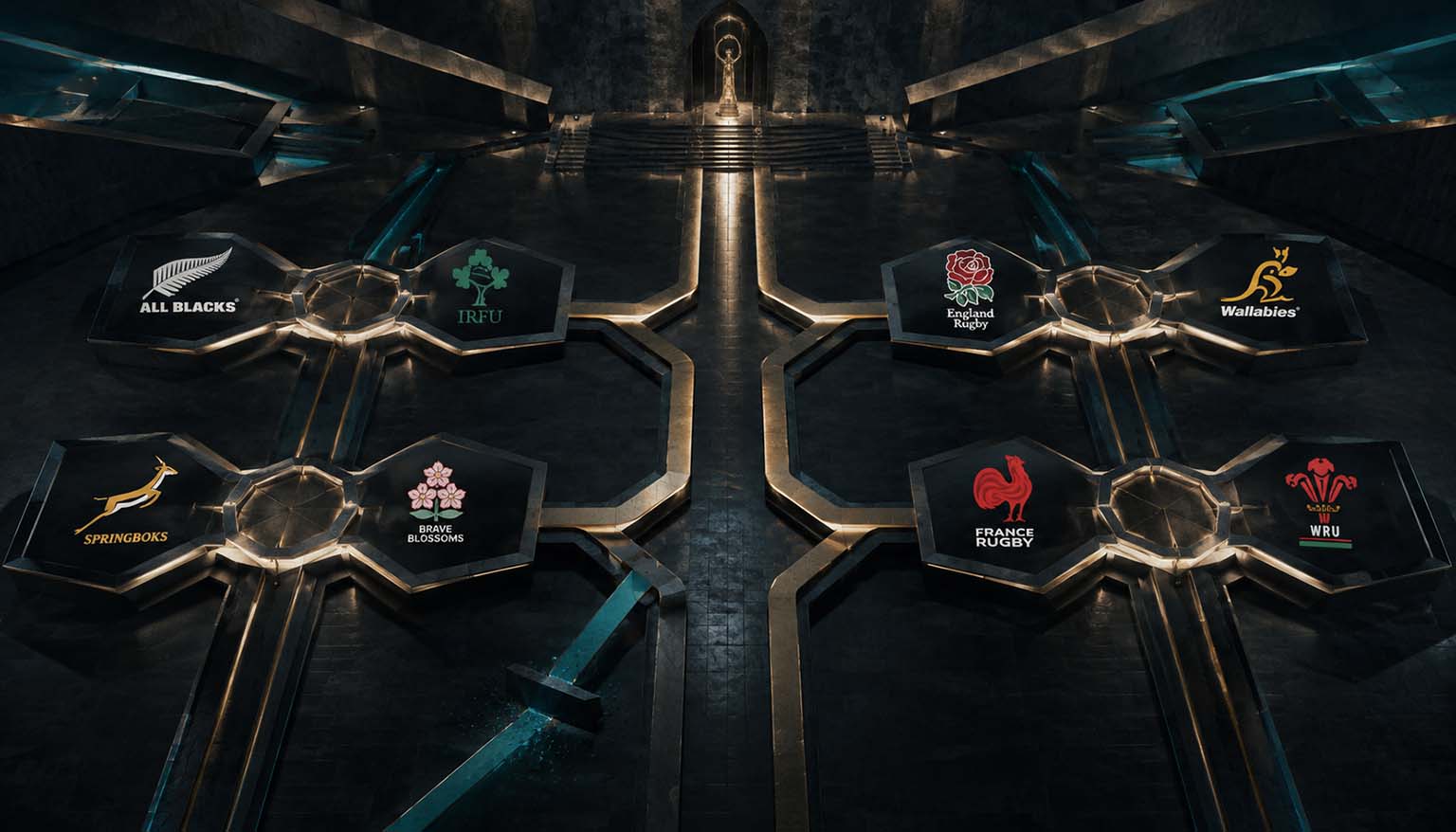
By the Rugby World Cup Final week in October 2023, there were only two teams left.
- New Zealand.
- South Africa.
For most rugby supporters, the question was straightforward: who would win?
For Chris Styles, another question had emerged during the tournament.
What exactly should the Human Futurist model be measuring?
- An individual player?
- A captain?
- A coach?
Or something created when influential people interact with one another inside a particular competitive environment?
That distinction is what makes Article 227 more interesting than a sporting prediction.
The historical research did make one. Before the final, its developing Scorecard gave the combination of Jacques Nienaber and Siya Kolisi an advantage over Ian Foster and Sam Cane.
South Africa subsequently defeated New Zealand 12–11 at the Stade de France on 28 October 2023 and became Rugby World Champions for a record fourth time.
But knowing that the prediction landed is only the beginning. The bigger research question is why Chris had stopped looking at performance as though it belonged to one person at all.
Four Years After the First Springbok Prediction
The route back to 2019 matters. Six weeks before that Rugby World Cup began, the earlier Human Futurist research had compared the captains and coaches of several leading nations.
South Africa entered the tournament ranked fifth in the world. Yet the historical model identified an unusual 2019 correspondence around Springbok coach Rassie Erasmus: his Personal Attainment Number 16/7 coincided with a concentrated Annual Experience Number 7.
The researchers interpreted that alignment as unusually favourable and backed South Africa to win the tournament.
They did. South Africa beat England in the 2019 final to win its third Rugby World Cup.
Four years later, the research question had developed.
Rather than simply asking whether one coach or captain possessed an unusually strong annual pattern, Chris and Suzanne were testing a new 30-individual-datapoint performance Scorecard.
Rugby offered a particularly interesting laboratory because captain and coach both exert substantial but different influences over performance.
- The coach prepares the system.
- The captain has to operate within it under pressure.
And neither controls the match environment.
That produces at least three potentially interacting layers:
CAPTAIN → COACH → EVENT
Article 227 began exploring what happened when those layers were examined together.
The Model Wasn’t Working Perfectly, and That Mattered
If this were simply a story constructed after South Africa won, it would be considerably less useful.
The original source preserves something much more important. The model had already been wrong. During the pool stages, it had favoured South Africa over Ireland. Ireland won.
Later, the initial Scorecard leaned towards Ireland beating New Zealand in their quarter-final. New Zealand won.
France presented another challenge. Head coach Fabien Galthié and captain Antoine Dupont appeared particularly strong in the Scorecard, yet South Africa eliminated France by a single point.
- These were not inconvenient details to remove from the archive.
- They were the interesting part.
Chris went back into the data.
Ireland Exposed One Problem
When Ireland failed to progress against New Zealand, Chris re-examined Johnny Sexton’s blueprint and noticed 23/5 in Sexton’s career position.
That prompted a new question.
The tournament was taking place in 20[23].
Could the unreduced year component, ’23’ matter when the same value appeared inside an individual’s underlying architecture?
The original study then looked elsewhere.
- Fabien Galthié had a Personal Attainment Number of 23/5.
- Argentina coach Michael Cheika carried 23 in the career position.
- England captain Owen Farrell had 23 within his Full Birth Name calculation.
All four were associated with teams whose tournament eventually stopped despite different degrees of competitive strength.
That does not establish a 23 effect.
The sample is tiny, selection effects remain possible, and the Scorecard itself was being modified while the tournament unfolded. But methodologically, something important had happened.
An unexpected result had changed the question.
The model was no longer being used simply to celebrate matches it appeared to explain. A miss had prompted Chris to look for a variable that the first version may have omitted.
For contemporary Human Futurist research, that is far more useful than an untouched run of apparent successes.
Stop Comparing Individuals. Compare Relationships.
By finals week, Chris had reached another conceptual shift.
The New Zealand question was not: Is Sam Cane better aligned than Siya Kolisi? And the coaching question was not: Does Ian Foster have stronger numbers than Jacques Nienaber?
The meaningful comparison was:
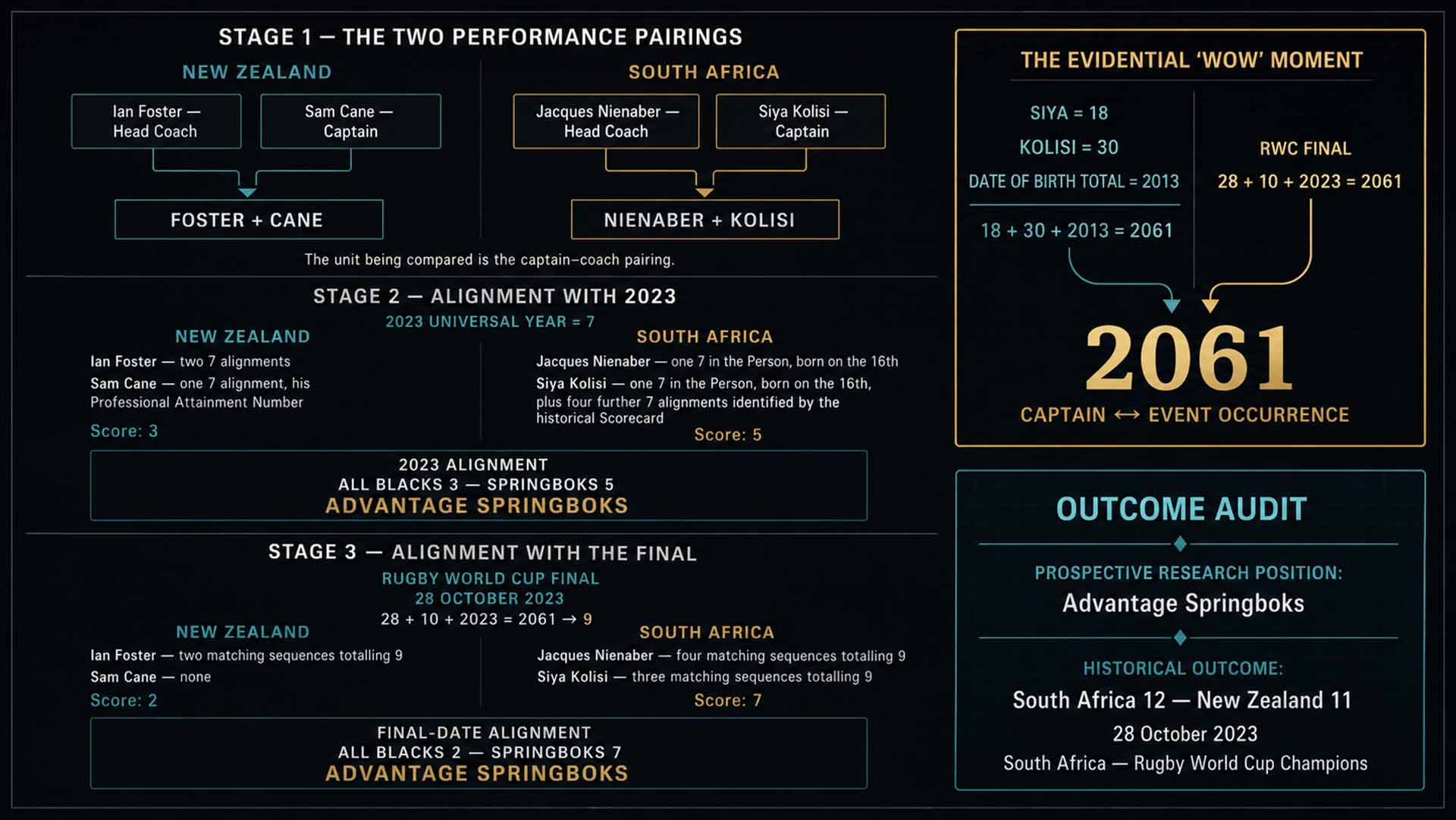
FOSTER + CANE against NIENABER + KOLISI because captain and coach do not perform independently.
A coach’s strategic architecture is enacted through players. A captain interprets, communicates and adapts that architecture under competitive pressure.
Each affects the operating environment of the other. In systems language, their interaction can generate properties that neither individual possesses separately.
That is the idea this contemporary article calls The Third System:
INDIVIDUAL A + INDIVIDUAL B ≠ merely two individuals
Instead:
CAPTAIN + COACH → RELATIONAL PERFORMANCE SYSTEM
The 2023 final then introduced something else. The event itself.
Why 2023 Began to Separate the Finalists
2 + 0 + 2 + 3 = 7. Chris therefore examined where 7 appeared across the four finalists’ Scorecard positions.
New Zealand [All Blacks]
For New Zealand, head coach Ian Foster produced two relevant 7 occurrences. Captain Sam Cane produced one, and that occurrence sat in his Professional Attainment position.
The historical Scorecard total was:
ALL BLACKS — 3
South Africa [Springboks]
South Africa produced more.
Jacques Nienaber and Siya Kolisi were both born on the 16th, giving each a 16/7 structure in the Person position.
Kolisi then carried another four 7 occurrences across the datapoints being used in the model, including career and name-related positions.
The historical Scorecard therefore read:
SPRINGBOKS — 5
The pre-final comparison became:
ALL BLACKS 3 — SPRINGBOKS 5
Advantage Springboks. On its own, that would still be one annual comparison. Then Chris introduced the date of the final. And the gap widened.
Then the Final Created a Third System
The final was scheduled for 28 October 2023. The historical calculation reduced the complete date as:
28 + 10 + 2023 = 2061 | 2 + 0 + 6 + 1 = 9
Chris therefore examined the Scorecard for positions matching the Number 9 architecture of the event date.
For New Zealand, Foster had two matching sequences, both in the Physical and Emotional Life Path positions.
Cane had none.
ALL BLACKS — 2
For South Africa, Nienaber had four: his Physical and Emotional Life Path positions, Full Birth Name and Call Name.
Kolisi had three: his Physical and Emotional Professional Attainment positions and his Call Name.
SPRINGBOKS — 7
The second comparison therefore became:
ALL BLACKS 2 — SPRINGBOKS 7
Again: Advantage Springboks.
But Chris found one additional correspondence. The event calculation was 2061.
The historical name calculation:
Siya = 18. | Kolisi = 30.
Kolisi’s date-of-birth calculation was 2013.
Add them:
18 + 30 + 2013 = 2061 The same unreduced total as: 28 + 10 + 2023 = 2061.
This is Article 227’s evidential “look again” moment. Not because 2061 caused South Africa to win. There is no evidence for that.
And not because matching arithmetic proves that the model has predictive validity. It does not. What makes the occurrence interesting is structural. Chris had begun with one person’s architecture.
The research moved to the captain and coach relationship.
Then a third component, the external event, produced a correspondence with one of those individuals.
The object of study was becoming:
PERSON ↔ PERSON ↔ ENVIRONMENT, rather than the isolated athlete.
And Then the Match Was Played
Your Content Goes Here
This is where prospective status matters. The final result was not known when the historical article concluded that the Nienaber–Kolisi combination held the competitive advantage.
The match was subsequently played on 28 October 2023 at the Stade de France.
South Africa won 12–11.
The margin could scarcely have been smaller.
South Africa became the first nation to win four men’s Rugby World Cups and completed back-to-back titles after its 2019 victory.
So the historical prediction was directionally correct.
Pre-match position: Advantage Springboks.
Outcome: Springboks win.
That makes Article 227 unusually valuable within the High Performance Archive because the proposition can be audited against an objective event. But it also creates the temptation that contemporary research must resist.
A correct prediction does not validate the method that generated it.
A Correct Prediction Is Not the Same as a Validated Model
There are serious unresolved questions. Were all 30 Scorecard data points and their weighting rules permanently fixed before the tournament?
- What exactly qualified an occurrence as positive or negative?
- Were the same rules applied identically to every team?
- How unusual is a 5–3 or 7–2 alignment when compared with hundreds of other sporting events?
- How often does the losing team possess the apparently stronger architecture?
- And because the 23 variable was investigated after Ireland and France had already lost, how should those later discoveries be separated from genuinely pre-event rules?
Those questions do not weaken Article 227. They tell us what the next research programme needs to do.
A stronger future Scorecard would be frozen before competition begins. Every variable would be defined. Weightings would be fixed. Predictions would be timestamped.
No rules would be altered after seeing a result without the alteration being recorded as a new model version.
Every match, success or failure, would remain in the dataset.
Then the real question could be tested:
Does relational and event alignment discriminate performance better than chance, rankings or analysis of the individual alone?
From Sports Prediction to Relational Performance Intelligence
That is why the 2023 Rugby World Cup Final deserves to open the contemporary High Performance collection. The memorable story is that Chris’s final-week model favoured South Africa — and South Africa won.
The durable research proposition is considerably larger. The individual may not always be the correct unit of analysis.
- A captain changes under a particular coach.
- A coach’s capability changes according to the captain through whom strategy is expressed.
Both operate differently under different competitive conditions. The event itself introduces pressure, timing, opposition and consequence.
Together they create a system that exists only through interaction.
CAPTAIN + COACH + EVENT → THIRD SYSTEM
That proposition does not belong only to rugby.
It can be tested in doubles partnerships, coach–athlete combinations, leadership teams, founder–CEO relationships, surgical teams, military command structures and any other environment where outcomes are produced through closely coupled human systems.
Article 227 therefore marks an important transition in the Human Futurist archive.
From:
Who has the strongest individual architecture?
towards:
What happens when multiple architectures interact?
And eventually:
Can we measure when the relationship itself becomes a source of exceptional performance — or vulnerability?
That is a much more consequential question than who won one rugby match. It is the beginning of research into The Third System.
FROM THE HUMAN FUTURIST RESEARCH ARCHIVE
This contemporary article revisits Article 227, written during the Rugby World Cup Final week in October 2023.
The historical research applied a developing 30-individual-data-point IMB performance Scorecard to captain–coach combinations during the tournament and concluded before the final that the pairing of Jacques Nienaber and Siya Kolisi held a competitive advantage over Ian Foster and Sam Cane.
South Africa subsequently defeated New Zealand 12–11 on 28 October 2023.
The contemporary article preserves that prospective status while reframing its more important research contribution around relational architecture, event alignment and the emerging concept of The Third System. The original historical document remains preserved within The Human Futurist Research Archive.
Share This Article, Choose Your Platform!
Related Posts






From understanding decisions to informing them.
Beyond the Research
The Business & Leadership archive examines consequential decisions after they have happened.
The Intelligent Mathematical Blueprint and Private Advisory take the underlying Human Futurist thinking into a different environment: helping leaders examine the circumstances surrounding decisions that have yet to be made.