
Can Repeating Performance Sequences Identify Future High-Performance Windows?
When a winning pattern returns, does performance return with it?
For a golfer who had already achieved so much, Rory McIlroy spent an extraordinarily long time being defined by something he had not done.
By the end of 2014, he was a four-time Major champion. He had won the U.S. Open in 2011, the PGA Championship in 2012 and then, during a spectacular summer in 2014, The Open at Royal Liverpool and another PGA Championship.
He was 25. It was reasonable to imagine that many more would follow.
Instead, the years began stacking up.
McIlroy kept winning. He remained one of the finest golfers in the world. He repeatedly put himself in contention. Yet every Major season seemed to bring another version of the same conversation.
Could he still do it? Was something missing? Had the moment passed?
And towering above all of those questions was Augusta.
The Masters was the one Major McIlroy still needed to complete the career Grand Slam. By 2022, when the historical Human Futurist research was being developed, he had finished second at Augusta but the green jacket remained out of reach.
The original Article 226 was therefore built around a deceptively simple question: Will Rory McIlroy win another Major?
Chris Styles decided to look backwards before he looked forwards.
Chris Went Back to 2014
If you wanted to understand what exceptional performance looked like for McIlroy, there was an obvious place to start.
2014.
That was the year he won two Majors.
Rather than looking only at McIlroy’s underlying profile, Chris examined the annual sequence his model associated with that season.
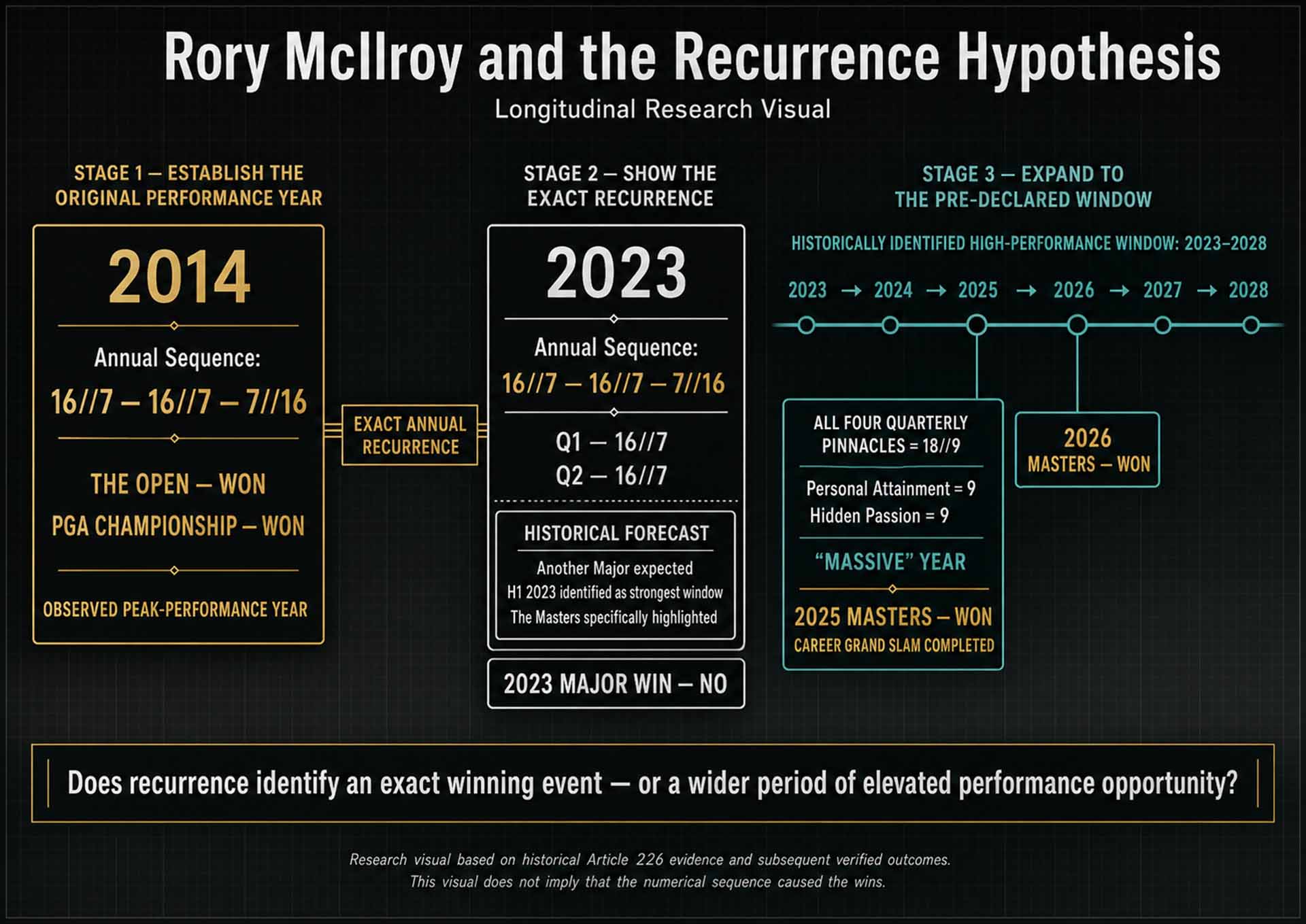
It was: 16//7 — 16//7 — 7//16.
Then he began moving through McIlroy’s longitudinal timeline. 2015. 2016. 2017. 2018. The sequence changed.
He continued forward.
And then he reached 2023.
The same sequence appeared again: 16//7 — 16//7 — 7//16.
Not approximately the same. Not one common number appearing somewhere in the model. The same annual data-string that had accompanied McIlroy’s two-Major 2014 season was calculated to return nine years later.
That was the moment the research became interesting.
Because Chris was no longer simply asking whether a particular number appeared in successful years. He had found something much more specific: a previous high-performance sequence was about to recur.
And 2023 had not happened yet.
Then the Pattern Tightened
The recurrence was already enough to attract Chris’s attention. But he kept drilling down.
Within the historical model, 2014 and 2023 were also both Number 7 Universal Years. McIlroy’s Inclusion Chart identified 7 as one of his two Hidden Passion values, calculated at 327% of the normalised target. That added another layer.
Then Chris calculated McIlroy’s quarterly sequence for 2023.
The first quarter produced Q1 — 16//7. The second produced Q2 — 16//7.
So the 16//7 structure defining the year was repeating again across the first six months.
And right at the beginning of Q2 sat the tournament McIlroy wanted more than any other.
The Masters.
The original research did not hedge its position. It explicitly identified H1 2023 as McIlroy’s strongest period and stated that 2023 could be the year he finally won the green jacket.
For Chris, the logic was compelling. McIlroy’s last extraordinary Major-winning year had a particular sequence. That sequence was returning. The first two quarters amplified it. And Augusta fell directly inside the window.
This was no longer simply a retrospective observation. Chris had made the call before the result was known.
And Then Rory Didn’t Win
Rory McIlroy did not win the 2023 Masters. He did not win any Major in 2023. The specific prediction failed.
That matters because the historical article was unusually confident. It did not merely suggest that McIlroy might play well. It argued that another Major was highly likely, highlighted the first half of 2023, and specifically looked towards Augusta.
If the contemporary Human Futurist archive preserved only the successful parts of old predictions, the archive would become considerably less useful.
So the miss stays. But something else stays too. Because the original research did not end with 2023.
Chris Had Seen a Bigger Window
When Chris mapped the longer sequence, he identified what the historical article described as a run of “golden performance years” from 2023 through to 2028.
That distinction becomes important.
The sharpest forecast concerned 2023. But the larger proposition was that McIlroy was entering an extended period in which his performance architecture repeatedly returned to historically significant territory.
The model also identified another interesting phase in the second half of 2024.
Then came 2025.
The 2025 Concentration
The original quarterly modelling gave 2025 a very different structure from 2023.
For 2025 it calculated: Q1 — 18//9; Q2 — 18//9; Q3 — 36//9; Q4 — 18//9.
All four quarters therefore resolved around 9.
That mattered within the original methodology because McIlroy’s Personal Attainment Number was also 9, while 9 was his other Hidden Passion value.
The historical article’s conclusion was characteristically emphatic: 2025 would be a “MASSIVE” year for Rory.
The source contains a labelling discrepancy in its 2025 graphic concerning the Universal Year, so that element should not be used as evidence. The four quarterly values and the accompanying interpretation, however, are explicit in the historical document.
And importantly, all of this existed before what happened next.
Then Came Augusta
On 13 April 2025, Rory McIlroy finally won the Masters. After a dramatic final round and a playoff against Justin Rose, he secured the green jacket and completed the career Grand Slam.
It had taken nearly eleven years since his previous Major. It had taken years of Augusta frustration.
And it did not happen in 2023, when the original Human Futurist article had most confidently expected it.
It happened in 2025, the year that same historical research had separately identified as unusually concentrated and potentially “massive”.
Then the story became stranger still.
In April 2026, McIlroy returned to Augusta as defending champion and won again, securing a second consecutive green jacket.
So, by 2026, the wider pre-declared 2023–2028 performance window contained two Masters victories.
One of them completed the career Grand Slam. The other made McIlroy a back-to-back Masters champion.
That does not magically turn the failed 2023 prediction into a successful one.
But it does make the original research considerably more interesting.
So What Had Chris Actually Found?
This may be the most useful question in the entire article.
The tempting conclusion would be: the numbers predicted that Rory McIlroy would win the Masters.
But they did not. The historical source predicted the Masters too early.
A more interesting possibility is that the original model may have been identifying something broader than a single winning event.
Perhaps recurrence should not be thought of as: the same sequence returns → the same result must return. Elite performance simply does not work that way.
A golfer can arrive in exceptional form and lose by one shot. Another player can produce the week of his life. Weather changes. A poor swing at the wrong moment matters. Confidence moves. Course conditions change. Injury, preparation, equipment, coaching, relationships and decisions all become part of the performance environment.
An individual architecture, even if it ultimately proves meaningful, would never be the only variable.
Which raises a different proposition:
Could recurrence identify a period in which the conditions for exceptional performance become more favourable, without determining exactly what the athlete will achieve?
That is a much more useful high-performance question.
A Performance Window Is Not a Promise
Imagine knowing that an athlete was approaching a period resembling one associated with a previous peak.
What would you do with that information?
You would not tell them they were guaranteed to win.
You might instead ask whether the preparation surrounding that period deserved greater attention.
- Should competition scheduling change?
- Should recovery be protected more aggressively?
- Should technical experimentation happen earlier?
- Should the coaching team avoid unnecessary disruption?
- Should mental preparation increase?
- Should the athlete arrive at the important events physically and emotionally fresher?
This is where high-performance timing becomes potentially more valuable than sports prediction.
The question moves from: Will Rory win? If a potentially important window is approaching, how do we give Rory the best possible chance of performing within it?
That is a very different application. And it is much closer to what Human Futurist research is becoming.
The Intelligent Mathematical Blueprint does not hit the golf shot. It does not control the leaderboard. It does not neutralise the other players.
But if recurring architecture can eventually be shown to identify meaningful performance windows, it could potentially become one additional piece of information inside a much larger high-performance system.
The Real Recurrence Hypothesis
Rory McIlroy gives us a fascinating case. In 2014, he won two Majors while the model recorded 16//7 — 16//7 — 7//16.
That exact sequence returned in 2023.
Chris predicted another Major and placed particular emphasis on the Masters.
The win did not come.
Yet the same research had also identified a broader 2023–2028 high-performance period and highlighted 2025 as exceptional before McIlroy finally won at Augusta.
Then he won there again in 2026. One athlete cannot prove a recurrence model. Nor should later success be used to erase an earlier miss.
But that is precisely why this case belongs in the High Performance archive.
It gives us both. A prediction that was too precise. And a wider pattern that became more interesting with time.
The next question therefore should not be whether Rory McIlroy proves the model. He cannot.
The question is whether the same phenomenon appears elsewhere. Take athletes with clearly defined peak-performance periods. Map the architecture surrounding those peaks. Wait for those configurations to recur. And then watch what happens.
Not once. Across dozens of athletes. Across hundreds of competitions.
Because if recurring performance architecture has any genuine signal at all, that is where it will eventually become visible.
And if it does, the most valuable question will not be: Who is going to win?
It will be: When an exceptional-performance window appears to be returning, what can an athlete do differently because they know it is there?
That is where prediction begins to become preparation.
FROM THE HUMAN FUTURIST RESEARCH ARCHIVE
This contemporary article has been developed from historical Human Futurist research preserved as Article 226.
The historical source was produced prospectively for the 2023 period. It identified an exact recurrence between McIlroy’s 2014 and 2023 annual sequences, placed particular emphasis on H1 2023 and the Masters, projected a wider 2023–2028 performance period and separately highlighted 2025 as highly significant.
The contemporary article preserves both the unsuccessful specific 2023 forecast and the later outcomes within the broader pre-declared window. The original document remains preserved within The Human Futurist Research Archive.
Share This Article, Choose Your Platform!
Related Posts





From understanding decisions to informing them.
Beyond the Research
The Business & Leadership archive examines consequential decisions after they have happened.
The Intelligent Mathematical Blueprint and Private Advisory take the underlying Human Futurist thinking into a different environment: helping leaders examine the circumstances surrounding decisions that have yet to be made.