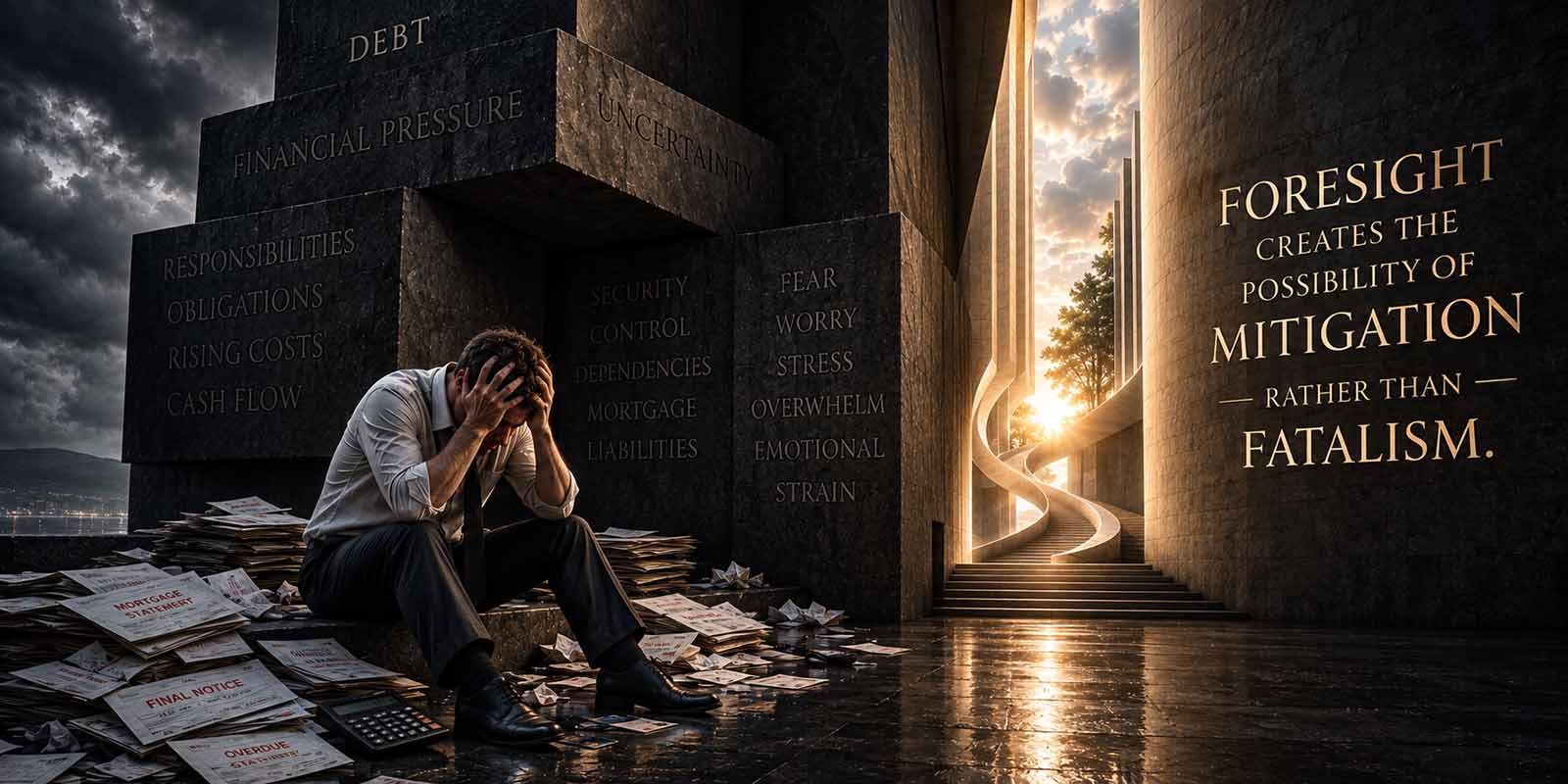
What If We Could See It Coming?
Most People Do Not Know the Mathematical Architecture of Their Lives
They know their age. They know their income. They know where they live, what they own, what they owe, what they want and, perhaps, what they fear losing. They may have financial plans, career plans, business plans, retirement plans and contingency plans.
But they usually have no idea whether a particular period of their life may carry an elevated experiential theme around the very things upon which those plans depend.
This is one of the questions at the heart of my research into Human Futurology.
Because what if certain mathematical sequences do not simply describe aspects of human experience? What if they correspond with recurring experiential conditions? And what if understanding those conditions before they arrive could influence the way we prepare for them?
One sequence in particular has repeatedly caught my attention: 38//11//2.
My research increasingly suggests that when this sequence becomes a significant theme within an individual’s Intelligent Mathematical Blueprint (IMB), there can be considerable emotional strain associated with material matters, particularly money, financial security, property, resources and the structures upon which a person depends for material stability.
But that is only part of the observation. What makes 38//11//2 particularly interesting is what appears to happen next. The material pressure frequently seems capable of travelling into other areas of the individual’s experience, with a seriously negative effect on self-expression, happiness, optimism and creativity.
In other words, we may not simply be observing a difficult financial or material period. We may be observing an experiential chain reaction.
And that raises an important strategic question:
What could change if you knew that risk existed before you entered the period in which it was most likely to become relevant?
From Individual Numbers to Mathematical Life Architecture
One of the fundamental developments within Human Futurology has been the movement away from treating numbers as isolated characteristics.
The more interesting question is not simply:
What does 3 mean? Or: What does 8 mean?
It is:
What happens when these mathematical variables interact within a particular architecture, at a particular point in a person’s life?
That changes the nature of the enquiry completely. We move from numerical description to mathematical life architecture. And 38//11//2 provides an excellent example.
The Architecture of 38//11//2
Within my research, 8 repeatedly appears strongly associated with the material architecture of life:
- money → resources → property → security → financial responsibility → material consequence → control.
The 3 occupies a very different experiential territory:
- expression → communication → creativity → happiness → enjoyment, spontaneity → freedom to engage with life.
The 11//2 dimension introduces another important consideration: heightened emotional experience, sensitivity, relationship dynamics and the way circumstances may be internally processed. Look at those elements not as isolated meanings, but as an interacting system.
Something much more interesting becomes visible.
Material pressure may constrain expression.
When financial security becomes uncertain, attention changes. When a property problem develops, attention changes. When income falls, debt increases, a business experiences cash-flow problems, or an unexpected financial responsibility appears, attention changes.
The person who was previously asking: What could I create? may start asking: What can I afford?
The person asking: What would make me happy? may begin asking: What is safest?
The person thinking: What possibility could I pursue? may instead think: What happens if this fails?
This matters because human beings do not possess unlimited emotional and cognitive capacity.
Material insecurity consumes bandwidth.
It demands calculation.
- Monitoring.
- Decision-making.
- Risk assessment.
- Control.
- Contingency planning.
- And worry.
The 3 may therefore not disappear. It may become crowded out by the 8.
When Money Stops Being About Money
One of the most important observations emerging from my research is that material problems rarely remain purely material.
- Money becomes emotional.
- Property becomes emotional.
- Employment becomes emotional.
- Business performance becomes emotional.
- Security becomes emotional.
A mortgage is not merely a financial instrument when someone fears losing their home. Business cash flow is not merely accounting when salaries depend upon it. A reduction in income is not simply arithmetic when a family has built its life around that income.
Property is not simply an asset when it represents home, identity, security and belonging. And financial dependence can alter relationships, confidence, autonomy and self-perception.
This is where the 11//2 component of 38//11//2 becomes particularly intriguing.
My developing hypothesis is that the 8 may frequently identify the material territory in which pressure occurs, while 11//2 describes something of the emotional amplification or transmission of that pressure.
The material problem therefore becomes an emotional experience.
And the emotional experience begins affecting the 3.
- Expression reduces.
- Creativity contracts.
- Optimism diminishes.
- Enjoyment becomes harder.
- Communication may become strained.
The person’s psychological world becomes increasingly occupied by the problem that needs to be solved. The sequence begins to look less like several independent numerical components and more like a system:
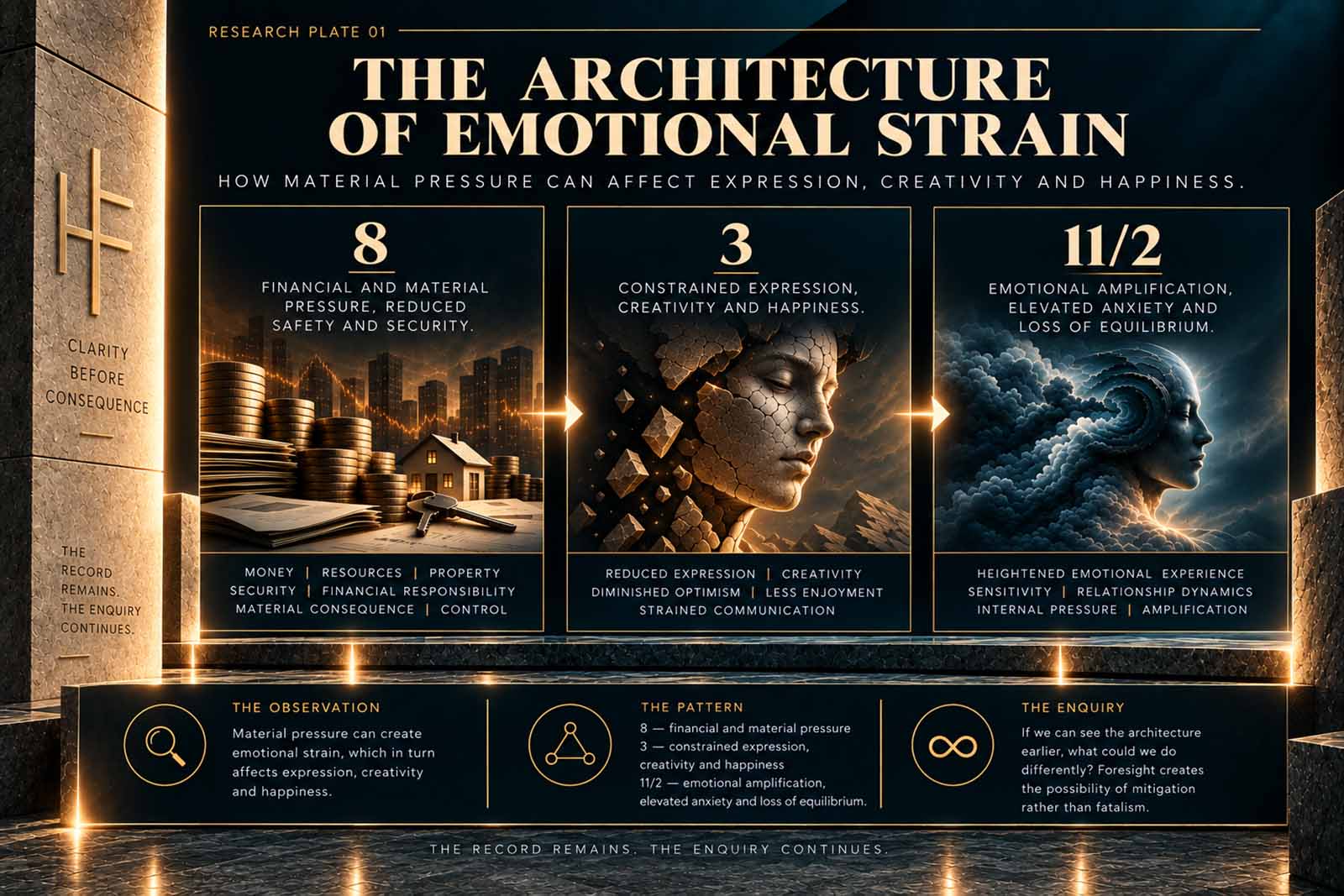
This is what I mean by the architecture of emotional strain.
But There Is Another Problem
Most people have absolutely no idea when 38//11//2 may become relevant to their lives.
This is perhaps the most strategically important part of the entire discussion.
If you do not understand your bespoke mathematical architecture, you cannot know when a particular experiential sequence may become active within it.
And if you do not know that, you cannot incorporate that intelligence into your planning.
- You experience the year first.
- You understand it afterwards.
That distinction is enormous.
Imagine discovering after a period of considerable financial and emotional difficulty that the architecture associated with that period could potentially have been identified beforehand.
What might you have done differently? That is the question Human Futurology asks.
What If You Knew Beforehand?
Suppose your IMB indicated that 38//11//2 was going to become an important annual experiential theme.
This would not mean that financial disaster was predetermined. It would not mean that you should expect to lose a property. It would not mean that something terrible must happen.
Human Futurology should never be reduced to deterministic fortune-telling. The intelligence lies somewhere much more useful. You would know that your research profile indicated a period in which material security and its emotional consequences warranted greater-than-normal strategic attention.
That knowledge could change behaviour.
- Perhaps you would enter the year with a larger cash reserve.
- Perhaps you would reduce unnecessary financial exposure.
- Perhaps you would reconsider taking on highly leveraged commitments immediately before the sequence became prominent.
You might review mortgage arrangements, insurance, contracts, property liabilities or business dependencies earlier than you otherwise would.
- A business owner might strengthen working capital.
- An executive might think more carefully before allowing lifestyle expenditure to rise alongside a temporary increase in income.
- A family might discuss financial contingencies before circumstances force the conversation.
- Someone contemplating a major property transaction might conduct more rigorous downside modelling.
But the planning need not stop with the 8.
If the research indicates that material pressure can subsequently affect the 3, then protecting the 3 becomes part of the strategy too.
That might mean consciously protecting creative activity. Maintaining relationships and social connection. Recognising withdrawal earlier. Protecting time that is not consumed by financial problem-solving.
Being aware that reduced happiness or self-expression may be a secondary consequence of material pressure rather than evidence that everything in life has suddenly become wrong.
That is a fundamentally different use of mathematical intelligence.
Foresight Creates the Possibility of Mitigation Rather Than Fatalism
This distinction is crucial. The purpose of identifying an experiential risk is not to create fear about what might happen.
It is to create the possibility of doing something differently before it does.
- Companies do this all the time.
- Governments do it.
- Investors do it.
- Military strategists do it.
- Insurers do it.
- Boards do it.
They identify possible future conditions and ask:
- What is our exposure?
- What would happen if this occurred?
- How resilient are we?
- What could we do now to reduce the consequence?
Nobody regards a corporate risk register as evidence that every identified risk will happen. The value lies in recognising that something could happen and preparing intelligently for the possibility.
Yet when it comes to our individual lives, we frequently operate with remarkably little equivalent foresight.
- We prepare financially according to age.
- We prepare professionally according to career stage.
- We prepare businesses according to economic forecasts.
But what if another layer of individualised intelligence exists? What if aspects of our own mathematical architecture could indicate periods in which particular experiential domains deserve additional attention?
That is one of the possibilities my research into the IMB is exploring. And it leads to a principle that sits at the heart of this enquiry:
From Forecasting to Mitigation
This is where Human Futurology becomes particularly relevant to strategic thinking.
The objective is not:
“38//11//2 is coming. Something bad will happen.”
The objective is:
“38//11//2 appears within your forthcoming architecture. What does our accumulated research tell us about this sequence, and what could you reasonably do with that intelligence?”
Those are profoundly different propositions. One creates fear. The other creates preparedness.
If 38//11//2 has repeatedly demonstrated an association with emotional strain surrounding material security, then the rational response is not anxiety.
It is scenario planning.
- What material dependencies currently exist?
- Where is financial resilience weak?
- Which property commitments carry disproportionate exposure?
- Where is income concentrated?
- What happens if expected revenue does not arrive?
- What obligations cannot easily be reduced?
- What financial circumstances would create the greatest emotional strain?
- Which relationships would be affected?
And importantly:
What parts of yourself are most likely to disappear when material pressure increases?
- Your creativity?
- Your communication?
- Your humour?
- Your social engagement?
- Your optimism?
- Your capacity to imagine alternatives?
If so, those become assets worth protecting too.
The 38 Feedback Loop
There is another possibility I believe deserves much deeper research.
What if suppression of the 3 eventually makes the original 8 problem harder to solve?
Consider the architecture:
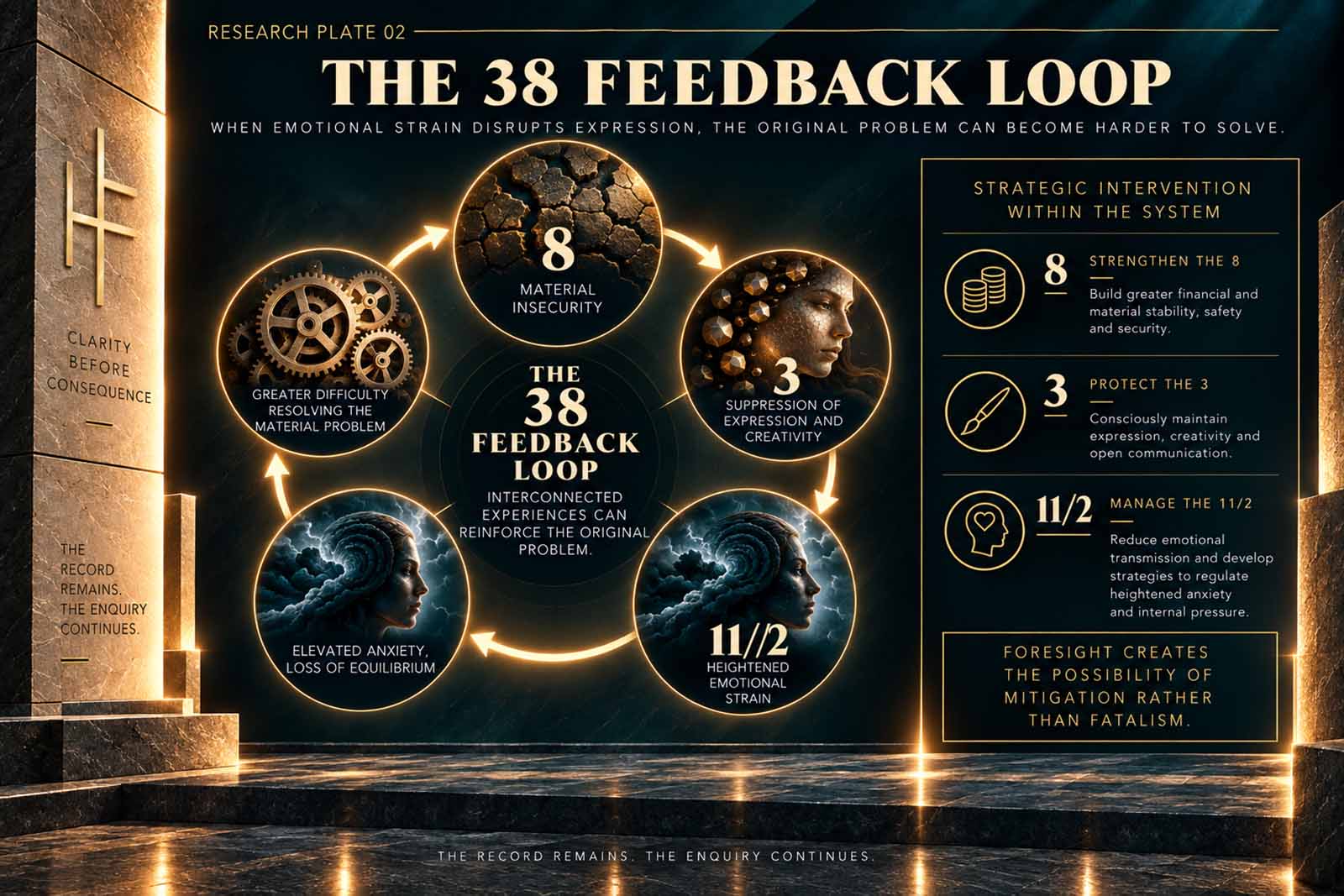
Further emotional strain
That would create an experiential feedback loop. If future case analysis continues to support this relationship, it may prove to be one of the more important findings associated with 38//11//2.
Because intervention could theoretically occur at several points in the architecture.
- You could strengthen the 8.
- You could manage the emotional transmission represented by 11//2.
- You could consciously protect the 3.
That is much more sophisticated than assigning a positive or negative meaning to a number.
It is strategic intervention within an experiential system.
Knowing Your Architecture Changes the Question
Without an IMB, an individual experiencing the pattern might reasonably conclude:
“My finances are difficult, therefore I am unhappy.” Or: “I’ve lost my creativity.” Or: “My relationship is struggling.” Or: “I don’t feel like myself anymore.”
Each symptom may appear independent. But what if they are connected? What if the architecture tells a larger story? And what if seeing that architecture changes the decisions you make?
This is why I believe bespoke mathematical architecture matters.
- Two people of the same age can enter the same calendar year experiencing entirely different personal architectures.
- Two executives can operate within the same economy while navigating very different experiential themes.
- Two families can experience the same economic environment while their individual mathematical architectures suggest different areas of vulnerability, opportunity and consequence.
The calendar tells us when the year begins. It does not necessarily tell us what the year may ask of us. That is the territory Human Futurology is investigating.
The Strategic Advantage of Seeing Earlier
The greatest potential value of Human Futurology may ultimately not be its ability to explain what happened. It may be its capacity to help us think differently before something happens.
Hindsight can produce understanding. Foresight can change behaviour. And changed behaviour can change consequence.
That does not require believing that the future is fixed. Quite the opposite.
If everything were predetermined, strategic intelligence would be largely pointless.
The value exists precisely because human beings can respond.
- We can prepare.
- We can strengthen.
- We can reconsider.
- We can delay.
- We can accelerate.
- We can diversify.
- We can protect.
- We can communicate.
- We can create contingencies.
And sometimes we can decide not to make a particular decision at all.
The IMB does not need to tell someone what will happen for it to possess strategic value.
It needs to reveal something sufficiently meaningful about the architecture of possibility that the individual can ask better questions before consequence arrives.
38//11//2 Is Therefore More Than a Sequence
My continuing research into 38//11//2 is not attempting to establish another fixed definition.
It is investigating a recurring experiential architecture.
The developing research proposition is that when 38//11//2 becomes a significant annual theme, material-security concerns — particularly those involving money, property, resources and financial stability — may acquire unusually high emotional significance.
That emotional pressure may then affect expression, creativity, enjoyment and subjective wellbeing.
And, potentially, the resulting contraction of creativity and adaptive thinking may make the original material challenge more difficult to resolve.
This proposition requires continued testing.
- More cases.
- More comparison.
- More prospective observation.
- And importantly, examination of cases where the expected relationship does not occur.
That is how useful research develops. But there is already a strategic implication worth considering. Most people do not know their bespoke mathematical life architecture.
They therefore have no reason to know when 38//11//2, or another significant experiential sequence, may become prominent.
And without that intelligence, there is little opportunity to proactively consider the particular risks associated with it.
They encounter the experience. Then they react. Human Futurology asks whether we can reverse some of that sequence:
- See earlier.
- Think earlier.
- Plan earlier.
- Mitigate earlier.
And then observe whether knowing the architecture changes the eventual consequence. Because perhaps the most important question is not:
Can mathematics tell us what our future will be?
Perhaps it is:
What could we do differently today if we understood more about the mathematical architecture of tomorrow?
That is the question Human Futurology intends to investigate.
Share This Article, Choose Your Platform!
Related Posts



From understanding decisions to informing them.
Beyond the Research
The Business & Leadership archive examines consequential decisions after they have happened.
The Intelligent Mathematical Blueprint and Private Advisory take the underlying Human Futurist thinking into a different environment: helping leaders examine the circumstances surrounding decisions that have yet to be made.