

Part of The Evolution of the IMB
This article explores one of the first significant consequences of looking beyond numerical reduction: the discovery that numbers arriving at the same Essence could still contain very different underlying information.
For Chris Styles, 1, 10, 19 and 28 were no longer simply four routes to 1. Retaining their original structure opened the possibility of examining deeper relationships, synchronicities and personal timing patterns — including the concentration effect that first drew his attention to the 1980s.
Why One Was Never Just One marks an important methodological shift in the evolution of the Intelligent Mathematical Blueprint: reduction remained useful, but it became the beginning of the enquiry rather than the end of the analysis.
What Chris Styles began to see when a simple reduced number stopped being the end of the enquiry.
What Day Were You Born?
Not the month. Not the year. Just the day.
The 1st? The 10th? The 19th? The 28th?
At first glance, those four dates appear different. Reduce them, however, and they arrive at the same place:
- 1 → 1
- 10 → 1+0=1
- 19 → 1+9=10 & 1+0=1
- 28 → 2+8=10 & 1+0=1
That shared destination is useful. Chris Styles calls it the Essence. It provides an initial framework for thinking and pattern recognition.
But his research eventually led him to a more uncomfortable question: if 1, 10, 19 and 28 all become 1, what disappears when we stop there?
If there is meaningful intelligence here, why are we interrogating it so simplistically?
That question would eventually change almost everything.
The Problem Was Not the Numbers
Chris did not initially reject numerology. Quite the opposite. Something about it captured his attention immediately.
He was fascinated by the proposition that numerical structures linked with birth dates, names and life cycles might contain information about human experience.
But the way those numbers were being interpreted troubled him. Traditional numerology generally reduces calculations into a relatively small collection of core numbers and archetypes.
For Chris, that created a methodological problem. Consider four people born on:
1 | 10 | 19 | 28
Traditional reduction ultimately takes all four numbers back to 1.
- 10 becomes 1.
- 19 becomes 1.
- 28 becomes 1.
At one level, Chris could see the usefulness of that classification. But as someone trained to think analytically, another question immediately appeared:
Four Chocolate Cakes
Chris uses a deliberately simple analogy.
Imagine four chocolate cakes. From across the room, the label is accurate: chocolate cake. But cut into them, and the similarity quickly becomes less useful. One may be dark chocolate and orange. Another may contain coffee. Another nuts. Another may have layers of ganache, sponge and mousse.
They belong to the same broad family. They are not the same cake.
For Chris, 1, 10, 19 and 28 began to present the same problem. The shared Essence remained useful, but deeper diagnostics suggested that the raw numbers carried different internal information.
Reduction, he concluded, was not useless. Stopping at reduction was the limitation.
That shift sounds small. In practice, it changed the direction of his research.
The Clue Was Not a Personality Description
The breakthrough did not begin with Chris deciding that the numbers must contain more information. It emerged through years of working with people’s timelines.
From 2017 onward, he repeatedly built and interrogated individual frameworks, comparing numerical structures with the experiences people remembered from their lives. The process was iterative, often frustrating and frequently unsuccessful. He describes it as having to “fail my way to success”: try a structure, test it against cases, abandon what produced little, change the method and keep looking.
One recurring observation began to bother him.
For people old enough to remember the period, the 1980s seemed unusually persistent in conversation. Again and again, people identified experiences from that decade as among the most memorable and personally significant of their lives.
The experiences themselves were not the same. They could be positive, difficult, transitional, relational, professional or deeply personal.
The common feature was memorability. Why?
Then the Individual Years Began to Stand Out
As Chris separated the cases according to the day on which people were born, another pattern appeared.
People born on the 1st, 10th, 19th or 28th share a No.1 Essence. In his case work, 1981 repeatedly drew his attention for this group.
For the No.2 group, people born on the 2nd, 11th, 20th or 29th, 1982 came into focus.
Then 1983 for No.3. 1984 for No.4. The sequence continued.
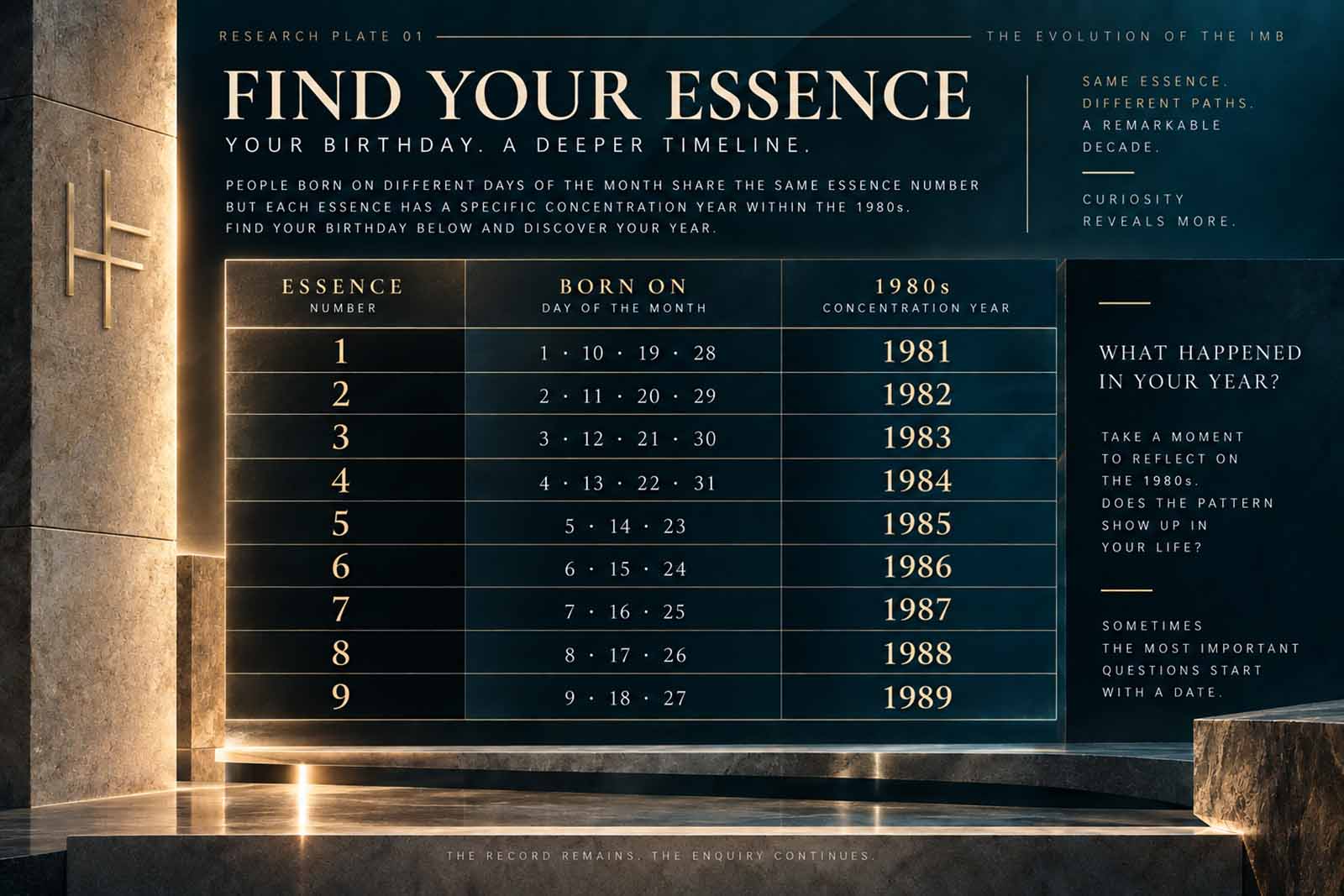
This was the point at which curiosity became a methodological question. Chris had noticed the human pattern first. He then went looking for a possible numerical architecture underneath it.
Why the 1980s?
The clue came from a simple mathematical property.
In digital-root arithmetic, adding or removing a 9 does not change the final non-zero digital root of the remaining digits. Chris had learned to use this as a cancellation shortcut when interrogating numerical structures.
For example:
1999 → 1+9+9+9 = 28 → 10 → 1
Cancel the 9s and 1 remains.
1979 → 1+9+7+9 = 26 → 8
Cancel the 9s and 1+7 = 8.
Now look at the shared numerical structure of the 1980s:
1980 → 1+9+8+0 = 18 → 9
Within Chris’ analytical method, that 9 can be cancelled. The final digit of each year is therefore exposed with unusual clarity:
1981 → 1 · 1982 → 2 · 1983 → 3 · … · 1989 → 9
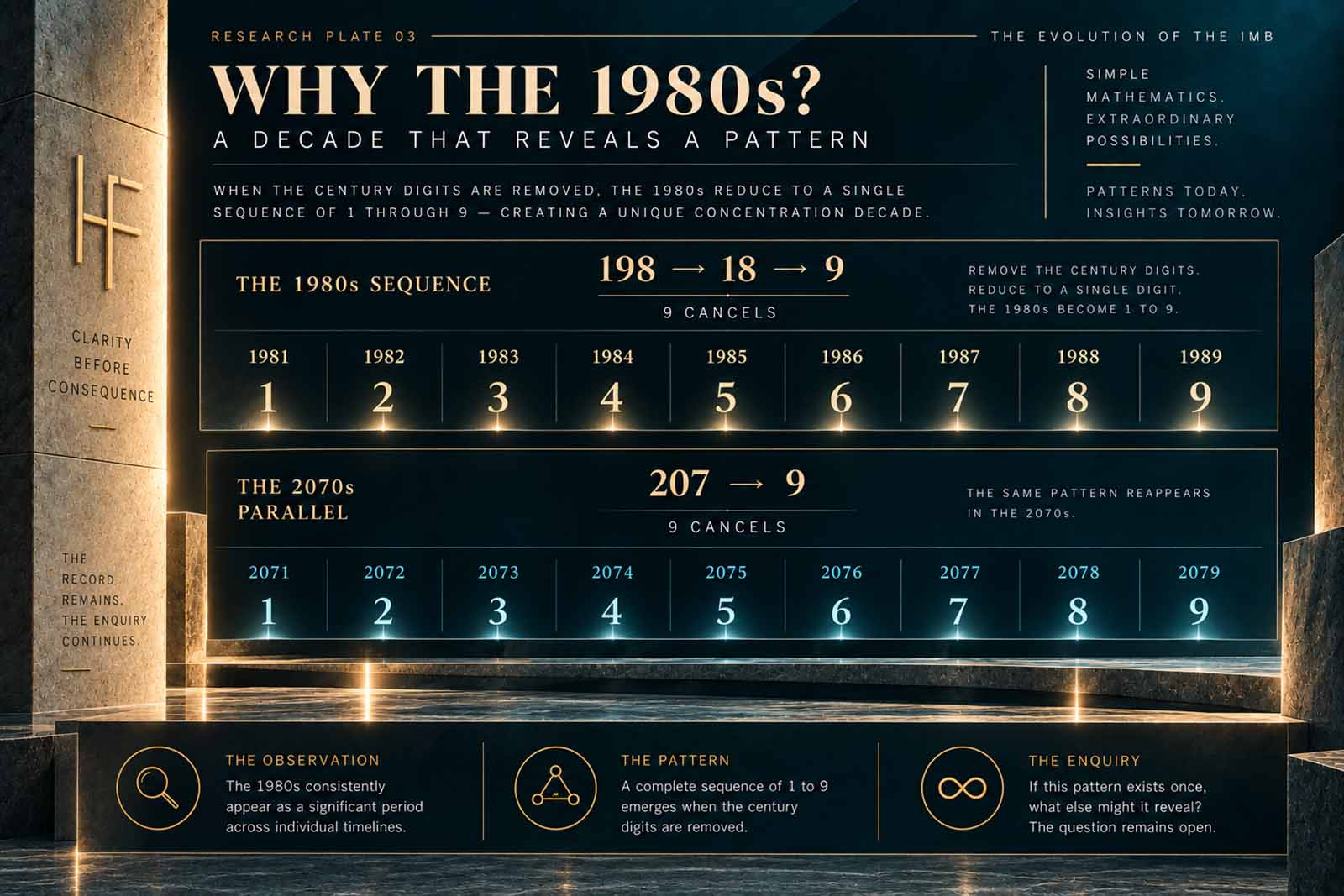
The mathematics of that reduction is straightforward. The Human Futurist proposition goes further: Chris interprets the decade as a period in which the relevant personal timing architecture contracts into a one-year window for each Essence group.
The Concentration Effect
Chris is precise about the term concentration: it means a one-year timeframe only.
In the wider timelines he developed, the relevant personal window can span two, three, four or five years. He describes those wider periods as more diluted: the experience is generally longer, more drawn out and therefore less concentrated into one sharply memorable year.
The 1980s are different.
For a No.1 person, the timeframe contracts to 1981 alone. For a No.2, to 1982. The sequence continues through 1989 for No.9.
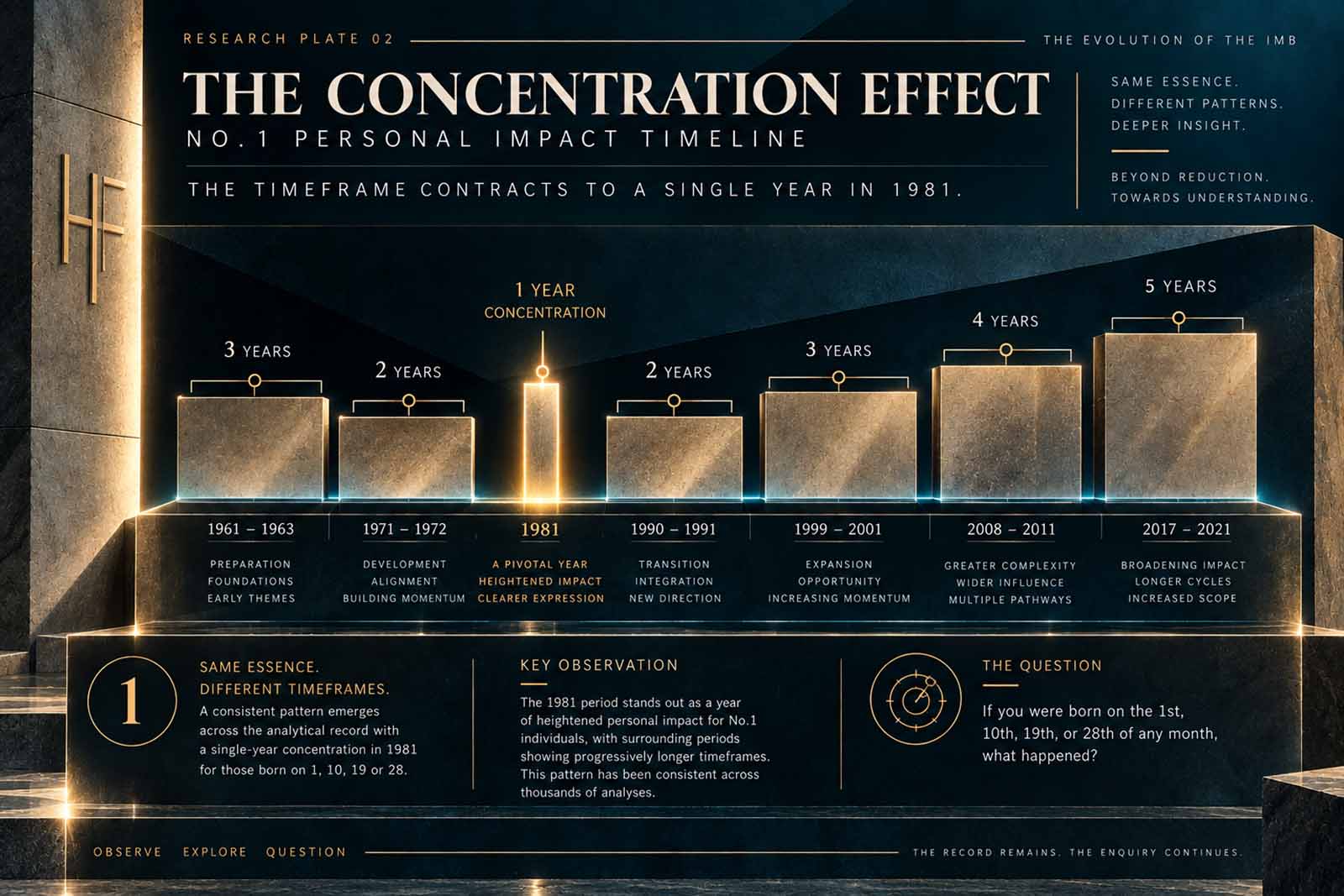
Chris’ observation from his case work is not that everyone experiences the same kind of event. Quite the opposite. The spectrum is extremely varied. His proposition is that the shared feature is the intensity of personal significance and memorability when the relevant timing window is compressed into one year.
This remains a research proposition emerging from his accumulated case work rather than a statistically established causal finding. Chris has repeatedly said that the body of data now needs formal statistical interrogation.
But the pattern changed how he thought.
Try It Against Your Own Life
If you were alive and old enough to form lasting memories during the 1980s, there is an obvious way to engage with the question.
Find your birth-day Essence in the table above. Then look at the corresponding year.
Do not force a match. Do not search for what you think should be there. Ask a simpler question:
What actually happened?
Was that year ordinary? Was it unusually memorable? Did something begin, end or alter direction? Was there a personal experience that still comes immediately to mind decades later?
A single remembered experience proves nothing. Neither does recognition establish causation. But this is exactly how Chris’ own enquiry developed: not by asking people to believe a proposition, but by noticing recurring structures and then asking what else might be hiding inside them.
And Then It Happens Again
The concentration architecture is not unique to the 1980s.
Look at 2070:
2070 → 2+0+7+0= 9
The same cancellation condition returns. Within the framework, that produces another complete concentration sequence:
2071 → No.1 · 2072 → No.2 · … · 2079 → No.9
That prospective recurrence mattered to Chris because the framework was no longer simply retrospective. A mathematical structure identified from past timelines could also be located ahead in time.
That did not answer whether the human proposition would hold. It created something potentially more valuable for research: a future period that can be observed rather than reconstructed afterwards.
The Essence Was the Beginning, Not the Answer
This is where the original 1 / 10 / 19 / 28 problem became much larger.
Chris did not conclude that Essence numbers should be abandoned. They remained useful precisely because they stimulated pattern recognition.
What changed was their status. The Essence became the first layer of the analysis rather than the last.
Once the raw numbers were retained, a deeper framework began to emerge: more relationships, more synchronicities, more timing structures and progressively more individualised information.
The chocolate-cake label could tell him about the family. The ingredients told him what he was actually looking at.
Why One Was Never Just One
A No.1 Essence can arise from 1, 10, 19 or 28. At one level, they share something. At another, they are different structures.
For Chris, that realisation became one of the early departures from the method he had originally learned. The question was no longer simply what a number reduced to. It was what information remained inside the number before reduction — and what happened when that information was allowed to interact with time.
That shift would eventually become central to the Intelligent Mathematical Blueprint: not isolated numbers, but layers; not static descriptions, but relationships; not a single calculation, but architecture moving longitudinally across a life.
And it leaves a deceptively simple question.
You know the day you were born.
How much do you actually know about what is inside it?
Research Note
This article documents the development of Chris Styles’ methodology and the observations that shaped it. The mathematical reductions shown can be checked independently. Claims connecting the timing structures to personal experience describe Chris’ research observations and interpretations and should not be read as independently established scientific findings.
Share This Article, Choose Your Platform!



From understanding decisions to informing them.
Beyond the Research
The Business & Leadership archive examines consequential decisions after they have happened.
The Intelligent Mathematical Blueprint and Private Advisory take the underlying Human Futurist thinking into a different environment: helping leaders examine the circumstances surrounding decisions that have yet to be made.