
Part of the Rugby World Cup 2019 Case Study
This closing article looks across the complete Rugby World Cup 2019 sequence, from the first retrospective comparison of Kitch Christie and Jake White to the last pre-Final call on Rassie Erasmus and South Africa. It is not another historical chapter, and it is not a twelfth article. Its job is to ask what changed in the thinking once the research was exposed to results that had not yet happened.
clarity before consequence
The most important result was not getting the prediction right. It was discovering what happened when human judgement moved beyond the evidence — and having the discipline to let that mistake change the method.
Getting it wrong changed the work.
The easiest version of this story would begin with the calls that landed. New Zealand would not win. England would reach the Final. Australia’s route would close against England. Japan would make its first quarter-final. South Africa would reach the Final and win it.
But that is not where the most useful lesson sits. The moment that changed the research came when Chris backed Ireland to beat New Zealand in the quarter-final, and the All Blacks won 46–14.
The significance was not simply that a prediction was wrong. It was that, looking back, Chris could see why he had made it. Earlier analysis had already concluded that Ireland were unlikely to reach the semi-final. Joe Schmidt’s 2019 pattern looked strong; Rory Best’s did not. When the actual quarter-final pairing arrived, Chris allowed a new judgement to override that earlier conclusion.
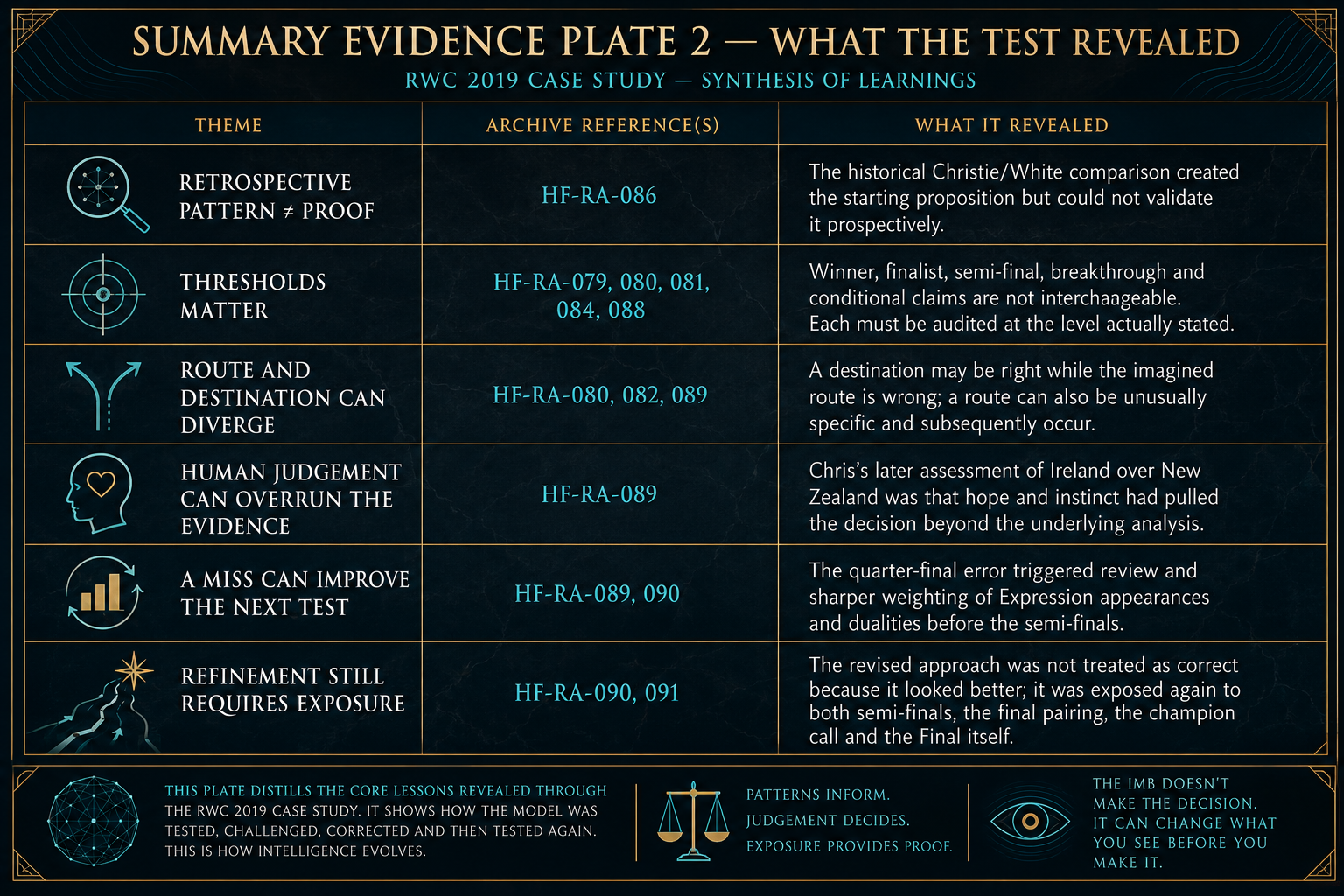
Today he describes that decision as more hopeful and heart-led than purely analytical. That distinction matters. The model had not suddenly delivered a clean new answer. Human judgement had moved beyond what the underlying evidence could confidently support.
The tournament became the test
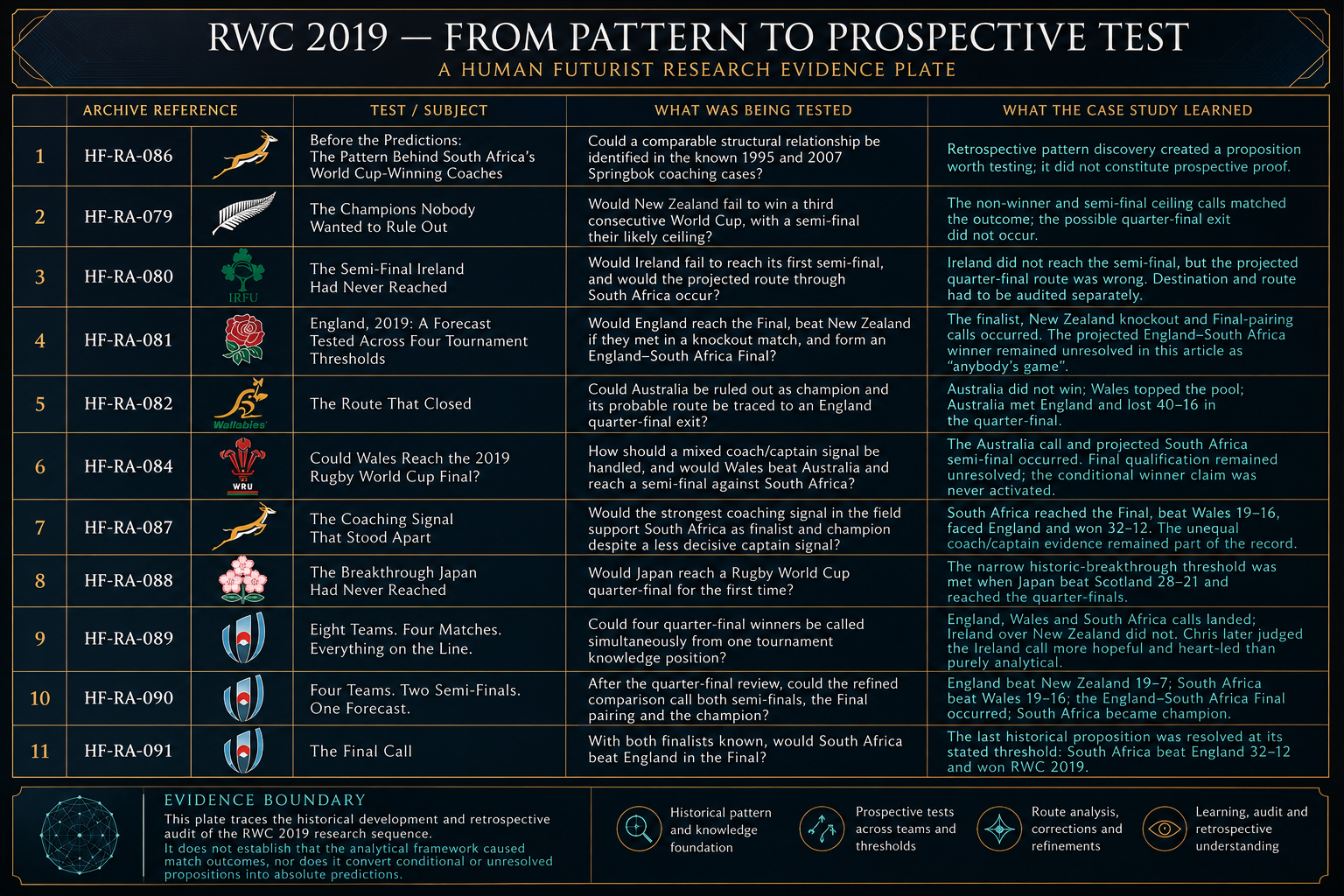
The Rugby World Cup 2019 predictions had begun in a very different place, with research that was not predictive at all. Chris first looked backwards at South Africa’s previous World Cup-winning coaches, Kitch Christie in 1995 and Jake White in 2007. Their key values were different, but the research identified a comparable structural behaviour: the winning year appeared to bring important parts of each coach’s underlying analytical profile into unusually close alignment.
That was interesting, but it was retrospective. The result was already known. The comparison could generate a proposition; it could not tell Chris whether the proposition would survive a future tournament.
New Zealand became the first serious exposure. Before the 2019 tournament began, the reigning back-to-back champions were judged unlikely to win a third title, with a semi-final their likely ceiling. The All Blacks did reach the semi-final and lost there to England. One possible route in the original article, a quarter-final exit, did not happen. The ceiling did.
From there, the research widened. Ireland introduced conflicting coach-and-captain signals. England produced a much stronger combined case and was placed in the Final, with a further conditional call that England would beat New Zealand if they met in a knockout match. Australia was judged unlikely to win and, more unusually, was mapped towards an England quarter-final exit. Wales exposed the problem of mixed leadership evidence: strong captain, less convincing coach, a correct call against Australia, a correctly projected semi-final against South Africa, but no clean Final prediction.
South Africa was the pivotal comparison
Across the country-by-country work, one coaching profile stood apart. Chris regarded Rassie Erasmus’s 2019 pattern as materially stronger than the other leading coaches he had analysed. Siya Kolisi’s profile was less decisive; the historical source called it a “mixed bag”, so the South African case was never a neat story of two equally strong leaders.
Even so, the conclusions became increasingly specific. South Africa were placed in the Final. They were given the edge over Wales in a projected semi-final. The research repeatedly converged on an England–South Africa Final, and the South Africa work ultimately gave the Springboks the edge there too.
Japan tested something different. The question was not who would win the tournament but whether the host nation could cross a threshold it had never crossed before. Before the decisive Scotland match, the answer was a “resounding yes”. Japan won 28–21 and reached its first Rugby World Cup quarter-final. That chapter mattered because the success condition was narrow, visible and fixed in advance.
Then four predictions had to survive the same weekend
The quarter-finals changed the character of the Rugby World Cup 2019 predictions. Separate team analyses were no longer enough. Eight teams had to be compared head-to-head from the same knowledge position.
Chris called England over Australia, Ireland over New Zealand, Wales over France and South Africa over Japan. Three happened. One did not.
That 3-from-4 result is useful precisely because it cannot be tidied into a perfect story. The England, Wales and South Africa calls survived. The Ireland call failed, and the reason mattered. It exposed a tension between the earlier analysis and the later decision.
The call that mattered because it failed
A weak research culture can react to a miss in two ways: hide it, or explain it away. The RWC 2019 sequence did neither. Chris went back through the work and changed how he weighted parts of the comparison.
In the semi-final analysis, the focus tightened around Expression appearances and what the historical research called dualities. That refinement did not erase the quarter-final error. It produced a new set of propositions that could fail in their own right.
Before either semi-final was played, Chris called England to beat New Zealand, South Africa to beat Wales, England and South Africa to meet in the Final, and South Africa to become world champions.
England won 19–7. South Africa won 19–16. The projected Final pairing occurred. South Africa then beat England 32–12.
Those results are among the strongest prospective moments in the case study because the field was small, the time horizon was short, and the propositions were explicit. But their value is not that they somehow turn the earlier miss into a success. Their value is that the revised thinking was exposed again rather than protected from another test.
What did the Rugby World Cup 2019 predictions reveal?
Several features survived repeated exposure. The research was able to discriminate between some contenders rather than simply identify obvious favourites. The early All Blacks non-winner call challenged the strongest conventional benchmark. England’s Final progression and conditional knockout call against New Zealand were unusually specific. Australia’s projected route to an England quarter-final was more informative than a generic “they won’t win” judgement. Japan’s first-quarter-final threshold was clean. South Africa remained the most persistent positive signal in the portfolio.
Just as important, the case study shows why those statements cannot all be given the same label. A tournament winner, a finalist, a maximum progression threshold, a conditional fixture, an unresolved Final and a historic breakthrough are different kinds of propositions. Treating them as interchangeable would make the record look simpler than it was.
Where did the analysis struggle?
The clearest weakness was interpretation under uncertainty. Ireland had already shown that a destination and the imagined route to that destination could diverge: Ireland did not reach the semi-final, but not by the South Africa quarter-final route originally envisaged. Wales showed that strong and weak signals inside one team did not combine neatly. France had not received the same coach-and-captain treatment before the quarter-final, creating an uneven comparison.
And the Ireland–New Zealand quarter-final exposed something more human. Even a structured framework still passes through the judgement of the person using it. The evidence can be read cautiously or aggressively. Hope, instinct and narrative can pull interpretation beyond the data. The problem is not solved by pretending the human disappears.
What changed after the miss?
The research became more disciplined about three things: what exactly counted as success, how different signals were weighted, and where interpretation ended and judgement began.
That is why the later semi-final and Final chapters matter. The refinement was not presented as truth simply because it had been revised. It was asked to make fresh, visible commitments. Then those commitments were allowed to meet the tournament.
This is also where the modern Human Futurist principle of Precision Over Prediction becomes relevant. The useful question is not whether a framework can sound certain. It is whether it can make the decision boundary clearer: what is being forecast, at what threshold, from what knowledge position, and with what uncertainty still unresolved.
Taken together, the Rugby World Cup 2019 predictions reveal something a simple accuracy score cannot.
Why this matters beyond rugby
Rugby made the test unusually visible. Matches happen on fixed dates. Tournament routes narrow quickly. Results are public. A proposition can be frozen before the event and compared with what happened afterwards.
Most consequential decisions are messier. A founder deciding whether to expand, an executive assessing a leadership team, an investor weighing timing, or a family approaching a major transition rarely gets a clean scoreboard a week later. But the underlying problem is similar: what can be seen before the consequence arrives, and how much confidence should be placed in it?
RWC 2019 did not establish certainty, and it did not prove that a mathematical framework causes sporting outcomes. What it created was a documented prospective test. Patterns were identified. Forecasts were made. Some thresholds were met. Some routes were wrong. One judgement overran the evidence. The approach changed. Then it was tested again.
That is a more useful legacy than a prediction scorecard.
The IMB does not make the decision. It can change what you see before you make it. Rugby World Cup 2019 was an early, imperfect and unusually visible example of what that distinction can look like in practice.
The research did not end in Yokohama. What changed there was the standard Chris would increasingly apply afterwards: preserve the knowledge position, define the threshold, separate signal from judgement, keep the misses visible, and let the next outcome test the next version of the thinking.
Share This Article, Choose Your Platform!
Related Posts






From understanding decisions to informing them.
Beyond the Research
The Business & Leadership archive examines consequential decisions after they have happened.
The Intelligent Mathematical Blueprint and Private Advisory take the underlying Human Futurist thinking into a different environment: helping leaders examine the circumstances surrounding decisions that have yet to be made.