
Part of the Rugby World Cup 2019 Case Study
This Case Study follows Chris Styles’ RWC 2019 research as it moved from historical pattern recognition into live tournament testing. Each article freezes what the source actually said at the time, then separates that prospective position from what became known later.
For Australia, the supplied source was written during the pool stage after the Wallabies had beaten Fiji and while the tournament route was still unresolved. The exact publication date is not established in the supplied document, so this chapter does not manufacture one. What matters is the knowledge position: Wales had not yet been confirmed as Pool D winner, Australia’s quarter-final opponent had not yet been fixed, and the Wallabies had not yet been eliminated.
Four years earlier, Michael Cheika had taken Australia all the way to the Rugby World Cup final.
Australia had pedigree. The question was whether 2019 had the same shape.
The 2015 Wallabies topped a difficult pool, survived a one-point quarter-final against Scotland, beat Argentina in the semi-final and pushed New Zealand deep into the final before the All Blacks pulled away. Cheika was subsequently named World Rugby Coach of the Year. This was not a coach whose World Cup credentials needed inventing.
Michael Hooper brought a different kind of authority. By 2019 he was the Wallabies captain, an openside flanker with a reputation for work rate, competitiveness and resilience. The historical article even paused on a small moment from Australia’s opening win over Fiji: with the Wallabies nine points behind, Hooper calmly told a Fijian opponent that Australia would take the points, score a try and go ahead. The sequence then unfolded broadly as he had said. The anecdote mattered because it captured the confidence of the player being tested.
So the live question was not whether Australia possessed pedigree, leadership experience or belief. It was whether the 2019 leadership pattern looked like the kind of pattern Chris had been finding around exceptional tournament success.
Chris tested the leadership pair, not the shirt
That distinction is important. The historical source did not argue that Australia’s rugby history had suddenly become irrelevant, or that a mathematical profile could explain how a quarter-final would be played. It applied the same developing research discipline to the people carrying the principal leadership roles: head coach Michael Cheika and captain Michael Hooper.
By this stage of the RWC 2019 research, Chris was looking for meaningful recurrence between a leader’s core profile and the year-specific sequence around the tournament. Strong overlap did not guarantee a title. Weak overlap did not cause defeat. The question was narrower: did the year carry enough of the leader’s established pattern to justify confidence at the highest success threshold?
Michael Cheika: a strong coaching record, but weak 2019 overlap
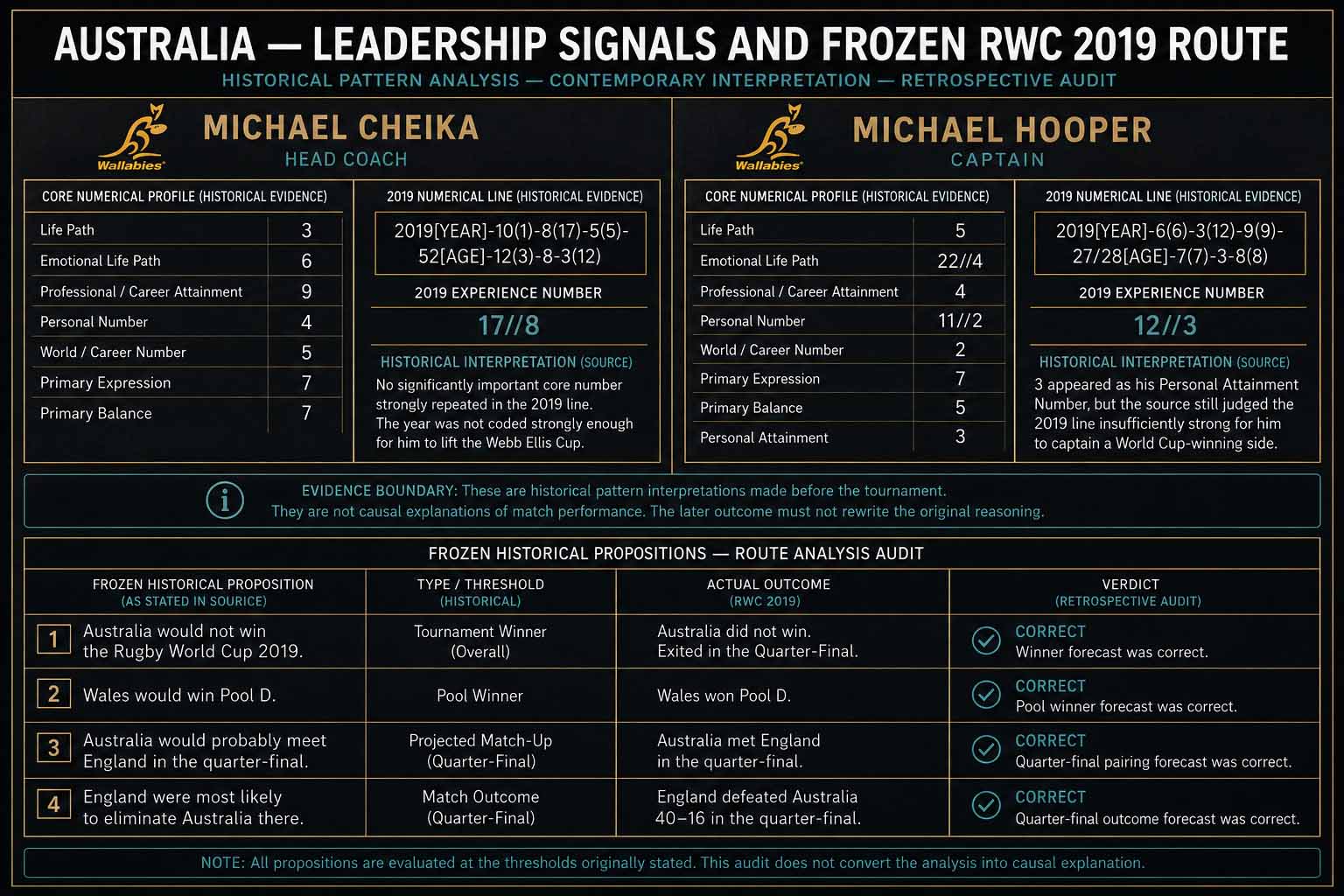
The source recorded Cheika’s significant core values as Life Path 3, Emotional Life Path 6, Professional/Career Attainment 9, Personal Number 4 and World/Career Number 5. His full birth name reduced to a Primary Expression Number 7, while his initials also produced a Primary Balance Number 7.
Against that baseline, the 2019 year-on-year sequence was recorded as:
2019[YEAR]-10(1)-8(17)-5(5)-52[AGE]-12(3)-8-3(12)
The 2019 Experience Number was 17//8. The historical interpretation focused on the prominence of 8 and on the absence of what the source regarded as a sufficiently strong recurrence of Cheika’s important core numbers. It also noted 10//1 as the beginning of a new personal cycle and 5 as an Emotional Personal Year associated, within the historical framework, with change.
The conclusion was unusually direct. Chris did not see Cheika’s 2019 sequence as strong enough for the head coach of the side that would lift the Webb Ellis Cup.
Michael Hooper: competitive authority without a “red-hot” year
Hooper’s profile gave the analysis a second chance to change direction. The source recorded Life Path 5, Emotional Life Path 22//4, Professional/Career Attainment 4, Personal Number 11//2 and World/Career Number 2. His full birth name reduced to a Primary Expression Number 7; his initials reduced to a Primary Balance Number 5. The source also identified 3 as his Personal Attainment Number.
His 2019 sequence was recorded as:
2019[YEAR]-6(6)-3(12)-9(9)-27/28[AGE]-7(7)-3-8(8)
Hooper’s 2019 Experience Number is calculated as 12//3. Unlike Cheika’s 17//8, the 3 did have a defined place in Hooper’s wider profile through the Personal Attainment position. But the historical assessment still did not regard the overall 2019 line as sufficiently strong to offset the concern created by Cheika’s sequence.
That produced the leadership-pair judgement: neither side of the coach/captain combination gave Chris the level of success confidence he was looking for at the tournament-winning threshold.
The forecast became more specific than “Australia won’t win”
This is where the Wallabies article becomes more useful to the Case Study than a simple negative prediction. The source did not stop at “Australia will not win RWC 2019”. It used the expected pool order and the tournament bracket to make a conditional route forecast.
Chris wrote that Wales’ coach-and-captain numbers looked “vastly superior” to Australia’s and therefore expected Wales to win Pool D. If that happened, Australia would probably finish second and move into the quarter-final assigned to the runner-up of Pool D: a match against the winner of Pool C. The source expected that team to be England.
The final prospective step was explicit: England’s coach-and-captain 2019 coding had already been assessed as excellent, so England were identified as the most likely side to end Australia’s campaign in the first knockout round.
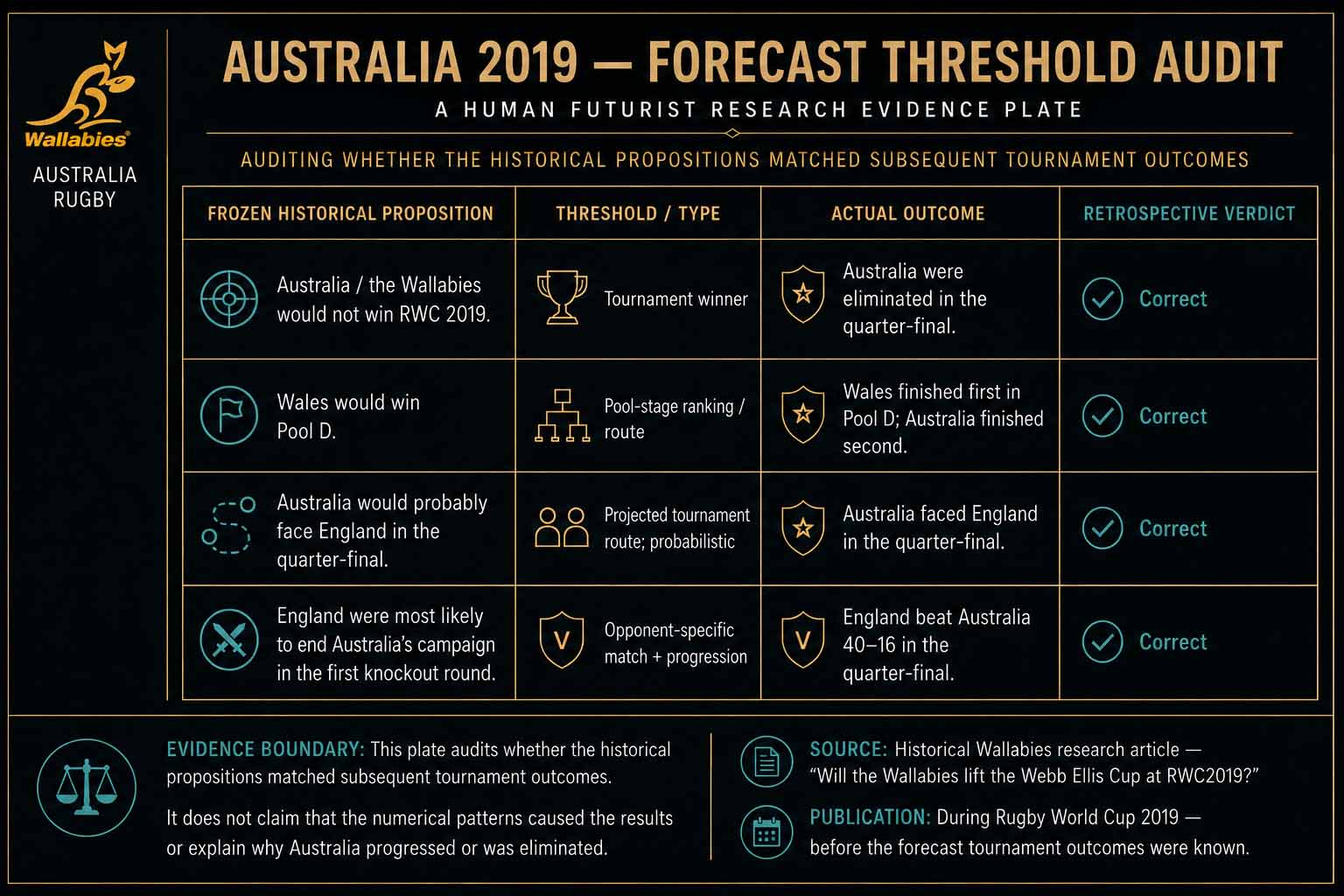
That created four separate propositions, each with its own threshold. Treating them as one winner/no-winner call would lose the most interesting part of the historical record.
What happened next
The route then became real. Wales beat Australia 29–25 in Tokyo and went on to finish top of Pool D. Australia finished second. Under the tournament draw, that placed the Wallabies against England, the Pool C winner, in the quarter-final.
On 19 October 2019 in Oita, England beat Australia 40–16. The Wallabies were eliminated at the exact tournament stage and by the opponent identified in the historical route forecast. England subsequently reached the final, where South Africa won 32–12. Australia did not lift the Webb Ellis Cup. World Rugby’s official tournament history records the 40–16 England–Australia quarter-final result and the subsequent knockout sequence.
The forecast audit
Why the route matters more than the headline
A retrospective headline could make this look easy: the model said Australia would not win, and Australia did not win. But that is not the strongest evidential feature of the source. Many teams do not win a World Cup. A non-winner call has a broad success base.
The route forecast materially narrowed the test. It required Wales to finish above Australia in Pool D, England to occupy the corresponding position on the other side of the bracket, and England then to beat Australia in the quarter-final. Each step could have failed independently. Wales could have finished second. England could have failed to win Pool C. Australia could have won the quarter-final. None of those alternatives occurred.
That does not turn the analysis into proof of a predictive mechanism. It does, however, make this a stronger prospective test than a generic tournament-vulnerability statement. The source committed itself to a sequence of contingent events while those events were still unresolved.
It also sharpens an emerging distinction inside the wider Case Study. Leadership-pattern analysis may be used at several levels: tournament-winning potential, likely progression, route construction and opponent-specific match judgement. Those are not interchangeable forecasting tasks. The Wallabies source happened to make claims at all four levels, which means it should be credited and scrutinised at all four levels.
What the Cheika–Hooper comparison actually adds
There is another reason this chapter matters. Earlier RWC 2019 articles tested strong-looking patterns around teams expected to go deep, or mixed signals around teams whose ceiling was uncertain. Australia offered the inverse problem: what should the framework do when a historically credible rugby nation and experienced leadership pair do not show the level of year-specific alignment the research is looking for?
The answer in the historical source was not to ignore reputation. It was to separate reputation from the 2019 test. Cheika’s 2015 final and coaching honours remained part of the context; Hooper’s leadership qualities remained visible. Yet the prospective judgement still moved against Australia at the highest threshold.
That is a useful discipline for any forecasting framework. Strong prior credentials can be relevant without being allowed to decide the answer. A framework only becomes testable when it is willing to disagree with the prestige of the subject it is examining.
The limitation is as important as the hit
The limitation is as important as the hit
The historical source used language that was far more certain about the underlying system than a contemporary Human Futurist article should repeat. Claims that the numbers were “unquestionable” or that significant success would “always” reveal itself in the data are not treated here as established facts. They belong to the historical voice of the source, not to the evidential standard of this Case Study.
What can be preserved is the testable proposition. Before the relevant outcomes were known, Chris judged the Cheika–Hooper 2019 combination too weak for a Wallabies title, expected Wales to take the pool, projected an England quarter-final, and expected England to eliminate Australia. Those propositions can be compared with the tournament record without needing to accept a causal explanation for why they matched.
That separation, forecast from explanation, outcome from mechanism, is central to the value of revisiting the archive now. A historical hit is evidence that a proposition landed. It is not, by itself, evidence that the theory underneath it is correct.
What this article adds to the Case Study
The Wallabies chapter adds a route-level prospective test. It shows the developing framework being used not simply to identify a likely non-winner, but to combine leadership assessment with the tournament bracket and specify a plausible elimination path before that path was fixed.
For the wider Rugby World Cup 2019 Case Study, that matters because it raises the standard of evaluation. The useful question is no longer only “Was the team call right?” It becomes: how much of the route was actually stated in advance, at what level of certainty, and which parts survived contact with the tournament?
In Australia’s case, the frozen source gives an unusually clean answer. The winner threshold, pool-order proposition, projected quarter-final opponent and elimination call all aligned with what followed. The responsible conclusion is not that the model therefore “proved” itself. It is that this particular prospective route test deserves to be recorded as a successful one — and then weighed alongside the successes, misses, ambiguities and unresolved propositions across the full 2019 research portfolio.
Share This Article, Choose Your Platform!
Related Posts





From understanding decisions to informing them.
Beyond the Research
The Business & Leadership archive examines consequential decisions after they have happened.
The Intelligent Mathematical Blueprint and Private Advisory take the underlying Human Futurist thinking into a different environment: helping leaders examine the circumstances surrounding decisions that have yet to be made.